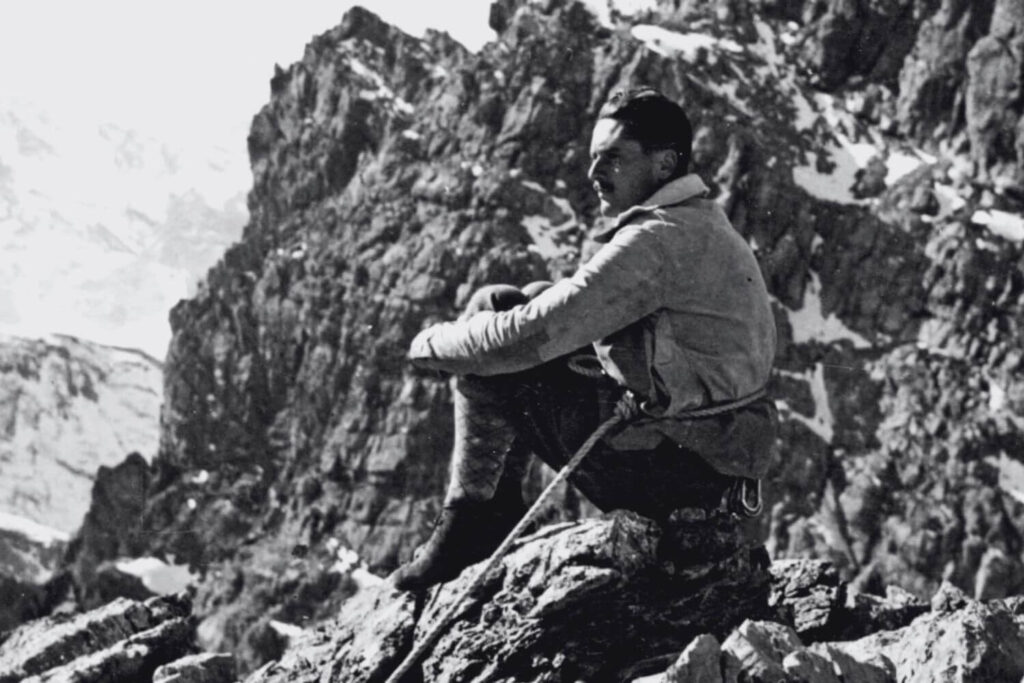
The Great Depression. Fourteen years after the end of the Great War, the world was plunging into fresh trouble. It started in America, but the wave that swept away jobs and threw people into poverty soon rolled across the Atlantic and hit Europe too. At the start of 1932, Oskar Speck, a 25-year-old electrician, also found himself out of work. The factory had closed. Find a job elsewhere? And where exactly? In Germany it was unthinkable. But rumours about Cyprus were doing the rounds. Its copper mines supposedly still had plenty of work for miners who could keep hacking at the rock under the harsh Mediterranean sun.
But how to get to Cyprus? Oskar could shake barely a few marks out of his pockets, nowhere near enough for the journey. The prospect of work still hung on the far side of a thousand-kilometre chasm. Only one option came to mind – his kayak.
The Sunnschien was a cheap two-person folding kayak made by Pionier – first you assembled a wooden frame, then covered it with rubberised canvas. Simple. In the 1920s these kayaks were all the rage and Oskar owned one too. He just adapted it for one person, and in the space originally meant for a second passenger he loaded the few things he had left. He sold the rest. And on Friday 13 May 1932, in Ulm in the south of the country, he gave himself up to the calm current of the Danube, which carried him through Hungary into Romania.
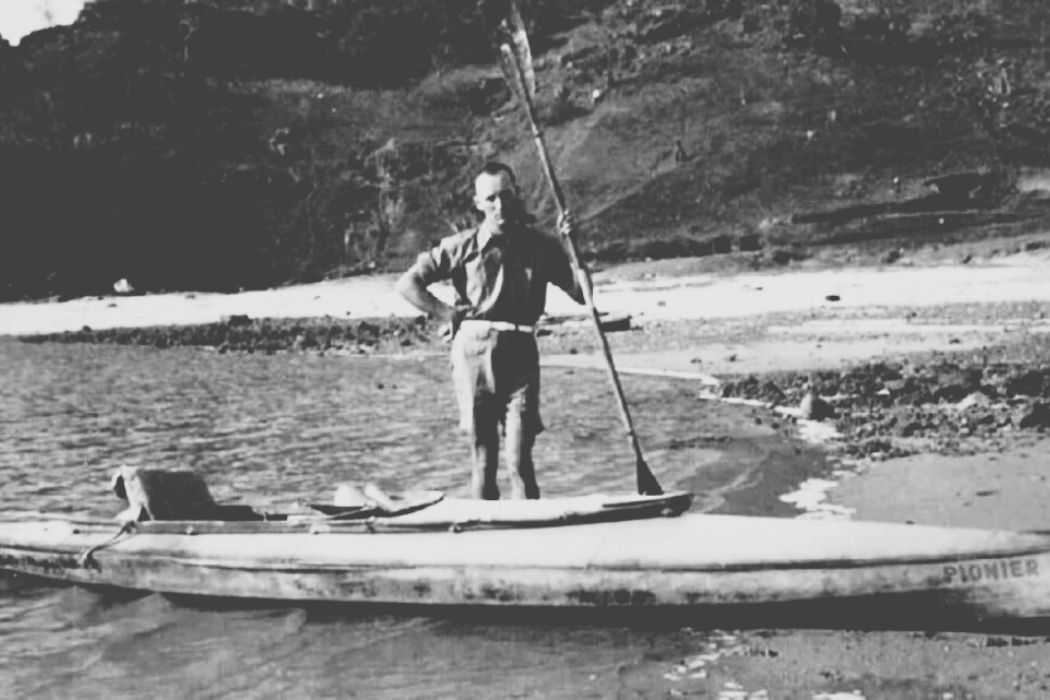
Even worse than an empty stomach, whose unstoppable rumbling kept reminding him that the money had run out after just 180 kilometres, was the boredom on a great river that struck him as far too placid. So near the Bulgarian border he switched to the Vardar, a river rushing south – and that, my word, was a different ride altogether. Oskar Speck charged into wild mountain rapids that very nearly smashed his kayak to pieces. Before he could repair it, winter came and the river froze. He was stuck less than 300 kilometres from the Aegean Sea.
Only with the spring thaw did a much thinner Oskar Speck – who had struggled to scrape together any work or food at all in the wild Balkans – make it into the waves of the Aegean. Waters he had never known, and for which, as soon became clear, his boat had not been built at all. He avoided a collision with a cargo ship by a hair's breadth. Even so, he got a proper shaking and salt water poured into the belly of his fragile kayak. So he rigged up a spray cover and, to sail faster on the open sea, also fixed a small sail at the front.
Seven knots – almost twice the speed he could manage by paddling. Without a keel, though, the boat could capsize in a flash with the slightest lapse of attention to the waves. So Speck set himself a clear rule: no sleep – at any cost.
That's how he weaved his way between the Greek islands, slipped along the Turkish coast, and then the scent of Mediterranean air began to mingle with the grimy stench of sweat drifting from the Cypriot copper mines. Which – after more than a year on the road – was a truly unpleasant smell. Thoroughly uninviting. In the end, Oskar Speck touched the shores of Cyprus only very lightly and briefly. As soon as he had restocked, he dipped his paddle into the Levantine Sea and headed further east – to Syria.
Thousands of years ago, the great Sumerian empire was born in these parts. They call it the cradle of civilisation. Mesopotamia – the land between the rivers. The Fertile Crescent, which once came to life thanks to the abundant flow of the Euphrates and the Tigris. But as Oskar Speck paddled down the Euphrates towards the Persian Gulf, he found himself in places so hostile and barren that for most of that year his only goal was simply to survive. Often the only food he could find was dates, the one thing that grew in the wilderness. For days on end he fried in the fierce sun, and fear made him dig in with his paddle whenever gunfire rang out from the riverbanks.
Were they shooting at him? Who knows. There was no time to find out. In the end a raging storm spat him out onto a small river islet, where it then kept him prisoner for a week amid the stench of a rotting corpse.
In the spring of 1934 the sea finally opened up before him and the bow of his kayak began cutting through the salty waters of the Persian Gulf. But a stop on the coast of Iran, during which the Pionier people were supposed to deliver him a new kayak, dragged on far longer than he had planned. Malaria wrung every bit of energy and strength from his body and trapped him in a land where people kneel five times a day and turn their minds towards Mecca.
Only after six months, in September 1934, was Oskar Speck able to set off again. But the malaria never left him in peace for the rest of the journey. And he still had five years of paddling ahead of him.

It took months to wrestle with the Arabian Sea and round the coastal waters of Pakistan. And more endless months of paddling along India's west coast to Sri Lanka. In the ports he was welcomed as a hero paddling around the world, but also suspected of being a German spy cunningly gathering information for what was by now Hitler's Nazi Germany.
While Oskar Speck sat in his kayak, the world was changing.
When the three-month monsoon season, which he waited out in Sri Lanka, came to an end, he pointed the bow of his kayak into the Bay of Bengal – this time the other, eastern Indian coast lay ahead. By then he had spent four years in the kayak, long enough for reports of Speck's journey to start appearing regularly in newspapers around the world, right next to the banner headlines about the looming Nazi threat. People recognised him, and Pionier, which had stumbled into the best advertising it could wish for, kept supplying him with new kayaks along the way.
But the equatorial heat was sucking all the life out of Speck's body. Although surrounded by endless water, he struggled miserably to stay hydrated. He was dehydrated, his skin was sunburnt, and often he didn't eat a single bite all day. There was nothing to eat. In the Andaman Sea a monsoon storm toyed with him so cruelly that he had to paddle for some forty hours straight to avoid being swept out to the open sea – his hands gripped the paddle so tightly that he could barely unclench his stiff fingers afterwards. And finally, on the coast of Indonesia, the malaria returned to his body, reborn.
The final blow of this brutal stretch was an attack by about twenty Indonesian locals. They dragged him out of the boat, and while some latched onto him like leeches, others tied his hands and feet with strips of dried buffalo hide. Then they grabbed him by the hair and dragged his wretched body through the sand. Speck had a perforated eardrum and was already losing consciousness when the attackers left him lying on the ground – luckily not far from his kayak. As soon as they were out of sight, the groggy Speck gnawed through his bonds, crawled to the boat and quickly pushed off into the open sea.
By the end of 1938 he could almost see the coast of Australia. But the authorities of the Dutch East Indies "blocked" his direct route, so just short of his goal Oskar Speck had to turn his kayak towards New Guinea. As a bonus, he endured heavy tropical downpours every day, threaded his way through treacherous mangrove swamps and watched crocodiles bigger than his kayak hurl themselves into the water from the banks. He escaped their razor-sharp jaws, but on Daru Island he fell into the hands of a police officer. The man had no idea what to do with the German intruder. In the end he simply confiscated the Mauser pistol the dreamer – who had been paddling around the world for almost seven years – carried in his kayak, and let him go to finish his dream.
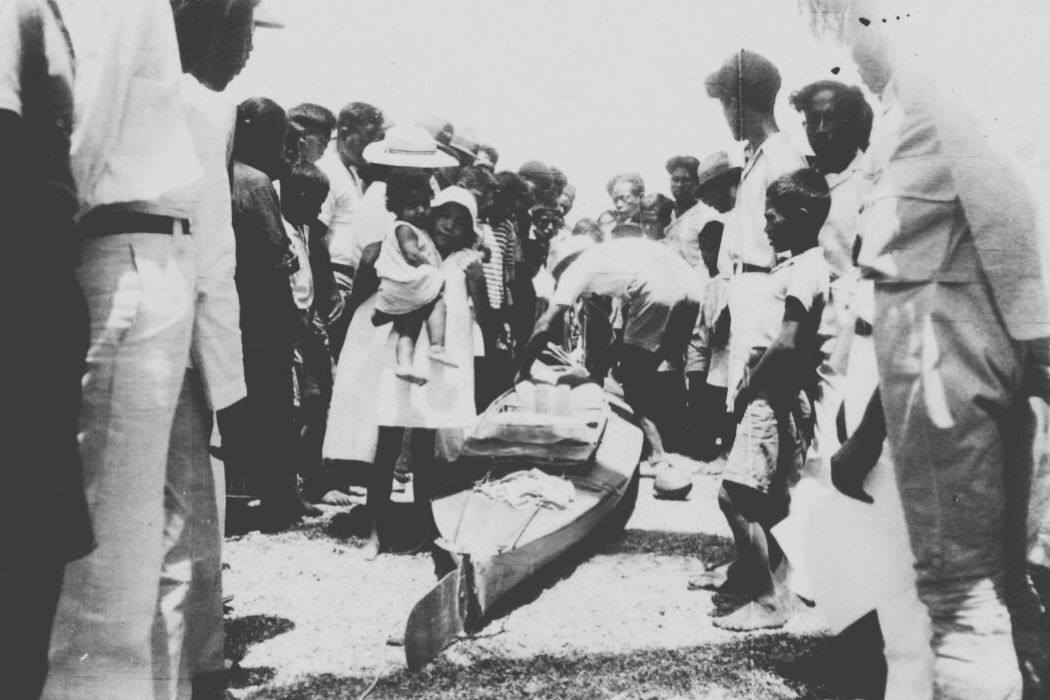
Oskar Speck sighted the outline of Saibai Island, just off the northern coast of Australia, in early September 1939. On the bow he flew the new flag of his country – the swastika his friends had posted to him in New Guinea. But as he approached the shore, among some fifty Melanesian islanders he made out three police uniforms too. When he stepped onto dry land, one of the uniformed men spoke the words he certainly didn't want to hear after all those hardships: "I regret to inform you that you are under arrest, Herr Speck."
Germany and Australia had just gone to war. And after seven years and four months, Oskar Speck had paddled straight into six years of captivity.
After his arrest on Saibai Island, Oskar Speck was first sent for a month to a prison camp on Thursday Island. He was then deported to Brisbane and later moved to the Loveday internment camp, from which he managed to escape, but only for a short while. He was soon re-arrested and wasn't freed until January 1946.
The Australian authorities examined the documents, photographs and letters Speck had with him. In the end they concluded that he was neither a Nazi nor a spy. "Oskar Speck is a loyal German," their report stated, "but no signs of political activity have been found."
Just a week after his release from prison, Oskar Speck found work in an opal mine in New South Wales. He soon gained Australian citizenship too and founded a successful opal trading business.
By the time Oskar Speck was ready to tell his story and show the photos from his journey, the world had other problems on its mind, so he never became the celebrated hero he had dreamed of being.
He died in 1995 at the age of 88.
In November 2016 Sandy Robson completed a 23,000-kilometre voyage retracing Oskar Speck's route. She set off from Germany at the age of 42. She reached Australia five and a half years later. Unlike Oskar, she faced no political problems. She did, however, have to deal with crocodiles, pirates and malaria.