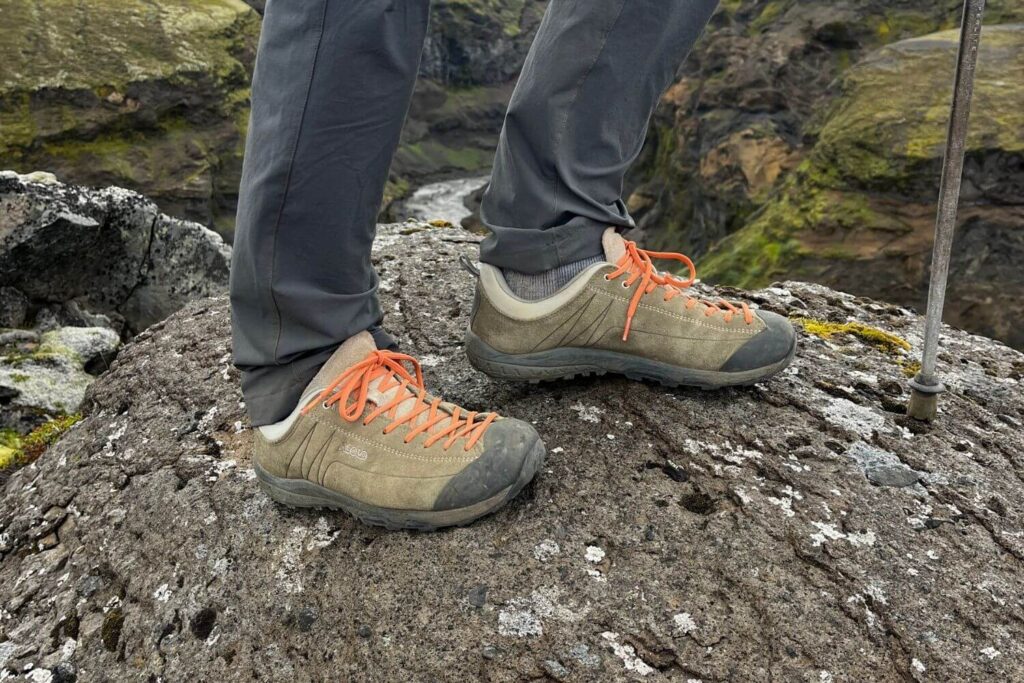
I mainly took the boots as approach shoes for crags and for shorter mountain trips in Austria or in the Giant Mountains. The kind of places where heavy hiking boots weren't needed, but where I also didn't want to rely only on soft running shoes (which is what I did before I got the Asolo Eldo GV). That's exactly the terrain where they showed what they can do.
Thanks to the stiffer sole and climbing toe, I could rely on them even for light scrambling – whenever rocky sections popped up along the way. What I liked most was the confidence I felt standing on small footholds. And also that the shoe didn't twist on my foot at all.
They were great for hikes of ten to fifteen kilometres too. No breaking in was needed, and even after a longer day I had no trouble with blisters or pressure points. The cushioning actually surprised me as well – I'd expected a harder footfall. On gravel they were fine. As soon as rocky terrain appeared, they got even better.
A day trip in the Brdy hills. Pack on his back, brisk pace. Along forest tracks and across meadows. After a few kilometres some small crags appeared – about five metres high. Instinct said: scramble up them. So Tomáš planted the climbing toe – and simply went up.

They surprised me the moment I put them on. For a long time I'd believed that classic trainers are best for light, fast ascents. But here I could feel straight away that this was something a little different.
Putting them on was comfortable and natural – no wrestling with the tongue or the laces. The boots hugged my foot firmly, yet didn't feel clumsy at all. From the very first steps I felt they were stable, but not too stiff – combining the security of a hiking boot with the lightness of an approach shoe.
The Asolo Eldo GV weighs just 290 grams (half a pair in UK size 8). It's designed for technical approaches, via ferratas, ordinary hikes and all mountain outings where lightness and agility count.
When I took my first few steps on a hard surface, I was surprised that despite their technical character they weren't extremely stiff. You feel the security of a firm sole, yet the boots don't "fight" your feet. After ten or fifteen minutes I'd stopped noticing I was wearing new boots at all.

I was pretty surprised by how well they handle long stretches. I'd expected my heel or little toe to start complaining after ten-plus kilometres on forest tracks or rocky terrain – but nothing. No blisters, no rubbing, not even a feeling that the boots still needed "breaking in".
The Asolo/Vibram AG sole uses the MegaGrip compound for extra grip in both dry and wet conditions. The tread is self-cleaning, so you won't lose your footing even in mud.
I think I really put them through their paces. On rock, the benefits of the climbing toe and the Vibram MegaGrip compound showed the most. On smooth rock they held really well. The toe could be placed precisely on small footholds – and when I needed to "edge", the boots didn't collapse on my feet like the trail shoes I'd been used to until then.

A few scuffs and scratches from climbing on rock and walking among stones have appeared, of course. But otherwise? I'd say they still look almost like new.
The Asolo Eldo GV has a tough rubber rand around most of its circumference, which protects not only the boots themselves but your feet too – especially in demanding terrain where you're "hacking" your way through scree and rocks.
They handled moisture really well. Even during longer activity in the heat or the wet, I never felt my feet were "cooking" or that moisture was trapped inside. Combined with Bridgedale merino socks it was a great pairing – my feet stayed dry, without the unpleasant "warm and soggy" effect I know from other membrane footwear.
And when they got wet on the outside? They always dried surprisingly quickly – all it took was loosening them, taking out the insole and letting them air. It never took long before they were dry again.

On Koukalova hora we got completely soaked. The rain didn't build up gradually – it just came down and didn't stop for several hours. Everything was drenched: pack, clothes, rocks, grass... but not my feet. Even though I was out all day, moving through wet grass and mud, the boots stayed one hundred per cent waterproof. The Gore-Tex didn't let water in even when the uppers were completely saturated.
The Asolo Eldo GV, beneath its seamless technical polyester upper, hides a GORE-TEX Extended Comfort membrane that protects against getting soaked from outside and ensures decent breathability even on warm days.
Honestly – before these Asolo boots I'd never had proper approach shoes. For a long time I believed the best shoes for getting to the crag were climbing trainers or trail shoes – because they're light, comfortable and easy to run and walk in.
A typical example: my Salomon S/Lab Sense Ride 5. Brilliant shoes for mountain running, with great cushioning and grip on dirt and in the woods – but as soon as rock, scree, a via ferrata or the need to stand on small footholds comes along, their limits show. With the Asolo Eldo, though, I felt for the first time what a difference a stiffer sole makes, along with a climbing toe and a protective rand.

The boots really suited me – especially when it comes to solidity and sure footing. On rocks and scree they keep your foot stable, the toe is firm, the sole doesn't twist and the grip is excellent. I was also surprised how well they wick moisture – even on a wet day my feet stayed dry and there were no blisters at all.
Even when you wear the sole smooth, it's not the end. Asolo boots can be resoled. Just send them to us – and you'll get them back with a new sole, rand, laces and insole, and repaired seams.