How to choose the right boot size

Measure twice, take your time trying them on, and then come back without blisters and with all your toenails. The right boot size means your heel stays put and your toes aren't short of room. Small boots won't stretch, and you can't make big ones smaller by pulling the laces tighter. So start with this guide.

Know where you're headed

That's the first thing to get clear. There's no such thing as an all-round boot, and the wrong construction can give you as much grief as the wrong size. Each boot category is made with a different sole stiffness and on a different last, which defines the shape of the boot – above all the width of the toe box and the height of the instep and heel.
Also bear in mind that mountain boots are bought a touch bigger. Your feet swell during the day, and when your toes hit the front of the boot on descents, it really hurts. Men tend to buy boots with more room to spare than women, whose feet are narrower.
  • Low hiking shoes up to 0.5 cm bigger.
  • Ankle hiking boots up to 1 cm bigger.
  • Kids' boots up to 1.5 cm bigger (mainly because their feet are growing).

All about boot construction

The individual design features tell you what your boots will be like and what terrain they suit. Get to know the materials and manufacturing methods and you'll find the right pair of boots, too.
boot construction

Choosing your size online

By insole size

Measure the insole of your own boots. A pair that fits you well and matches the type of boots you want to buy (so if you're choosing hiking boots, measure the insole from hiking boots). This is the easiest way to get the size right.
  • Take the insole out of the boot and lay it on a flat surface.
  • Measure its length in centimetres at the longest point.
  • That gives you your boot size in Mondopoint (MP). Using the manufacturer's size chart, you can then find its equivalent in the more common EU (39, 40, 41…) or UK (7, 8, 9…) sizes.
Measuring the length of a boot insoleMeasuring the length of a boot insole

By measuring your foot

Measure both feet (they're never quite the same size) and go by the bigger one. You'll need a sheet of paper, a pencil and a ruler.
1
Lay a sheet of A4 paper on the floor with its shorter edge against the wall.
Measuring foot length
2
Stand with your foot on the paper (at right angles to the wall) with your heel against the wall.
Measuring foot length
3
Trace around the front of your foot. You may need someone to help you.
Measuring foot length
4
Measure the distance straight from the edge of the paper to the furthest point. That gives you your size in Mondopoint (MP); then add the extra room depending on the type of boot (see boot construction above).
Measuring foot length

Size charts

Asolo men's boot size chart
mpeuukus
243855 ½
24,538 ⅔5 ½6
2539 ⅓66 ½
25,5406 ½7
2640 ⅔77 ½
26,541 ⅓7 ½8
274288 ½
27,542 ½8 ½9
2843 ⅓99 ½
28,5 43 ⅔9 ½10
2944 ½1010 ½
29,54510 ½11
30461111 ½
30,546 ⅓11 ½12
31471212 ½
31,547 ½12 ½13
3248 ⅓ 1313 ½
32,54913 ½14
3349 ½1414 ½
33,55014 ½15
3450 ⅔1515 ½
34,551 ½15 ½16
35521616 ½
35,552 ⅔16 ½17
Asolo women's boot size chart
mpeuukus
2235 ½34 ½
22,536 ⅓3 ½5
2336 ⅔45 ½
23,537 ½4 ½6
243856 ½
24,538 ⅔5 ½7
2539 ⅓67 ½
25,5406 ½8
2640 ⅔78 ½
26,541 ⅓7 ½9
274289 ½
27,542 ½8 ½10
2843 ⅓910 ½
28,5 43 ⅔9 ½11
2944 ½1011 ½
29,54510 ½12
30461112 ½
30,546 ⅓11 ½13
31471213 ½
31,547 ½12 ½14
3248 ⅓ 1314 ½
32,54913 ½15
3349 ½1415 ½
33,55014 ½16
Asolo kids' boot size chart
mpeuukus
11,51933
12,5203 ⅔ 3 ⅔
13214 ½4 ½
13,5225 ⅓5 ⅓
14,5236 ⅓6 ⅓
15246 ⅔6 ⅔
15,525 7 ⅔7 ⅔
16,5268 ½8 ½
17279 ⅓9 ⅓
17,5281010
18,52910 ⅔10 ⅔
193011 ⅔11 ⅔
19,53112 ½12 ½
20,5 3213 ⅓13 ⅓
213311
21,5341 ⅔1 ⅔
22,535 2 ⅔2 ⅔
2336 3 ⅓3 ⅓
23,5374 ⅓4 ⅓
24,53855
25395 ⅔5 ⅔
25,5406 ½6 ½

Trying boots on in a shop

Don't rush. Give it time. And go trying boots on in the afternoon. Your feet swell during the day – much like on a mountain hike. If you buy your boots in the morning, they may turn out to be tight in the end.
1

Socks

Take the socks you'll be wearing in the boots to the shop with you. They should be breathable – the kind that keep your feet dry. And cushioned in the places that take the most punishment. And if you use orthopaedic insoles, bring those along too.
Why socks matter
Ponožky Bridgedale
2

A bit of room

Do your toes have enough room? If not, you're heading for a black toenail on descents or even a painful infection. In mountaineering boots, too little room in the toe can even lead to frostbite. That's why there should always be some space in front of your toes in mountain boots. You can easily find out how much is left by taking the insole out of the boot and standing on it.
  • Low hiking shoes up to 0.5 cm bigger.
  • Ankle hiking boots up to 1 cm bigger.
  • Kids' boots up to 1.5 cm bigger (mainly because their feet are growing).
A centimetre of room in hiking boots
3

Lacing

Push your heel back, centre the tongue and lace your boots up properly. With two-zone lacing on hiking boots, you tighten the lower part up to the locking hooks and the upper part above them separately. How tight depends on the terrain. Either way, your boots must always be laced so that your heel stays put. Heel lift is one of the most common causes of blisters.
How to lace hiking boots
lacing hiking boots
4

Uphill and downhill

Use the ramp the shop ought to have. Walking uphill, your heel mustn't move up and down. If it does, the boots are too big or not laced tightly enough. Walking downhill, your toes mustn't hit the front. If they do, the problem is again either too small a size or badly tightened boots.
Walking downhill

Boots for bunions

Hallux valgus, or bunions, need more room at the front of the boot. That's why Asolo also created a Bunion Fit version of its Greenwood GV hiking boots, which gives more room for the enlarged joint.
Asolo Greenwood EVO GV
Asolo Greenwood EVO GV Bunion

How to break in new boots

Straight off on an all-day hike! Well, that could still cause trouble. Especially with stiffer boots for tougher hikes and high-mountain treks. While light hiking shoes adapt to your feet very quickly, hiking boots need time. Even several weeks. And a 60 kg woman will take longer to break in stiff boots than a 100 kg man.
1

The right socks

Always wear the right socks. Ones that are breathable to keep your feet dry and cushioned where your feet take the most punishment.
Why socks matter
Bridgedale socks on a branch
2

A centred tongue

From the very first time you put them on, make sure the tongue is properly centred. Once it slips to the side early on, it will never go back to the right position. And then it will press.
centring the tongue of a hiking boot
3

Zone lacing

Learn to work with zone lacing, which lets you tighten the instep and the ankle separately. How tight each one should be differs for going up and coming down.
How to lace hiking boots
lacing a hiking boot
4

Break them in slowly

To steer clear of blisters, wear the boots at home first. Then take them on a short walk, a couple of hours' outing, and only then on an all-day hike. Even so, always pack some gel blister plasters.
mountain hike

Boots from a family of shoemakers

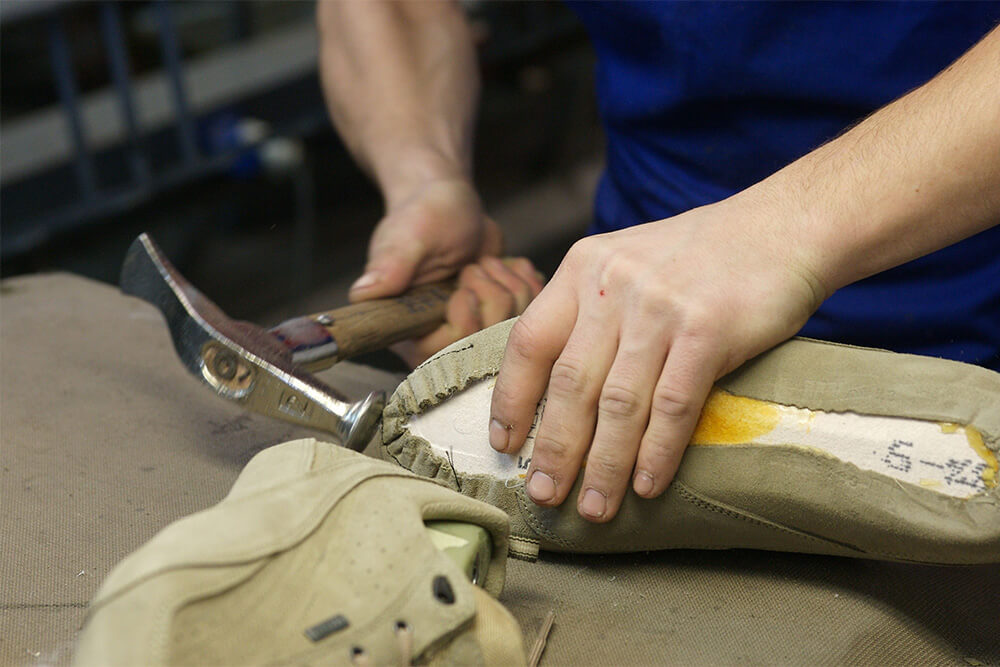
An honest shoemaker will make you boots that last. Boots whose seams won't give way in the middle of a two-week trek. An honest shoemaker will even repair your boots after years of wear and get them ready for more years of adventure. And such shoemakers really do exist – in the Italian Zanatta family.
All about Asolo
Asolo family photo – history
Choose your language
newsletter

Sign up for the newsletter

As you read it, cold air will tickle your face. The mountains are calling…
Horolidi newsletter EN
envelopemagnifiercrossmenuchevron-upchevron-down