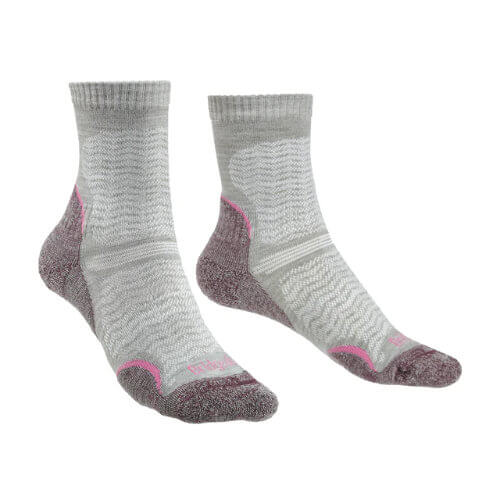
Why bother about socks at all?

Because it's bad socks that cause blisters. They usually don't wick sweat, so your boots get damp inside – the first step to blisters. And bad socks also slip around on your feet and inside your boots – that's the second step to blisters.

What outdoor socks are for

Great boots won't be great at all if you wear the wrong socks with them. You'll rub your heels raw and blisters on your soles will make you wonder whether you'll reach the hut by nightfall. That's why outdoor socks must:
  • Hug your foot so they don't slip as you walk – neither on your feet nor inside your boots.
  • Have well-placed cushioning that protects sensitive spots from rubbing.
  • Wick moisture and keep your feet dry.
Two hikers hopping across water on stepping stones

Expedition socks

For the coldest, harshest conditions – used mainly in mountaineering boots. But they'll warm up permanently frozen feet anywhere. They are heavyweight with extra cushioning to insulate and absorb impact. They're tough and wick moisture.
Bridgedale Explorer socksBridgedale Explorer socks >

Hiking socks

For day hikes as well as multi-day treks with a heavy pack. Worn in low-cut hiking shoes and tall hiking boots alike, which is what decides their height. Their weight depends on the temperature and season – midweight, lightweight or ultralight.
Bridgedale Hike socksBridgedale Hike socks >

Running socks

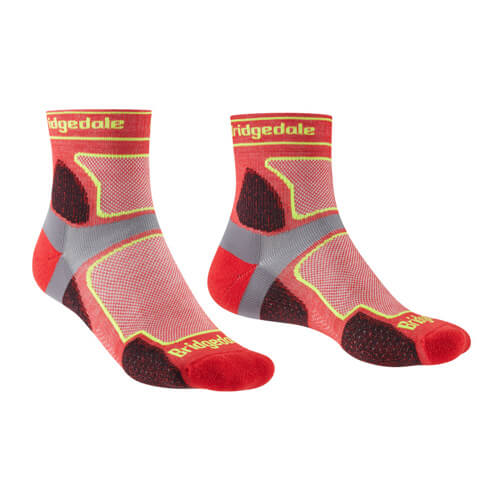
Besides running, you'll also wear them for fast hiking and cycling. They wick sweat quickly and have much more cushioning at the toe and Achilles. Thanks to a higher share of Lycra they hug your foot snugly and always cover the ankle – so they don't slip on your feet and no grit or pine needles get in.
Bridgedale Trail Run socks Bridgedale Trail Run socks >

Ski socks

For downhill skiing, ski touring and cross-country skiing. The socks are knee-high (mid-calf for cross-country) and their weight varies with temperature and intensity of activity. As a rule they have more cushioning – especially on the shins – and wick sweat well.
Bridgedale Ski socks Bridgedale Ski socks >

Liner socks

On multi-day outings they keep your feet dry and so also protect them from frostbite. They're lightweight and wick sweat. On a multi-day trek or an expedition you swap them regularly and use just one warmer outer pair, which stays dry and keeps insulating well.
Bridgedale Liner socksBridgedale Liner socks >

Waterproof socks

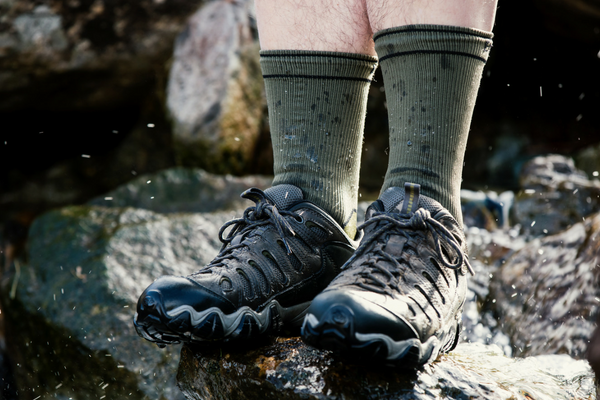
For hiking, running, cycling and climbing as a backup. They keep your feet dry even when your shoes are completely soaked. Thanks to a membrane they're 100% waterproof, yet breathable. Heavier versions are warmer and suit less intense activities – fishing or hunting. They also come in different heights.
Bridgedale Storm Sock socksBridgedale Storm Sock socks >
Why will ordinary (and cheaper) socks get you into trouble?
1
Because they have no cushioning.
2
They're usually made of cotton, which doesn't wick moisture.
3
They're not as precisely shaped to your foot and have no features that stop them moving on your feet and inside your boots.
All of which then leads to blisters. On top of that, they aren't usually very durable, so you'll soon wear holes in them and throw them away.

Sock weight (thickness)

Thick, medium or thin? Which socks you put on doesn't depend only on the temperature outside. It also depends on:
  • Where you're heading. If you're going on a trip with a light pack, you'll take thinner socks. But on a trek with a twenty-kilo pack you need thicker ones – which are also more cushioned and protect your feet from pressure sores.
  • What boots you have. The stiffer the boots and the less flexible the sole – e.g. mountaineering boots and heavy hiking boots – the thicker the socks you need for comfort and to prevent pressure sores.
  • How tight your boots are. If they're on the roomy side, thicker socks will help them fit better and stop them rubbing. If your boots are snug, go for thinner socks – your feet swell as you move and your boots could start to pinch.
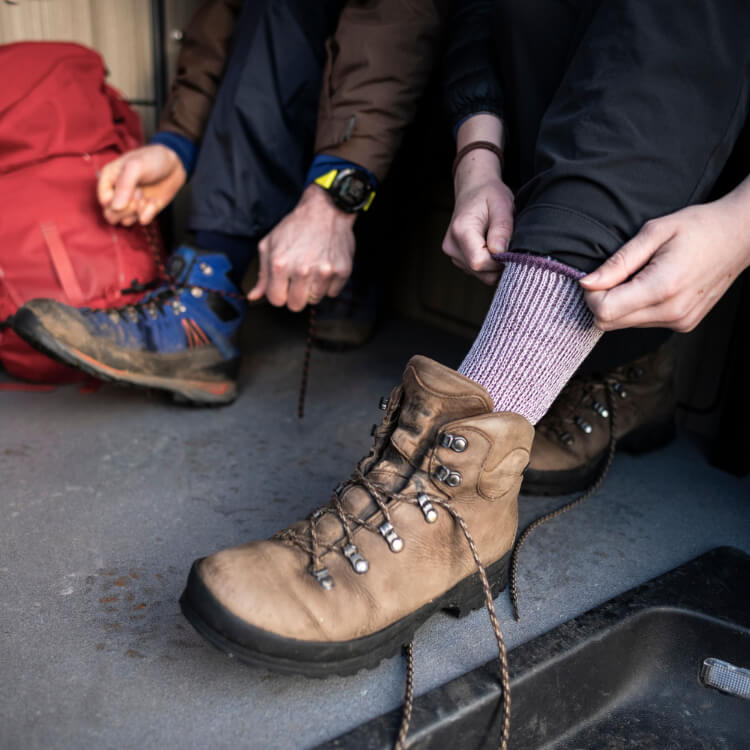
putting on socks

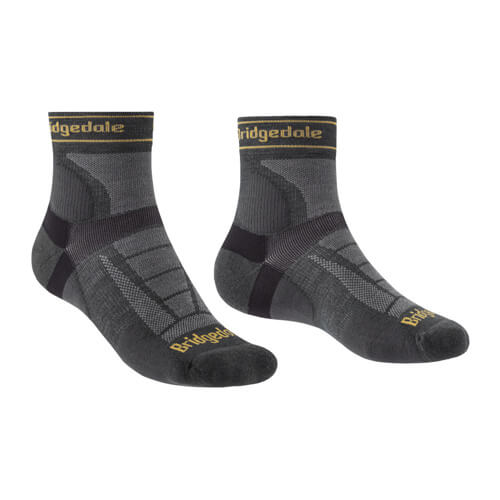
Ultralight

Running, cycling and hiking in warm to hot weather.
Bridgedale Trail Run UL T2 MS socksBridgedale Trail Run UL T2 MS >

Lightweight

Hiking in spring, summer, autumn. Running in spring and autumn.
Bridgedale Hike LW MP 3/4 socksBridgedale Hike LW MP 3/4 >

Midweight

Hiking on colder days – spring, autumn, winter.
Bridgedale Hike MW MC socksBridgedale Hike MW MC >

Heavyweight

Winter hiking, mountaineering and expeditions.
Bridgedale Explorer HW MP socksBridgedale Explorer HW MP >
Why should you wash socks inside out?
For two reasons. First, most of the dirt (sweat or skin particles) builds up on the inside. And second, washing them inside out keeps the cushioning working and the shock absorption active.
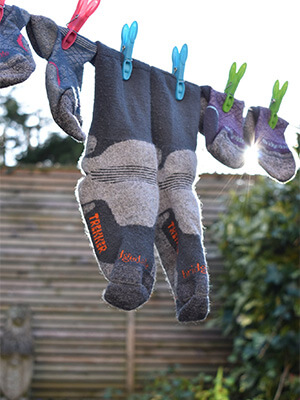
socks hanging on a washing line

Sock materials

The best material for outdoor socks? Definitely not cotton. It absorbs sweat and doesn't move it anywhere. So your feet stay in a constantly damp environment, and from there it's only a short step to proper blisters.
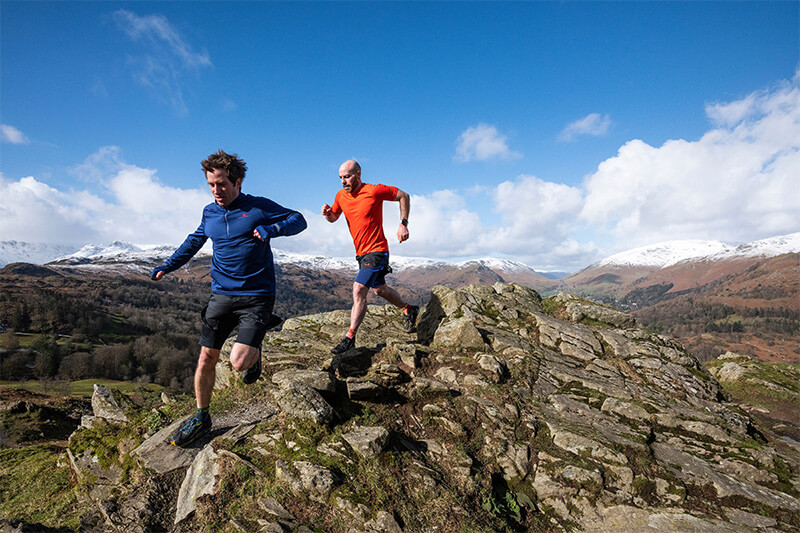
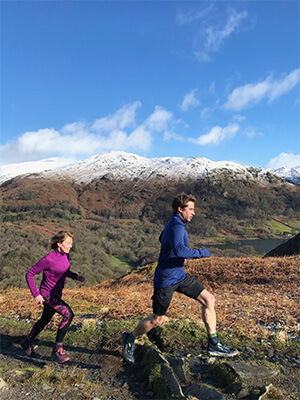
Two runners in the mountains

Synthetic material

Polyamide, polypropylene or special fibres such as Coolmax® – their advantage is fast moisture wicking and high durability. Socks made purely of synthetics, however, aren't as resistant to odours and bacteria – so you have to wash them more often.
For intense activity in warm and hot weather – running, cycling, fast hiking.
Bridgedale Trail Run UL T2 CS socksBridgedale Trail Run UL T2 CS >

Merino wool and synthetic blend

Socks with a share of merino wool keep you warm even when damp. And thanks to merino's antibacterial properties they don't smell even after several days on your feet and stay pleasantly soft. The synthetic fibres speed up moisture wicking and protect the fine merino from damage.
For hiking in any season, expeditions, mountaineering and running.
Bridgedale Hike LW MC socksBridgedale Hike LW MC >

Merino Performance

Snug, tough socks that last for years of hard use. A larger share of durable new wool and stretchy synthetic fibres outweighs the fine merino. So the socks hug your foot more closely and wick sweat fast.
For demanding activities, long hikes and trekking in the mountains.

Merino Comfort

Extra comfy socks with a looser cuff that doesn't squeeze your calves or restrict circulation. A larger share of fine merino wool brings comfort and synthetic fibres add durability. Even so, they're not as tough as Merino Performance.
For hiking and trekking. Thanks to the loose cuff they're great for sleeping in your sleeping bag.
How the socks are made
The ones with the Bridgedale logo are made quite differently from most other socks in the world. Merino wool is first wrapped around a tough synthetic fibre, and this combination creates a resilient material you won't wear through even after years of use. In the end you'll get by with just a few pairs of socks – and so save money.

Sock height

There's a simple rule: socks must be taller than the cuff of your boots (or ski boots) – by at least 3 cm. Otherwise your boots will keep rubbing the skin on your legs. And that's not nice.

Knee-high

Knee
Tall socks for ski and ski touring boots.
Bridgedale Ski Lightweight socks Bridgedale Ski Lightweight >

Mid-calf

Boot / Crew
Socks for tall hiking boots and mountaineering boots.
Bridgedale Hike LW MP socksBridgedale Hike LW MP >

Above the ankle

¾ Crew
For lighter mid-cut hiking boots and low shoes.
Bridgedale Hike LW MP socksBridgedale Hike LW MP >

Ankle

Low
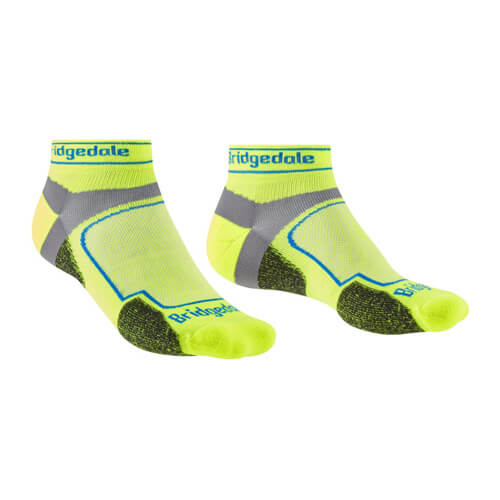
Lower sports socks for running, cycling and light hikes.
Bridgedale Hike UL T2 CP socksBridgedale Hike UL T2 CP >
How not to get the size wrong?
Socks come in size ranges – e.g. 40–43. At the same time they need to hug your feet so they don't move as you walk and give you blisters. So look for socks where your usual size is close to the top of the range or one size above it.
  • If you're a size 42 or 43, socks in the 40–43 range will be ideal for you.
  • If you're a size 44, socks in the 40–43 range will suit you better than 44–47.
  • If you're a size 40, socks in the 40–43 range will be loose on you, so go for the 36–39 range instead.
2 runners in the mountains

Sock cushioning

The heel, toes and shin take the most punishment. Inside your boots they rub against the lining and absorb impacts. So the material in these areas tends to be thicker or knitted differently. You need more cushioned socks:
  • As the length and difficulty of the outing increase (multi-day treks).
  • As the weight of the pack on your back increases (15 kg or more).
  • As the stiffness of your boots increases (ski boots, mountaineering boots, heavy hiking boots).
HOW DOES A DIFFERENT KNIT CHANGE YOUR COMFORT?
The inner loop is more elastic than the outer loop – which gives you cushioning at just the right moment. Bridgedale calls this special cushioning behind the toes, on the instep and at the Achilles T2 technology. You won't notice it's there. But your feet will feel good in your boots even after a long day on them.

Socks with a lifetime guarantee

In Newtownards, Northern Ireland, socks were already being made during the First World War. And they still are today. At Bridgedale, several generations of the same families from Newtownards often work side by side, and it's thanks to them that the socks are so tough you won't wear through them even after 3,500 km on the Appalachian Trail. Every pair goes through a hand inspection before leaving the factory, and you get a lifetime guarantee on yours.
all about the Bridgedale brand
Choose your language
newsletter

Sign up for the newsletter

As you read it, cold air will tickle your face. The mountains are calling…
Horolidi newsletter EN
envelopemagnifiercrossmenuchevron-upchevron-down