
This June marked a year since Dan finished the toughest race in the world's road ultra-cycling series, the Race Across America – better known as RAAM. The route runs from the west coast of the USA to the east coast. That's a crazy 5,000 kilometres in total. Riders have to cross three deserts and mountain passes over 3,000 metres high. They have to keep going in brutal heat, but also through storms and relentless rain.
It's an unbelievable strain on the human body, and heading off predictable problems is a must. Read how Dan, with help from Bridgedale socks, looks after what carries him to the finish – his feet.

“A race like RAAM is an extreme test of both physical fitness and mental strength. At the same time it puts huge demands on the quality of your gear. It starts with the bike and ends at the most sensitive points where the rider touches the bike – backside, hands, feet. Choosing the right shorts and saddle, gloves and handlebars, shoes and socks is often a tough nut to crack that takes years of trial and error. I've learnt first-hand how painful that method can be. Feet take an incredible beating in ultra races. One moment they're swelling and pressing against the cycling shoes in the heat radiating off the road, the next they're soaked through on a long ride in the rain, and at other times they're fighting off the cold. And all the while they're under constant pressure from the carbon sole and the shoe's tongue. One bad seam in a sock is all it takes to land you in serious trouble.

So for an ultra you need socks that are anatomically well designed, cushioned in the right places and breathable elsewhere. Minimal seams in the right places are a must too. Then there are big demands on the material, which should provide as much comfort as possible – wicking sweat, drying quickly and keeping your feet at a comfortable temperature. Last but not least, they need to be durable. Socks that work well but have holes in them the next day are useless. All in all, that's a lot to ask. After many years I finally found what I was looking for: Bridgedale socks, perfect in every respect. I got through RAAM 2019 in three pairs from the Ultralight range, which I still use for racing and training. I won't start another ultra project with anything else on my feet!”

Daniel Polman finished RAAM as only the third Czech in its 38-year history, and even achieved the best Czech time and placing. All this despite a collarbone broken in four places and then screwed back together less than two months before the start. He tells this almost unbelievable story in his book DREAAM. He has also been invited to join the world's elite ultra-endurance riders in the 9,000 km Red Bull Trans Siberian Extreme from Moscow to Vladivostok. He'll be on the start line in June 2021 as the first Czech in history.
Find out more about Dan at www.danielpolman.com.
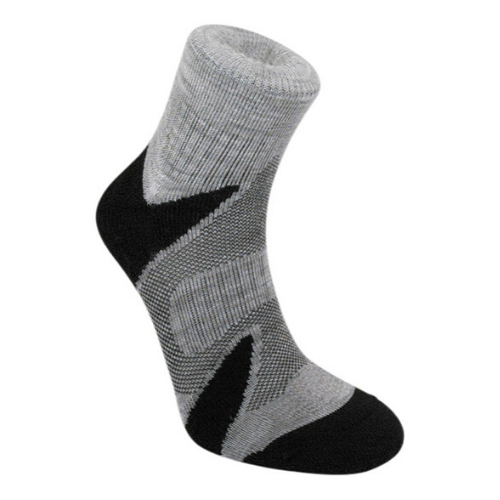
Bridgedale Trailsport Lightweight men's socks

Bridgedale Trailsport Lightweight women's socks
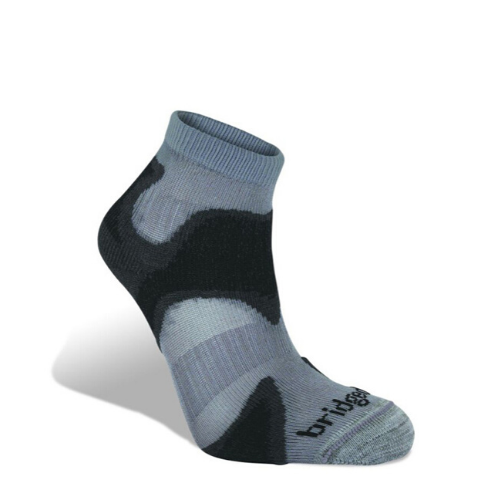
Bridgedale Trailsport Ultralight T2 men's socks

Bridgedale Trailsport Ultralight T2 women's socks
My body is working exactly as I expect it to. Between the obstacles laid in my path by million-year epochs of eruptions, folding and weathering, my feet land precisely on the spots that then catapult me into the next stride up the trail. Again and again. The terrain is not the enemy. I am the terrain. But the real test is only just coming. My trainers no longer meet in mid-air so often, while the life-giving pump forces more and more oxygen into my clenching muscles. Faster and faster. Heavy lungs make me give up my upright stance and drop into a slight forward lean. Perhaps so I can take a really close look at this trail heading for the clouds.

As soon as I emerge above the dwarf pines, which, like the last of the Mohicans, stubbornly defy the harsh weather of the Jeseníky Mountains, an icy wind through my sweat-soaked T-shirt lets me know I'm nearing the end of the first eight-kilometre test. Or rather, ours? Because there were two of us running. Yet it felt as if I were alone on the trail. My partner kept a low profile. Just nodding along to the rhythm my legs set. Only here, on a windswept mountain meadow, where I so love repeating to myself: "What more do I need? Just this!", does my companion show how indispensable he is on outings like a run along the Jeseníky ridge. He readily hands over a light jacket, two decilitres of water – filled into a bottle back down at the spring – that wets my tongue like music, and half an energy bar. He'll carry the other half for the way down, when every step on the steep descent will stamp the last of my strength into the mud.

To be honest, I was a little worried about him. And about myself. Because with a pack that won't sit still on your back, you won't run for long. But he – the Lowe Alpine Aeon – stays calm. Our backs work in rarely synchronised rhythm. Feather-light shoulder straps hug my shoulders firmly, but never roughly or clumsily. And at the waist there's one good click and you can forget about it. He surprised me again – my partner!
But what tested our relationship most were the grains of Mars-red Jordanian sand in Wadi Rum, creeping into every corner, crack and crevice. When you're woken by the Muslim call to prayer echoing through the dusty streets of a grubby Bedouin village, and at breakfast, sitting on a green rope coiled up for carrying, you stare at walls several hundred metres high, you have only one worry in the morning: what are you going to climb today?

Jebel Rum, Jebel Um Ishrin, Jebel Khazali. Plenty of directions, plenty of routes, but no fixed protection. At most, at the end of a rope length, you'll find a thread in the rock wrapped in a few slings bleached by the Arabian sun, whose age not even an expert could determine. Will you trust them? You don't have much choice. So, apart from a fair dose of courage, these bare walls demand plenty of your own gear, which you have to bring to the foot of the wall. Cams, nuts, slings, karabiners, two half ropes. And not very often, but now and then, and always quite unexpectedly, a hold will leave the position it had kept for centuries before you came along. So bring a helmet too. And water! A litre is, of course, nowhere near enough in the desert. When did it last rain here, I wonder?

But my partner, the Lowe Alpine Aeon, carried all of it to the foot of the wall. Whatever didn't fit inside, he strapped on the outside – rope and helmet. And then, on the wall, he simply blended in. He let himself be carried upwards and knew he mustn't disturb me. That I needed complete calm to put my full concentration into every move on sandstone that was worryingly brittle in places and reassuringly solid in others. That was our teamwork.
True, he didn't leave the desert without a scratch. The finer the grains of sand, the harsher they battered his surface – on the wall and while we wandered through canyons in an endless, mood-souring quest to find the one gorge that doesn't dead-end in a labyrinth of rock but leads to the safety of the village. Grubby and scratched, he still did his jobs – sit tight and carry. And he showed particular stubbornness when we needed to haul dry wood, gathered in the dust below the cliff, up to the top of the sandstone massif: for a fire. He ignored the fact that the elastic cords on his sporty, sculpted sides are meant mainly for trekking poles. Instead of protesting, he grabbed the twisted desert branches and didn't drop a single one all the way up. And all the while a sleeping bag was swinging at his waist. What a foolish idea, heading out to sleep in the desert with an eighteen-litre pack.


But those 66 painful kilometres on foot from Liberec to Sněžka might have seemed just as foolish. On the hard tarmac of the Jizera Mountains, on Polish boardwalks and on the rocky Czech-Polish Friendship Trail, we faced the pitfalls of the terrain together. He even glided with me now and then through mountain air, always parted ahead of him by my body as it set chunky 27.5-inch tyres rolling along a dirt trail. And he always sat perfectly. And whenever the call was "Intensive training!", he cooled my sweaty back with doses of fresh air. He's a good partner. Together, anywhere!


Lowe Alpine Aeon ND16

Lowe Alpine Aeon 18
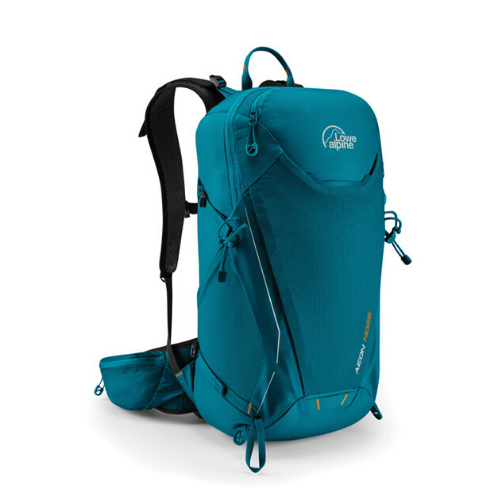
Lowe Alpine Aeon ND25

Lowe Alpine Aeon 27
I climb mountains. I write about mountains. I photograph mountains. And I always come back happy. It's written in my name, after all.
It's simply got a God-given talent. Or rather, it's the legacy left in it by Jeff Lowe. He knew very well how to prepare for a solo ascent of Ama Dablam or one of the Trango Towers. Either way, here it is. It's called Halcyon, and over recent months it's taken a beating that fully revealed all its strengths and maybe a few weaknesses.
This is a hard-earned report on how the Lowe Alpine Halcyon climbing pack performed on my back.

This time, at the little pond near the "Koupák", we don't carry on right as usual along the yellow-marked tarmac road to the Maják. We turn left onto the blue trail instead. Towards Kapelník. A 60-metre rope on my back, a bundle of slings – including two brand-new hand-tied knot chocks – the essential hardware and, above all, lots of water. One look through the treetops at the yellow terrorist camping in the sky makes it clear we're going to sweat on the wall. We scramble up the slope below "Herr Kapellmeister" and I'm loving how perfectly the Halcyon sits on my back. Or, to be precise, no pack loaded with twelve kilos of climbing gear has ever fitted me this well. Maybe it's because I chose the smallest back length (Lowe Alpine offers three – S, M, L), which suits my 171-centimetre frame perfectly – a frame that never fits one-size-fits-all designs.
The last thing I do before stepping into the opening crack is pull the tape out of the lid pocket and wrap eyeballed strips around the third joints of my left index and middle fingers. One main compartment with side access, two lid pockets – outer and inner. That's it. Simplicity itself, nothing superfluous to break. That's how I like it. And the first bolt is waiting – time to climb. I put the tape away and the pack stays down in the sand.

"Along the cutting path on the southern slope of Klínový vrch. Follow it along the contour for about a kilometre, then up to the left to Supí hlava." According to the guidebook, a breeze. In reality, though, the steep slope throws rocks hidden under fallen leaves and rock steps in our way, while young beech saplings whip at us. We scramble up to the rock pulling on whatever branches offer themselves, and my shorts are already properly soaked with sweat. The Jizera Mountains! A beer before climbing would go down nicely – for the thirst and for the courage.
We're here mainly for photos, so I climb with the pack, carrying the camera and a second lens. And it works – the hip belt doesn't clash with my harness, and if worst comes to worst I can take it off. Again, the right back length probably played its part, because the hip belt sits just right so that my gear loops are easy to reach. But hang on! Up a chimney? Seriously? Great, let's find out who's sharper – the granite around me or the Halcyon on my back. I have a feeling I know the result. Wrong. Not a single quartz crystal managed to bite into the pack as I shuffled through the tight space, let alone tear it. Looks like it can take a lot. So let's do it again, now that I don't have to worry about scraping the pack on the biting granite and can drag it through any old mess. Which is what we do here in the Jizera Mountains several times a week.

The alarm goes off at 5:30. It's still dark outside as we close the door of Zamkovského chata behind us and descend the slippery steps to an even more slippery path. Our goal is somewhere up in the starry sky above our heads, and it's clear we'll sweat buckets after sunrise. Maybe the long johns weren't a good idea. Before the steep slope below Téryho chata, I drop the pack in the snow, undo the side zip and easily pull the crampons out of its belly. The Tatras are under ice, after all. Through the same side opening I also pull out my flask in one go throughout the long day.
At Prostredné Spišské pleso we leave the trodden track and take a technical ice axe in hand – just one for now. The second stays fixed to the pack in a clever head-locker system that works quite differently from the usual – the shaft is cinched into a special loop in the compression strap, and a metal toggle simply passes through the hole in the axe head. No plastic "slider" on a bungee that sooner or later breaks and the elastic wears out. Plus, it's all easy to operate even in thick gloves. I love that.
Halfway up the Jordánka gully, the couloir gets steeper and the snow harder. Only the four front points of the crampons are touching the snow now, so we take the second axe off the pack. We puff. We groan. Our calves burn. But we keep at it. On the north side of Posledná veža, the echoes of our breathing are joined by the screech of crampons on bare rock, which doesn't stop even on the ridge of Lomnický štít. So little snow in January. Under the astonished looks of the tourists and their quick-witted questions "Isn't that dangerous?", we climb over the railing at the viewpoint as one. Me and the Halcyon pack. All day it didn't shift on my back once, and its quiet company contributed to a frosty reward from the Šariš brewery. Now just the normal route down. Back to Zamka.

It's a good mate. It looks good, fits well and holds up well – against granite, snow, even rain. Snow doesn't stick to its back panel, it has no useless gimmicks and there's nothing on it to break. A true mountaineer, plain and simple.

Lowe Alpine Halcyon 35:40 Navy

Lowe Alpine Halcyon 35:40 Red

Lowe Alpine Halcyon 45:50 Navy

Lowe Alpine Halcyon 45:50 Red
I climb mountains. I write about mountains. I photograph mountains. And I always come back happy. It's written in my name, after all.

It's mid-October, it has to be said. And the plan is to set off exactly as Kauschka did back then – at 2 a.m. from Liberec's Lidové sady park. We pack minimalist. At worst we'll warm up with soup at some mountain hut.
The only dilemma is footwear. I'll get further on an empty stomach than with raw heels and an aching instep. So they have to be light, yet comfortable. Roomy, too, because your feet swell after so many kilometres, and if my little toes start getting squashed, I'd rather jump into the Snow Pits. Although... well... that's Poland... I'll have to think about it.
So I have a brilliant idea. I get Asolo to send me a pair of Flyer trainers. Friday morning I collect them from the post office, in the afternoon I wear them into town for a coffee – to break them in, that's what you're supposed to do with new shoes, apparently – and at 2 a.m. on Saturday we set off.

I hate tarmac. I hate the never-ending Promenádní road. I hate whoever came up with this Sněžka idea. Which is me. By five in the morning at Smědava my thighs have turned to wood. After all, Jakuszyce isn't a bad destination either, is it? At least there's a bus back to Liberec from there. Luckily, with the sun rising over Jizerka and a switch to a soft forest path, it's as if we've been given new legs. No more tarmac today. And honestly – I'm amazed that nothing on my feet is pinching yet. My toes have so much room you could smuggle some Polish contraband in there. Quite a surprise for an otherwise narrow Asolo.
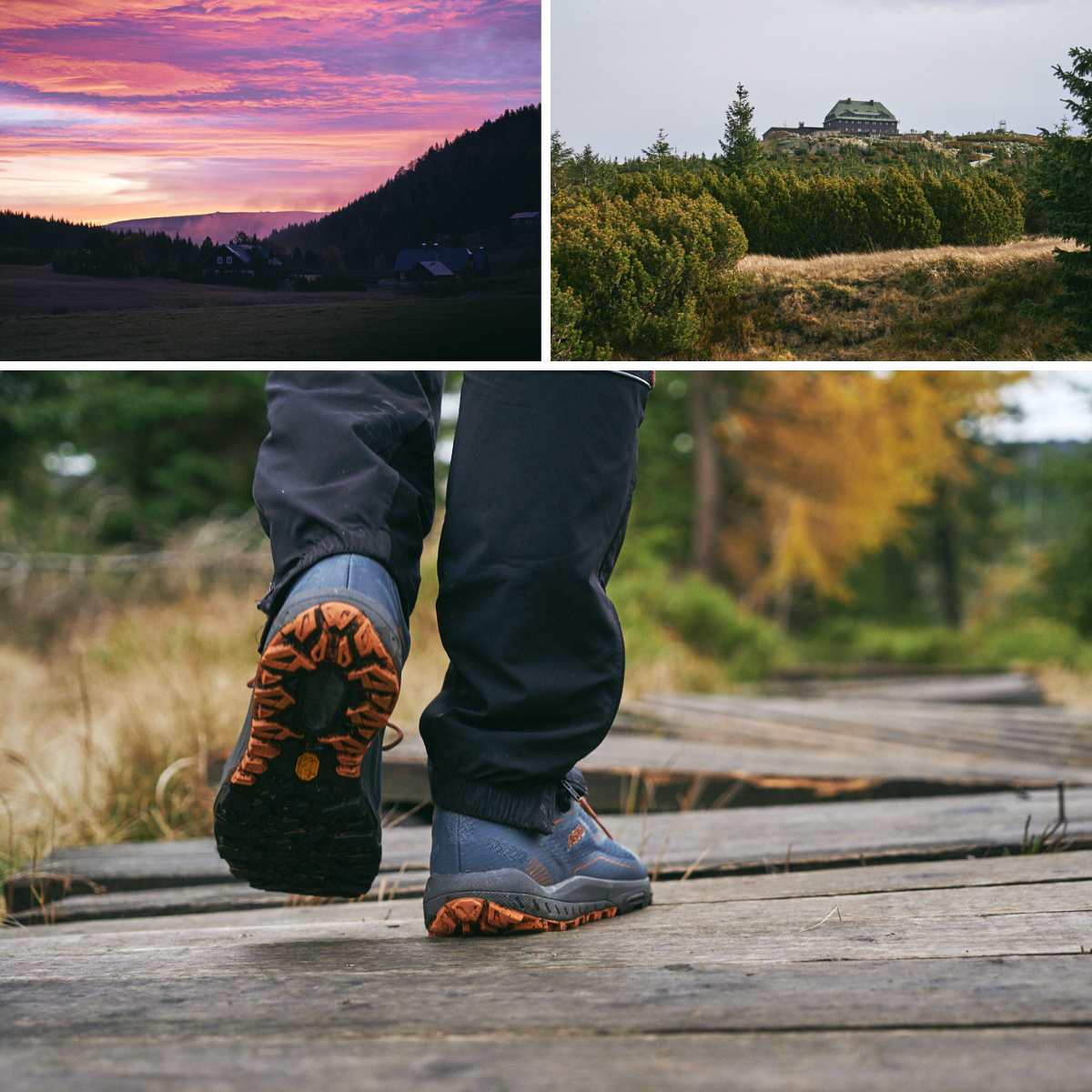
Shall we stop for soup at Vosecká hut? It's only a half-kilometre detour. No, we shan't. Every 100 metres saved is good for our legs. Though I have to say that even with more than 40 kilometres behind me, I can't feel the slightest hint of discomfort in my Asolo Flyer trainers. They're doing the job nicely.
And below Vysoké kolo we finally see it. Sněžka! And it's still a hell of a long way off. So we'd better not look at it. At Petrovka we take a break and wolf down bread rolls, Ája takes her shoes off, her instep is starting to ache. My feet don't need a break – I can't even tell I'm wearing shoes.

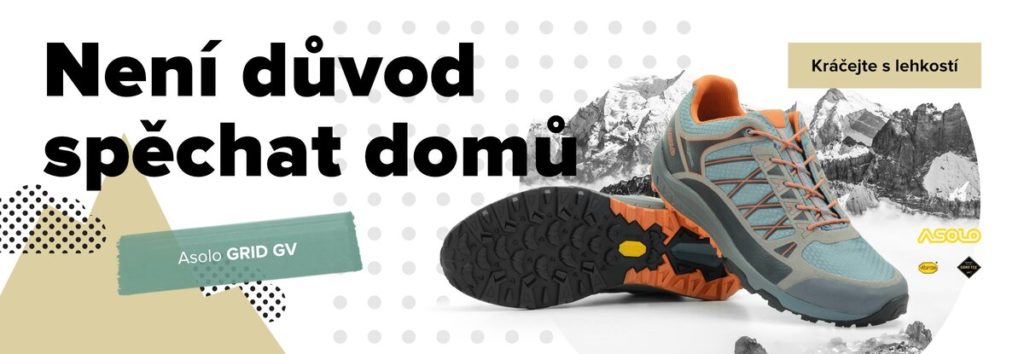
No, the Poles just keep walking and won't step aside for love nor money. And their Agnieszkas shriek like mad while they're at it... Are we there yet? My legs are slowly refusing to obey, and the Czech-Polish Friendship Trail isn't exactly a solid foundation to build on. Nothing but boulders and holes. Luckily, the Vibram sole on the Flyers grips like a dream. Wherever I step. All it's missing is a pair of little wings.
At a quarter to five we're standing on Sněžka. In fog. Ája can't put weight on her foot any more for the pain. My thighs have turned to wood. The remaining 28 km to Harrachov probably isn't happening today. We finish as high as we possibly can, after 66 km, 2,400 metres of ascent and 1,200 metres of descent. Hats off to Mr Kauschka. Hats off to the Asolo Flyer trainers for carrying me all the way here without a single sore spot or blister.
And now tell us what time the chairlift goes and where we can get something to eat!

Since getting back from Sněžka I haven't gone out in any shoes other than the Asolo Flyer. I wear them for climbing trips to the Jizera Mountains, for strolls in the Jeseníky Mountains and for that coffee in town. I've even climbed in them – an easier route on Jizera granite. I wonder how they'll like the Jordanian desert?


Another good 30 centimetres fell overnight. The smell of breakfast, which our landlady is making for us, is already drifting up from downstairs. She's fantastic. Both the breakfast and the landlady. We'll eat and head out. From the headboard of the bed I grab blue-grey ski socks with the Bridgedale logo on the toe. I think today will be our sixth ski day here in Georgia. And every morning I slide my feet into my ski boots wearing the very same socks.
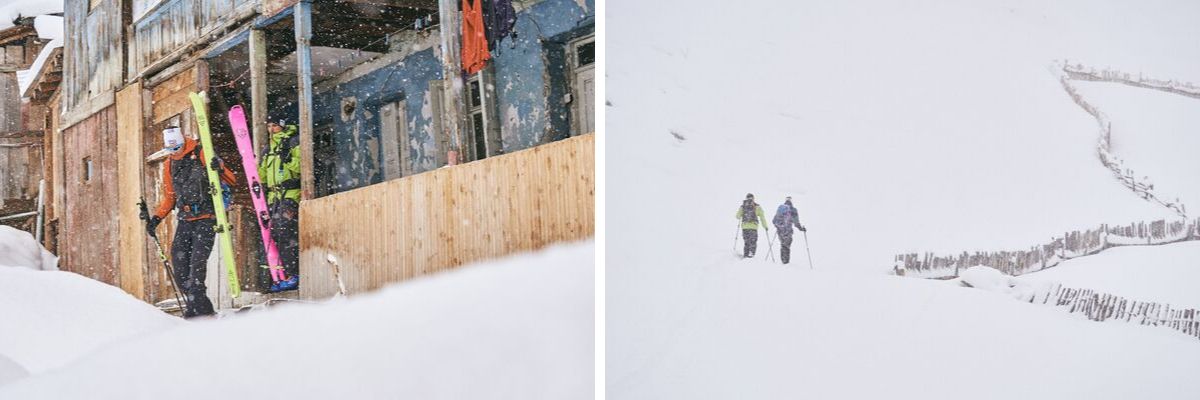
Because they don't smell at all. Only when I pull them out of my ski boots after a full day of skinning and skiing is there a faint whiff in the air. But as soon as they dry, the odour is gone. Merino wool is simply a gift of nature. And even after being worn in ski boots day after day, the socks stay soft, as if I'd just taken them out of the dryer – no sweat-starched tin cans. Enough talk, let's get to it! The powder is calling. And I'll probably pull that second pair of Bridgedale socks out of my bag just for appearances' sake – after all, skiing the whole of Georgia in one pair of socks would be weird, right?
Freshly knitted socks are half as big again as the final product. They are then steam-washed several times and shaped on a form – until they reach their final size.
— from the Bridgedale sock production process
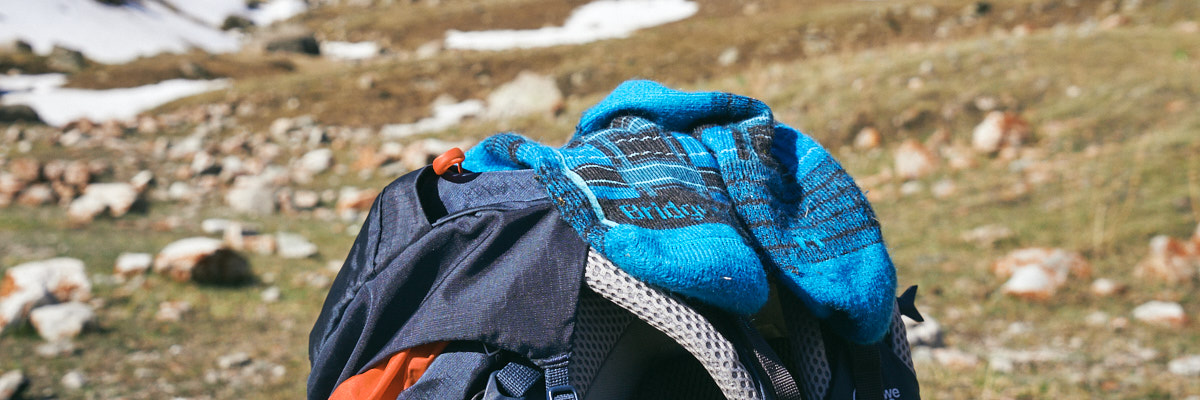
True, that's not exactly pocket money. But which socks can you wear for a week or longer? Well, you can wear any socks. The question is what the people around you think about it. And my daily routine is certainly no gentle shuffle. Mornings working in a café in town, afternoons at the crag, evenings on a floor covered in dog hair and splinters from a chewed-up stick. Tomorrow we'd better take the beast on an all-day trip to the Jizera Mountains. And so on, round and round, flat out. Two pairs a year are enough. Because Bridgedale lasts – no worn-out heels or holey toes. Unlike cheap socks which, if you're lucky, end up in the bin after six months.
The merino wool yarn is first wrapped in a synthetic fibre, and only then are the socks knitted from it. This creates a dense, hard-wearing knit that you won't wear through in a hurry.
— from the Bridgedale sock production process
First snow in the Jeseníky Mountains. That light dusting that sugar-coats the mountains but doesn't yet flatten the bilberry bushes. I'm walking along an old hunting path. Wet grass brushes against my low Gore-Tex hiking shoes, and with every touch it tries to push moisture through the membrane. The trail climbs up to the ridges. I wade through bilberries and snow pours into my shoes from above. That's where the membrane gives up. My feet report damp inside. And it's still a good two hours' walk home to the warm. Over similar terrain.
I pull Bridgedale waterproof socks out of my pack – last year's new release. I brought them as a backup for exactly this situation. I pull them on instead of my soaked socks and put my damp hiking shoes back on. Now merino wool keeps me warm and a waterproof membrane keeps the water at a respectful distance from my feet. After six hours outside I unlock the front door. I'm done in. Shoes soaked through – feet just fine.
The Hydrotech membrane has a hydrostatic head of >10,000 mm and is breathable enough to cope even with intense activity.
Well, with the autumn drizzle on its way, I reckon my Bridgedale Stormsocks will be seeing plenty of action. After all, mud and rain are no reason to stop running in the mountains.

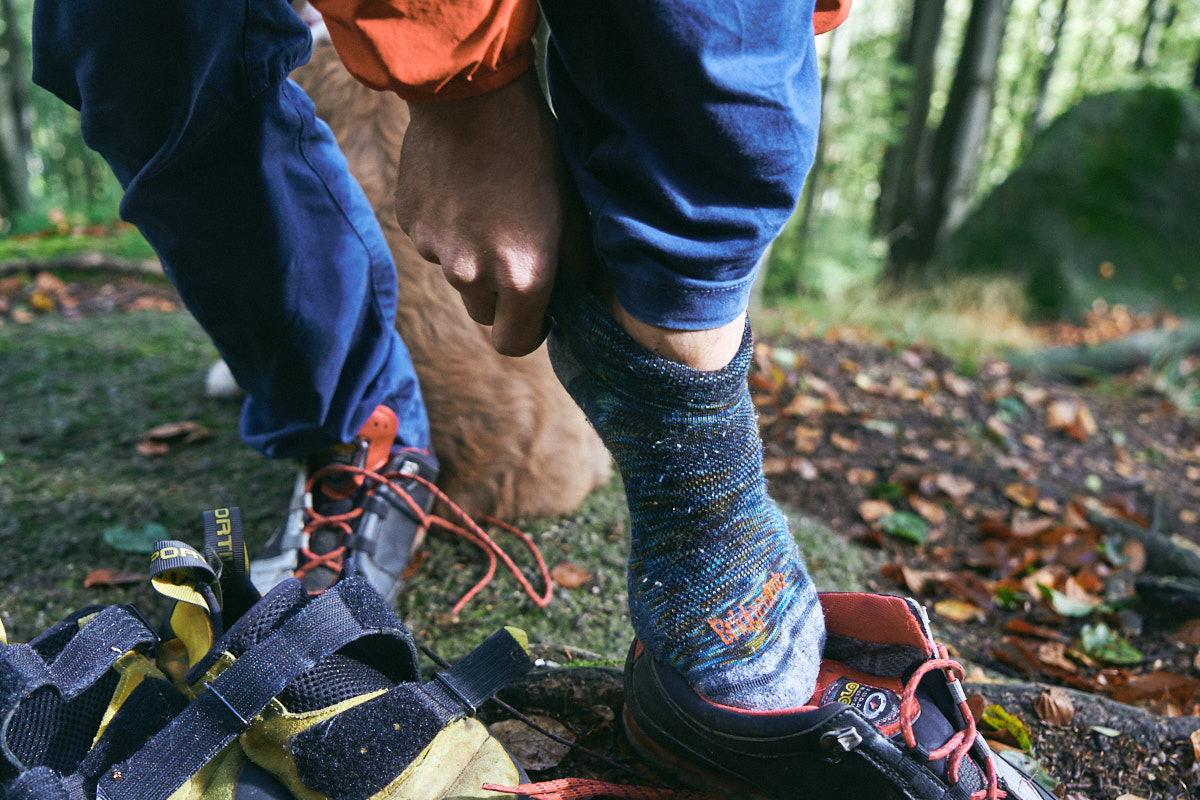
Just one warning to finish. The first time you put them on, the first step, the first all-day hike. Bridgedale socks are simply different. Soft, comfortable and unbelievably tough. It's hard to describe, you have to try it. Just be prepared not to take them off for at least a week. Except maybe to sleep.

Hike Lightweight – for hiking boots and low hiking shoes, from Czech mountains all the way up to four-thousanders.
Hike Ultralight – all year round in low hiking shoes and around town.
Stormsocks – for autumn and winter running, and as a backup in foul weather.
Ski Lightweight – for freeriding and ski touring.
"Blimey, what on earth are you lugging in that pack? It's decked out like a Christmas tree."
"Dunno, the usual. I just took everything that might come in handy up there."
"You fool, you're going to suffer."
14 days with a pack on your back. Freedom for some, purgatory for others. It all depends on how lean you can pack, how much useless junk you haul along and which clever little tricks you don't forget. And they're mostly tiny things – trifles – that in the end spare your shoulders more bruising than necessary and your mouth words you won't find in any dictionary.

Good night and sweet dreams! Comfort is a lovely thing, but this particular item is so easy to replace. Take your down jacket and stuff it into the empty compression sack of your sleeping bag. Voilà! A soft, fluffy pillow fit for a sleep clinic. You can fill the sack with other clothes too, but a puffy down jacket is the best.

Not a scrap of free space in your pack should go to waste. You're not going to carry air around the mountains, are you? Socks, boxers, gloves and other small bits of clothing perfectly fill every gap and crevice. Stuff them into your boots, your cookware and even the space between your crampons. And while we're on cookware – do you need a full set of pots, or will one do?

Clever compressing saves you a few litres of volume too. Cram your sleeping bag and down jacket tightly into compression sacks. Instead of folding T-shirts and fleeces, roll them up and secure them with a hair tie. And to keep your pack tidy, use handy Packing Cubes in different sizes.

Air again. Prick the bags of instant meals with a needle, squeeze out the excess air and tape over the hole so they don't puff up again. Now you can pack one more carbonara.

Backpacks aren't waterproof, after all. And a rain cover? It never protects what's inside 100%. In long, heavy rain, water runs down your back and seeps in. Clothes, sleeping bag, documents, money, electronics and anything you don't want wet – wrap it in plastic bags. They work a treat against moisture. And you can leave the rain cover at home. A good few grams saved.
In the mountains, cleanliness becomes a relative concept. Shower gel and shampoo? A six-degree mountain stream hardly invites a long splash about anyway. More like a quick dip and run. Besides, washing chemicals like that into it isn't exactly eco-friendly. You can get by perfectly well in the mountains without soap (and even in everyday life). Take a nearly finished tube of toothpaste – no need to carry a full one. Buy sunscreen in a small size. And ladies can swap tampons for a menstrual cup – nature will thank you.

Two are enough, right? While you're wearing one, you can wash the other in a river and dry it on your pack as you walk. Same with socks. Plus, merino wool doesn't smell even after several days of wear, and with Bridgedale socks it stays nice and soft too. More important than a clean T-shirt every day is getting your layers right for every kind of weather – from zero to thirty-five degrees. With a light fleece, a softshell, a down jacket and a waterproof jacket you'll always find a solution. And waterproof trousers? Unnecessary for the hardier among us – your legs can take anything.
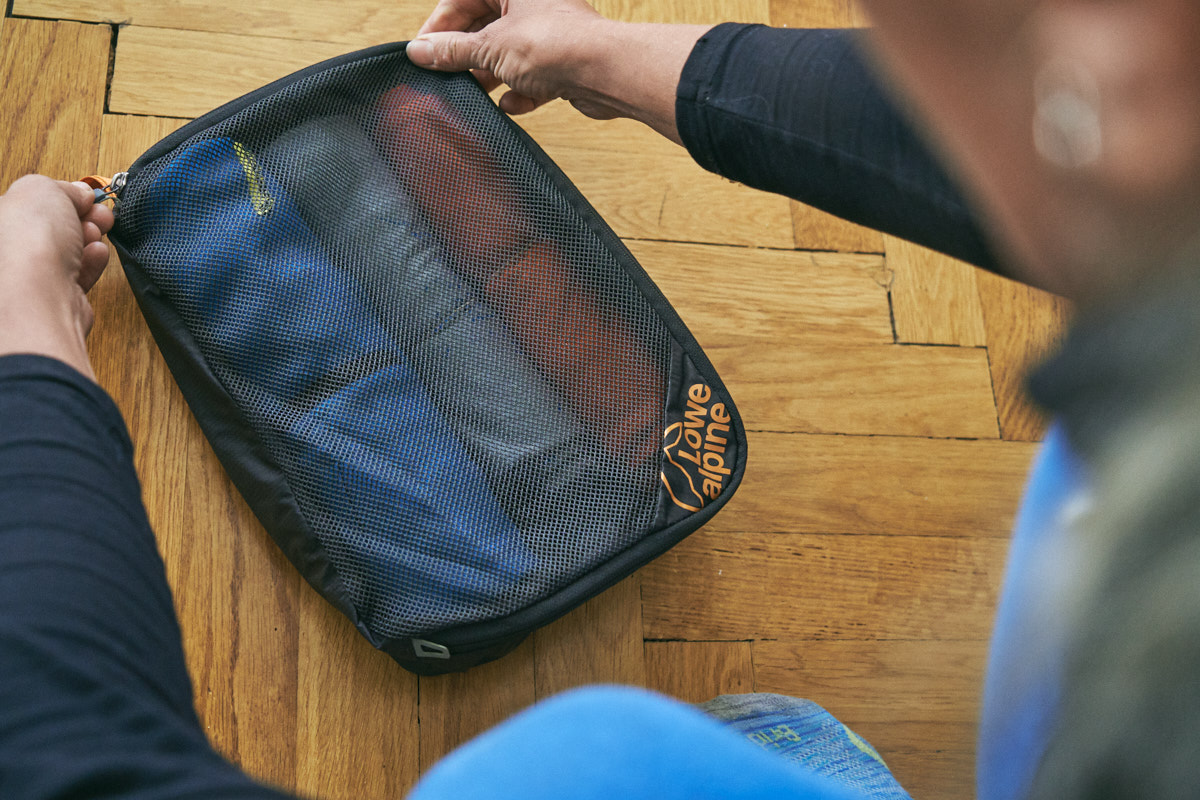
Do you know the Packing Cube from Lowe Alpine? With three sizes of mesh organisers, your pack or bag will stay neat and tidy.
Or better, a few. For rubbish, of course. And there'll be more and more of it.
One last tweak before heading up. Pull the side compression straps tight so the gear inside doesn't shift around. And once you swing the pack onto your back, don't forget to pull the load lifters on the shoulder straps. That sets your centre of gravity right and you'll tackle obstacles as if you were born with a pack on.

See you in the mountains!
