
The Lowe Alpine Altus pack, with a capacity of 52 to 57 litres, saw me through the whole season this year. All that time it sat softly on my back and held on to me firmly through all my mountain escapades. And the last one was a real cracker.
When did our journey together begin? Back in April.
In Czechia the snowflakes were still falling on us, but Lake Garda at Easter – that was another league! Azure skies and warm sunshine. In this via ferrata El Dorado we soaked up spring with every pore. And anyone still feeling cold on the Sentiero Contrabbandieri ferrata was soon warmed up by the serious exposure. You'd struggle to find any fixed cables there. It's not really a via ferrata in the true sense of the word. More an old smugglers' path hewn into the rock. It runs along the lake, and moving along the narrow ledge calls for a cool head – not a single step out of line.
On the Monte Albano ferrata, though, we couldn't have done without the steel cables – it's a strenuous masterpiece above the village of Mori. You spend quite some time climbing there, so the sun, which was beating down on us the whole time, painted this year's first freckles on my skin. And then the mountains to the north lured us in. The iconic Rino Pisetta ferrata climbs a vertical, exposed wall, and spring was only peeking in there cautiously. And on the Signora delle Acque ferrata I gradually pulled a long-sleeved top out of my pack, then a fleece and finally a jacket too. As the name of the ferrata hints, the route leads through a canyon with a waterfall, and the sun can barely get through.
"How do you manage to bring a whole wardrobe on a via ferrata?" the guys wondered.
"You just need a good backpack. Big, but light too. One that fits your body and has loads of pockets," I winked, letting them in on my secret.
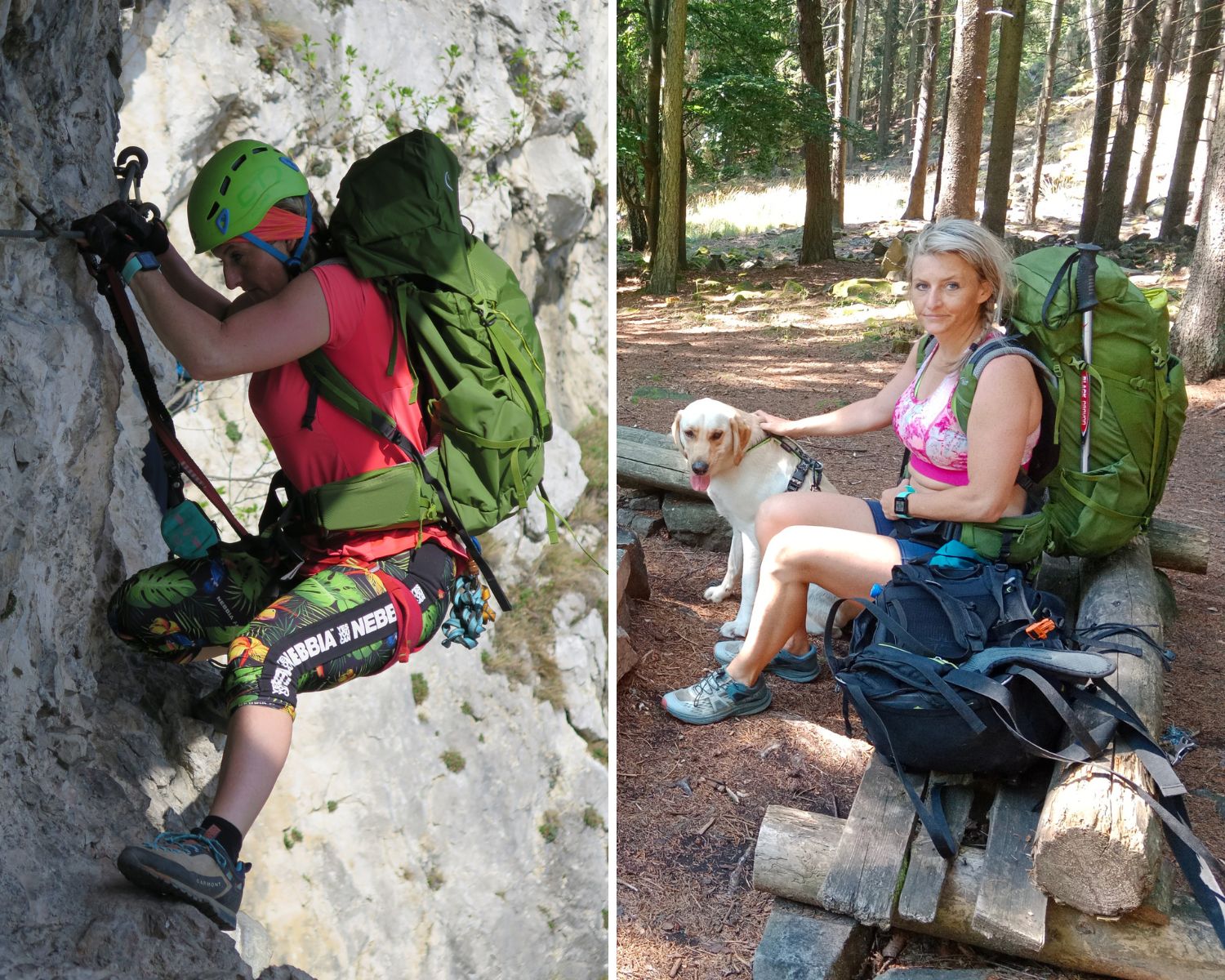
In summer we set off on hikes around Austria's Lake Altaussee. Views earned with several hours of climbing. Feasting our eyes on the Dachstein and the Totes Gebirge. But I'm definitely no camel, so I have to drink a lot and regularly. Luckily, my "Altie", as I named the pack, is designed for big water supplies. It has an airy back system that keeps ventilating nicely, so even when I was lugging two two-litre bottles of water – quite a load on such scorching days – I wouldn't say my back was exactly dry, but it certainly wasn't drenched in sweat. That was great.
And it was great on my multi-day rambles through the Brdy forests too, where the separate bottom compartment for my sleeping bag came in handy. And all it took was to unroll the extension collar of the main compartment and I instantly had another five litres for my extra wardrobe.
I was purring with contentment.
I always am when I sleep under the stars. What I don't carry, I don't have – perfect! And the weather was so kind to me! Only once did I get caught in a light drizzle – and the tough material with its HydroShield water-repellent finish handled it with ease. Even the ash I smeared on the pack by the fire came off the surface easily. A quick rinse in a stream did the trick.
I guess Lowe Alpine expect their packs to get some rough treatment.
But the biggest adventure awaited me at the very end of the season. Königsjodler – endless climbing along a jagged ridge, up, down, up and round and round again. And in the whole range of conditions. From sunshine we plunged into fog, fog turned to rain, and below the top, at almost 3,000 metres, we even got this year's first snowflakes. Ten hours of full-on effort.
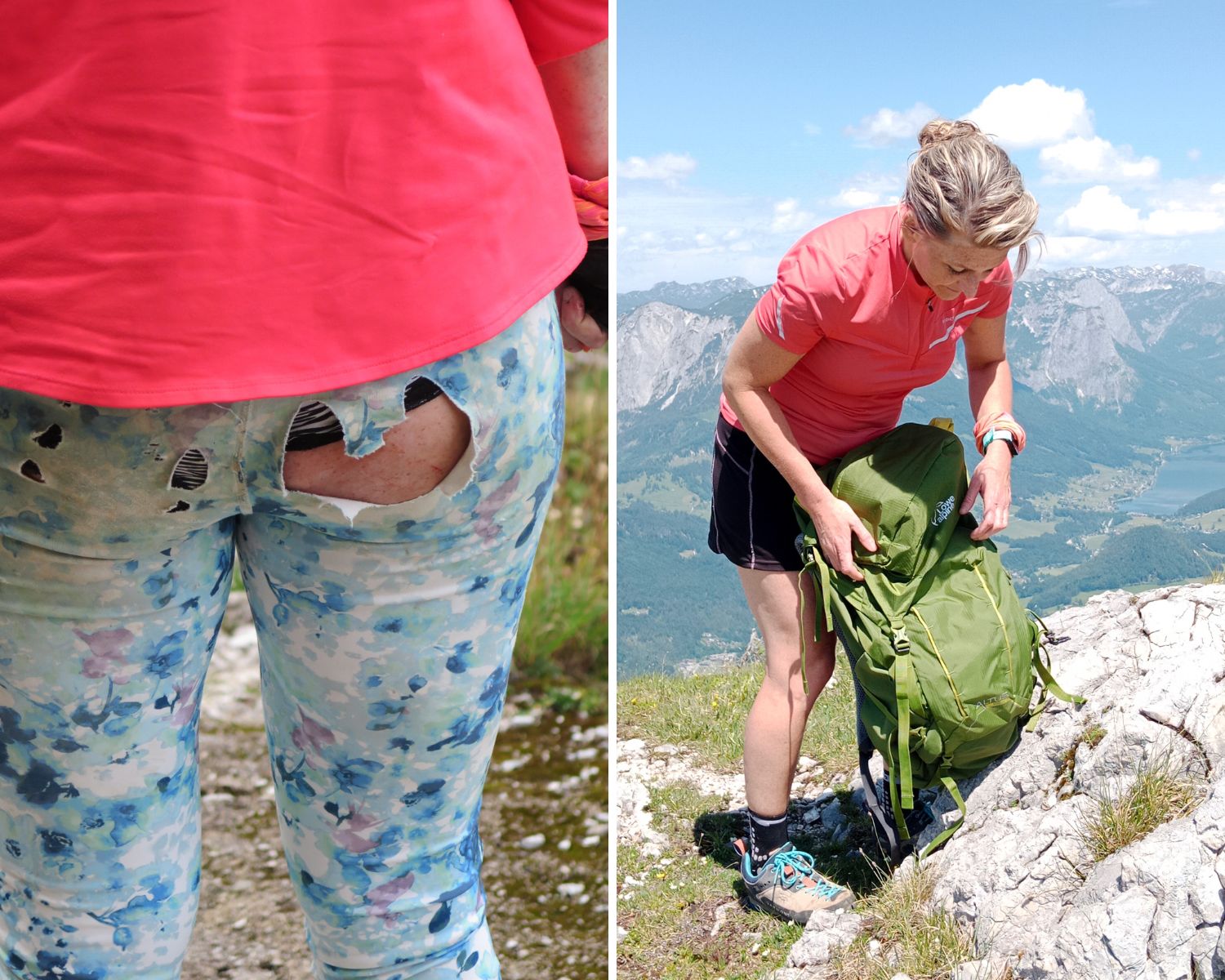
The way down then confirmed the saying that the descent is often harder than the ascent. We chose the Mooshammersteig path. And no, it didn't come for free. A glacier, downclimbing and descending fifteen hundred vertical metres of exposed rocky terrain with unprotected climbing sections. Thanks to the grey, falling mist, the rock was pretty slippery in places. So much so that at one point I set off downwards on my bum. As I fell, I landed on my pack and got wedged with it in a narrow chimney.
Now what? I caught my breath for a moment and then started counting the damage. Trousers in tatters and a bum turning every colour of the rainbow. Luckily, the pack had my back covered. And how did it fare after such a ride on bare rock? Unscathed! And I mean truly unscathed. Not even a scratch. I then tried to get my nerves into the same state, and step by step we carried on, slowly and gently, downwards. And when, two days later, I was packing my indestructible Lowe Alpine into the car, I turned to the mountain one last time with a humble "thank you".
It was a proper stress test – for both of us. And we passed – both of us.
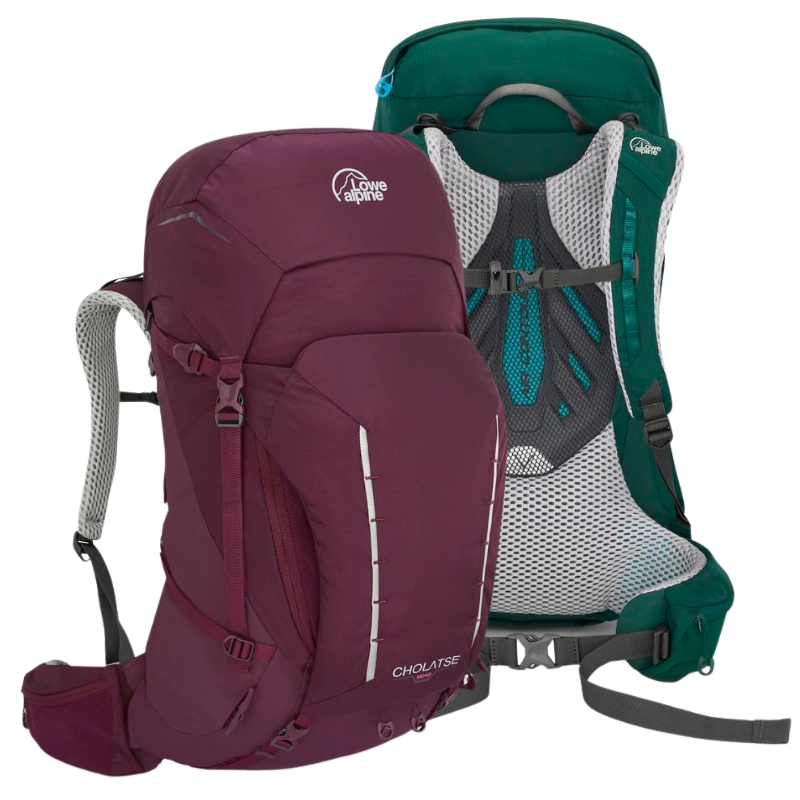
The successor to the tested Altus pack is Lowe Alpine Cholatse. It differs only slightly in the back panel.
As usual, I head out without a plan. But staying at home is unbearable when there's a meadow outside my window, forests above the meadow and, above the forests, mountain ridges – the ridges of my Jeseníky. All I've got is a rough direction. An idea, a hunch of where I'd like to go. But I don't know the route, the destination or the distance. I'd love to just shoot off and run. With nothing – just shorts, a T-shirt and trainers. Now that's freedom! The trouble is, I probably can't fuel this non-plan and this uncounted distance on blueberries picked along the trail. I have to put a few shackles on my freedom. I have to take a pack.
You can't set off on a run into the unknown with just 300 ml of water on your waist. The Jeseníky may be tiny mountains, but they're mountains all the same. A storm rolls in, hunger hits, and eventually darkness falls. Anything can happen. And how glad I'll be then to be carrying a dry T-shirt, a jacket, waterproof socks, a head torch and two or three spare bars on my back.
And all things considered, the pack actually ended up giving me freedom on my runs.
With a pack, you see, I managed to discover a new sport. A kind of duathlon, really. I packed climbing shoes and a bit of rope and jogged from crag to crag. On each one I climbed something easy, and that way I could run maybe twenty kilometres and climb five or six routes. The old-school climbers would of course have called it normal training – and they probably climbed in whatever they ran in. But with modern gear, I gave it a modern name:
Climbrunning.
Only my old pack kept bouncing on my back the whole time, so innocently, as if nothing was wrong, until the shoulder straps had worn grooves into my neck. Ouch! Admittedly, it wasn't really a running pack. Whereas the Rab Aeon LT is. So I put a bit more trust in it.
And it still managed to surprise me.

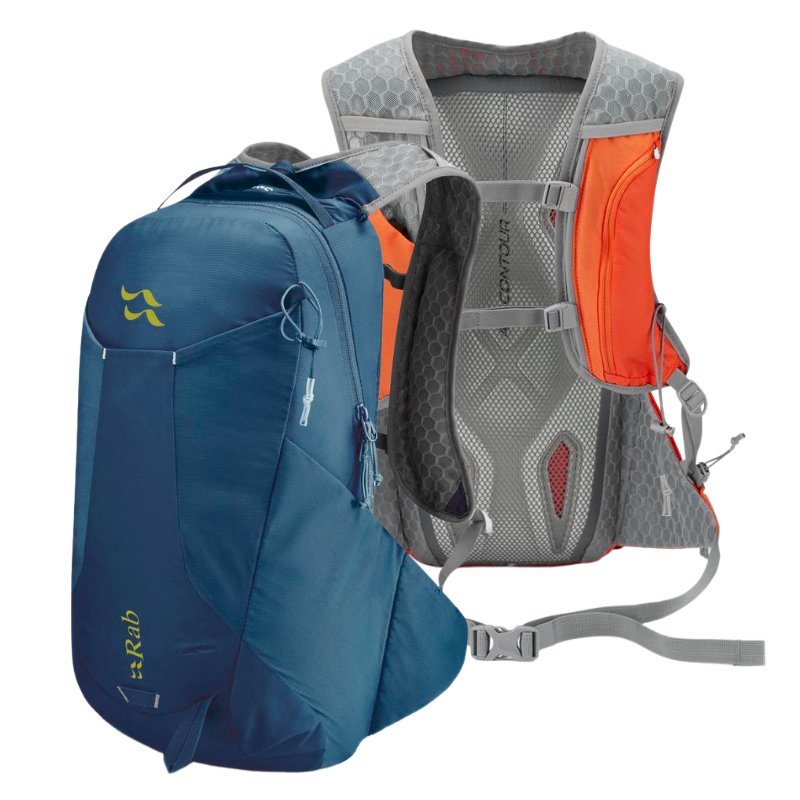
At first glance it's not one of those hugging race vests. It simply looks like a pack. Small and compact, the kind you'd happily take on a hike. A pack that fits more than a 90-gram windbreaker and three gels.
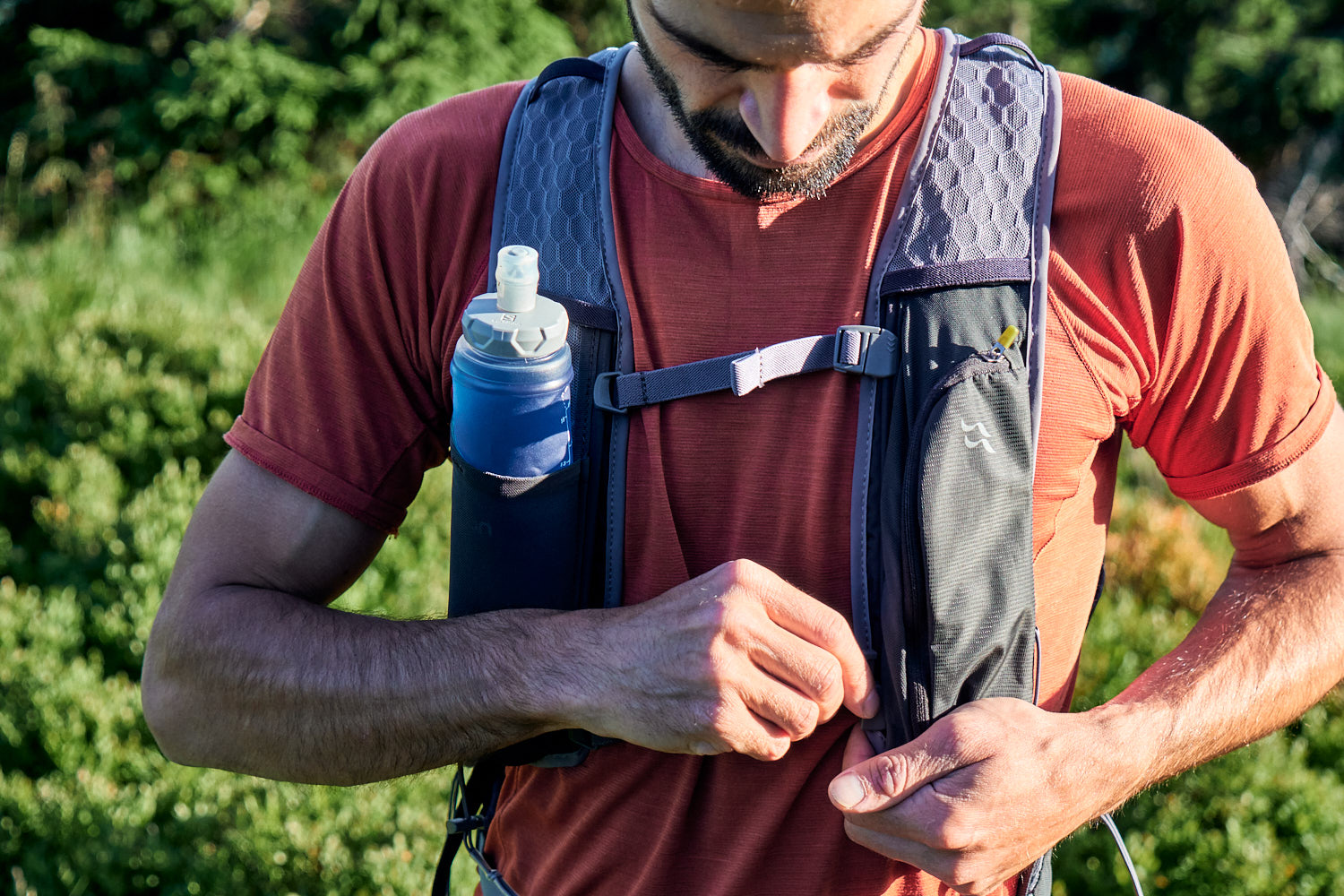
But for all its "ordinariness", the Rab Aeon LT has the same – or at least very similar – shoulder straps as a running vest. Plus two stretchy chest straps and a hip belt. So it sits well on your back. It doesn't even wriggle much or bounce up and down when you're running downhill. Of course, you'll notice a little movement – with 18 litres of volume it's probably impossible to eliminate. And yes, running vests fit like they're sewn on, but then they don't have that kind of capacity.
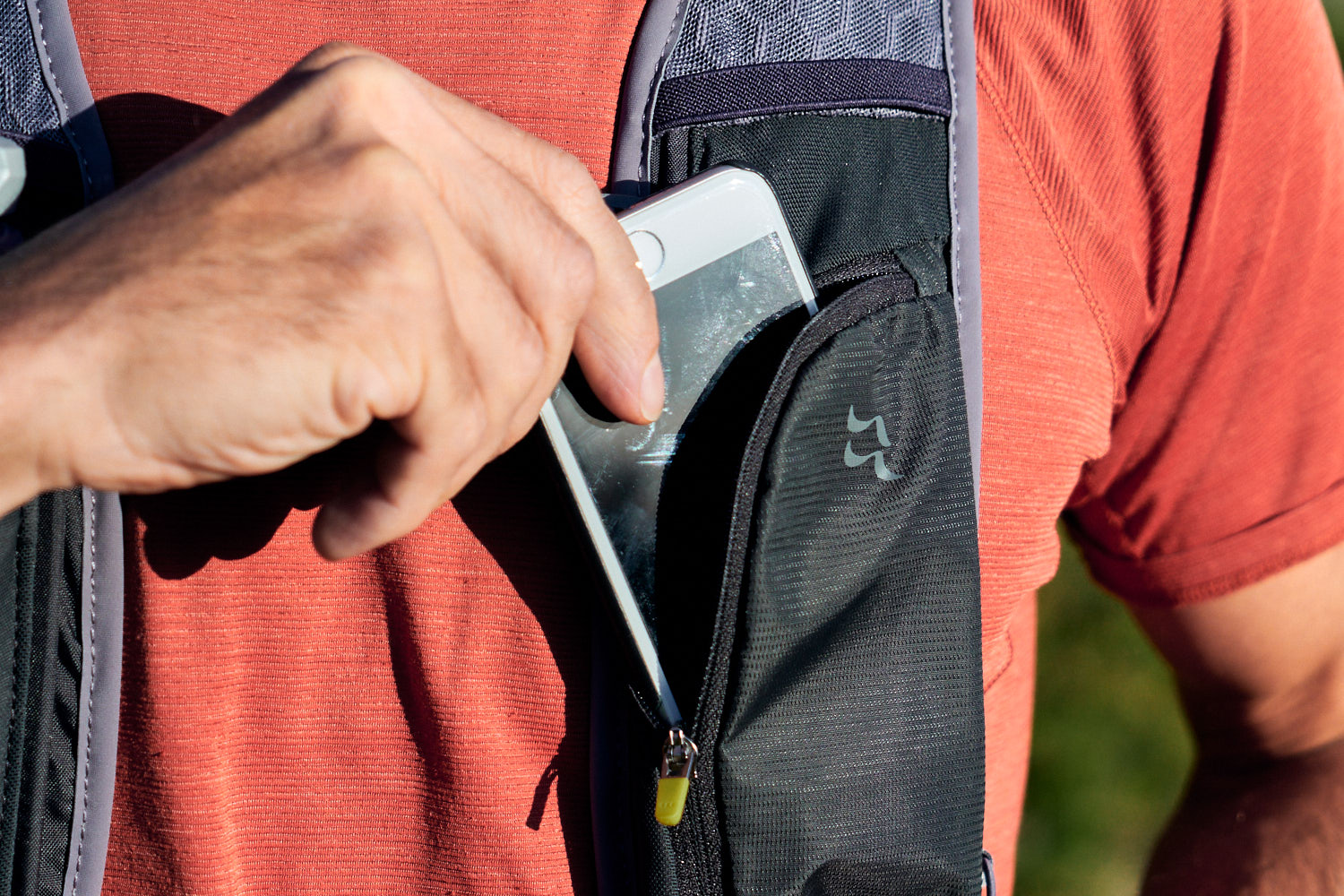
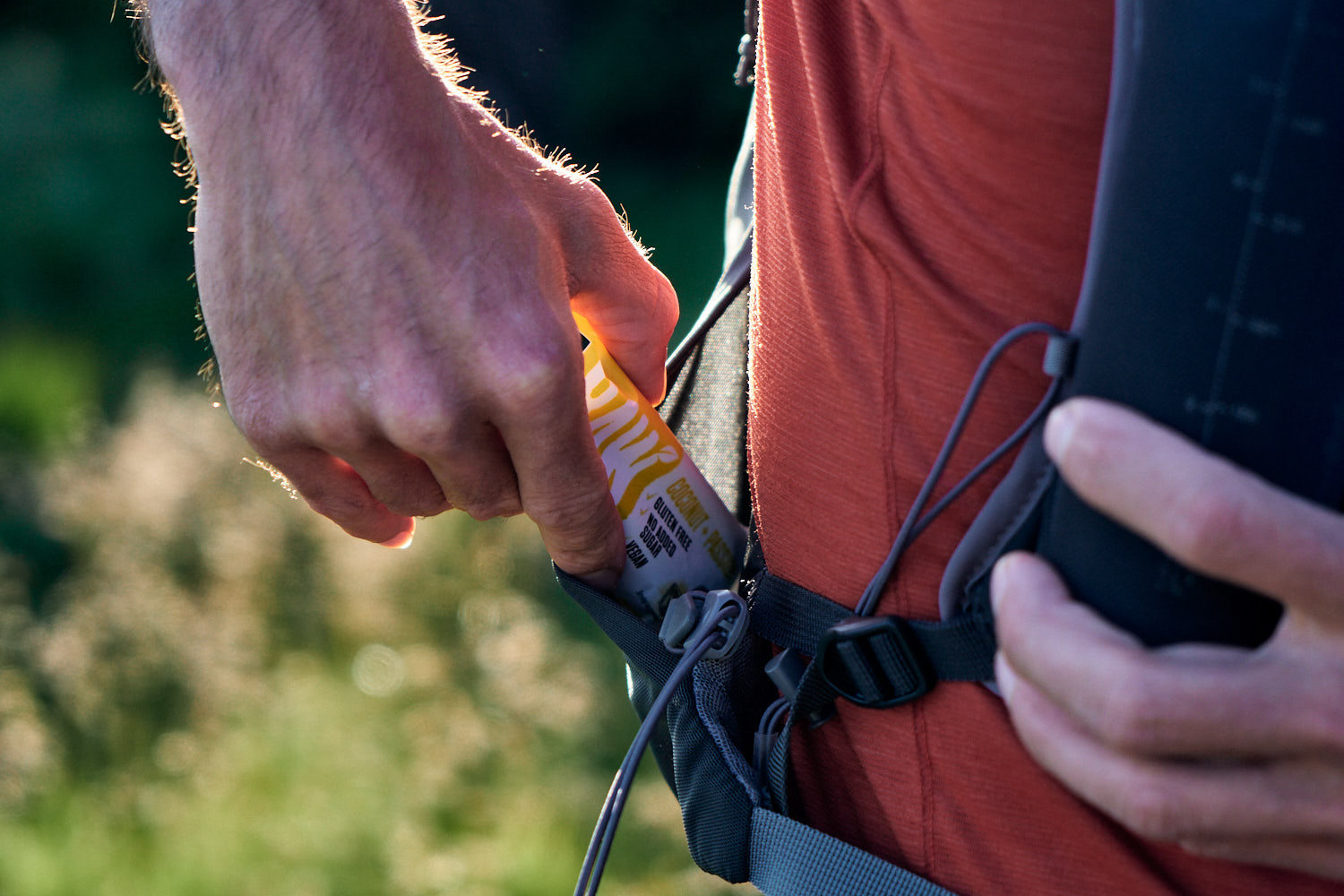
Taking its cue from running vests, though, the Rab Aeon LT has pockets on the shoulder straps for a soft flask, a phone and an energy bar. And then there are those big stretch pockets on the sides. Brilliant! You just reach in mid-run, fish out a headband or sunglasses and carry on. You don't even stop. Superb!
Do-it-all gear tends to be good for nothing. And specialised gear – apart from the one thing it's made for – tends to be good for nothing too. Some people like it that way – one pack for running, another for cycling, another for hiking. Others see it as a waste. That's up to each of us. The Rab Aeon LT is primarily a running pack. But because its volume and build set it apart from classic running vests, you can just as easily take it on the bike. Or on a shorter hike. Or for some climbrunning.
These features come in handy here, there and everywhere:
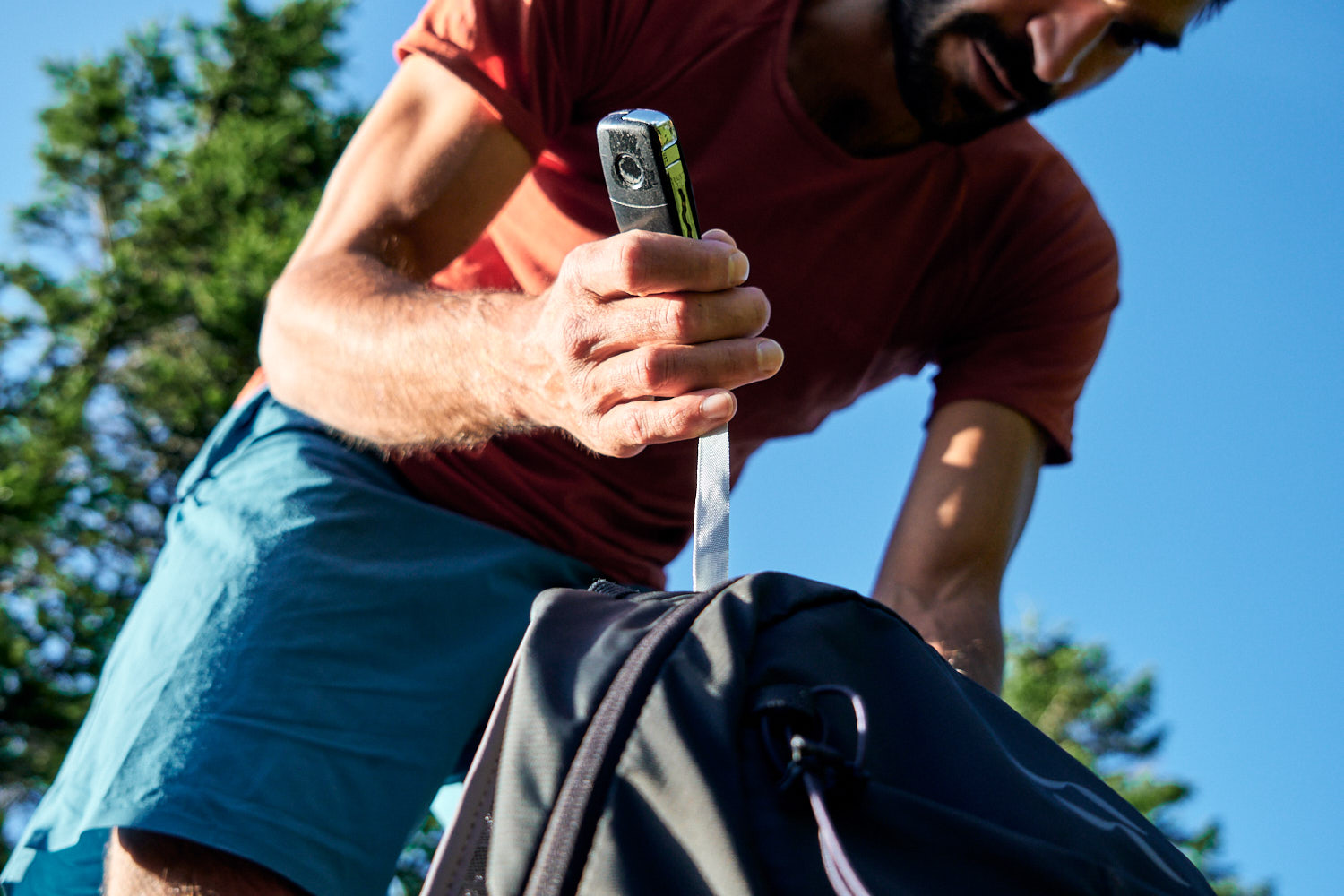
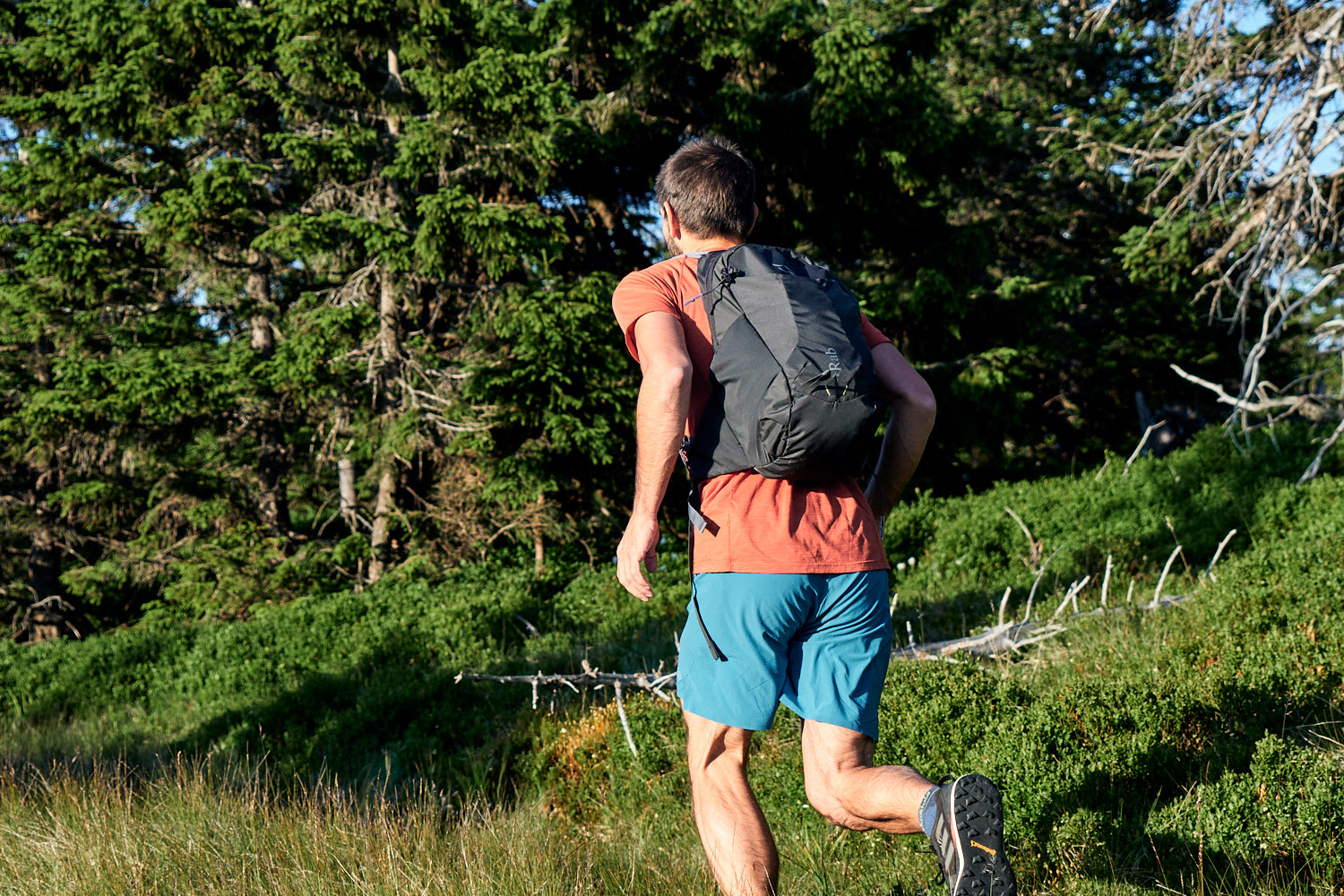
You might be wondering how Rab – a brand that until now only made clothing and sleeping bags – could come up with a good running pack just for the fun of it. But in reality, the Aeon LT isn't just Rab, it's also Lowe Alpine, which has been making packs since 1967. The two brands belong to the same company and their products overlap. So this (not just) running pack, too, has well-thought-out features tested over the years:
So hurry off to the mountains. With the Aeon, it's pretty good fun.
Just under ten kilometres and 1,673 metres of ascent. It rained all night – rained? It absolutely poured – and the forests of the Tamar valley are soaked through. I step off the beaten path and plant my foot in a sopping sponge. Squelch! Soon, though, we'll escape this dripping world, where every branch you push aside – bowed across the path by the weight of its own leaves – sends a shower down your neck. The forest will get lower and lower until there's none at all, and the green carpet of grass will finally give way to bare scree, loose rocks and big white crags – broken here and there by even whiter snowfields, leftovers of a long winter.
Our goal has also chased away the clouds that were still sitting on its shoulders after dawn. Jalovec is sending a positive signal – while the soles of my Asolo Eldo Lth GV approach shoes have been tickling its flanks for quite a while now.

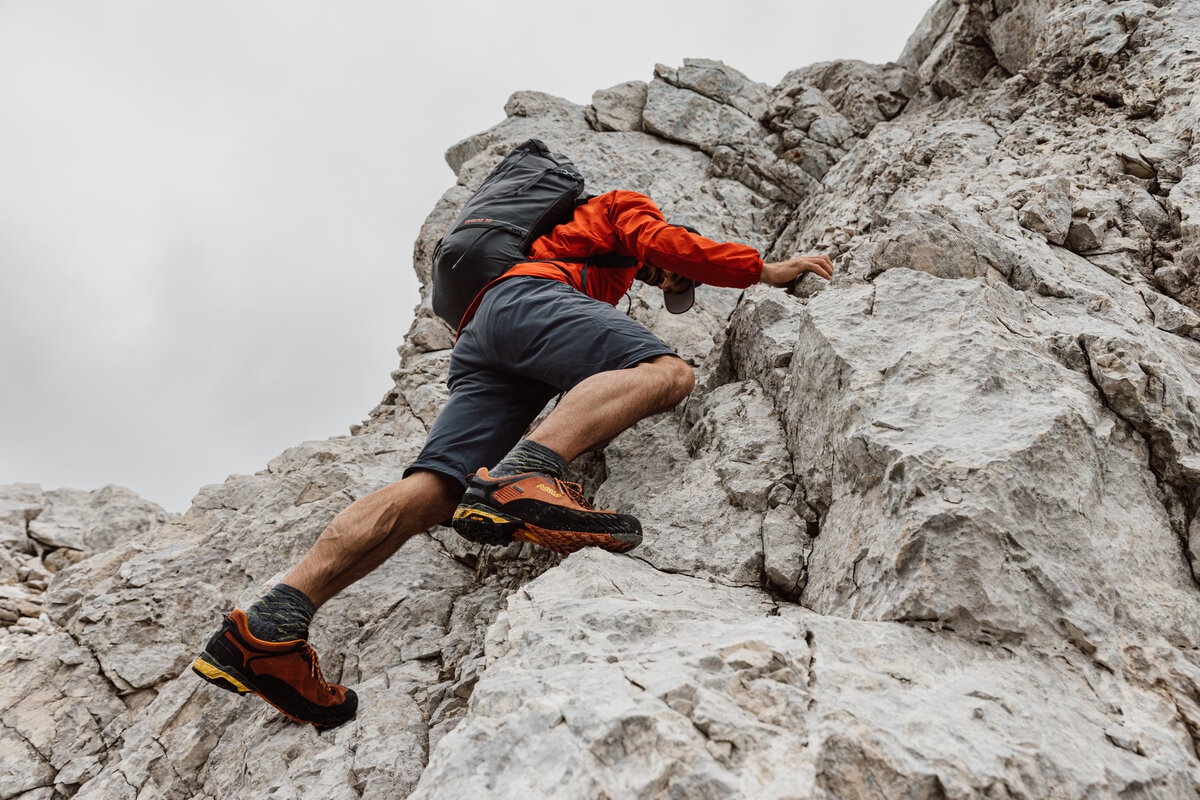
Unless a glacier or other piles of snow block your way, you might well get by in the mountains with low approach or via ferrata shoes. After all, they're made for walking and scrambling on rocky terrain. The only question is how tough they are. That very scree in the Julian Alps, for instance, can be nastily sharp – the edges of the limestone rocks cut into uppers and soles like razor blades.
Asolo Eldo Lth GV are tough enough. The protective rubber rand runs from the toe a good way back. And that's a good thing, because if the rand is shorter, it can:
A) start peeling off where the foot flexes as you walk,
B) and that flex point is where the upper tends to be most vulnerable – without a rand, rocky terrain will damage the material and seams or even rip them open.
The rubber rand on the Asolo Eldo Lth GV* is also high, so you can sink them into abrasive scree or a squelchy forest floor and neither razors nor moisture will reach the leather upper. A slightly lower rand protects the Eldos at the heel too. So they actually have a protective reinforcement all the way round – much like hiking boots for demanding terrain.
Lth in the name stands for leather – the shoes have a leather upper.
GV tells you the shoes come with a Gore-Tex® membrane and a Vibram® sole.

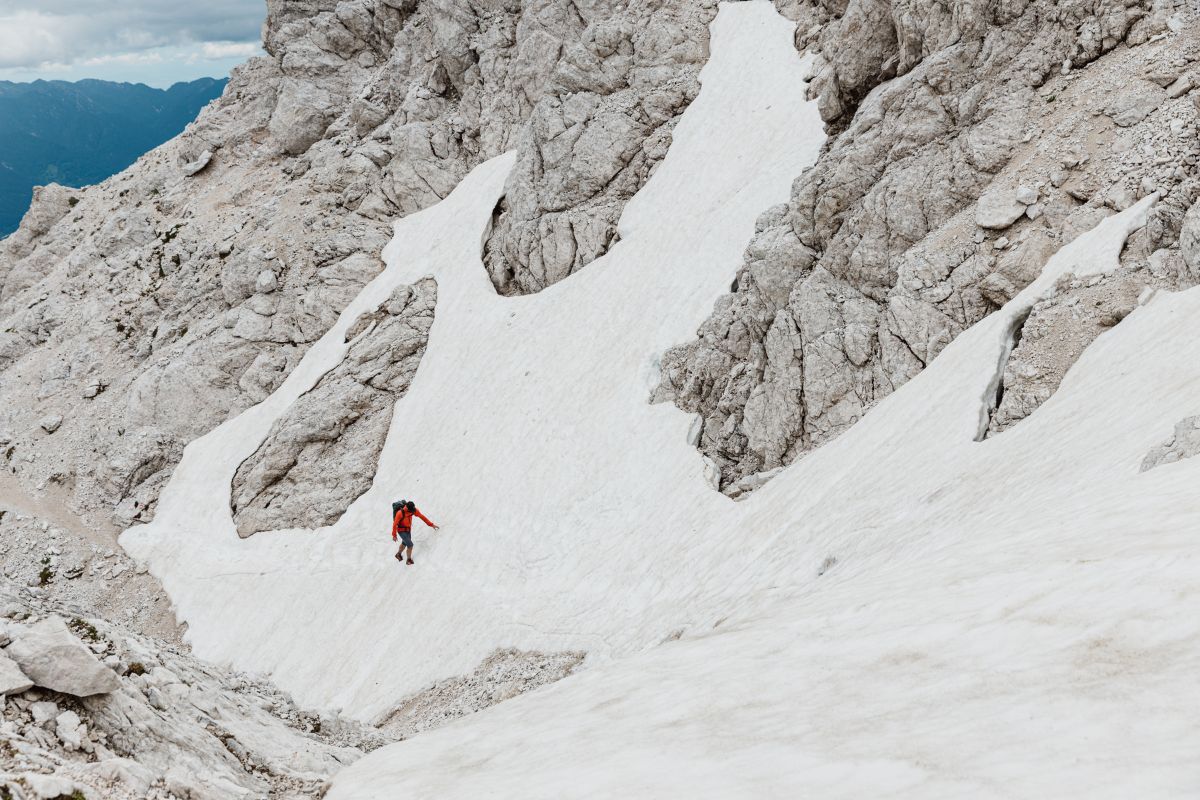
Down in the valley the ground is muddy, higher up it crumbles and at the very top it's solid as a rock. And sometimes pretty slippery too, when you step onto a steep snowfield – a toboggan run ending in the depths. So you need a sole with a tread that won't clog with mud and won't slip on snow, plus a smooth climbing zone at the toe for rock-solid movement on via ferratas and climbing terrain. Asolo Eldo Lth GV has both. On top of that, the sole is made from the Vibram® Megagrip compound. Compared with Vibram®'s older compounds it's fairly soft – meaning nice and grippy – yet still hard-wearing.
And then there's stiffness. In overly stiff shoes (hiking boots) you won't find much confidence on rock – you can't flex them and the toe won't brace securely. Overly soft shoes, on the other hand, won't support you on treacherous ground – like that scree below Jalovec. Getting the stiffness right on approach and via ferrata shoes such as the Asolo Eldo Lth GV isn't easy even for the manufacturer. Here, though, they've struck a pretty good balance. Asolo Eldo are stiffer than Asolo's older approach models (e.g. Apex or Salyan), but still flexible enough for brisk walking – not to mention climbing.
The thin, only lightly padded tongue also adds to the good feel on your feet. And so does the reliable lacing. The lace loops are made of tough cords (really tough), only slightly thinner than the laces themselves. So you tighten your shoes in the morning and don't have to bend down and fiddle with the laces until evening.
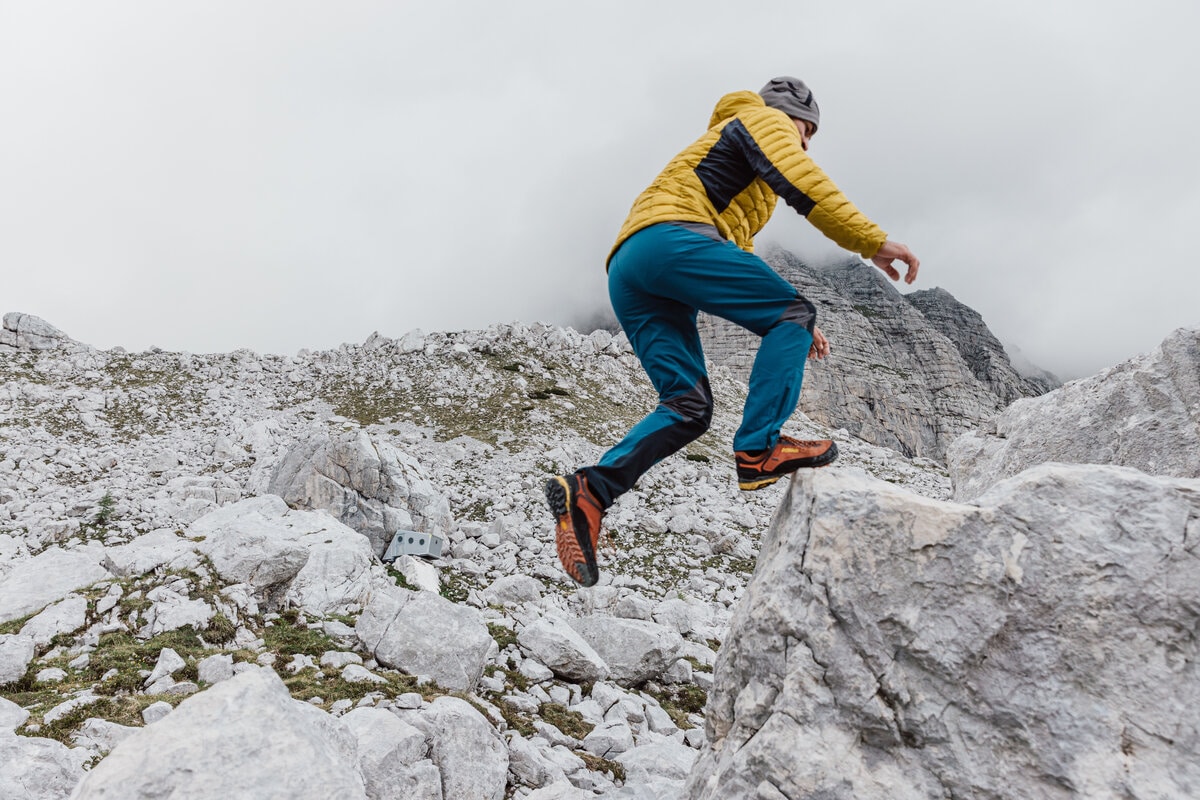
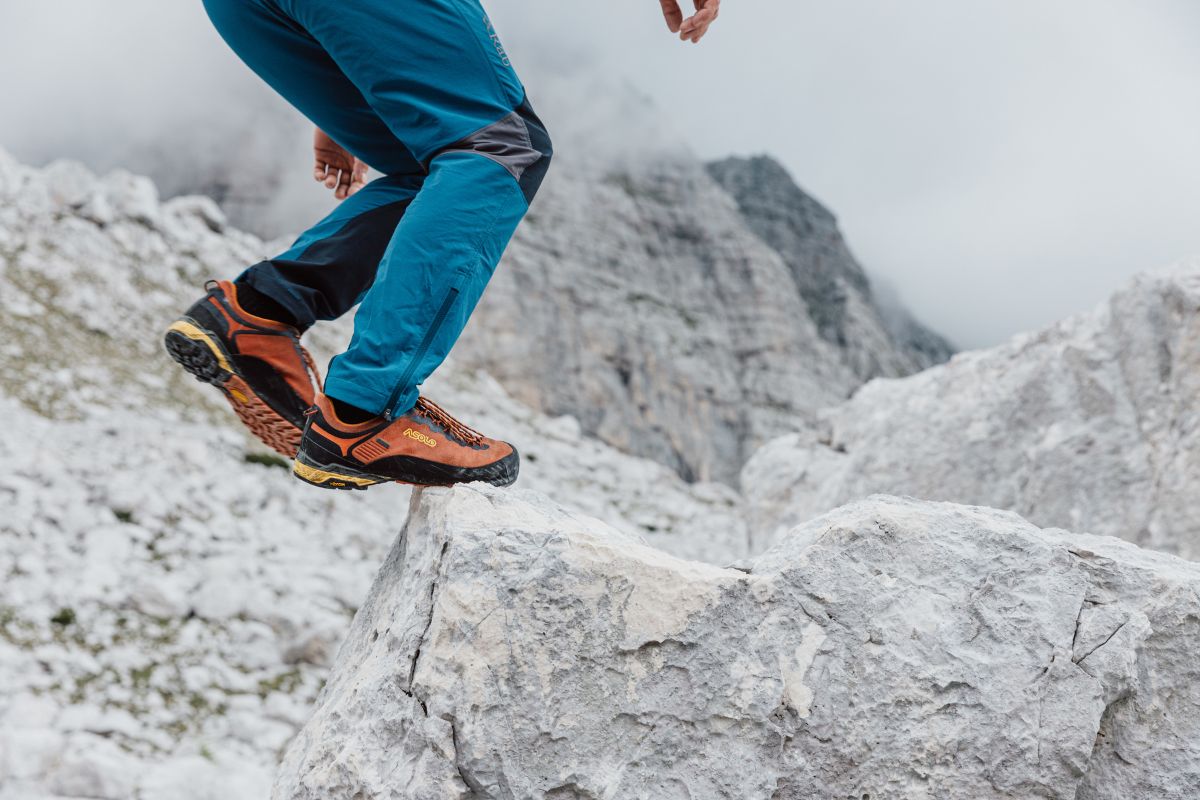
It looks like the summit isn't far now. But in the mist that has settled on Jalovec again, I can only guess the distance. My mate waits below the fore-summit – and I carry on alone. I don't want to hold us up – I want to race towards the top. And I can. I can hop lightly and surely from rock to rock – I can trust every step up, and down too – it holds – even in that damned gully on that damned steep snowfield, which ends tens of metres below me, and then there's nothing but hundreds of metres of thin air.
The only thing slowing me down is a slight lack of oxygen – but a gap in the clouds drives me on. And suddenly: Stop! – Not a step further. This is the summit! The top of Jalovec. For the Asolo Eldo Lth GV, though, the high point comes on the way down – during the quick run back. On rock they stick like glue. Because they're really good:

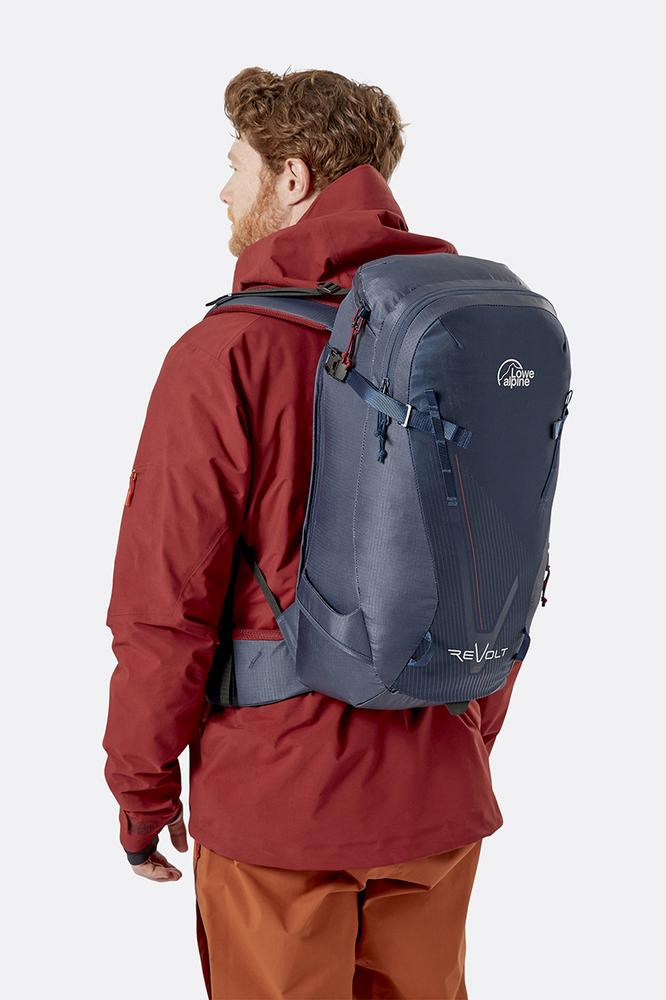
I can't help it. There's no other way. I need to capture these moments for eternity. Again and again I have to pull out one of my two cameras and try to use it to halt the relentless march of time. The movement has become a routine: free my right shoulder from the snug padded strap and tilt my whole body slightly to the left, at just the right angle for the pack to slide off the other shoulder into the fluffy snow, already lightly tamped down with my left ski, and land at my feet with its back facing the sky. There isn't much time; everything has to happen in quick succession. Only rarely can you shout "Wait, stop!" and pause the action on the screen of mountain life. When a skier is charging down a slope, he won't hit the brakes for you and ruin his own fleeting moment of powder bliss. The cameras have to sit in the pack so I can grab them instantly, without rummaging. I'd probably miss a good half of my shots if I had to do without the back-panel access, which I value enormously on the Lowe Alpine Revolt ski touring pack: two zips, two quick pulls, with gloves on of course, and the whole back panel swings open. As if I were opening a suitcase. Except this ski touring "suitcase" rides on my back all day without making too much of a fuss about being there.
Yes, this article is a celebration of the Lowe Alpine Revolt ski touring pack. It caught my eye, then convinced me and finally won me over.
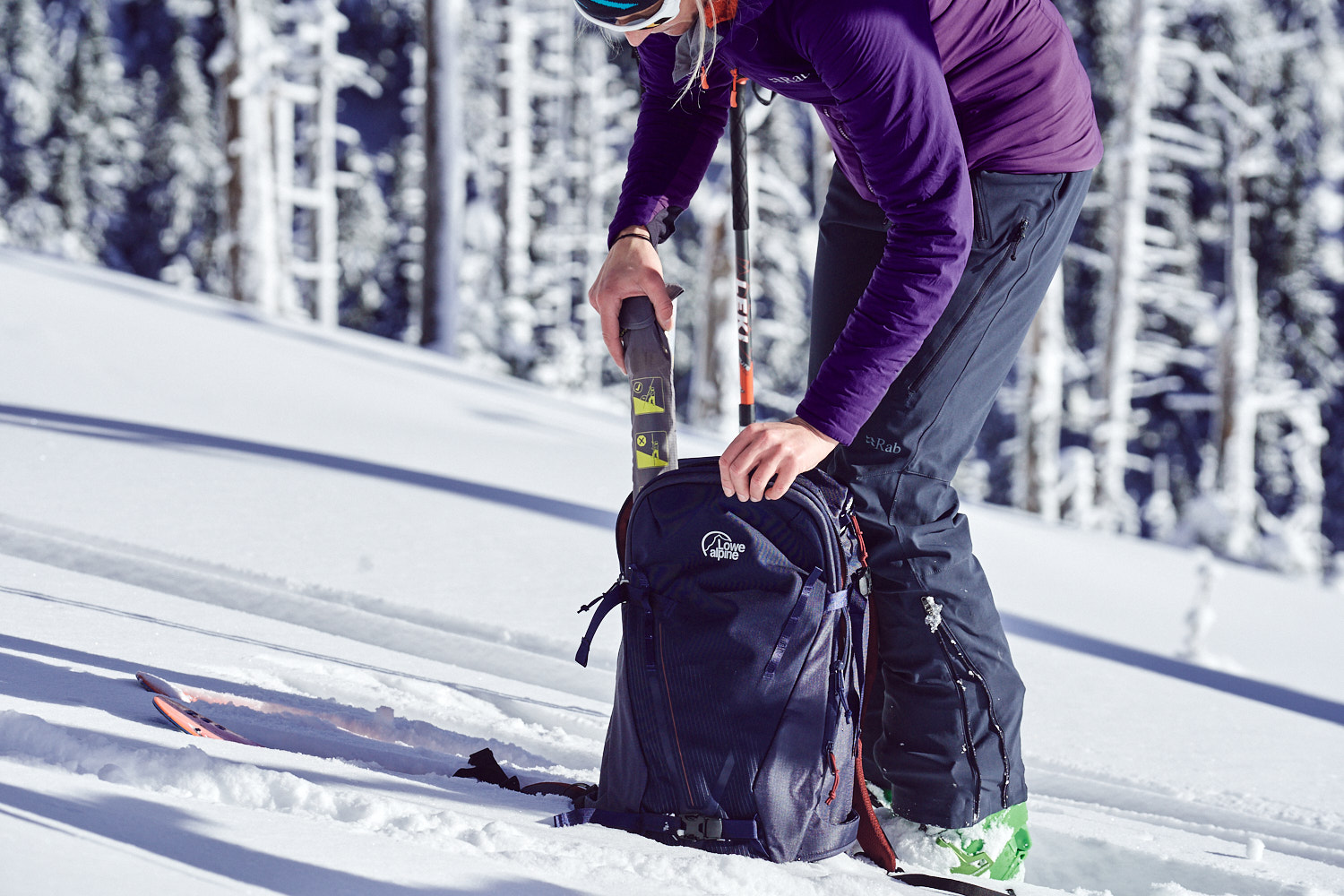
It's not just for photography that you'll appreciate the speed and sheer simplicity of getting into a ski touring pack through a swing-open back panel. Just think of fishing for dry gloves in the freezing cold when they've filtered down to the very bottom. With back access you see the whole contents of the pack and your hands go straight to the right spot. To get your flask or first-aid kit, you don't have to throw your down jacket, spare hat, snacks and everything else piled on top out into the snow.
"What else should I pack for the tour? Just in case?" With four kilos of camera gear I usually face the opposite problem: what else can I do without? I deliberately choose packs of around 25 litres for day tours, because if you really want to enjoy the ski down, a bigger pack just gets in the way. But then comes the other side of the coin: making do with less. Over the years spent on skins I've worked out a minimal kit that gets me through any situation, with four pairs of gloves and miracle duct tape being the essence of success. Even so, I often hit the limits of a pack's capacity, and stuffing the skins inside meant putting on my jacket to free up space for them. Compared with everything I've used before, though, the Lowe Alpine Revolt seems to be a bit inflatable.
I've never had this much room in a 25-litre pack. Ski goggles and Horalky wafers have their own pocket at the top, and its volume isn't eaten up even when the two main compartments (besides the one already described, there's also an avalanche compartment for probe, shovel and saw) are stuffed to bursting. And if, like me, you're obsessed with losing your keys and would rather check ten times that they haven't wandered off on a whim, the Lowe Alpine Revolt will give you peace of mind. Two internal pockets, one of them with a key clip, will soothe your nerves.


It's frustrating to count the days you manage to get out on skis. It's much easier to put up with tallying the days that won't let you head out. And luckily, this year there haven't been many of those so far. Praise be to my home Jeseníky mountains, at whose foot I live, and to the Swiss border that opened for a few days. So ever since the spruce branches bowed under a white eiderdown and the slopes were flooded with sparkling white, I've spent many beautiful but also demanding hours with the Lowe Alpine Revolt. It's had quite a time with me. Especially when, instead of a single walking ice axe that the Headlocker attachment system was originally designed for, I forced two climbing tools on it and headed off with Tomáš Petreček to take a few shots on the ice. It coped – the pack, that is. Helmet included, sitting snugly under the integrated mesh, which you can hide completely in the bottom of the front panel when you don't need it.
Living with skis on your feet – and in my case probably in your head as well – is beautiful but demanding. Especially on your gear. An expensive waterproof outfit turns into work overalls, and I'm already starting on my second set of self-adhesive patches. I've got red thread ready for the down jacket and black for the gloves. A split ski tip was saved by two-part epoxy glue, and the pack is going through some tough times too. So far, though, it acts like it's no wimp, and if it does have any weakness, it has decided not to show it to me. The burly fabric clearly doesn't give in easily, and as is usual with Lowe Alpine, you won't find many things on the pack that could break.
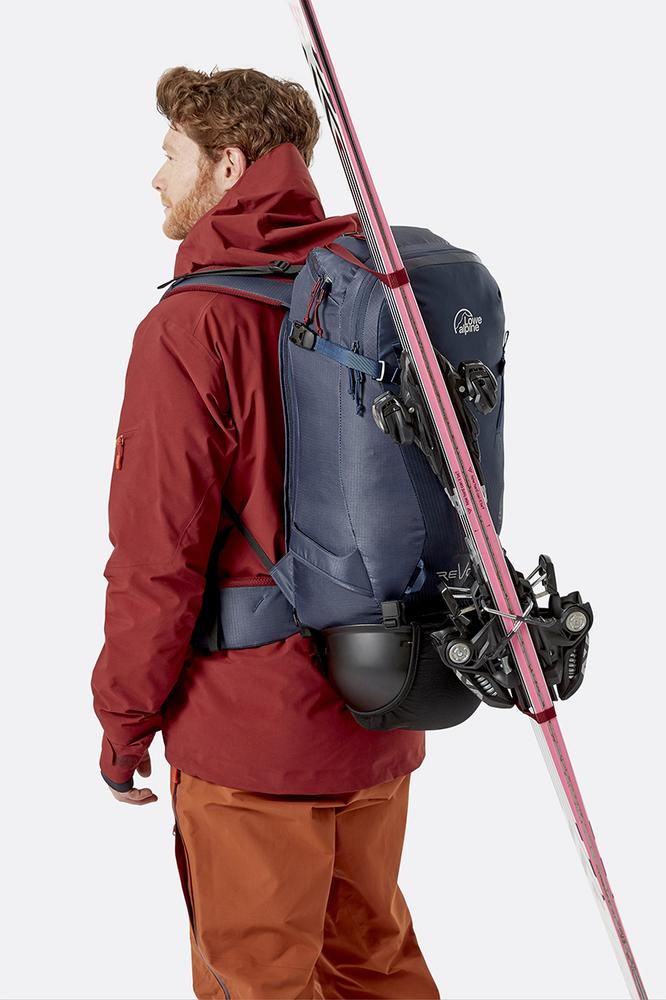
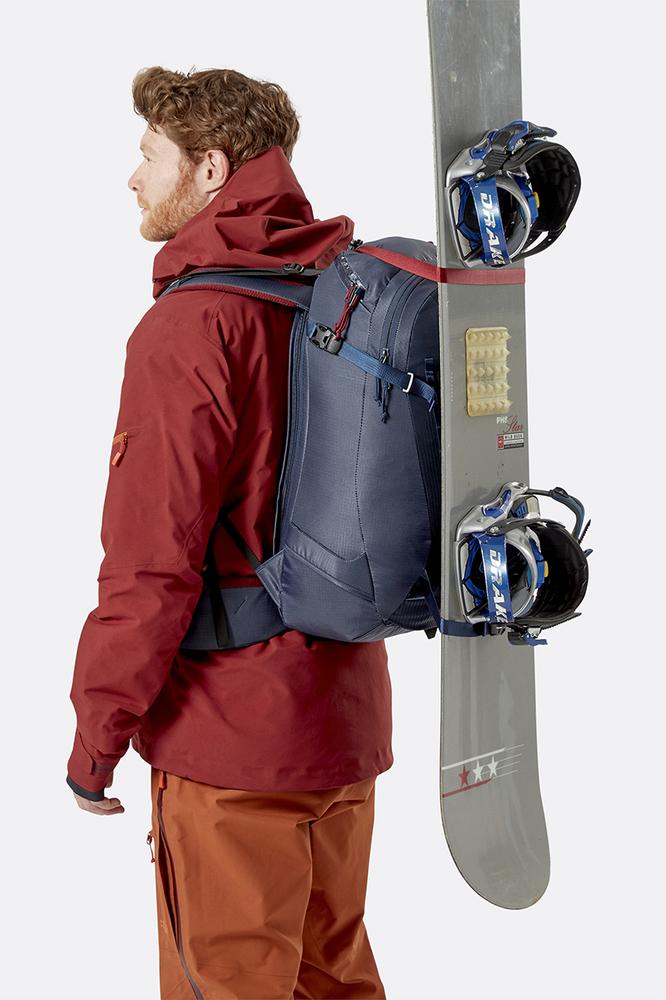
Simply put, it's a champ. When I'm worn out, it'll even carry my skis for me. One on each side, or on the front. And it could handle a snowboard too, apparently. But enough talk now, we have to get back out there – it's snowing.
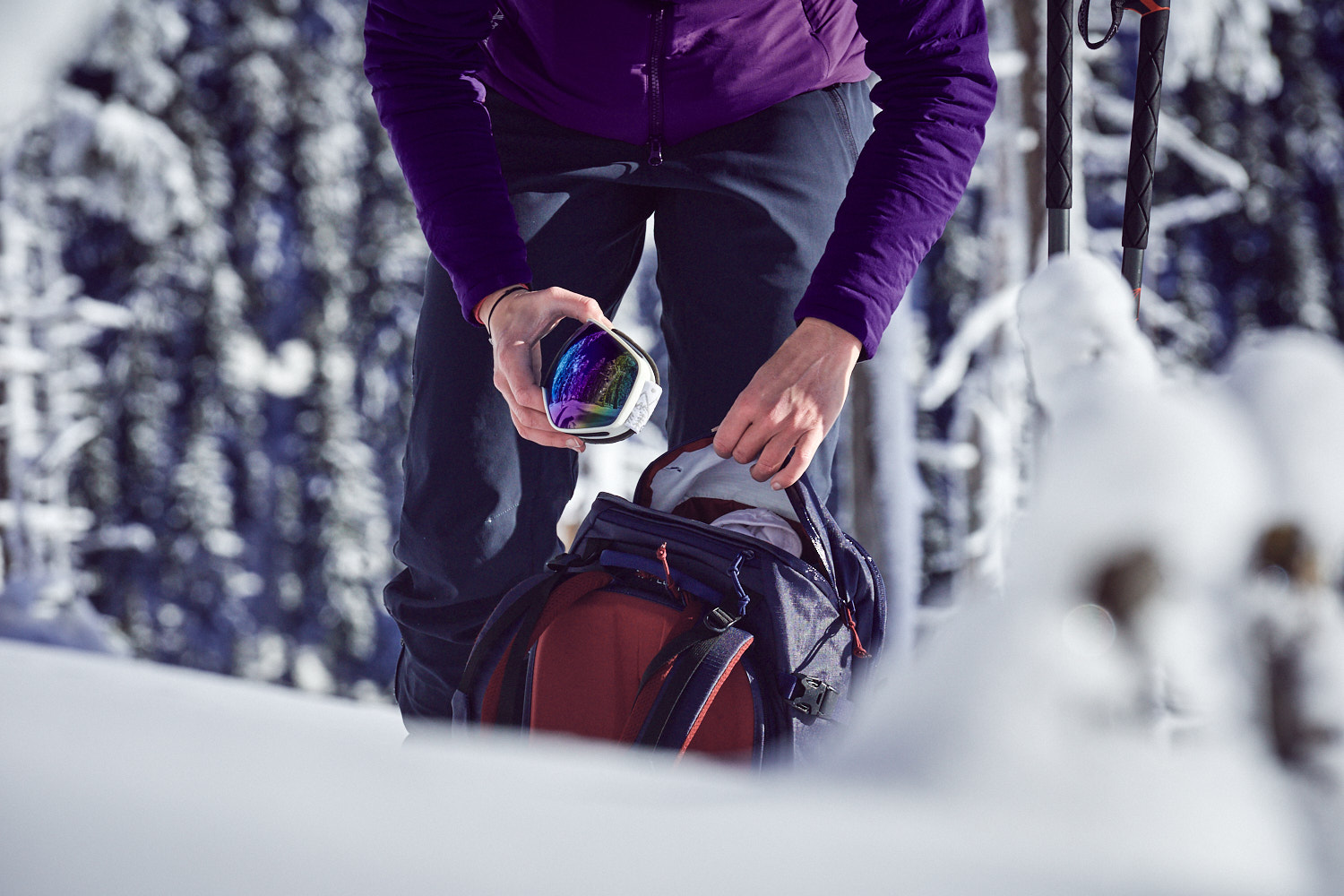

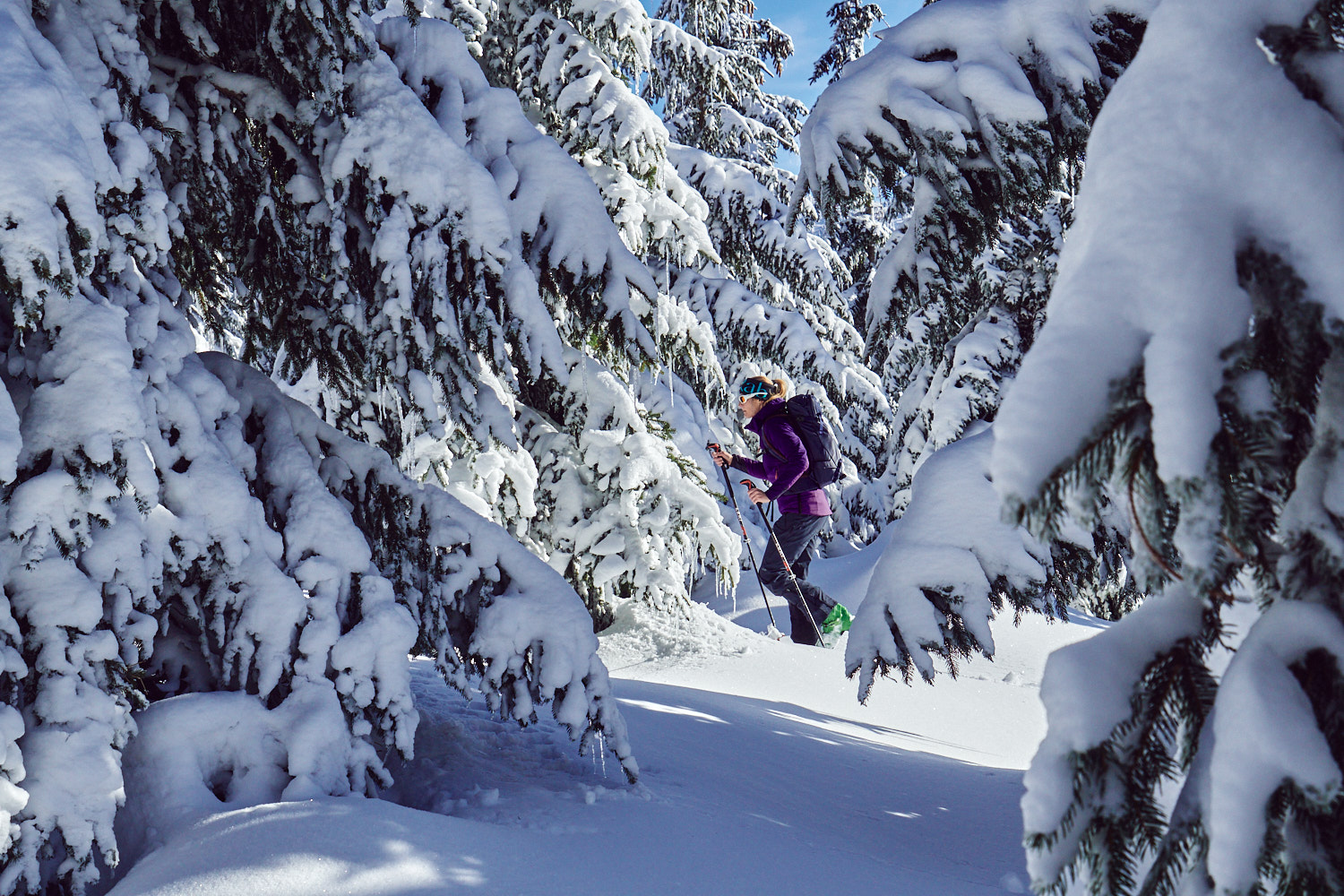
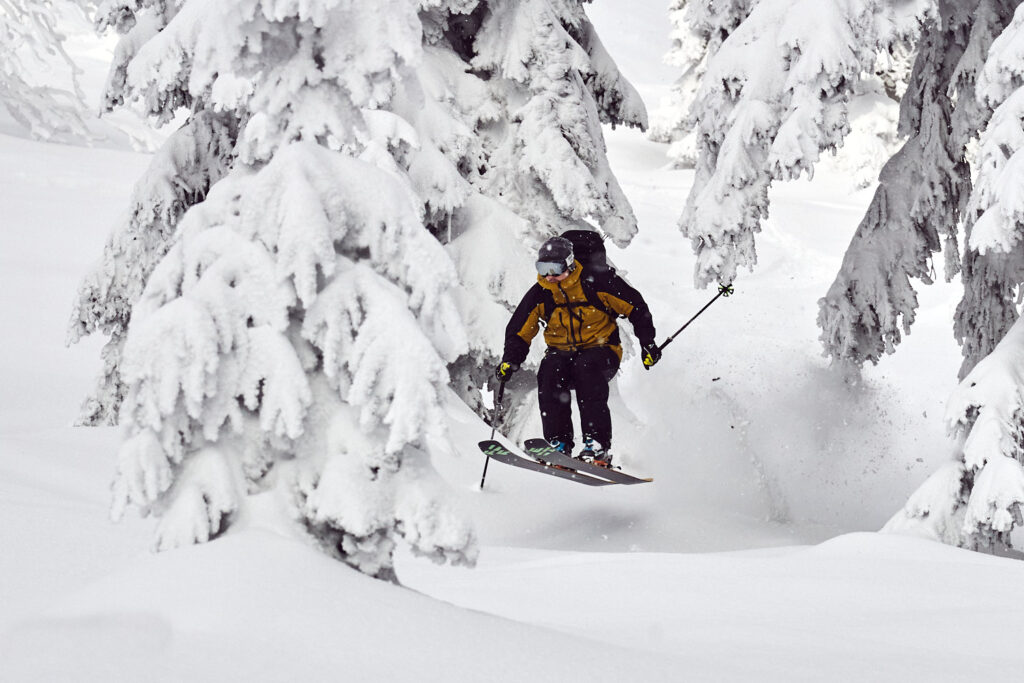
The Revolt ski touring and freeride pack doesn't make its presence felt at all on your turns. Snow doesn't stick to the Tri-Flex™ back system and you can operate every buckle and zip with gloves on. But what you'll appreciate most is the roomy back-panel access, which lets you quickly find a dry hat even in a blizzard and fish out your flask without taking your gloves off. More info >>

I climb mountains. I write about mountains. I photograph mountains. And I always come back happy. It's written in my name, after all.
Let's now move roughly 900 kilometres south-west. Across the Italian border. To a small town near Venice, where the rooftops are covered with red clay tiles and an old fortress looks down on them from a pine-covered hill. At the same time as the Copper Tower film crew was roaming the Tatras, one of its nine thousand inhabitants was a certain Giancarlo Tanzi. A young Italian who escaped at every free moment to the sun-bleached walls of the Dolomites, below which green meadows dotted with fuzzy edelweiss flowers fell away into the valleys. But he never fell in love with those heavy leather boots. Their weight only made the way to the summit longer and added beads of sweat to his brow. Still, nobody has ever achieved anything in the mountains with words alone. So the handy Giancarlo Tanzi began thinking about how to lighten the load on his feet. He sought out local shoemakers and talked them into experimenting with a material they had never used for boots before. Cordura – a light, tough fabric developed by DuPont during the Second World War for use in tyres, which later found its way into workwear and became the main construction material for backpacks.
Many prototypes ended up as worthless scrap. Then in 1975 Giancarlo Tanzi presented the world with the first hiking boots made from a combination of leather and Cordura. He called them Scout and, as a proud patriot, gave his newly founded company the same name as his home town – Asolo. With the hindsight of almost half a century, we now know his achievement deserves to be called revolutionary.

But the young Italian spotted another problem with mountain footwear. Moisture! Leather on its own, as long as it's kept well greased, won't let water through. But after the shoemaker's needle has done its work, the material is left full of unsealed holes. And just at the right moment, news reached the town of Asolo that an American company, W. L. Gore & Associates, had recently won a contract to produce a waterproof fabric for clothing for polar explorers preparing to cross Antarctica. Giancarlo Tanzi got hold of a few metres of the material, sold under the name Gore-Tex®, and began experimenting with the lining of the boots he was making. In 1980 – again under the Asolo brand – he launched the very first hiking boots with a waterproof, breathable membrane.
Let's move once more. But only a short way. Half an hour's drive east along the SS348 road, downstream along the Piave river, lies the small town of Nervesa della Battaglia. After the end of the Second World War, shoemaker Oreste Zanatta and his wife opened a small shoe shop here. Northern Italy, economically devastated by the global conflict, began to flourish rapidly after 1946, and with the demand for quality goods the business grew too, until Oreste gradually employed every member of the family. During the 1960s he handed the reins to his son Ambrosiano, who turned the small family business into a thriving company called Tecnica Group. You may know the name you've just read. Or at least it may ring a bell. Today, besides Tecnica outdoor and ski boots, Tecnica Group's portfolio includes the ski brands Nordica, Blizzard and Marker, Lowa hiking boots and Rollerblade inline skates.
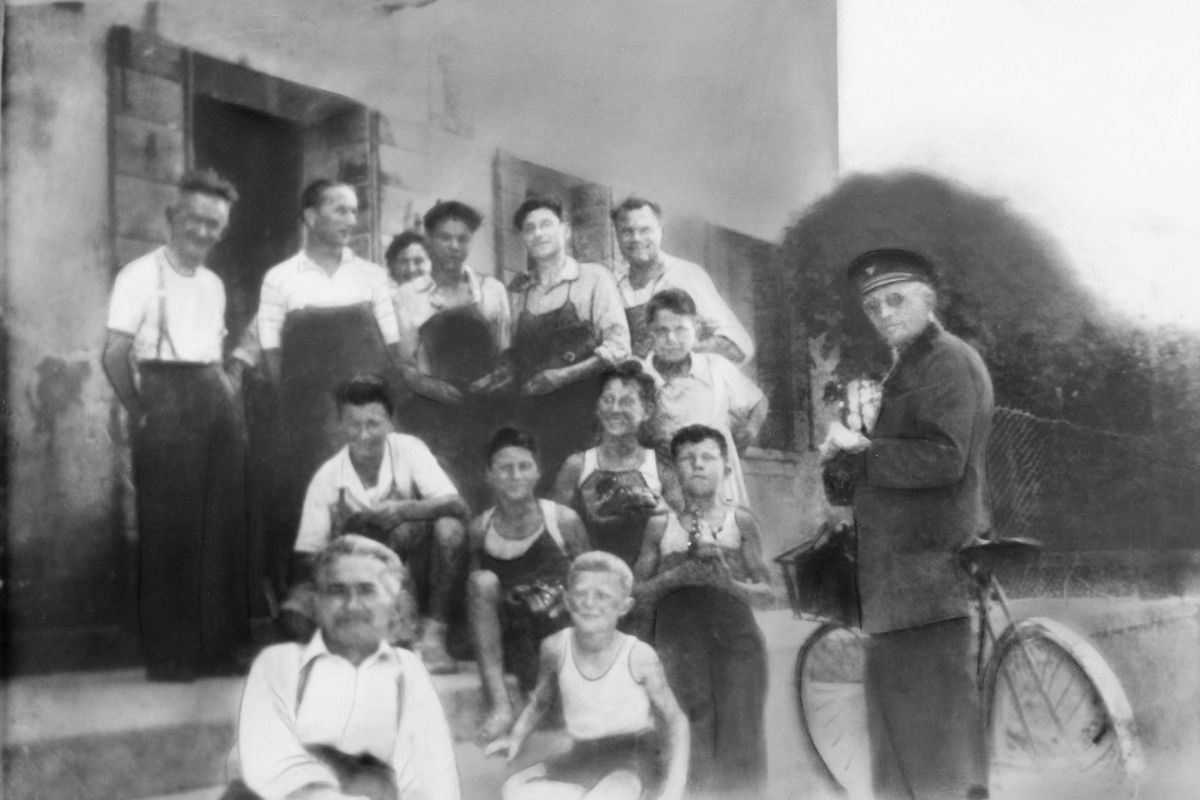
1998 then became a turning point for two men living 30 kilometres apart. Both were tired of business. In the nineties, Giancarlo Tanzi was making specialist mountaineering boots from thermoplastic materials and, inspired by biomechanics, was striving for the closest possible harmony between boot and human foot. Ambrosiano Zanatta was a key manager of a footwear company employing hundreds of people around the world. The paths of the two entrepreneurs crossed when Ambrosiano sold his stake in Tecnica Group and his children Anna, Marco and Luca – the third generation of the Zanatta family – used their father's money to buy the Asolo brand from Giancarlo Tanzi.
The circle closed in the town of Nervesa della Battaglia, which became Asolo's headquarters. But the story goes on. Now with the fourth shoemaking generation of the Zanatta family, represented by Luca's daughter Ludovica. And old Mr Ambrosiano still walks the aisles between the stations of the production process, keeping an eye on the careful work of the Italian shoemakers. And although a revolution like the two that Giancarlo Tanzi sparked one after another in the footwear industry would be hard to repeat today, the whole Zanatta family keeps looking for further small improvements, from mountaineering to hiking boots. They all focus solely on work steeped in the scent of leather and mountains.

Right after the Zanatta family took over the Asolo brand, the siblings opened their own factory in Sibiu, Romania, so they could oversee every production step and the reliability of their boots. Specialist mountaineering models and prototypes are still developed and stitched in Nervesa della Battaglia in northern Italy. Over the last 20 years Asolo has introduced many small innovations that have earned awards from prestigious outdoor authorities and magazines. One of the most interesting is definitely the Micro Pulley System lacing, which makes your boots sit better and more precisely on your foot and stops the laces wearing through. The Zanatta family believes mountain boots are bought for decades, which is why Asolo takes old boots in for repair: for 2000 Kč it fits them with new soles, repairs the seams, replaces the laces, renews the waterproofing and returns them to their owner ready for many more years in the mountains.

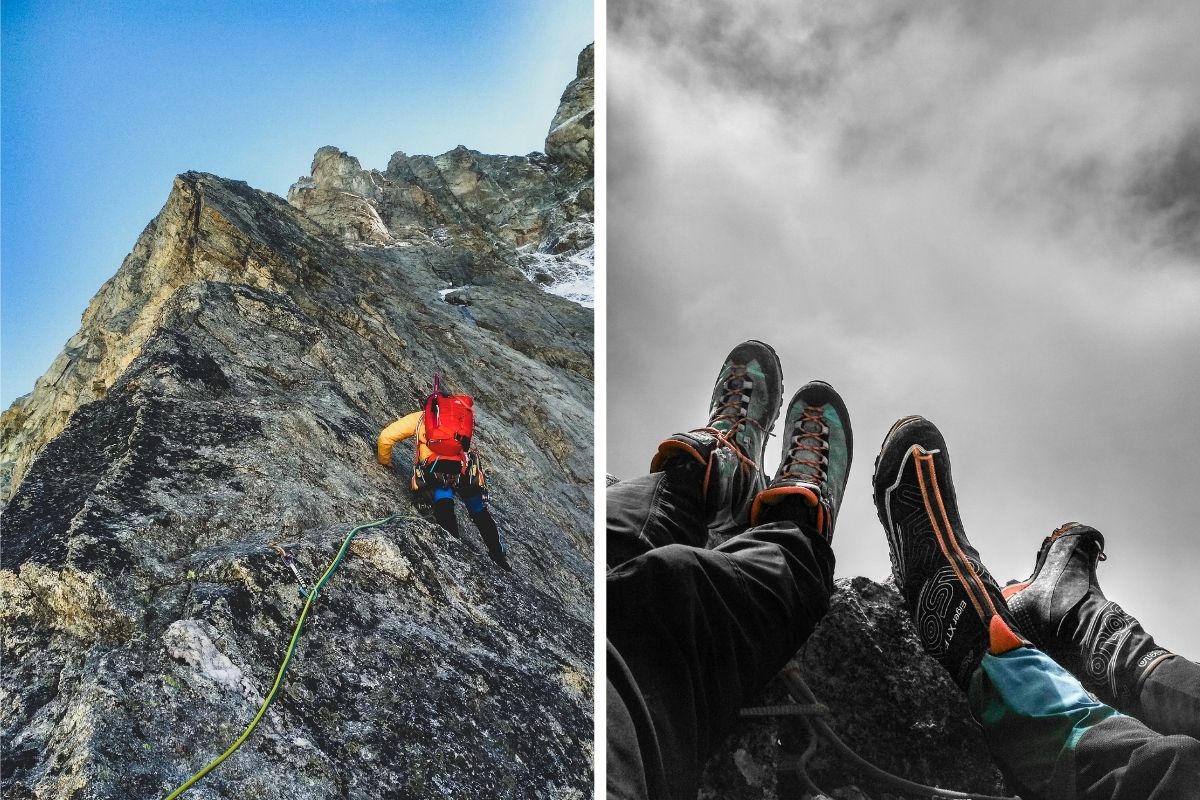
Many years have passed since then. I remember first reading about this route in Radovan Kuchař's book “Ten Great Walls” (Deset velkých stěn). I knew straight away that this was exactly the goal I wanted to attempt one day. And so here I am, standing on the Leschaux Glacier - just like Cassin years ago - looking up. All sorts of feelings are mixing in my head. Humility, determination, fear. All of it spinning round in my noggin like a chair-o-plane ride. The face makes a big impression on me. Exactly the kind you want to make the first time you meet your girlfriend's parents. It's going to be a big challenge. Ideal for testing not only my own resilience, but also my new Asolo Eiger XT EVO GV mountaineering boots.

On a face as big as the Grandes Jorasses, anything can happen to you. Especially when you spend three days on it, during which just about every season of the year comes round. We were hot, then cold. One moment we were drowning in sweat and the next - for a change - in the water pelting us as raindrops. We didn't escape some snowy fun either. But in all these conditions my feet stayed warm. The very first time I put on the Asolo Eiger boots, my feet felt like never before. That warmth! Since I've had them, I haven't come anywhere near the point where you lose the feeling in your toes. Even when I stood in wet snow for an hour belaying Ondra on probably the craziest pitch of the whole route, my feet didn't freeze. I'd love to say the same about my fingers and the rest of my body, but sadly I can't. It was bitterly cold.
Comfort on the face also gets a big boost when, in the morning after an emergency bivouac, you can jump into your boots and warm up your numb toes. Or when, after a whole day in climbing shoes, you slide into a comfortable boot that doesn't pinch or squeeze anywhere. This is probably the Asolo Eiger's biggest asset. But perhaps also a small pitfall. The climbing itself really took it out of us. But not as much as the descent that followed. Three hours of trudging across the glacier in darkness, fog and heavy rain took its toll - absolutely everything got soaked, boots included. The material forming their outer insulation soaked up water and kept soaking it up, and afterwards I spent a long time drying the boots in the sun. In the same breath, though, it has to be said that even when the boots ended up soaked like a sponge, the thermal comfort didn't change.
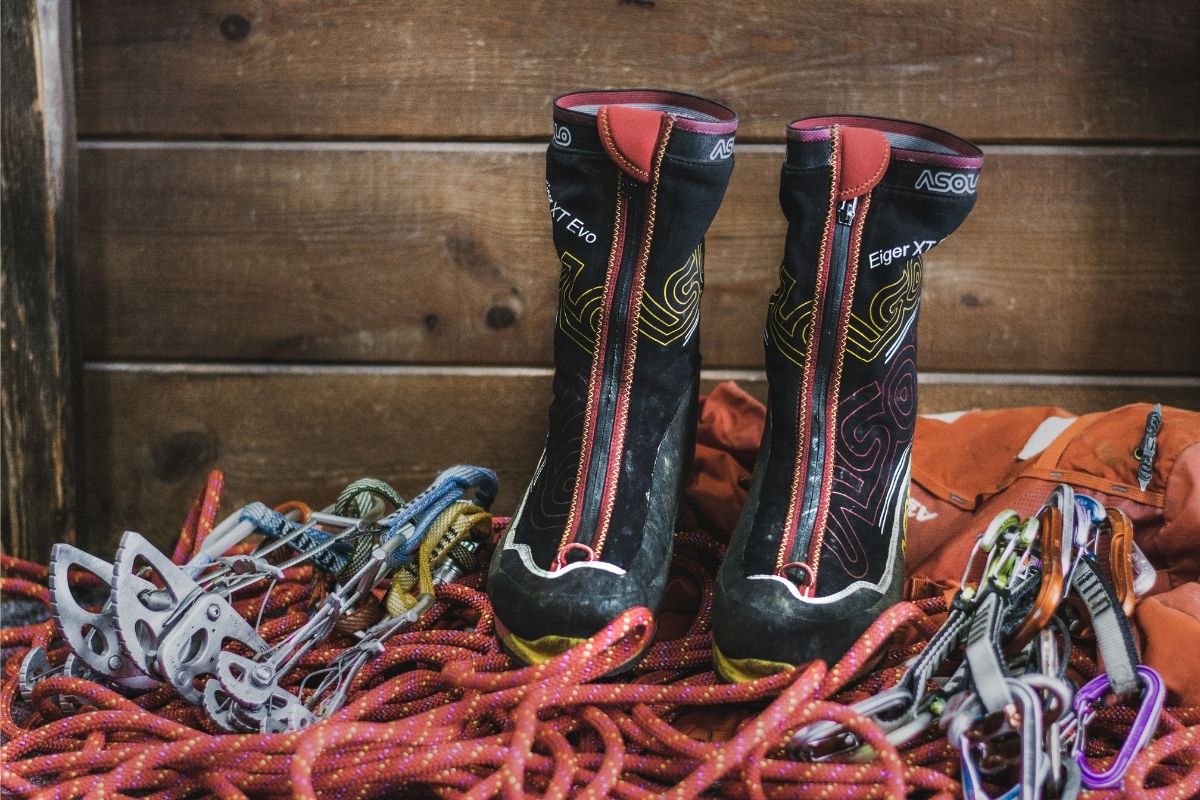
Fast and light - the style in which the world's best climbers try to tackle big faces - demands low weight from all your gear, while keeping the highest possible performance. Even though I climbed the Grandes Jorasses more in the old-school slow and heavy style, I still couldn't avoid worrying about weight. From harness to rucksack to boots, I needed to have technical, functional kit with me. The Asolo Eiger ticked that box in every respect. At 710 grams, they really are among the lightest in their category. When I wasn't wearing them, they hung clipped to my harness and didn't spoil the joy of climbing one bit.
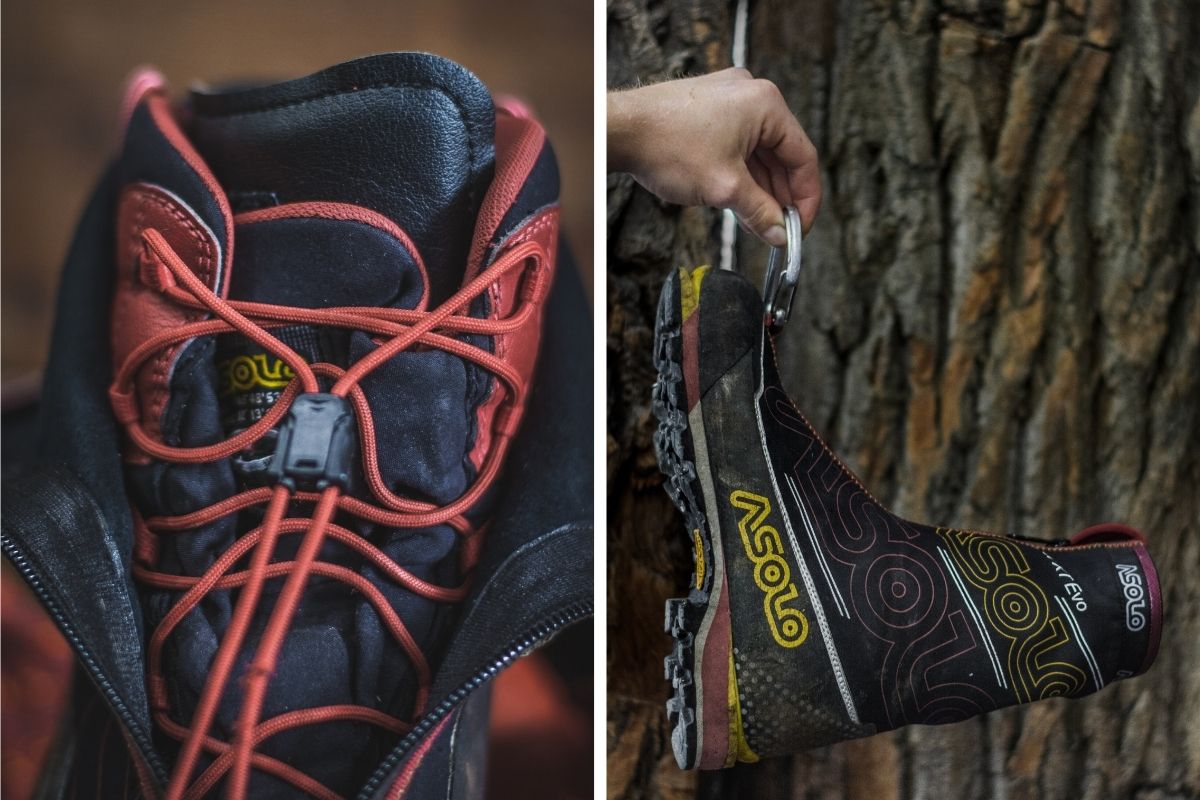
Of course, the boots have welts for step-in crampons and a climbing zone in the toe of the sole. Another nice feature is the quick-lace system, which means you have no trouble lacing up your boots even in thick mitts.
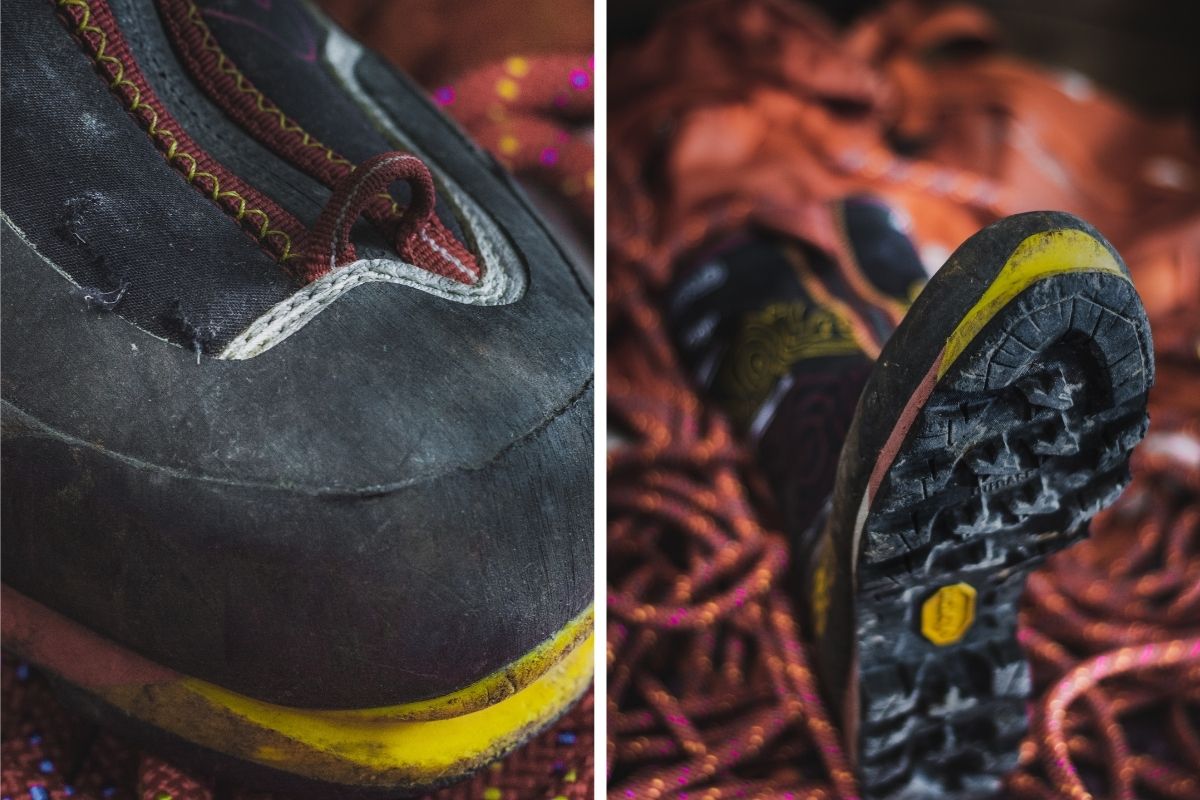
What I really enjoyed about the Asolo Eiger XT EVO GV was the small fabric loop at the toe - at the start of the outer zip. A seeming trifle that you'd dismiss at first glance as completely useless. Ha! Quite the opposite. The loop lets you hang the boots up safely and conveniently anywhere. On your harness, on the belay, on your rucksack or on a line to dry. You see, if you hang boots by the laces, they stay with the opening facing up, and rain gets in. But if you use this little loop, they'll hang upside down - opening facing down - and in the morning your feet slip into something dry. I love it when a manufacturer actually thinks about what it makes.
Even though the Walker Spur is largely rock, I had climbing shoes on for barely half a day. For most sections, it was these Asolo Eiger rockets that carried me. On low-angled scree, on wet rock, in thawed slush that looked like snow and also on fairly hard climbing sections, I felt comfortable. Perhaps that's because these boots aren't among the stiffest on the market. I was surprised myself at how relatively flexible the sole is. But that's exactly what you need when you're standing on a smooth slab and want to make a friction step. And standing on a small edge wasn't a problem either.
I also wore the Asolo Eiger XT EVO GV in the Tatras when climbing the route "Havraní vlasy" (Raven's Hair, M5) and when drytooling right behind our house in the Jeseníky Mountains, and even on more technical stuff at M7 I didn't find the softer sole a problem. If anything, I see it as an advantage. When you have to walk on harder ground, on scree or across a glacier, your feet don't suffer as much and walking becomes a lot more comfortable.
Nothing and no one is perfect, so even these boots have a few minor shortcomings. Though shortcomings is a strong word. The very strengths they excel in simply predispose them to these weaker spots. These are light boots. Low weight is their strongest weapon, but it also hides that small weakness. The softshell outer gaiter insulates brilliantly against the cold and weighs nothing. Unfortunately, that means lower tear resistance. It isn't leather. But if the Asolo Eiger XT EVO GV were made of leather, they'd lose exactly the elegance and lightness they excel in.
The worst thing about climbing the Grandes Jorasses is the descent. Endless trudging, abseiling, scrabbling around in scree. Something is always falling on your head, or you're ankle-deep in gravel. After that slog, a few small torn holes appeared on the toes of the boots. Nothing a needle, thread and a bit of glue couldn't fix. Still, it's worth bearing in mind that if you plan to stumble around in scree for a long time, these problems can crop up. To complete the picture, though: my helmet came off far worse than the boots.
And the winner is: the Asolo Eiger XT EVO GV!
These boots taught the face a lesson. The face fought back and tried to resist. It didn't give in easily, but it stood no chance against these boots. But can you really call it a victory? Yes, at times it was a fight. But when we topped out, I didn't feel victorious. I wasn't racing the mountain. We lived together. For three whole days we got to know each other, teased each other and sized each other up. At the start there may have been ambitions to conquer one another. But in the end we parted more like good friends than as winner and loser.
