
Radim: I haven’t been in the winter mountains for ages, so I’m looking for a peak worth the effort. Suddenly the name Watzmann pops into my head – somebody must have mentioned it to me once. I look up where exactly the mountain is and what there might be to climb on its faces. It looks like a fine peak, the drive is spot on, and I can’t find anything about a winter ascent of the “small” east face, which makes the challenge even more tempting.
Ondra: I rate Radim as one of the few genuinely good, truly all-round climbers. And when he comes up with an idea this interesting, I can’t say no. In the time before we leave, I dig around for information on the route we want to climb. But I search in vain for any mention of a winter ascent. All I find is an article by Ines Papert and Luka Lindič about their first winter traverse of the Kleiner and Grosser Watzmann, which they named the Family Traverse. And in it, one little gem – when deciding how to climb the Grosser Watzmann, Ines and Luka judged “our” route to be more dangerous in terms of avalanche risk and chose a different part of the face instead.
So we go for the Wiederroute on the east face of the Watzmann Mittelspitze. Ahead of us is a half-kilometre-high face with a long traverse along a prominent ledge and several shorter traverses. We’ll skin to the foot of the face, climb to the summit with the skis on our backs, sleep in a bivouac hut and ski back down to the valley the next day. A quick hit – that’s the plan.

We roll into the Hammerstiel car park at around eleven at night. We sort and pack the gear – a bit less of it than we’d originally planned, but that’s a quick hit for you. We rethink the original two-day plan with a bivouac in the hut on the summit of the Hocheck. Based on the summer times given in the topo – 4 hours approach, 4 hours climbing, 4 hours descent – we decide to do it in a single day. We’ll definitely be faster going up on skins, and we’ll whizz down on skis. And that frees up Sunday to climb some ice on the way home. A beer and good night.
The alarm goes off at five. We brew coffee, force down a bite to eat and, before we sling our packs on, the freshly opened toilets lure us in – no point hauling that up the mountain. Around six we set off over the remnants, or perhaps the faint echoes, of snow – it’s a strange winter.
Four and a half hours. That’s how long it takes us to put 1,300 vertical metres behind us and stand at the foot of the face. It seems we aren’t that much faster on skis after all. If anything, our skins were dragging. We’ll have to make up the time on the face.

We swap ski poles for ice axes. Finally, weapons we know how to wield – and maybe even race with. We strap the skis to our packs, rack up and off we go up the first pitches! To speed things up on the easy ground, we decide to simul-climb. So we both move at the same time, tied together by a rope that we clip into protection whenever we can. The first pitch is the one and only where the sun still shines on us. Even now in January it has real power, so the snow is melting like ice cream on a hot summer’s day. It gets us dreaming of relaxed spring climbing. But we soon find out we’re wrong again.
We’d sort of hoped that finding our way on the face wouldn’t be a problem. After all, in summer this route is pretty popular and often climbed. The description even mentions cairns, waymarks and chains. And we’d expected the odd bolt, or at least an old rusty peg here and there. None of that materialises – apart from two bolts at the start, which only served to reinforce our initial rosy outlook.
But traversing snowy ledges with almost no chance of placing protection is not much fun. Especially when the snow suddenly collapses, pours away and gives your feet little support – one step up, two steps down.
Ondra: Just before the end of the traverse, when I can no longer see Radim and have no idea whether there’s any protection between us at all, a chunk of snow slides away with me on it. With the skis on my back I’m so clumsy that I just sink and slide several metres through the loose snow before I manage to get my axe in properly and stop.
Radim: From the end of the traverse I climb about two pitches to the start of the main ramp. I bring Ondra up; I can’t see him most of the time, but his colourful vocabulary assures me he’s still here with me.

The main traversing ramp turns out to be quite wide, but more to the point – endless! There’s no firn for us to practically run up. Just loose, unstable, frozen powder. Maybe we should take the skis off our packs and skin up, because as it is we’re ploughing our way up, sunk to mid-thigh in snow.
And sadly, the conditions don’t change at all with the hard-won vertical metres. On top of that, our pace keeps dropping – the first ramp took far too much out of us. At times our progress up the face is no different from the ski approach to its base – we zigzag back and forth. So we don’t gain much height, but our trail-breaking is premier league. Any rabbit would be jealous.
At dusk we reach the end of the second, maybe third ramp – we’re losing count. We peer over the edge hoping to finally see better terrain. Not a chance! Another kick in the guts. Below us opens a rocky gully, and above it, on rock that isn’t exactly solid, a boulder problem dares us to climb up to the next ramp. Of course there’s no decent way to protect it. We stop hoping the ramp will ever end, and we’re not even sure we’re where we’re supposed to be. Call in the chopper?
Hardly. We have no signal. And besides, the shame of it! So we downclimb unstable snow, protected over a cornice on the ridge – reader, best not ask for details – then traverse into the face and hope it’ll let us through. A hole gapes beneath our feet. It opens up like the jaws of a beast that wants to swallow us boots and all.

Radim: The first attempt ends on bare rock that you simply can’t climb any further. On the second attempt I descend lower over unstable snow and finally reach a snowfield where – by now in the dark – I bring Ondra up.
Ondra: About a third of the way along the traverse I get the feeling Radim isn’t taking in the rope. I yell at him to take in, but apparently he can’t. So I keep traversing, and the rope is now swinging far below me – straight into the beast’s jaws. I swing over the edge and see there’s a knot in the rope jammed in the karabiner of a runner. There’s nothing for it but to climb down another ten metres to it, with the rope dangling way below my feet. According to the GPS we’re still three hundred vertical metres below the summit – which doesn’t do much for morale.
Radim: My legs are wobbling. When I stop, I feel sick. We’ve run out of water; we’re saving the last sip for the summit.
Ondra: The constantly collapsing snow is completely destroying me, mentally and physically. I used up my stock of swear words about two hours ago. I really don’t know any more. Then I think of my little son – whenever he gets up to some mischief, he starts laughing his head off. That cheeky grin of his brings a hint of a smile to my face too. And for a while it goes again.

At least the weather is on our side. It’s clear, windless, and the almost-full moon lights up the face like a giant lamp. After a few more pitches we finally scramble onto the summit ridge and then beneath the final little wall to the summit cross. Not a trace anywhere – no sign of any human presence. With hard-won smiles we shake hands in triumph.
But our great day out is far from over at the top. The watch says 23:00. We’ve got a lovely twelve hours on the face behind us and sixteen if you add the approach. So only twice what the topo gives for a summer ascent. Marvellous! After that last swig of water we set off along the ridge towards the Hocheck, where we can – or rather could – get a splendid night’s sleep. If only we hadn’t turned a two-day trip into a one-day one without sleeping bags or a stove.
Luckily we find chains under the snow, so at least we’ve got something to hold on to. Ondra’s head torch gives up the ghost, but the moon is in full swing tonight and stands in for any artificial light. The ridge, however, is once again longer than we expected. It takes us another two hours.
At one in the morning, with our lights and clinking gear, we wake three Germans in the bivouac hut on the Hocheck.
Radim: The German doesn’t look too keen on letting me into his sleeping bag. So I’m for descending another eight hundred vertical metres to the Watzmannhaus, where there should be a winter room with a stove, beds and blankets. Besides, three Germans won’t dry out the swimming pool in my boots, and they probably won’t suck on my rapidly freezing fingers either. I try to talk Ondra into carrying on with the “death march”.
Ondra: The overnighters tempt me with two mini sausages, which they give us as a bonus alongside half a litre of water. And the prospect of finally lying down! I no longer believe the talk that the terrain gets easier further on – I don’t believe anything any more. But I’m not going to split the team. So on we go.

We say thanks and goodbye and apologise for waking them. The signpost says two hours to the Watzmannhaus. This time it’s right. But the winter room is full. No wonder – at three in the morning. We sit down on the benches by the cold stove, take off our gear and gaiters, and we’re not capable of any further movement.
Radim: The toe of my ski boot liner is encased in ice; luckily my toes are fine. We need to light a fire in the stove and melt at least a litre of water from snow. We’re completely dehydrated.
Ondra: For the whole top third of the face, standing at the belays in ski boots, my little toes were tingling terribly. At times they hurt like hell. And I could feel every blister. My little toes are still tingling now.
In the end we tip the magnesium we find on the table into half the water from a pot standing on the stove. A group is just waking up; they’re pretty loud and clearly haven’t quite grasped the state we’re in. We ignore them, just hibernate on the benches and live through our muscle fever.
Around seven in the morning we wake up completely alone in the hut. Everyone has disappeared up the mountain. We stoke the stove with the last of the wood, melt snow for water, finish drying a few things and set off – the last thousand vertical metres down to the car.
Radim: Just below the hut I put my skis on. Having dragged them over the whole mountain, I have to ski at least a little bit. Even though my legs aren’t really listening any more.
Ondra: My feet hurt so much and are so wrecked from the ski boots that making a turn would mean one big cramp. It’s all downhill, so I shift into neutral and walk all the way to the car on foot.

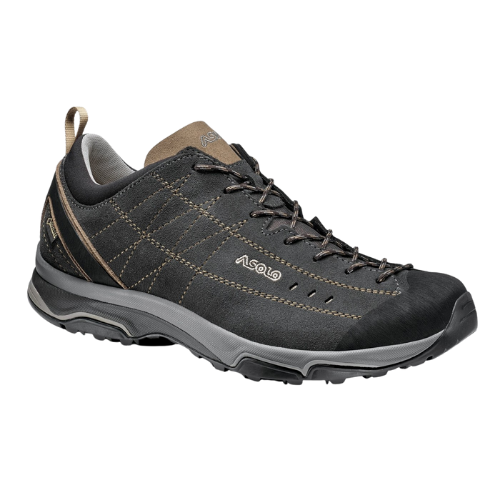
We set off from the valley at sunrise. The plan is to climb to around 1,700 metres to the self-service Wildenseehütte hut. It takes me quite a while, though, to get used to the snowshoes strapped to my feet. It's my first time on them (and my first Alpine trip in my new Asolo Arctic winter boots too, but more on those later), so I trot back and forth, trying walking uphill and downhill, and only once I'm fairly sure I won't fall flat on my face do we head up.
I know the Totes Gebirge from summer. But in winter even familiar mountains turn into a completely different world. And it's gorgeous! Everything is so clean and untouched, and the snow just sparkles in the sunlight. Still, the climb up really takes it out of me. I'm puffing hard and stopping every few minutes. But I carry on, dazed, up through the snowy splendour and phew! – at last there's nowhere left to climb. Now it's just a few kilometres of flat walking to the hut. Perfect silence lies over the whole range, broken only by the creak of our snowshoes sinking into the snow. If there's any life up here, winter has tucked it away under a thick duvet. Nature is fast asleep, and the dazzling white horizon completes the purity of the moment.
We only find the hut thanks to GPS coordinates. It has completely disappeared into a landscape levelled out by snow. We grab shovels and dig our way to the door. Clearly we have to earn the comforts of the hut.

I grab the handle, the door opens and we're saved – we have somewhere to sleep. I squeeze inside excitedly. A kitchen, a dormitory, a small woodshed – everything we need is here. We light the stove, melt snow and get dinner going. Meanwhile two local ski tourers arrive, and shortly after them we hear a very familiar language. Outside the hut a bunch of lads from Brno are taking off their snowshoes, and soon two more Czech skiers turn up. Not long after they arrive, darkness finally floods the mountains.
I step out for one last breath of fresh air for the day. It's clear and bitterly cold. Above my head thousands – tens of thousands – maybe hundreds of thousands of golden dots are twinkling. The conversations drifting out here are now and then split by a hearty laugh. This remote spot is pulsing with life in the middle of otherwise utterly deserted mountains. For tonight it has brought eight strangers together. “People with the mountains in their hearts always find common ground,” I think as I stand in the doorway and head back in. Because the kitchen is buzzing like a reunion of old friends.
The next day we just head back down. But I realise that something new has imprinted itself on my soul up there. That pure, quiet winter beauty – it's utterly simple, and anything extra would probably only spoil it. There's no need for anything shocking that hasn't been here before. Simplicity can be amazing too. Refreshing. And inspiring. Like this winter mountain landscape.
“I'm fallliiiiing!” I end the romance with a mighty scream. Lost in my daydream, a chunk of icy snow has suddenly broken away under my foot. I'm hurtling down the slope.

Ice axe! – flashes through my mind. I've been taught so many times in theory how to self-arrest with it. Now I'm trying it for real, and with all my strength, the whole weight of my body, I try to drive the pick into the frozen snow. And it works! I soon bring my uncontrolled slide to a stop. Danger averted. Still a little in shock, I sit down on my backside and notice red drops falling on the snow around me. Blood? Where's it coming from? What's happened to me? Luckily the icy crust has only nicked my palm a little, and I'm already waving up that I'm OK. While I wrap the cut in a hanky, the rest of the group comes down to fetch me.
Now without any more trouble, all together and in one piece, we reach the valley. And before we move from the quiet winter sonata back into exuberant spring, I turn one last time to the snowy summits behind us. May I keep that quiet beauty inside me for as long as possible.

Because there's one more thing missing – and that's PURPOSE. Once it's there, that fleetingness instantly turns into an opportunity. A chance for something lasting to be born. Purpose is like a message that gets passed on and shouldn't fade away. If I upgrade a mere physical feat with the role of “information carrier”, I also give it a purpose seasoned with a dose of responsibility.
When I think about it, many great feats began without any starting gun. And yet they were achievements that earned huge attention. Their aim was a message, and that's what gave the feat its purpose. Take Saints Cyril and Methodius, for example. They pulled off a tremendous feat, and thanks to the learning they brought, their message became immortal. The result is clear – it had a purpose.
People often ask me why I do this or that.
“Because it makes sense,” I reply. And when they ask what sense, my answer depends on the particular challenge I've taken on.
I always say you need a reason or a story behind your effort. Ideally both.
However long my ventures are, and even though I spend most of the time on my own, there's always someone with me virtually. Sometimes it's people from care homes for the disabled, other times children from children's homes. Mostly those who need motivation, help, a role model or simply proof that whatever you set your mind to can be done – as long as you go for it.
Now, just as so many times over the past ten years, I sit and think. Not about what I'll do, but how I'll do it. Because I already know the goal. And yet it all started so innocently.
At the time I was organising a 24-hour walking challenge. During it, Václav Lys approached me and introduced me to the project to build A House for Julie (A House for Julie). Vašek asked whether I'd like to help them spread the word about the project, or even help with fundraising. Building a children's hospice is a technical term – but the fates of the children and their loved ones are a sensitive subject for me. In the whole project and the chance to help, I found PURPOSE.
I decided to get involved by spreading the word and setting up what I call collection points. That is, places where collection boxes will be installed temporarily, and sometimes permanently, so people can donate to the House for Julie project. And to spread the word, I'll use a physical challenge. It will serve as a carrier for the message – widening the chance to help.

I've decided to set off from the warmth of my South Moravian home on a kick scooter, first to Sněžka, then to Králický Sněžník and finally to Lysá hora. I'll ride to the foot of each mountain, leave the scooter there and symbolically climb to the summit. Along the way I plan to set up collection points at places agreed in advance. Anyone who wants to help can get in touch with me about where to put them. So if you, or someone you know, would like to set up a collection point in your business or shop, I'll gladly come by. And since I'll be setting off from Brno, there could be countless places along the way to put them.
Now all that's left is to choose the right route.
How do I get the message that gives my whole journey its purpose across properly? Planning is the very beginning of a series not only of thought processes but also of actions aimed at making them happen.
I call, I write, I research, I spend ages thinking about how to optimise everything – how to make the most of the planned route, where to set up collection points, where to meet people, how to let as many people as possible know about the whole journey? I have to sort out tracking and reports – in short, fill the time that's meant to serve a good cause. But I also come up against worries, attempts to talk me out of it and incomprehension. That mustn't and can't put me off, though. After all, we've decided on a good cause that makes sense, and that's my goal: to give the effort a purpose!
But what I've described is still only one side of the coin. The other is the longing to set off and feel that bliss of freedom that comes with the city at my back and a free breath filling my lungs. I'm checking my kit rather than fine-tuning it. Experience tells me what I'll need, so I don't make many mistakes any more.
Helping those I can't help – that's not a typo, but a realisation of the need to spread the word about the chance to help. A children's hospice is a place that can only bring relief to those who can't be cured. As well as to those who live with them, and with that thought, 24 hours a day.
The gear and kit are waiting for their time. Time, which is the most precious thing we have. But how much of it does each of us actually have?

I sweeten the journey with a stop at the bakery in Oldřichov, swapping the loose change in my wallet for a few excellent pastries and a morning coffee. It’s a kind of kick-start – for my body and my senses. I take in the fresh taste and smell and sense that today will be one of those days when I lose myself in the landscape and have a quiet chat with it. We reach the right spot, I park the car and we start climbing into the hills. The dog runs happily in circles, rolls in the snow – and maybe even laughs. His doggy soul is in seventh heaven. I know he’s happy, and that’s good, very good.
From afar I greet a familiar rock tower, this time crowned with a cap of snow. We walk up to it and I remember last year, when a friend and I stood on its summit. It was October, and the day was cold and windy. We stood up there and the views were amazing! They filled my mind with joy, and at that moment I wished I had wings to soar over that colourful valley. Orange rowans glowed across the land, larches announced their presence in the sea of forest with yellow, beech leaves in several shades of gold and crimson were impossible to miss, and the beautiful maples – those jewels among trees – stood out above all. And among these colours were still more and more shades, a whole palette of other trees. And then one day the time comes when the sharp Jizera wind blows the fallen leaves into rock crevices, between the rocks and under the overhangs, and snow begins to fall from the sky. A quilt of snow mercifully covers the landscape and lends everything a peculiar nostalgia. Some years the snow quite literally buries everything.
Quietly, under my breath, I thank the tower once more for last year’s experience – it hears me anyway – and we carry on. We come to a stream that is almost frozen over, but in a few places the water still tumbles over the stones and falls into mysterious-looking pools, as if they were the eyes of this small but untamed brook. Some are clear and filled with light, others deep, a little brooding, and their gaze lures me to come closer and watch how water and ice create wonderful abstract shapes. From the banks hang frozen grasses, and the stalks that touch the surface are coated in ice, looking as if a confectioner had poured white icing over them.

The sun lights our way onwards. It reflects in the snow crystals, making them look like tiny diamonds scattered over the path and all around. I, too, once hid my own diamond in the Jizera Mountains. When I was a little boy, about six at the time, I saw The Treasure of the Silver Lake and wished very much to have a hidden treasure in the mountains as well. I found a polished piece of coloured glass, and my grandma, grandpa and I set off to hide it as treasure by a waterfall. They both promised never to tell anyone where my diamond was hidden, and I know full well they still keep that great secret safe to this day. On our trips and rambles together – and there were plenty! – it was these two who, from when I was tiny, taught me to listen to nature, to understand it and to be in tune with its ways. And Grandma also told me to notice details more than in detail, and not just in nature. My treasure has surely been carried off by the ravages of time, or at least by floodwater during summer storms or the spring thaw, but my diamond in the form of memories and everything Grandma and Grandpa taught me can never be washed away by time or water. I keep it for life, deep in my soul, in my heart – that’s the real treasure.
On the way I stop by some mighty beeches. In summer I like to lie beneath them, just gazing up into their crowns and listening to them rustle. Other times I lay my hands on the massive trunk, close my eyes and let my thoughts flow. I know that trees are great aesthetes, because each of them longs to grow straight, and that old trees have their rights too. And when cruel thirst comes in summer, trees start to scream, but we can’t hear them, because it happens in the ultrasound range. And I know one more thing – that trees have their secrets too.

We reach the rocky viewpoint just in time. An artist called Frost has created his most stunning works here. The sun’s rays haven’t yet touched the granite giant, so I can study all the ornaments, curves and decorations he has made. The surrounding landscape is already flooded with sunlight, and to me it’s like the water of life. A huge surge of energy arrives and I drink it in in deep gulps. It’s like an explosion. I want to run, jump, shout, clap. It’s a magnificent spectacle! It’s joy at this beautiful moment. It’s a wonderful sight and a unique experience.
I look out over the land a little longer, holding the dog in my arms, and everything inside me slowly fades out. Without hurrying, we carry on along the white trail up to the wooded hilltops, far from the bustle of the world... Everywhere is calm. A strange silence. And around us only snowy forests and a white landscape. On the way we rest by a little Jizera Mountains cross, where in summer a spruce sprig often lies and which someone ahead of us has already freed of hoarfrost. A few hours later we return the same way past the rocky viewpoint, but it’s no longer the same place, no longer the same feelings and experiences. The sun is slowly sinking below the horizon, saturating the landscape with many colours – from yellow through orange to burgundy. This play of colours and shadows awakens completely different impressions in me. No explosion, no energy – on the contrary, reflection sets in. In my mind I talk to my beloved mountains and confide in them.
And they listen and do not judge.
The first hint, or rather inkling, of any climbing comes from a village with a fitting name – Skály, which literally means "Rocks". That calms me down a bit. My hands start to sweat and a million thoughts whizz through my head. As we drive past the sign marking the start of the village, my friend reacts quickly to my withdrawal symptoms and, with icy calm, sets me straight: "There aren't any rocks here, though." That makes me nervous and I start to wonder what kind of area I've let myself be lured into. But we carry on and the road narrows. We arrive at a little church and park. The place feels pleasant. A church on a rise – peace and quiet – as if the universe had struck just the right balance at just the right moment. The sun is trying to squeeze its rays through the colourful treetops, and I soak up like a sponge the few unusually warm days that a gracious summer is offering us now, in autumn, as an encore. I'm looking forward to it – a new climbing area!
We walk along a path between meadows where the green of the grass has long since given way to shades of yellow. We chat about climbing, the air temperature is simply perfect for climbing and I feel good. All that's missing are the rocks! We turn off the path, walk past a small birch grove and suddenly there it is in front of us – a rock face. It's not very high, about fifteen metres, but it looks compact and solid – considering that in this corner of the world you climb on a rather unusual material: slate. For a moment I just stare in surprise, but then joy kicks in. We're going climbing! I slowly start to examine the individual holds and gradually load possible sequences of moves into my head. But what about the slate? And what about me, used to North Bohemian sandstone and coarse-grained granite? I'm expecting a slippery surface with no friction at all. And that's a challenge for me.
Climbing today takes an incredible number of forms. Over time it has evolved and split into individual disciplines – bouldering, sport climbing, trad climbing, ice climbing, dry tooling, and the list goes on. Some climbers specialise in sandstone, others have found their calling in cracks, then there are big-wall climbers, competition climbers on artificial walls, boulderers and a few other specialists. And it's precisely this wealth of options and variations that makes climbing such a unique and beautiful sport. I could even divide it into competitive and non-competitive. Competitive climbing takes place on artificial walls with clearly defined rules, whereas on natural rock the climber sets the rules and can choose whichever route catches their eye at that moment.

But there are only a few climbers who aren't afraid to lead a classic, poorly protected sandstone route and can also send a hard, bolted sport line. Nor do I know many boulderers who climb around 8A (the bouldering grade scale currently tops out at 9A – ed.) and can also find their way around the mountains or on ice. Those who can climb well on any rock, in any conditions, and aren't afraid of challenges – whether on small boulders or, say, in the mountains – are truly rare. And that, for me, is the beauty of climbing. And the greatest challenge. Being an all-rounder and able to handle everything climbing has to offer. It's good to realise the fulfilment it brings you and to take your fears as a challenge. Fear of uncertainty and risk holds you back and gets you nowhere.
So here we are, standing beneath that slate wall. A little unsure, but with my thoughts in order, I set off up the first route. We start gently – a line at a modest UIAA 5 should show me what I'm up against. I make the first few moves and realise I was completely wrong. The rock is divine! Compact, not slippery, and full of lovely holds, very often crimps, which I simply love. Some are more rounded, others razor-sharp. The sporty protection, with bolts drilled close together, is a pleasant change for me from trad climbing in the Jizera Mountains and on the sandstone of North Bohemia. Every wall is crowned with a lower-off anchor, which in my view borders on excessive comfort – but it's convenient, no doubt about that. On the right side of the wall the routes are more slabby – friction climbs that really test your footwork. The left sector, on the other hand, stands out with steeper, harder lines, so there's something for every taste.
Later we moved from the fives over to the left side too, climbing routes graded UIAA 9+ and 10-. And I have to say I really love this kind of short, intense route with no unnecessary fluff. So yes – I let myself be lured into a beautiful area. It's called Dobřečov, and I'll remember that name.
I can't remember snowfall like it for years. Certainly not this early. The odd thing was that the day before that white delivery I'd been riding my kick scooter through the surrounding countryside. Gazing at the rime left by the very first snowfall, I nostalgically recalled the warm beauty of the summer landscape. And the autumn slush, too – like when I rode through mud pretending to be frozen ground. My dog and I then gratefully made do with a heap of glowing ash smouldering near the railway line as proof of human presence. The lads who tend the land along the railway had burned the scrub they'd cut down there.
Warmth, is all you think when, after many hours of riding and pushing a scooter, you suddenly feel the smile of hot embers on your body. You take a few photos as a memento of moments that filled you with satisfaction. Then one last look at Stará hora and its steep slope, and out of nowhere your mind straps skis to your feet and suddenly – I'm already picking my line. Dreamer! At home I replay it all in my head like a National Geographic programme and contentedly close my eyes.

And when I open them in the morning – I find a picture-postcard winter outside, straight out of a Josef Lada painting! At that moment I become a child who can't wait for school to end.
In the afternoon I go sledging with the kids and we even build an igloo!
But it's also as if I'm surrounded by the restlessness of eager ski touring kit that's been waiting in the corner for more than half a year. It's behaving like a dog ready to dash off this very second. It is ready, no doubt about it. But what about me? What about us? The nearest mountains are – if everything goes well on the roads – a two-hour drive from Brno. And besides, where would we even go? How much snow is there? How far can you get? Questions like these queue up behind that first thought of the ski touring set-up.
Never mind, I wave it away as I shovel that incredible dump off the drive. There'll be more winter, I think, as the shovel bites its way through to the gate next to the lane, beyond which – snowy fields stretch far and wide into the distance.
Then it all clicks into place! Besides the “ski mountaineering” category there's also “ski touring”. That's it! I'll simply go on a tour. A tour – on skis.
All of a sudden, thoughts of looking like a ridiculous wannabe ski mountaineer in the field behind the house are gone. I'm a ski tourer, after all!
My clothing hugs me and my kit reports full readiness. I stick my skins on in the kitchen. Beyond the fence around our garden I clip into my skis, and the first slide of my right foot past my left assures me I couldn't have come up with anything better.
Lost in an ocean of snowy fields, calm spreads through me. The sun and the clean white plains let me become a polar explorer, quite literally. Knowing the rolling local landscape lets me pick the best routes. The hills, with their varying degrees of steepness, make the tour a varied affair. I zigzag up a hill. It has never seemed so high, so much fun and so varied as it does now. It's exactly the hill I called Stará hora at the start.

“Why?” I could ask myself as I stand on the treeless summit, looking out over a landscape that is slowly but surely wrapping itself in darkness. The villages lighting up below me bring the atmosphere of Christmas trees all the way up here. I think of my loved ones and feel a little sorry they're not here with me. What I see and feel will be hard to put into words for them later at home; I can only try in vain.
“Time to go home,” the person inside me commands. But the one outside knows he doesn't feel like it one bit. In the track I leave behind me, the peeping moon will soon read my message. So will the sun of a new day. And everyone, in fact, will be able to read in the snow that I was here.
It's strange to think how much information, how many options and how much gear we have, yet we only half use it all, and often not even that. We try to follow templates, as if we didn't realise that nature is more varied than the wildest imagination. There's one catch, though: nature won't come to us; it's only ready to welcome us into its home. It's often closer than we'd expect, and it has stories in store for us that we don't expect at all. And there are as many such stories in the world as there are sparks flying from a fire when you stir the burning wood. Sadly, they also go out just as fast if you don't make use of them.
Turn the sparks into a fire, and it will engulf you in flames of experience.
