
I can't help it. There's no other way. I need to capture these moments for eternity. Again and again I have to pull out one of my two cameras and try to use it to halt the relentless march of time. The movement has become a routine: free my right shoulder from the snug padded strap and tilt my whole body slightly to the left, at just the right angle for the pack to slide off the other shoulder into the fluffy snow, already lightly tamped down with my left ski, and land at my feet with its back facing the sky. There isn't much time; everything has to happen in quick succession. Only rarely can you shout "Wait, stop!" and pause the action on the screen of mountain life. When a skier is charging down a slope, he won't hit the brakes for you and ruin his own fleeting moment of powder bliss. The cameras have to sit in the pack so I can grab them instantly, without rummaging. I'd probably miss a good half of my shots if I had to do without the back-panel access, which I value enormously on the Lowe Alpine Revolt ski touring pack: two zips, two quick pulls, with gloves on of course, and the whole back panel swings open. As if I were opening a suitcase. Except this ski touring "suitcase" rides on my back all day without making too much of a fuss about being there.
Yes, this article is a celebration of the Lowe Alpine Revolt ski touring pack. It caught my eye, then convinced me and finally won me over.
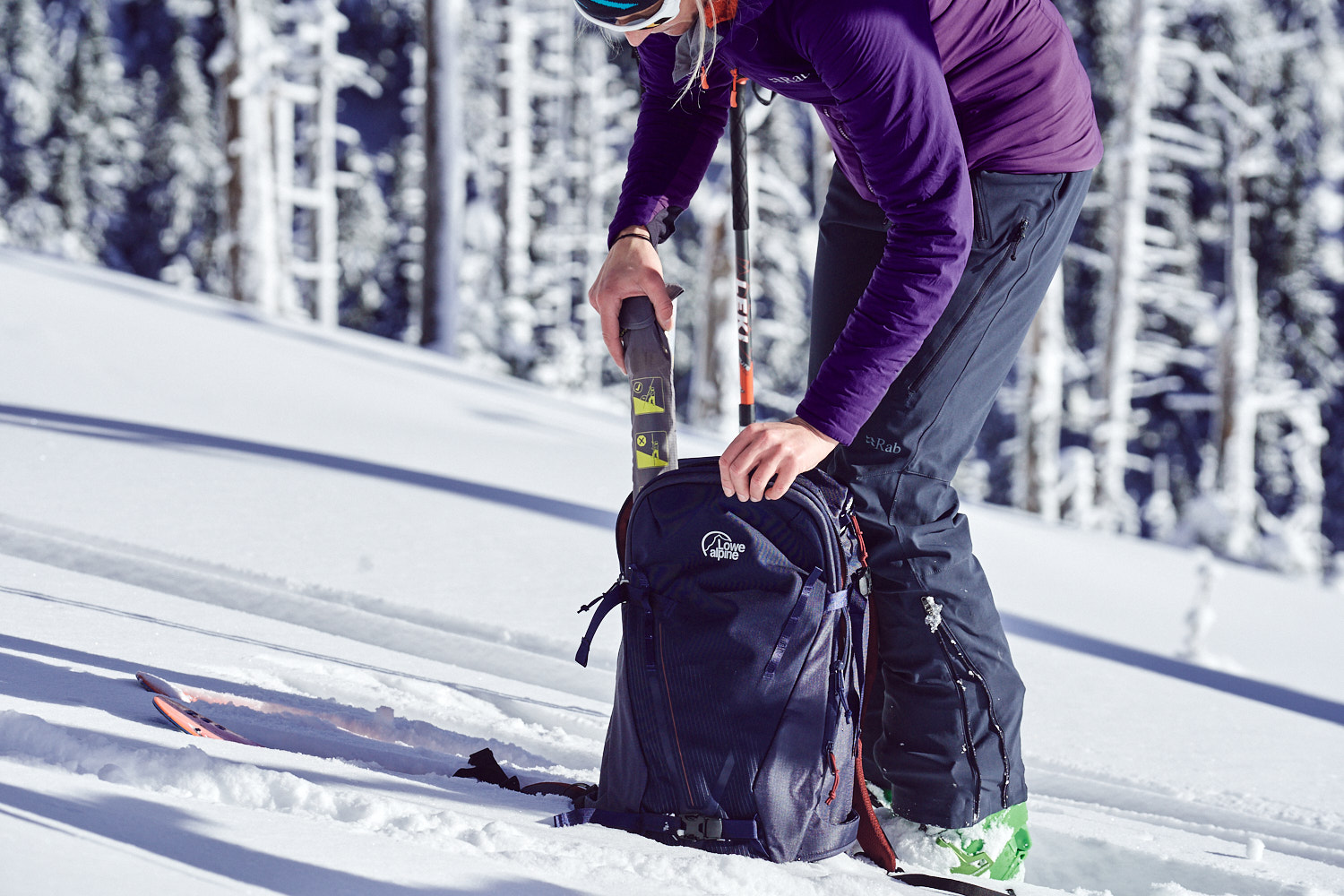
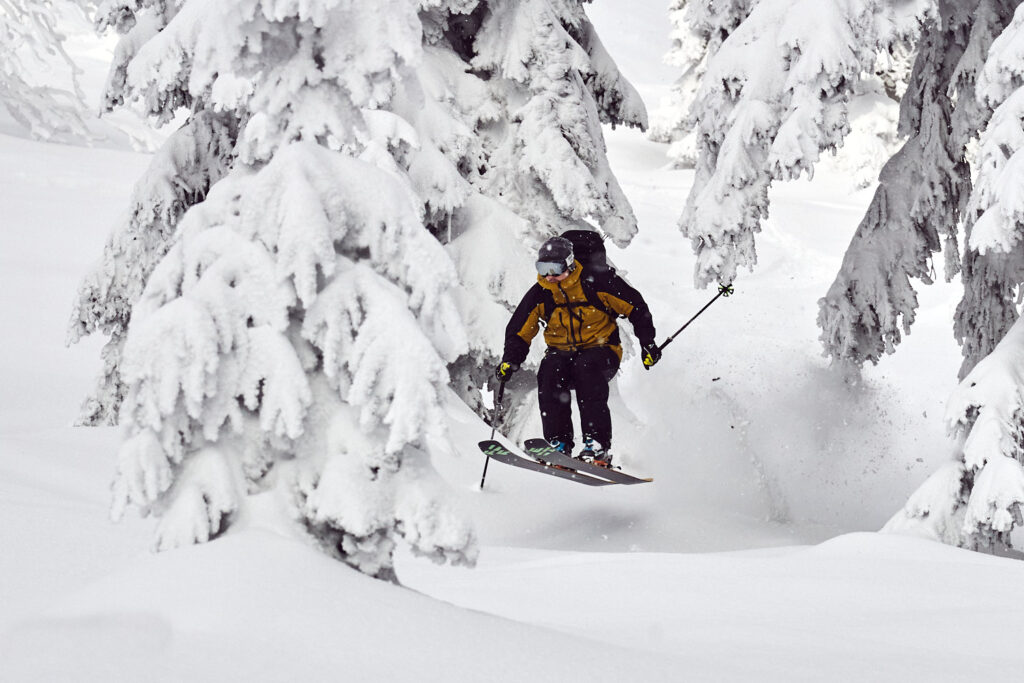
It's not just for photography that you'll appreciate the speed and sheer simplicity of getting into a ski touring pack through a swing-open back panel. Just think of fishing for dry gloves in the freezing cold when they've filtered down to the very bottom. With back access you see the whole contents of the pack and your hands go straight to the right spot. To get your flask or first-aid kit, you don't have to throw your down jacket, spare hat, snacks and everything else piled on top out into the snow.
"What else should I pack for the tour? Just in case?" With four kilos of camera gear I usually face the opposite problem: what else can I do without? I deliberately choose packs of around 25 litres for day tours, because if you really want to enjoy the ski down, a bigger pack just gets in the way. But then comes the other side of the coin: making do with less. Over the years spent on skins I've worked out a minimal kit that gets me through any situation, with four pairs of gloves and miracle duct tape being the essence of success. Even so, I often hit the limits of a pack's capacity, and stuffing the skins inside meant putting on my jacket to free up space for them. Compared with everything I've used before, though, the Lowe Alpine Revolt seems to be a bit inflatable.
I've never had this much room in a 25-litre pack. Ski goggles and Horalky wafers have their own pocket at the top, and its volume isn't eaten up even when the two main compartments (besides the one already described, there's also an avalanche compartment for probe, shovel and saw) are stuffed to bursting. And if, like me, you're obsessed with losing your keys and would rather check ten times that they haven't wandered off on a whim, the Lowe Alpine Revolt will give you peace of mind. Two internal pockets, one of them with a key clip, will soothe your nerves.


It's frustrating to count the days you manage to get out on skis. It's much easier to put up with tallying the days that won't let you head out. And luckily, this year there haven't been many of those so far. Praise be to my home Jeseníky mountains, at whose foot I live, and to the Swiss border that opened for a few days. So ever since the spruce branches bowed under a white eiderdown and the slopes were flooded with sparkling white, I've spent many beautiful but also demanding hours with the Lowe Alpine Revolt. It's had quite a time with me. Especially when, instead of a single walking ice axe that the Headlocker attachment system was originally designed for, I forced two climbing tools on it and headed off with Tomáš Petreček to take a few shots on the ice. It coped – the pack, that is. Helmet included, sitting snugly under the integrated mesh, which you can hide completely in the bottom of the front panel when you don't need it.
Living with skis on your feet – and in my case probably in your head as well – is beautiful but demanding. Especially on your gear. An expensive waterproof outfit turns into work overalls, and I'm already starting on my second set of self-adhesive patches. I've got red thread ready for the down jacket and black for the gloves. A split ski tip was saved by two-part epoxy glue, and the pack is going through some tough times too. So far, though, it acts like it's no wimp, and if it does have any weakness, it has decided not to show it to me. The burly fabric clearly doesn't give in easily, and as is usual with Lowe Alpine, you won't find many things on the pack that could break.
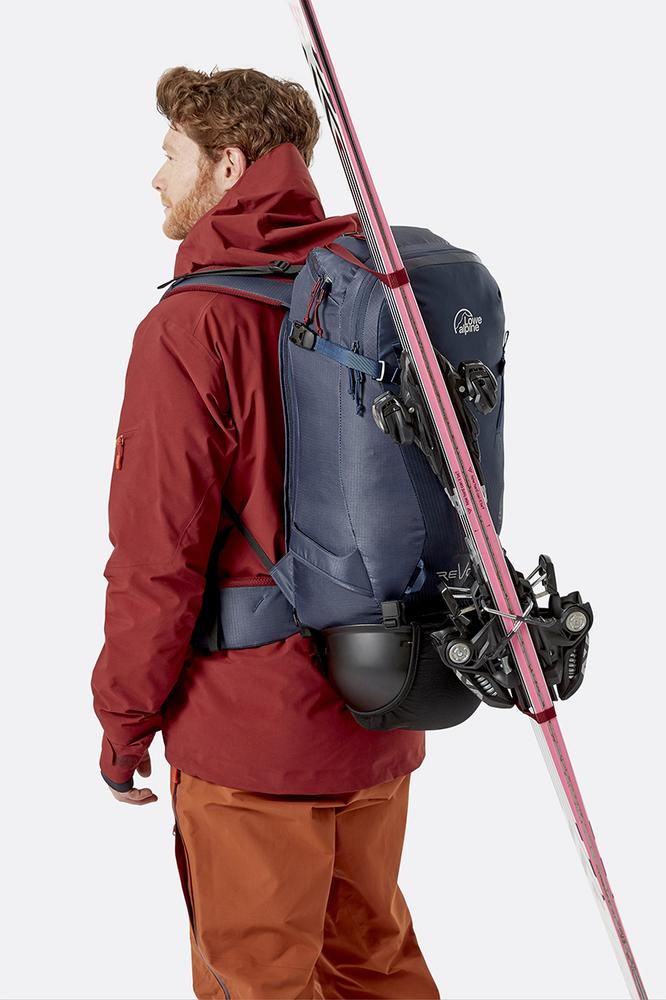
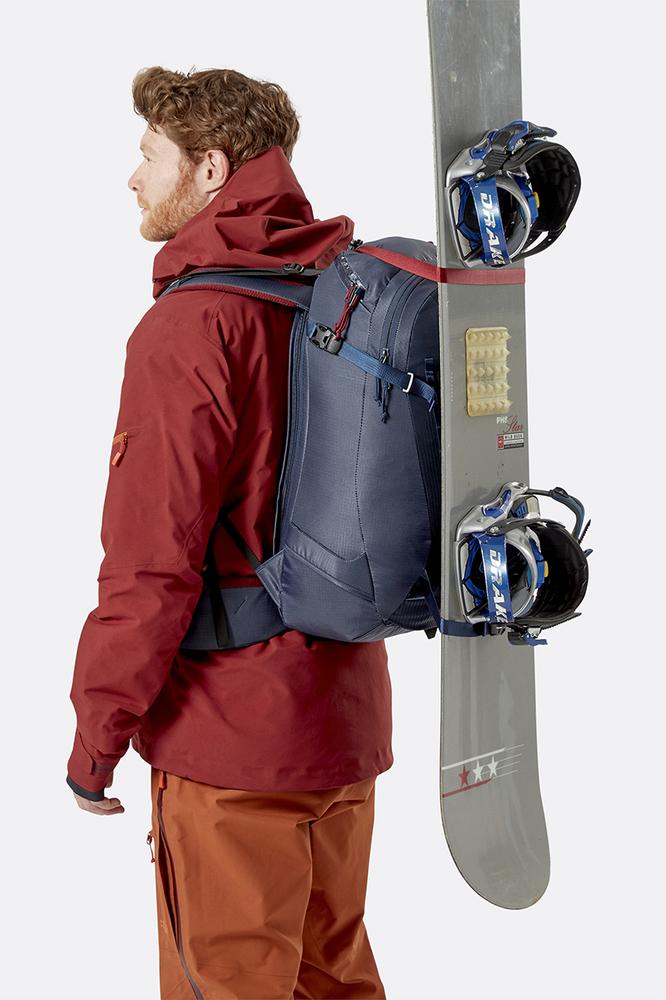
Simply put, it's a champ. When I'm worn out, it'll even carry my skis for me. One on each side, or on the front. And it could handle a snowboard too, apparently. But enough talk now, we have to get back out there – it's snowing.
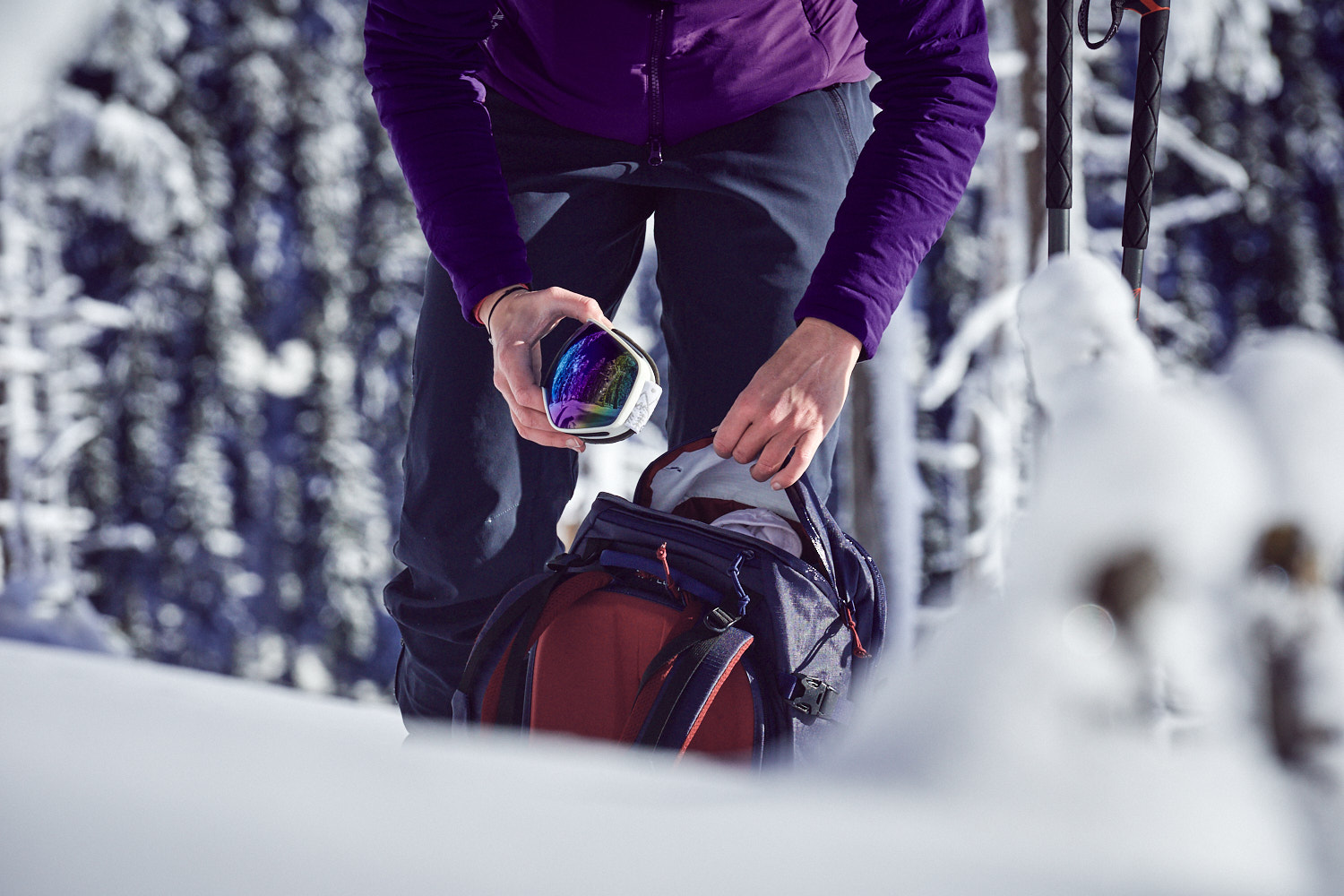

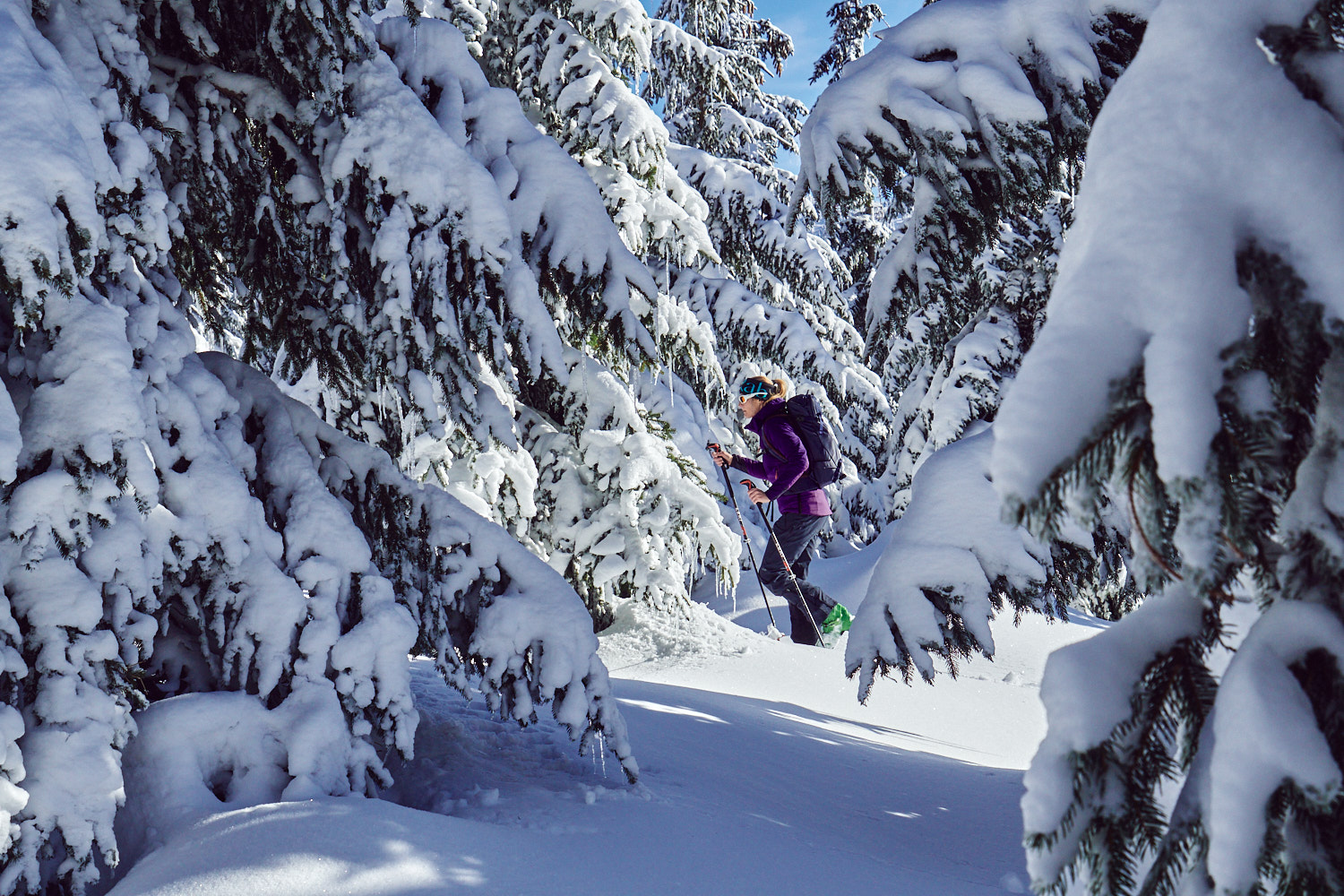
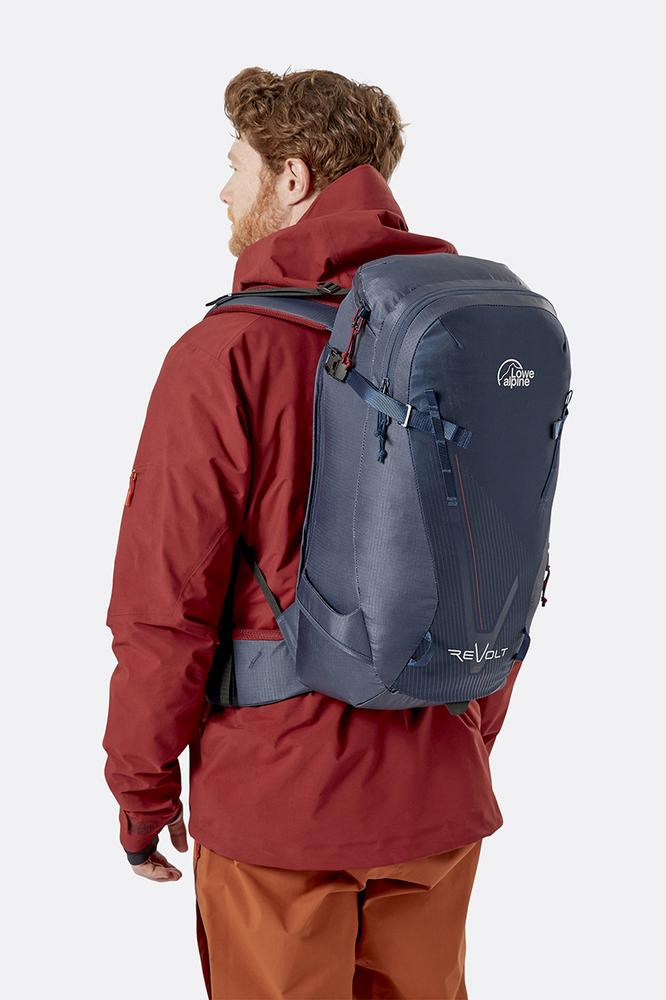
The Revolt ski touring and freeride pack doesn't make its presence felt at all on your turns. Snow doesn't stick to the Tri-Flex™ back system and you can operate every buckle and zip with gloves on. But what you'll appreciate most is the roomy back-panel access, which lets you quickly find a dry hat even in a blizzard and fish out your flask without taking your gloves off. More info >>

I climb mountains. I write about mountains. I photograph mountains. And I always come back happy. It's written in my name, after all.
In the years that followed I dug a pit in that same spot many more times, but never again did that much snow pile up. One to two metres, sometimes around three, depending on the winter. That was the usual mass of snow you had to shovel away before the blade ruffled the blueberry bushes at the very bottom. But we're talking about leeward slopes here, where snow driven across the ridges by the wind settles in greater quantities. On the windward slopes there's barely half a metre of cover. So what next? Will it get even worse? Is this the end of the good old Czech winter, with the modern version represented by a white strip set into green hillsides as proof of human vanity (and futility)?
Maybe not entirely. We'll still get snowdrifts, apparently. "But they'll be considerably rarer than we've been used to. Warmer and drier winters will prevail," climatologist Pavel Zahradníček from CzechGlobe – the Global Change Research Institute of the Czech Academy of Sciences – told the news site iRozhlas in January this year.
The bitter taste of last (non-)winter meant that from mid-February my skis never left the gloom of a garage corner, and a spider began spinning its web between their tips. Even the Lesser Caucasus was languishing without snow at the time. Had the heavens not sent down, like a gift from God, a saving thirty centimetres of sparkling white treasure just before we arrived in mountain-locked Hermon, we'd have spent our days sitting by the stove with Sirak, a big-nosed Armenian hunter, washing down sour pickled vegetables with vodka. As it was, the spirits of the Caucasus took pity on us after all, spared us the headache that goes with a fermenting stomach and generously let us draw our two parallel lines on the hills above the abandoned villages. Even though the way down meant weaving between thorny stalks poking above the snow cover, long enough to tug at your trouser legs. Not to mention the geological variety of the ground underneath. Snow never made it to Goris, though – a small town at 1,600 metres above sea level in the easternmost corner of Armenia. The mountains rising beyond the last shabby cottage looked like a bundt cake with a diet-friendly dusting of sugar.

That ski trip was a flop. And there were no others that year. Not even on the Jeseníky ridges behind the house. At home – in Malá Morávka, 700 metres above sea level – there were a few decent snowfalls, but they were followed by decent downpours too. Snow turned to rain. Fresh powder into squelching slush. There was no point – not on that nothing.
When I call up from my childhood memories those heaps of snow my parents used to throw me into, where we dug bunkers and deep trenches around that very same house at 700 metres, until Grandad came running out with his fist raised, threatening "Krucaj faja!" and demanding to know where his wooden planks were – planks meant for an entirely different purpose than serving as our bunker roof – I do think winters aren't what they used to be. True, I was smaller and everything around me was bigger. And besides, "thinking" means knowing jack, as someone with life experience much like my Grandad's once put it. So these days, instead of assumptions, I look for facts.
"The cause of climate change is most likely the intensification of the atmosphere's natural greenhouse effect as a result of human activity and the excessive increase in anthropogenic greenhouse gas emissions."
So says the website of the Czech Ministry of the Environment, under the Climate Protection and Energy tab. Economist Professor Václav Klaus, however, claims in an article published on 3 December 2019 on www.klaus.cz: "Nothing extraordinary has happened to the climate this year or in recent years, yet climate activists – people who have built their political careers on the threat that the climate will destroy us unless they get their way – are organising a frontal attack against us right now."

Are these facts? Or mere opinions? For precise historical measurement data, you can click through to the website of the Czech Hydrometeorological Institute: "In 1861–1910 the average annual temperature was 9.1 °C, in 1911–1960 9.6 °C and in 1961–2010 10.4 °C." And further on you'll find: "In connection with the changing temperature regime, the average number of days with high temperatures is also gradually increasing and the average number of days with low temperatures is decreasing." That's measured data – facts that can't be disputed. And to come back to Professor Klaus: the frog in the enamel pot didn't notice the water gradually warming around it either. And by the time it dawned on it, after a long spell of indifference, that its little legs were starting to smell delicious, a hungry Frenchman was already drooling over the hob.
The planet's climate is warming – that's a fact. And human activity is speeding the process up. Most scientists – climatologists – agree on that, and the most important body presenting the results of climate change research is the Intergovernmental Panel on Climate Change, founded in 1988 by the World Meteorological Organization (WMO) and the UN Environment Programme (UNEP). Economists and CEOs of ever-growing corporations, on the other hand, tend to hold the opposite view – nothing remarkable is happening. Why? And who's right?
"Considerably less snow falls and it rains more. The number of days with a classic mountain winter, with higher snowfall and deeper snow cover, is dropping significantly. Over the last twenty years by roughly 35 per cent."
That's what climatologist Pavel Zahradníček also said on iRozhlas. But maybe you don't even need to know what climatologists think. Would ski resorts keep adding more and more snow cannons, with ever better technology able to make snow even at temperatures around zero, if nothing were happening? People used to ski on natural snow – I remember that. And yes, winter always had its whims, like in the 1970s when people went out in shorts on New Year's Eve, only for the temperature to drop by almost 30 °C overnight. But are these still whims today, or a longer-term trend?

Will the Czech winter disappear?
If nothing changes, the data suggest that snow-covered roofs and the chill of snow melting down your neck will be things we only reminisce about, watching Bohumil Hanč, Gustav Anděl and Viki Cabadaj on screen. But then what to make of this year's first snow, which as early as 12 October disturbed the quiet life of the spider living between my ski tips and forced it to look for a new home? A lovely 20 centimetres of snow. I'd missed it so much. It has soaked back into the ground again, but how should I see it? As a sign of better days ahead, or a demonstration of a climate gone wild? The coming winter will probably give us a hint. But whatever it turns out like, the ball will stay in our court. I'm off to think about what to do with that responsibility
Let's now move roughly 900 kilometres south-west. Across the Italian border. To a small town near Venice, where the rooftops are covered with red clay tiles and an old fortress looks down on them from a pine-covered hill. At the same time as the Copper Tower film crew was roaming the Tatras, one of its nine thousand inhabitants was a certain Giancarlo Tanzi. A young Italian who escaped at every free moment to the sun-bleached walls of the Dolomites, below which green meadows dotted with fuzzy edelweiss flowers fell away into the valleys. But he never fell in love with those heavy leather boots. Their weight only made the way to the summit longer and added beads of sweat to his brow. Still, nobody has ever achieved anything in the mountains with words alone. So the handy Giancarlo Tanzi began thinking about how to lighten the load on his feet. He sought out local shoemakers and talked them into experimenting with a material they had never used for boots before. Cordura – a light, tough fabric developed by DuPont during the Second World War for use in tyres, which later found its way into workwear and became the main construction material for backpacks.
Many prototypes ended up as worthless scrap. Then in 1975 Giancarlo Tanzi presented the world with the first hiking boots made from a combination of leather and Cordura. He called them Scout and, as a proud patriot, gave his newly founded company the same name as his home town – Asolo. With the hindsight of almost half a century, we now know his achievement deserves to be called revolutionary.

But the young Italian spotted another problem with mountain footwear. Moisture! Leather on its own, as long as it's kept well greased, won't let water through. But after the shoemaker's needle has done its work, the material is left full of unsealed holes. And just at the right moment, news reached the town of Asolo that an American company, W. L. Gore & Associates, had recently won a contract to produce a waterproof fabric for clothing for polar explorers preparing to cross Antarctica. Giancarlo Tanzi got hold of a few metres of the material, sold under the name Gore-Tex®, and began experimenting with the lining of the boots he was making. In 1980 – again under the Asolo brand – he launched the very first hiking boots with a waterproof, breathable membrane.
Let's move once more. But only a short way. Half an hour's drive east along the SS348 road, downstream along the Piave river, lies the small town of Nervesa della Battaglia. After the end of the Second World War, shoemaker Oreste Zanatta and his wife opened a small shoe shop here. Northern Italy, economically devastated by the global conflict, began to flourish rapidly after 1946, and with the demand for quality goods the business grew too, until Oreste gradually employed every member of the family. During the 1960s he handed the reins to his son Ambrosiano, who turned the small family business into a thriving company called Tecnica Group. You may know the name you've just read. Or at least it may ring a bell. Today, besides Tecnica outdoor and ski boots, Tecnica Group's portfolio includes the ski brands Nordica, Blizzard and Marker, Lowa hiking boots and Rollerblade inline skates.
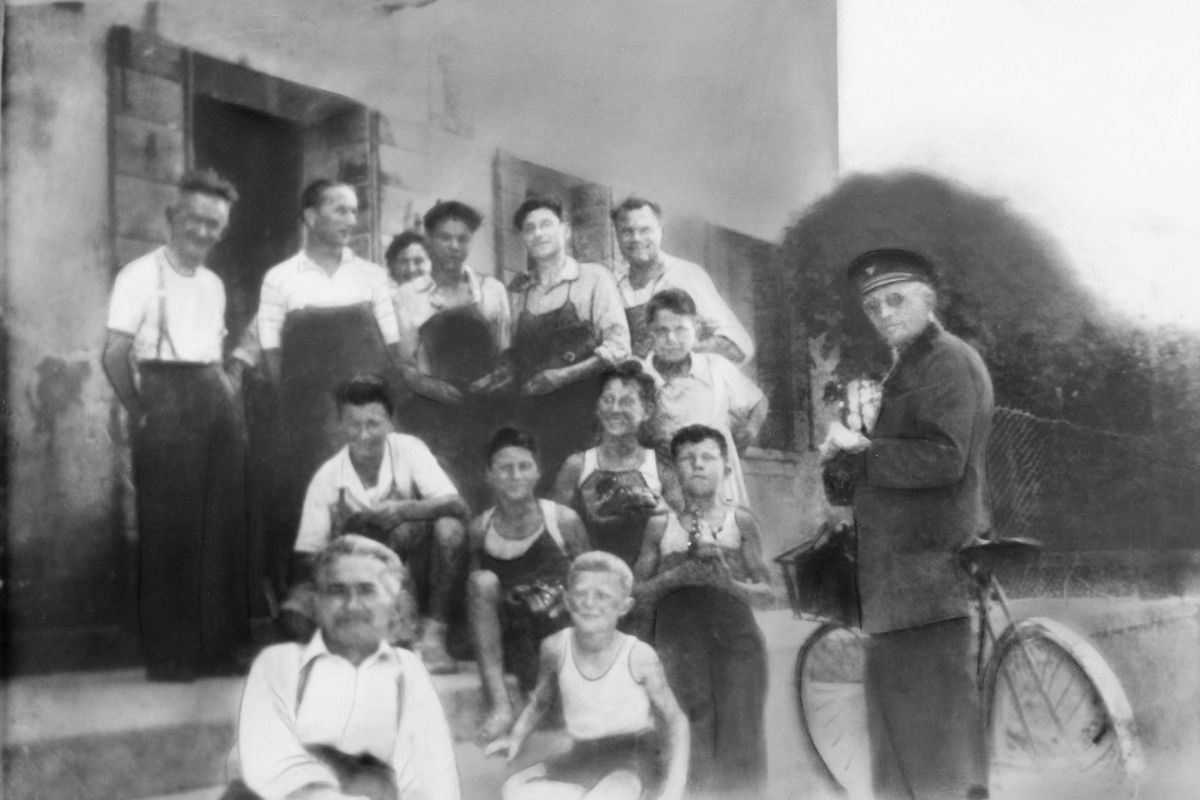
1998 then became a turning point for two men living 30 kilometres apart. Both were tired of business. In the nineties, Giancarlo Tanzi was making specialist mountaineering boots from thermoplastic materials and, inspired by biomechanics, was striving for the closest possible harmony between boot and human foot. Ambrosiano Zanatta was a key manager of a footwear company employing hundreds of people around the world. The paths of the two entrepreneurs crossed when Ambrosiano sold his stake in Tecnica Group and his children Anna, Marco and Luca – the third generation of the Zanatta family – used their father's money to buy the Asolo brand from Giancarlo Tanzi.
The circle closed in the town of Nervesa della Battaglia, which became Asolo's headquarters. But the story goes on. Now with the fourth shoemaking generation of the Zanatta family, represented by Luca's daughter Ludovica. And old Mr Ambrosiano still walks the aisles between the stations of the production process, keeping an eye on the careful work of the Italian shoemakers. And although a revolution like the two that Giancarlo Tanzi sparked one after another in the footwear industry would be hard to repeat today, the whole Zanatta family keeps looking for further small improvements, from mountaineering to hiking boots. They all focus solely on work steeped in the scent of leather and mountains.

Right after the Zanatta family took over the Asolo brand, the siblings opened their own factory in Sibiu, Romania, so they could oversee every production step and the reliability of their boots. Specialist mountaineering models and prototypes are still developed and stitched in Nervesa della Battaglia in northern Italy. Over the last 20 years Asolo has introduced many small innovations that have earned awards from prestigious outdoor authorities and magazines. One of the most interesting is definitely the Micro Pulley System lacing, which makes your boots sit better and more precisely on your foot and stops the laces wearing through. The Zanatta family believes mountain boots are bought for decades, which is why Asolo takes old boots in for repair: for 2000 Kč it fits them with new soles, repairs the seams, replaces the laces, renews the waterproofing and returns them to their owner ready for many more years in the mountains.

As always, today you are a mere visitor to a realm your kind has not yet managed to conquer. Not yet. Everything can change quickly. Just remember how your steps stopped at the sign forbidding you to leave the marked trails. You won't find it there today. Nor the path that once led you to that spot. Chainsaws tore down all the green scenery and diggers ripped their rooted remains out of the soil. One forbidding post has been replaced by twelve permitting ones – linked by a steel cable hung with chairs. You no longer have any reason to go back. Your piece of wilderness has vanished. But if you did find yourself there once more and looked back from one of those gleaming pylons, a double disappointment would overwhelm you at how far greed has gone. A wart! The traditional wooden lookout tower on the ridge opposite wasn't enough for them. It was too small. Not grandiose enough. Too modest. And you broke a sweat on the way up. Unforgivable! So a new one sprang up. Huge. With an entrance fee. With a chairlift and a slide. You can no longer gaze across the countryside without the graceful line of the mountain ridges being cut by this growth of human greed.
Your kind moves fast. Where will you retreat to for silence next time?
You know your mountains perfectly. You've explored every path that centuries of ancestors trod out and laid with stones on the steep slopes, so that with the last patch of snow they could drive their cattle up to the greening pastures, and before the coming half-year of white cover, bring down from the bare ridges hay that had breathed the crystal-clear air. You know where the tooth of time is gnawing at the last remains of old mountain huts and where granite boundary stones rise from the forest undergrowth. You've read up on the history and hold these places in sacred reverence. Your home, my friend.

But you're not allowed in. A no-entry sign may step aside for neatly pressed corduroy, but before your steps it stands unyieldingly upright. You are strong in your own moral principles, yet you can't knock down a wooden post bearing a green plate with the symbol of the Czech state. You realise it has its purpose. Even so, you may pause for a moment with the thought that your own country – represented here and now by two Bohemian double-tailed lions and two Moravian-Silesian eagles – places miserably little trust in your own sense of responsibility. After all, you understand nature. You feel part of it. But does your kind feel the same?
Do you remember that late-summer afternoon when nothing could keep you penned in behind the fence around the house any longer? You packed only the bare essentials in your rucksack and set off up the freshly mown meadow. To the ridges. Back then, too, your ears listened to a silence that sounds different every time. And just as the sun on the western side of the ridge was about to end its day-long pilgrimage, a whole herd of chamois set off from the east in pursuit. Fifteen, twenty – how many could there have been? A sight for the gods. Today reserved for you alone, my friend. Then every last one vanished into the dwarf pines, and you did the same. Your bed became the soft cushions of mountain grass, among which you spread out your blue sleeping bag. It's shared so many nights with you. Before the day was out, under the first star, you managed to light a solid-fuel tablet, and over the orange flame water for soup warmed through several romantic minutes. You finished eating. Narrowed your eyes. Fell asleep. And towards morning you were woken by the cool, damp touch of the dew-covered outer fabric of your sleeping bag brushing rudely against your face. Oh, come on! The sun hasn't even finished its night-time marathon on the other half of the globe. It's not yet time to leave the bedroom. Damp on the outside, perhaps, but warmed inside by your own body. When you later left – by now under a blue sky – all you left behind was a patch of flattened grass. Just like those chamois.
And now, my friend, as you return from your recent memory, look around you. The car park is overflowing. More cars are desperately wedged into the sloping verge. One after another. And this tin queue stretches several hundred metres up the road, from which the most popular trail in your mountains branches off along the river. You wouldn't want to push your way through the procession. Yes, the valley is beautiful. You know what draws people here. But you also sense that something bad is happening under the feet of the crowds. The noise and racket do no good here. The natural is dwindling, the artificial is growing. Surely you wouldn't want mass visits – mass disasters – to sweep over the places where a many-coloured silence still reigns. A rainbow silence. So perhaps the ban makes sense after all.

But you can't ban everything. The internet. Cerca trova! Seek and ye shall find! Like that bivouac hut with its warming stove and wooden bunks, which for years offered shelter under the quiet tolerance of all parties involved. Those initiated by older, more experienced hands knew how to behave. But once its location was splashed across the WWWeb, its end was in sight. Scattered shards, sooty walls, mess. You see? A ban isn't all-powerful. Anyone who wants to will find a way to overturn the age-old order of the mountains. Perhaps in a little box marked with a magnifying-glass icon. Or in their bottomless wallet. There are many of your kind, my friend. And they have power. The power of the powerful. What's dwindling instead is humility and the awareness that you, I and they are also part of nature. They like to think that man has become master. But that's a mistake. A profound error. One small thing is enough and... well, you know.
No ban can separate you from your mountains, the ancient paths, the moss-covered little memorials, the bubbling peat bogs and the primeval forested summits. In your eyes, an embargo isn't the right way. You see freedom and responsibility as two sides of the same coin. Rubbish gets picked up, fireplaces get cleared, animals' homes get respected. You're still a humble pupil of nature. And that's a good thing, my friend. Be proud of it.
Many years have passed since then. I remember first reading about this route in Radovan Kuchař's book “Ten Great Walls” (Deset velkých stěn). I knew straight away that this was exactly the goal I wanted to attempt one day. And so here I am, standing on the Leschaux Glacier - just like Cassin years ago - looking up. All sorts of feelings are mixing in my head. Humility, determination, fear. All of it spinning round in my noggin like a chair-o-plane ride. The face makes a big impression on me. Exactly the kind you want to make the first time you meet your girlfriend's parents. It's going to be a big challenge. Ideal for testing not only my own resilience, but also my new Asolo Eiger XT EVO GV mountaineering boots.

On a face as big as the Grandes Jorasses, anything can happen to you. Especially when you spend three days on it, during which just about every season of the year comes round. We were hot, then cold. One moment we were drowning in sweat and the next - for a change - in the water pelting us as raindrops. We didn't escape some snowy fun either. But in all these conditions my feet stayed warm. The very first time I put on the Asolo Eiger boots, my feet felt like never before. That warmth! Since I've had them, I haven't come anywhere near the point where you lose the feeling in your toes. Even when I stood in wet snow for an hour belaying Ondra on probably the craziest pitch of the whole route, my feet didn't freeze. I'd love to say the same about my fingers and the rest of my body, but sadly I can't. It was bitterly cold.
Comfort on the face also gets a big boost when, in the morning after an emergency bivouac, you can jump into your boots and warm up your numb toes. Or when, after a whole day in climbing shoes, you slide into a comfortable boot that doesn't pinch or squeeze anywhere. This is probably the Asolo Eiger's biggest asset. But perhaps also a small pitfall. The climbing itself really took it out of us. But not as much as the descent that followed. Three hours of trudging across the glacier in darkness, fog and heavy rain took its toll - absolutely everything got soaked, boots included. The material forming their outer insulation soaked up water and kept soaking it up, and afterwards I spent a long time drying the boots in the sun. In the same breath, though, it has to be said that even when the boots ended up soaked like a sponge, the thermal comfort didn't change.
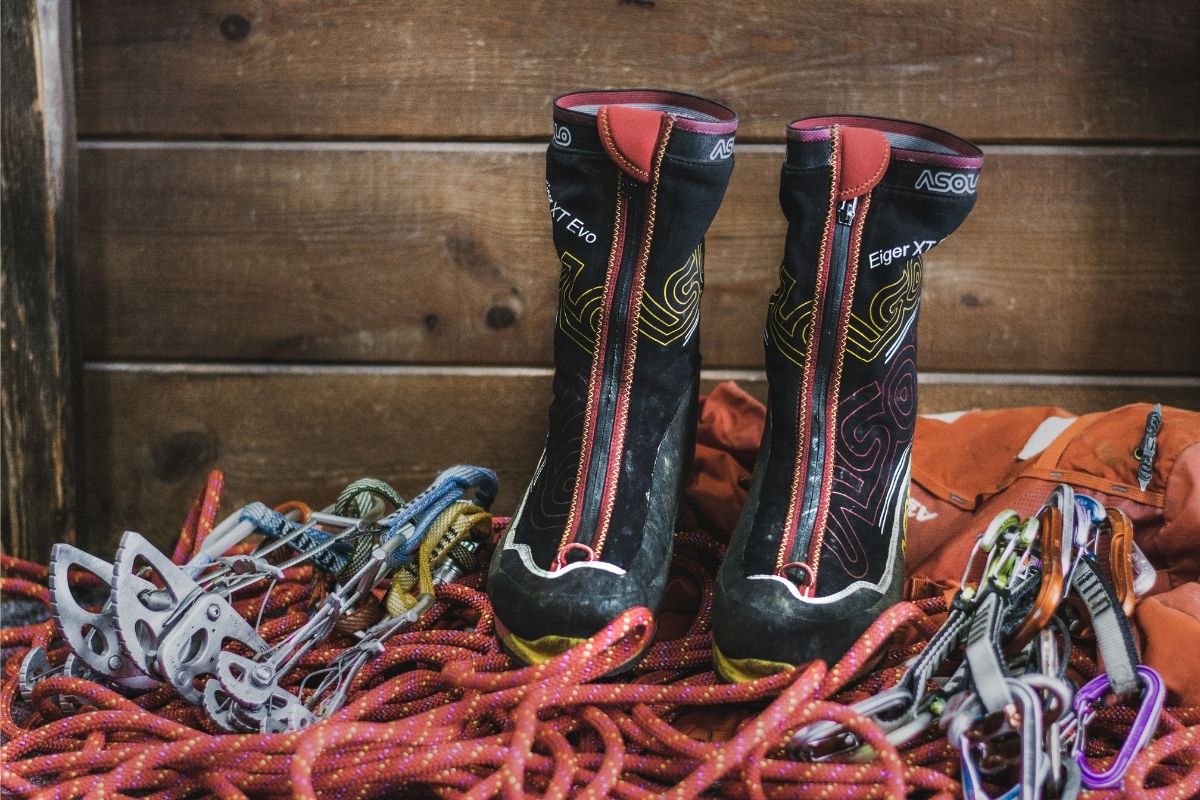
Fast and light - the style in which the world's best climbers try to tackle big faces - demands low weight from all your gear, while keeping the highest possible performance. Even though I climbed the Grandes Jorasses more in the old-school slow and heavy style, I still couldn't avoid worrying about weight. From harness to rucksack to boots, I needed to have technical, functional kit with me. The Asolo Eiger ticked that box in every respect. At 710 grams, they really are among the lightest in their category. When I wasn't wearing them, they hung clipped to my harness and didn't spoil the joy of climbing one bit.
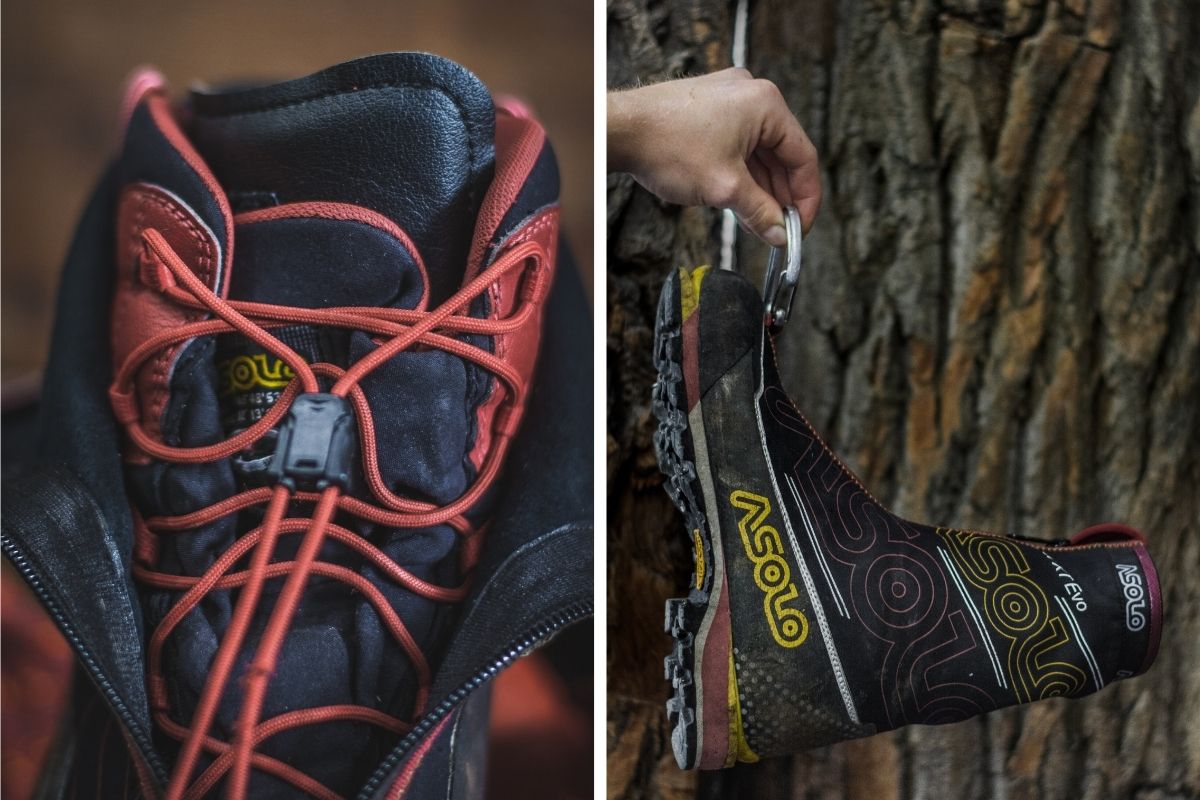
Of course, the boots have welts for step-in crampons and a climbing zone in the toe of the sole. Another nice feature is the quick-lace system, which means you have no trouble lacing up your boots even in thick mitts.
What I really enjoyed about the Asolo Eiger XT EVO GV was the small fabric loop at the toe - at the start of the outer zip. A seeming trifle that you'd dismiss at first glance as completely useless. Ha! Quite the opposite. The loop lets you hang the boots up safely and conveniently anywhere. On your harness, on the belay, on your rucksack or on a line to dry. You see, if you hang boots by the laces, they stay with the opening facing up, and rain gets in. But if you use this little loop, they'll hang upside down - opening facing down - and in the morning your feet slip into something dry. I love it when a manufacturer actually thinks about what it makes.
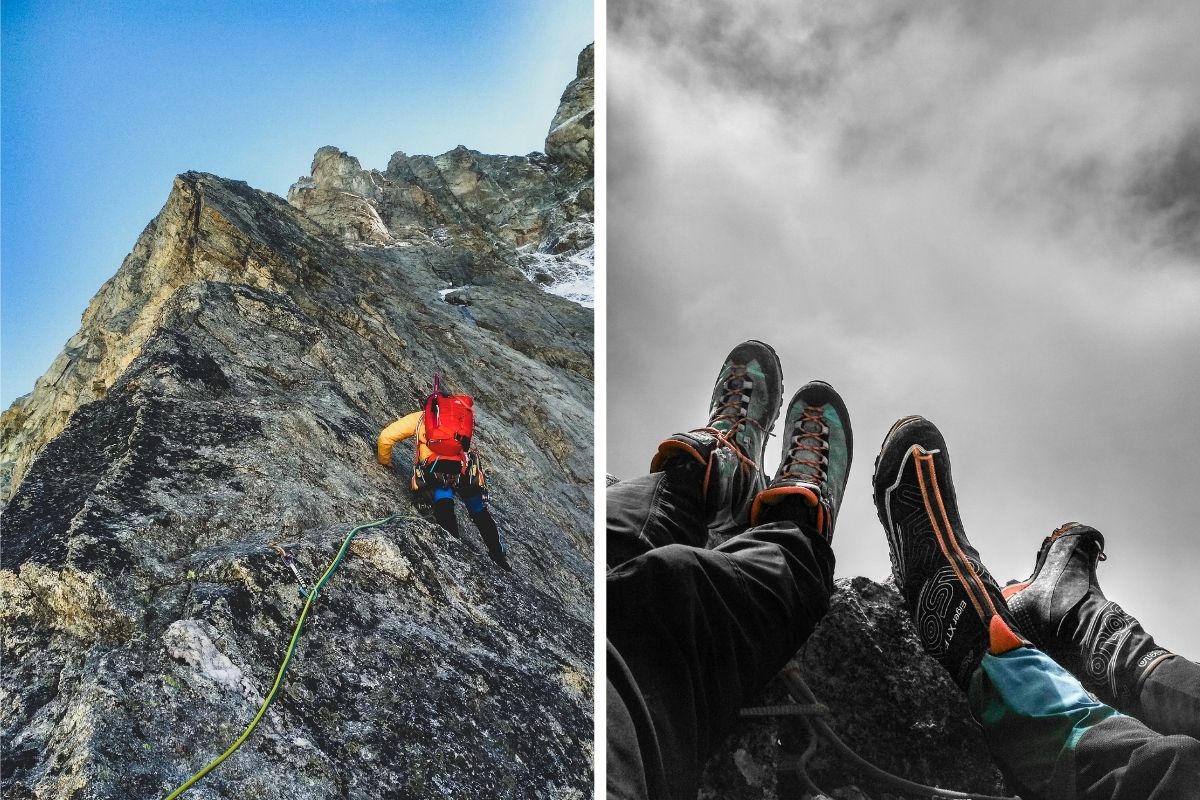
Even though the Walker Spur is largely rock, I had climbing shoes on for barely half a day. For most sections, it was these Asolo Eiger rockets that carried me. On low-angled scree, on wet rock, in thawed slush that looked like snow and also on fairly hard climbing sections, I felt comfortable. Perhaps that's because these boots aren't among the stiffest on the market. I was surprised myself at how relatively flexible the sole is. But that's exactly what you need when you're standing on a smooth slab and want to make a friction step. And standing on a small edge wasn't a problem either.
I also wore the Asolo Eiger XT EVO GV in the Tatras when climbing the route "Havraní vlasy" (Raven's Hair, M5) and when drytooling right behind our house in the Jeseníky Mountains, and even on more technical stuff at M7 I didn't find the softer sole a problem. If anything, I see it as an advantage. When you have to walk on harder ground, on scree or across a glacier, your feet don't suffer as much and walking becomes a lot more comfortable.
Nothing and no one is perfect, so even these boots have a few minor shortcomings. Though shortcomings is a strong word. The very strengths they excel in simply predispose them to these weaker spots. These are light boots. Low weight is their strongest weapon, but it also hides that small weakness. The softshell outer gaiter insulates brilliantly against the cold and weighs nothing. Unfortunately, that means lower tear resistance. It isn't leather. But if the Asolo Eiger XT EVO GV were made of leather, they'd lose exactly the elegance and lightness they excel in.
The worst thing about climbing the Grandes Jorasses is the descent. Endless trudging, abseiling, scrabbling around in scree. Something is always falling on your head, or you're ankle-deep in gravel. After that slog, a few small torn holes appeared on the toes of the boots. Nothing a needle, thread and a bit of glue couldn't fix. Still, it's worth bearing in mind that if you plan to stumble around in scree for a long time, these problems can crop up. To complete the picture, though: my helmet came off far worse than the boots.
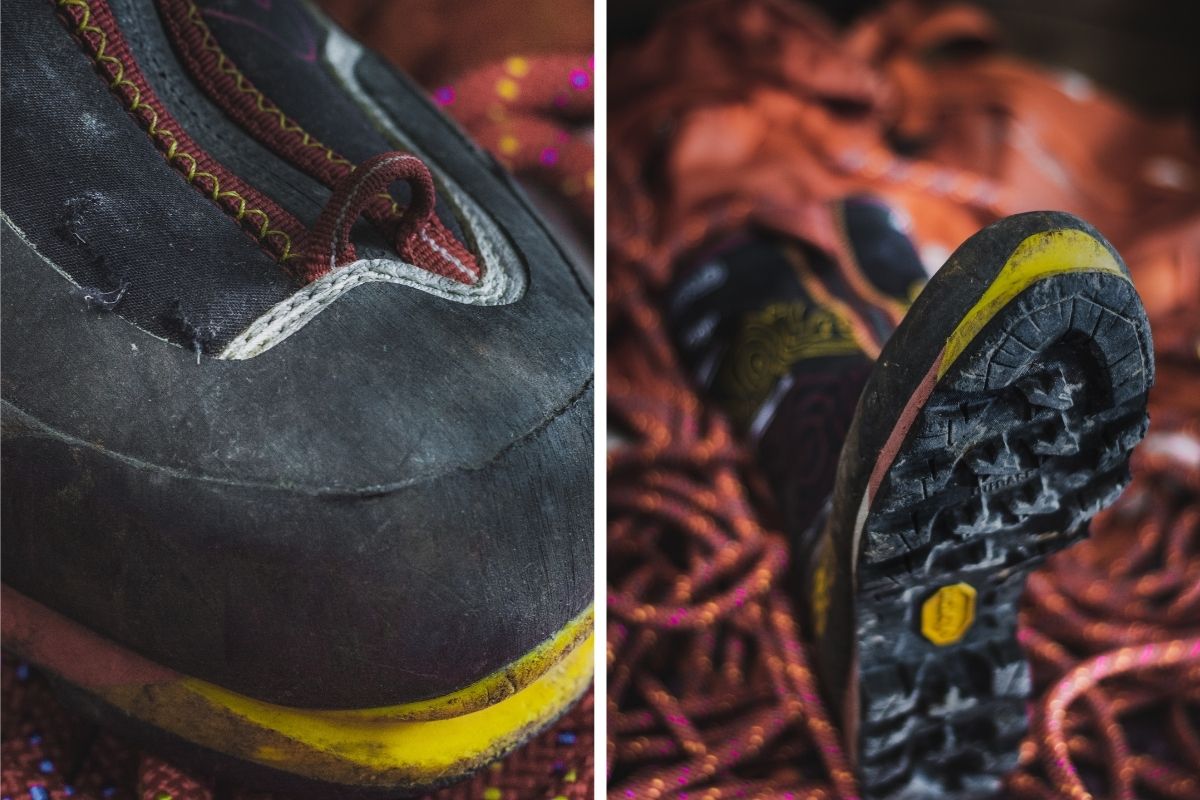
And the winner is: the Asolo Eiger XT EVO GV!
These boots taught the face a lesson. The face fought back and tried to resist. It didn't give in easily, but it stood no chance against these boots. But can you really call it a victory? Yes, at times it was a fight. But when we topped out, I didn't feel victorious. I wasn't racing the mountain. We lived together. For three whole days we got to know each other, teased each other and sized each other up. At the start there may have been ambitions to conquer one another. But in the end we parted more like good friends than as winner and loser.
Maybe you've heard it too at some point: "Climbing won't pay the bills. You'd better get your head down and study!" The more sensible among us understood all that. Even so, studying and building a career always got shunted onto the second, maybe third track. You'd rather chuck two-week-old sweaty clothes, an apple, a biscuit and a bottle of beer into your pack and vanish to the crags. Oh yes, that's the life – being a "crag rat". Will I have a job? Will I make the mortgage payment? I really must put up that shelf at home! None of that bothers you, though. All you're thinking about is whether you'll get a sling in below the bolt or whether it'll be another fight for dear life. There were times I had to run to the crags, I was looking forward to it so much.
Have you also managed to miss a family celebration, forget an anniversary and plan a holiday that only you enjoyed, because – purely by chance – there happened to be rocks there? Some people have even missed the arrival of their child into this world - they were at the crag.


Back when I was still at secondary school, I managed to win the regional and district rounds of a rope-climbing competition. The organisers were thrilled and straight away invited me to the national championships that weekend. My answer? "Sorry, no can do. We're off climbing in Ostrov this weekend." Who knows, I could have had a career in rope climbing. But I was at the crag.
Sure, you could object that anyone who does a sport they love feels the same way. But climbing is different. That mix of endorphins, adrenaline, fear and euphoria tastes so good! And you want another hit, even though your heart rate below the bolt was bouncing to a techno beat and fear nearly loosened your sphincters. Sweat-soaked T-shirt, sand in your ears, skinned knees – but a soul as happy as can be!

But what can you do about it? What about the addiction? You drive the people around you mad. Apparently you can't talk about anything else any more. At dinner you don't notice the nicely laid table or what you're eating. You just leaf through the guidebook with greasy fingers, looking for the route you'll climb tomorrow. You call your climbing buddies more often than your partner, and while brushing your teeth you grip the toothbrush intently, first with a full crimp and then with a half crimp, so the edges will feel good at the crag.
Family, work, responsibilities - how do you divide it all up without neglecting anything? And how do you fit climbing in?
After all, a week only has seven days!
Has anyone got a recipe for it?
