
The world runs in sharing mode. Or rather – online sharing mode. It's not just the shooter Counter-Strike, celebrating twenty years this year, or the latest iPhone features that are upgrading at a dizzying pace – so is life in the mountains. Ten years ago, you really had to graft your way up a hill, unfolding and refolding a paper map again and again, only to end up back at the last junction at least once anyway. Today you ride up on an e-bike with a satnav on the handlebars. Back then you climbed alone, three free chamois watched you from the forest and a startled doe crossed your path. Today you stand on the summit with ten, twenty, thirty other people. And not a single animal. Unless you count the Yorkshire terrier in someone's rucksack.

Is that a good thing? Or a bad one?
Let the qualified experts judge that – and the self-appointed investors will rush in to refute their arguments. Truth takes many forms. But the facts are indisputable – humans are part of nature.
"Homo is a genus of animals in the family of great apes (Hominidae), which includes the only living representative of humans – the wise human (Homo sapiens)... Hominids are medium-sized to large mammals with pronounced sexual dimorphism in orangutans and gorillas and less marked dimorphism in chimpanzees and humans."
— Source: wikipedia.org
And as part of nature, I feel responsible for the place I live in. Responsible for the mountains I live beneath, which can bathe in bright moonlight just as they can drown in fog and rain – like right now, as I write these lines heading towards... writing.
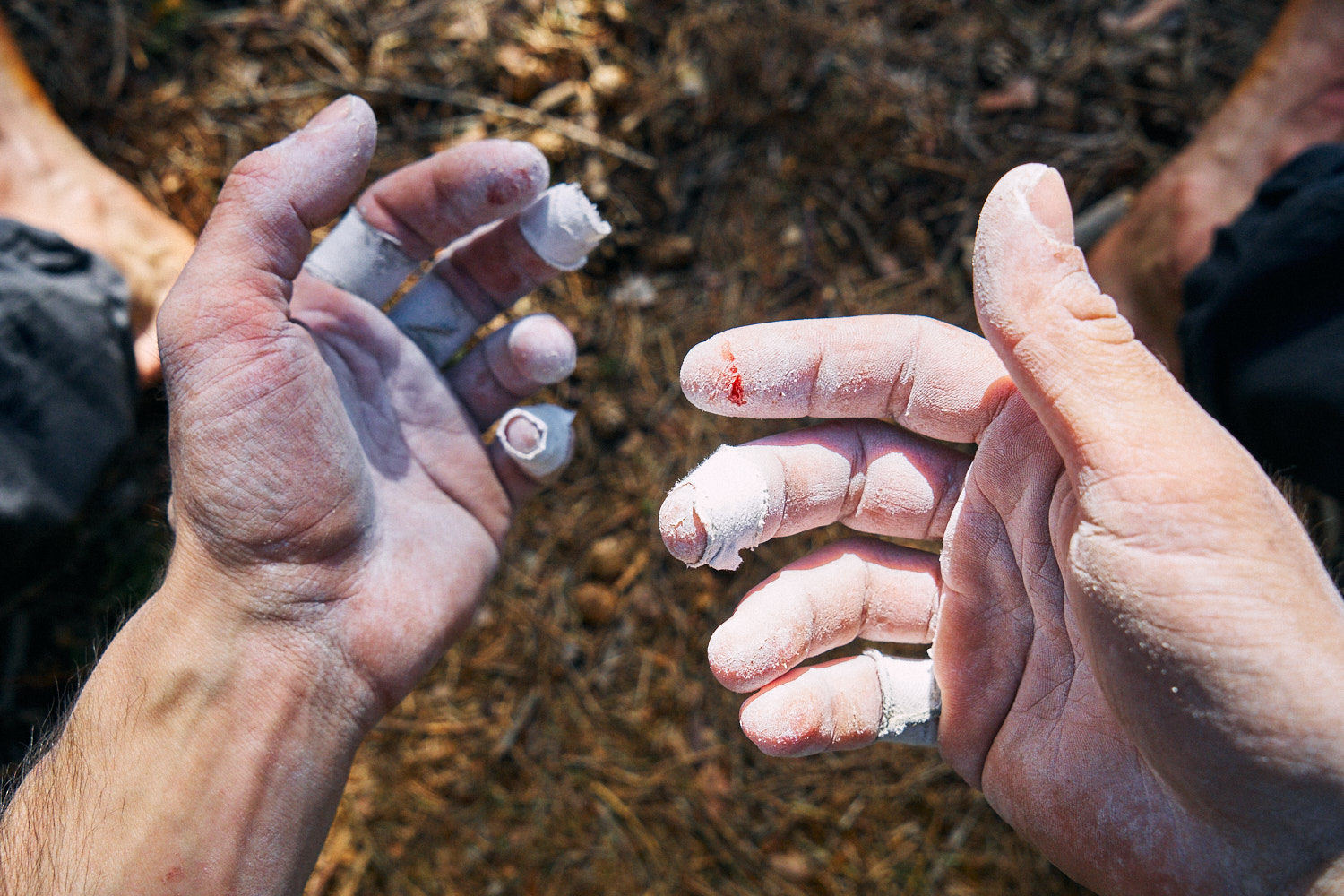
You've got the internet, you've got Facebook, you've got a blog, you've got freedom. You can write anything. Share the GPS track of any trail the soles of your running shoes have explored. You can share with the whole world your photos from skiing down the Velký kotel cirque – never mind that the area lies in a national nature reserve and the whole site is an avalanche zone, and that anyone who follows you might not assess the risk correctly. You can broadcast tips on the best climbing routes, or even details of a whole area that only locals go to. Or rather, used to go to.
Behind the screens at the many other ends of the internet there will certainly be people who appreciate your tips. But there's also a perhaps even larger group that can't defend itself against the published words – animals, plants, local residents. Before you posted, did you ever ask whether they mind?
"One person's freedom ends where another's begins."
— John Stuart Mill
I write a lot myself – for a magazine and several blogs. And one of my motivations for sitting down at the screen and tapping out stories on the keyboard is surely to share the experiences, feelings and emotions that shook me in some beautiful spot in the mountains. You probably feel the same. But I don't think it's necessary – in fact, I think it's right – to leave that place unnamed. Unspecified. Undisclosed.
I recently finished a big feature about climbing around Zbiroh, during which we found an old summit register on top of one of the sandstone towers, with entries by local legends dating back to 1965. And only half filled. So it could last up there another 55 years – as a testimony and a romantic memento for several more generations. Or I could reveal the name of that tower so that... well, why exactly? So the reader misses out. Misses out on the name, but not on the story. Their own story, though, they'll have to find for themselves.

It's easy to write something. To break a secret kept for years. To intrude on the living space of your fellow members of the kingdom of multicellular heterotrophic organisms – in other words, animals. It's so easy to send crowds of people heading for the crag right past a local old-timer's house. Across his land. And to tell the world that freeriding in the "Kotel" is awesome, without adding the B side – that avalanches come down there and the law doesn't even allow entry to the area.
Writing is also a responsibility.
That's how I see it. That's why you won't find specific names and descriptions in my writing. This is where my fingers fall silent. I write about emotions, feelings, atmosphere. Is that right? I don't know. Make up your own mind. We're free, aren't we?
I climb mountains. I write about mountains. I photograph mountains. And I always come back happy. It's written in my name, after all.
Pleasant, definitely. But surprising? If you consider the waitress's otherwise friendly Italian face, currently hidden behind an antisocial plastic visor, her right hand gripping a futuristic-looking gun aimed at our foreheads, and a metre-high sheet of Plexiglas splitting a piccolo table with an espresso into two lonely halves – then no.
Among the trees lining the otherwise fairly busy dusty paths to the crags, spiders weave their sticky masterpieces, to which my sweaty face lends the noble quality of transience. Aaaargh! Yuck! In an outdoor shop in the town of Como, my question "Do you have climbing shoes?" gets the answer: "Just three pairs." And the carabinieri driving by under the sinking sun smile mercifully at our silver Caddy, surrounded by camping chairs and a little table where water is heating in a pot for €1.29 ravioli, placed in the shopping basket by a disinfected hand in a disposable glove.

And now, after a week spent sanding down our fingertips on limestone and gneiss crags and sleeping in car parks in the deserted regions of Piedmont and Lombardy, we're heading north-east.
"So you're not taking a waterproof jacket?" Ája's voice carries through the half-empty, gloomy space of a huge multi-storey car park near the centre of Madonna di Campiglio, as she squashes hers into her rucksack. Today's goal is to climb up below the rock spire of Campanile Basso and find a bivouac spot, from which we'll set off up the wall in the morning. "No, because it's not going to rain." It mustn't, it can't, or it's got nothing to rain with? It just won't. Meteoblue says so, and so does my imagination. I'm simply not taking the Gore-Tex. The lid of my pack has already risen alarmingly high, and ahead of us – or rather above us – lie 1,200 metres of ascent to the snow-fortified Bocca degli Armi saddle. Let's go!

Sunburnt necks take on a damp sheen under the afternoon sun, which is crossing the Adamello massif opposite at a leisurely pace. But it may not stay like this for long. The Brenta Dolomites are a strange place. In the morning, under blue skies, everything seems so carefree. Limestone walls, shaped by years of erosion into Romanesque curves, lonely turrets and fortified battlements, draw the eye like a magnet. But later – before noon – the clouds come. And they don't leave until dusk. They claw their way up the grey walls and get shredded to rags in the narrow clefts. Like mysterious phantoms they creep between the rock towers, bringing a gloomy mood and shrinking human existence in this inhospitable world – only to vanish, for the briefest moment, into the depths and, drawing back the curtain, reveal the scenery that members of the human race dare to come up here to see.
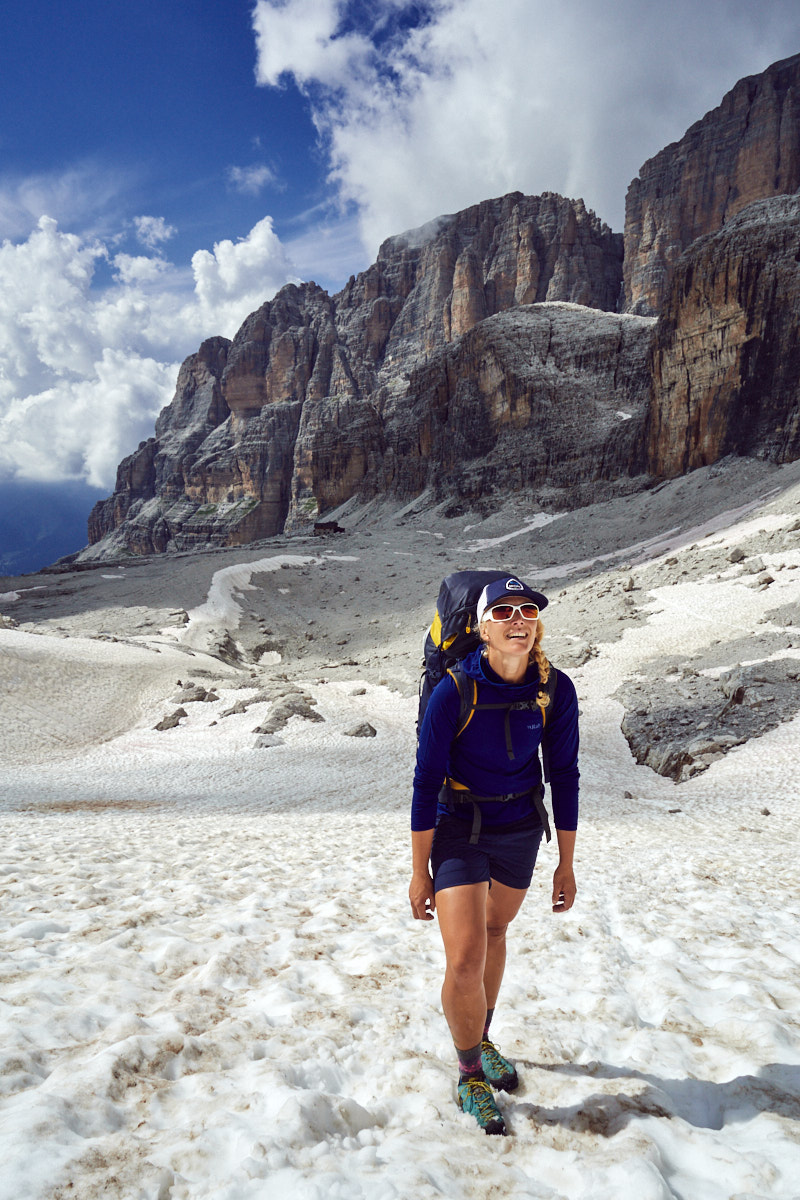

It's five in the afternoon and beyond the Bocca degli Armi the world ends. A snowfield, steep rock and then nothing. Just a dark grey void. The clouds are taking over the Brenta. But they don't look threatening. They're just here. And they keep our goal for tomorrow – the slender tower of Campanile Basso, soaring skywards from the labyrinth of rock – hidden behind a curtain of mystery.
We haul limestone rocks onto a flat spot on a rocky spur and build a little wall to shield two bodies from the chilly night wind sweeping in from the Adamello. We know the Guglia, as the Italians call the spire, is above us. We can sense its presence. But it stubbornly holds on to its mystery.

"I just felt a drop!"
So that's how it is. It's raining! Beneath grey shreds of cloud – which, going by our last five visits, I had taken for the usual local colour of the Brenta labyrinth rather than a harbinger of trouble – the sleeves of my red softshell jacket soak up drop after drop. Maybe it's just condensation? It's not supposed to rain, after all. But it is. So we look for shelter on a ledge under an overhang. You can sit here. But sleep? No way! Worst case, we'll scuttle down to the hut. It's not far.
Luckily it stops. And the moment we get the stove out, it starts again. Still just condensation?

Three times we go back to huddle in the dry shelter beneath the yellow wall, whose colour suggests raindrops rarely reach it. But with dusk, we finally get the view we had dreamed of for a night beneath Campanile Basso. The last cloud is drifting across the mountains, and now it has flopped down, along with the rest of its cumulus kin, many hundreds of metres below in the valley by Lake Molveno. Now we can stretch out on our modest little ledge behind the windbreak wall and, gazing up at a star-strewn sky, rest up for tomorrow's early start on the wall. "Good night."
The wind has picked up. It's cold. Does that mean dawn is coming soon? For now it's pitch black, so I just pull the hood tighter around my face with my right hand to keep more warmth inside my sleeping bag. Inside, I move my head torch to the other side so I don't lie on it with my right hip. My left one is bruised enough already.
"You asleep?"
"Not really."
"Got colder, hasn't it?"
"Yeah, it has... Whoa, did you see that?"
As if someone had flicked on the hallway light. Flash. The sky behind us lights up for a moment and dies down just as quickly. Except here the switch is controlled by someone mighty above us. A storm! But how? It can't be. The sky above us is clear. Nothing but stars... and there's that glow again! No thunder, though. It must be far away. But do we want to bet on that? Here? 2,700 metres up? With two sleeping bags and one waterproof jacket? God, no. Pack up!

It's a mad rush. I cram my sleeping bag, damp with night dew, into its compression sack and stuff my pack with whatever comes to hand. Done. But Ája is still wrestling with her self-inflating mat. Bloody hell, what an invention! Give me a good old foam mat any day. You fold it and off you go. My teeth are chattering. The sky lights up again. I'd really like to go now. Still no thunder. She's packed. Right, we're off.
A little lower down, sheltered from the wind by rocks, we have no reason to keep running. It's clear now – the outline of the cloud on the horizon is still lit up every so often by a brief flicker of strong light that turns even the dark sky above our heads blue for a moment, but it's moving away. We sit on cold rock and the clock on the phone says 3:20. Too early. Too early to squat here on a boulder for two hours until the sun is strong enough to let us do anything. In the beam of our head torches we look for even a tiny flat spot to finish our interrupted night. One seems decent, but... it slopes slightly and ends in a drop. "Come on, you don't toss and turn so much in your sleep that you'd slide off!" Well... hopefully not.

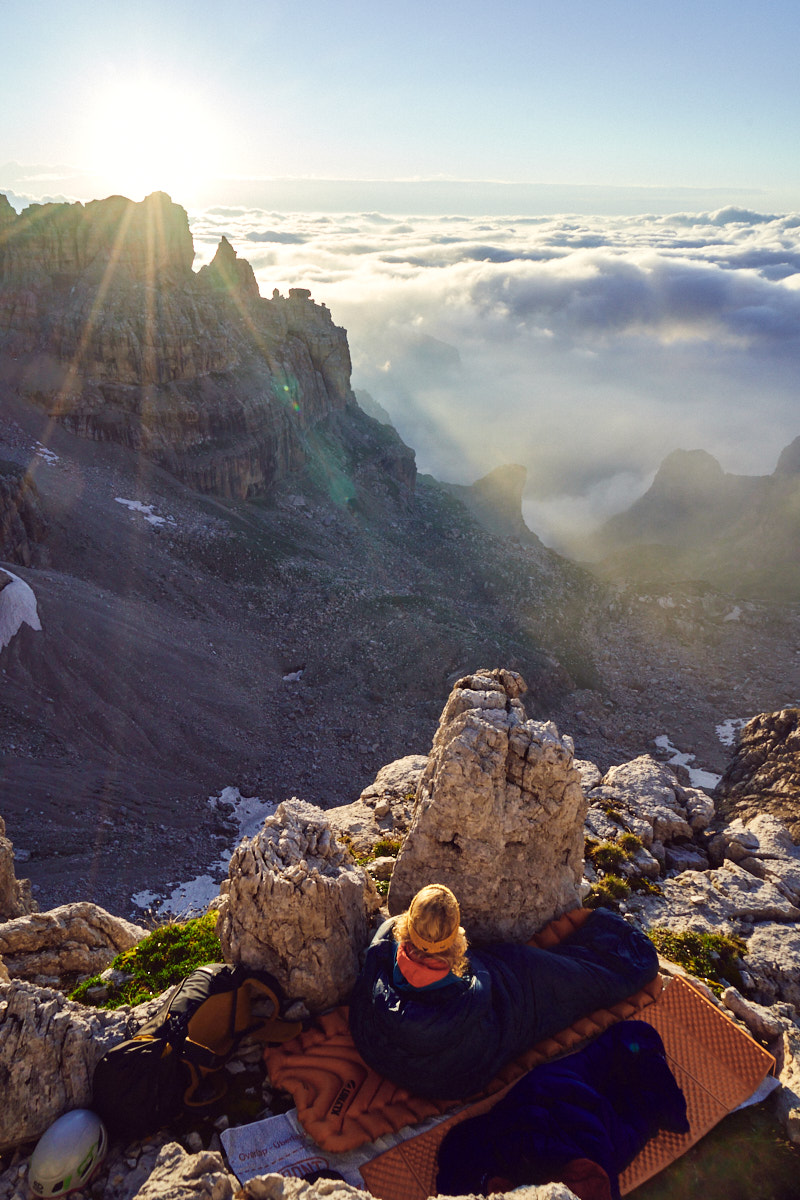
Campanile Basso. 11:11, and after eleven pitches we're standing on the summit. And the Brenta is already putting on its show again, one curtain of mist jostling with another for space, warning the engrossed audience that the morning romance is drawing to a close. The second act is coming. Enter the fog!

Just as the green strand of rope whistles through the air and whips up the dust at my feet, I feel a very localised dampness on my nose, which soon shows up visibly on my sleeves. Not again! But the timing is perfect. Abseiling in this would have driven me round the bend. Sodden ropes that tangle like hell, and water splashing into your face from the belay device like a windscreen washer. We change plans and from the saddle we run down the exact opposite side of the mountains from the path to our home on wheels. But the rain is getting heavier, and the vision of a massive wooden table graced with a bowl of pasta al ragù – the scent of Italy wafting from under the parmesan – and of steamed-up windows we're looking at from the right side, that is from inside, lures us to the nearby Tommaso Pedrotti hut.
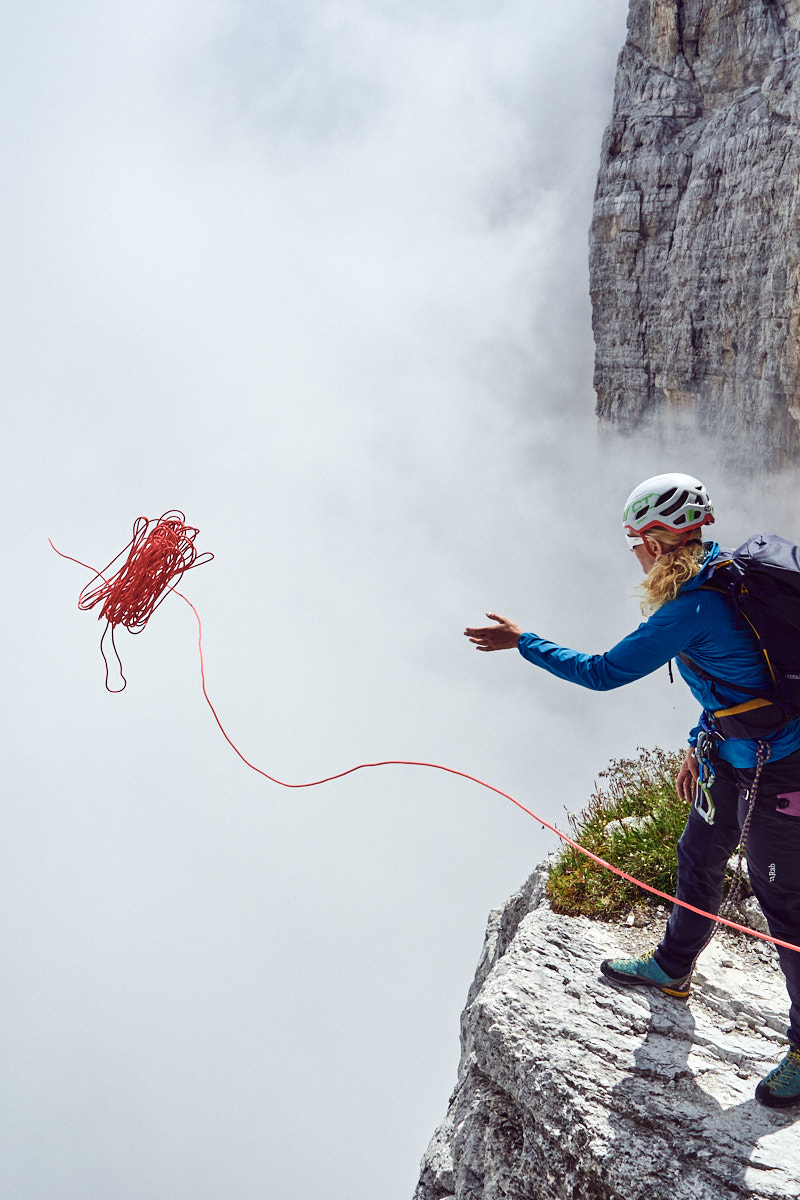
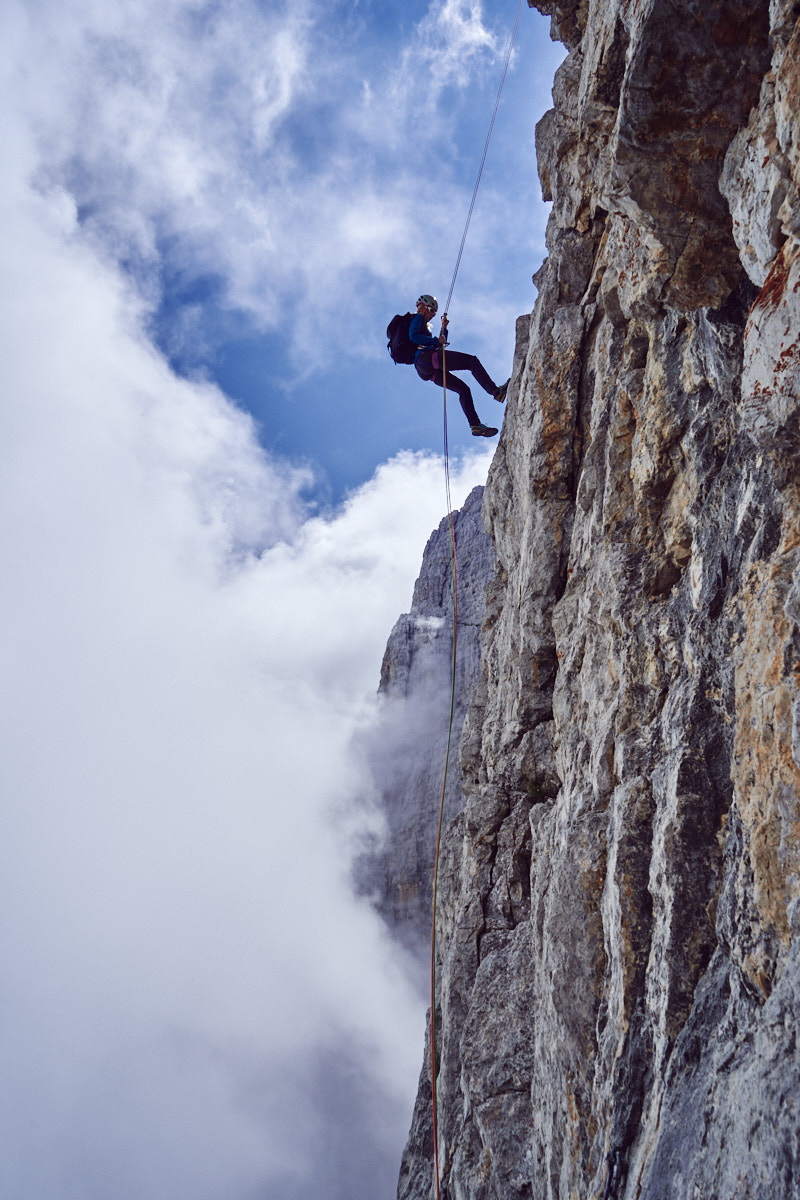
But with thirty euros in our pockets, we won't be living it up here. We still have to get down today. When the summit of the hill above the hut comes back into view, it's a clear signal: now or never. Even though the pasta, washed down with half a litre of beer, protests loudly for the first few minutes and would much rather vote for a soft, cosy bed on the first floor than frantic legwork through slushy snow and fast-drying rocks. But a dark wall is pushing towards us. Another wave from the Adamello. It wants to squeeze us, give us a good soaking and then flush us away. Who'll be faster?
We reach the chapel above the Brentei hut, currently under renovation, as the first icy drops fall. Then comes the wind, a downpour, even hail. Hell. But we've already won. This will pass soon too, and in the next window we'll make it down to the valley. And next time I won't tempt fate with that Gore-Tex jacket – I promise, here beneath the cross.

I climb mountains. I write about mountains. I photograph mountains. And I always come back happy. It's written in my name, after all.
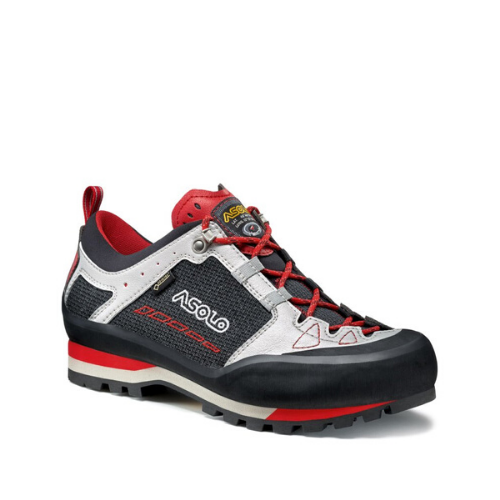
Asolo Freney Low GV trekking shoes

Asolo Apex GV trekking boots

Lowe Alpine Halcyon 35:45 climbing pack

Bridgedale Hike Ultralight merino socks
This June marked a year since Dan finished the toughest race in the world's road ultra-cycling series, the Race Across America – better known as RAAM. The route runs from the west coast of the USA to the east coast. That's a crazy 5,000 kilometres in total. Riders have to cross three deserts and mountain passes over 3,000 metres high. They have to keep going in brutal heat, but also through storms and relentless rain.
It's an unbelievable strain on the human body, and heading off predictable problems is a must. Read how Dan, with help from Bridgedale socks, looks after what carries him to the finish – his feet.

“A race like RAAM is an extreme test of both physical fitness and mental strength. At the same time it puts huge demands on the quality of your gear. It starts with the bike and ends at the most sensitive points where the rider touches the bike – backside, hands, feet. Choosing the right shorts and saddle, gloves and handlebars, shoes and socks is often a tough nut to crack that takes years of trial and error. I've learnt first-hand how painful that method can be. Feet take an incredible beating in ultra races. One moment they're swelling and pressing against the cycling shoes in the heat radiating off the road, the next they're soaked through on a long ride in the rain, and at other times they're fighting off the cold. And all the while they're under constant pressure from the carbon sole and the shoe's tongue. One bad seam in a sock is all it takes to land you in serious trouble.

So for an ultra you need socks that are anatomically well designed, cushioned in the right places and breathable elsewhere. Minimal seams in the right places are a must too. Then there are big demands on the material, which should provide as much comfort as possible – wicking sweat, drying quickly and keeping your feet at a comfortable temperature. Last but not least, they need to be durable. Socks that work well but have holes in them the next day are useless. All in all, that's a lot to ask. After many years I finally found what I was looking for: Bridgedale socks, perfect in every respect. I got through RAAM 2019 in three pairs from the Ultralight range, which I still use for racing and training. I won't start another ultra project with anything else on my feet!”

Daniel Polman finished RAAM as only the third Czech in its 38-year history, and even achieved the best Czech time and placing. All this despite a collarbone broken in four places and then screwed back together less than two months before the start. He tells this almost unbelievable story in his book DREAAM. He has also been invited to join the world's elite ultra-endurance riders in the 9,000 km Red Bull Trans Siberian Extreme from Moscow to Vladivostok. He'll be on the start line in June 2021 as the first Czech in history.
Find out more about Dan at www.danielpolman.com.
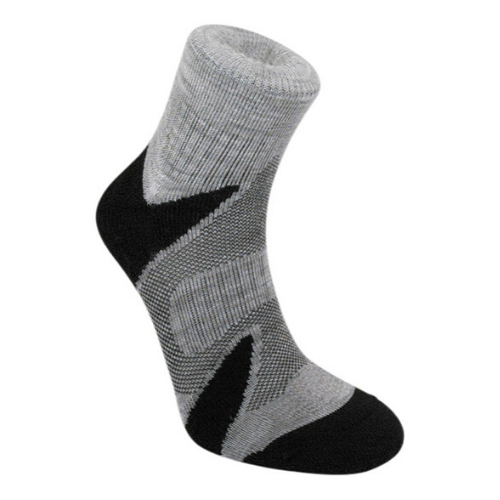
Bridgedale Trailsport Lightweight men's socks

Bridgedale Trailsport Lightweight women's socks
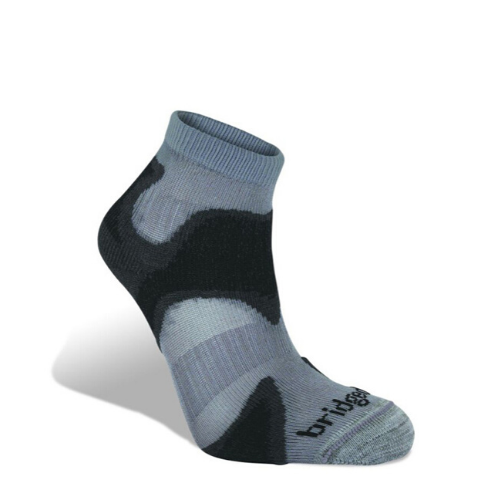
Bridgedale Trailsport Ultralight T2 men's socks

Bridgedale Trailsport Ultralight T2 women's socks
But it really is just a little further. One last breather and... yes! It really doesn't go any higher. With the creak of crampons leaving nothing but a jumble of geometrically regular marks in the snow, you turn towards the sharp ridge behind you. To mark your shared success, you stretch your right hand out to your partner, who is two steps short. For a moment your fluffy mittens merge into one. Done! Not a soul anywhere. Apart from the two of you. Before your four feet stood this high, they had to cover a long, long way. Five years? Ten? Fifteen? How long did your preparation take?
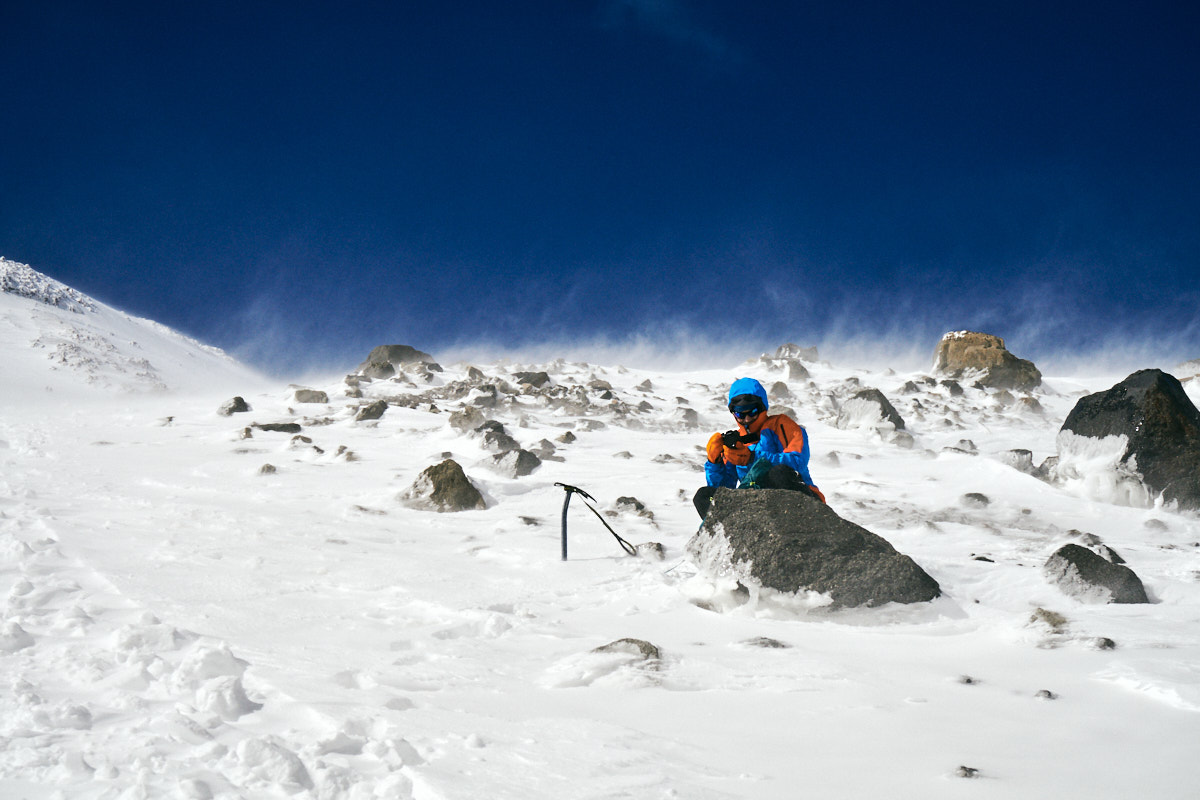
4,000 kilometres further west, another pair – quite possibly better equipped – is just joining a train of headlamps sliding steadily up towards the roof of Europe. Those two will get nausea too. They'll leave the same crampon marks in the snow. And on the summit they'll shake gloved hands. Everything the same. The same snow, the same views, the same joy. Only their journey took four days – including acclimatisation on the Argentière glacier. Next week they've booked a skydive, and in a month they're flying to Egypt for a freediving course.
"Many paths lead to God, one leads over the mountains."
— Rudolf Kauschka's gravestone and the first page of the author's diary
Those other two live a colourful life full of experiences. While you spend your whole life just learning how to tie a prusik from the free end of the rope, digging in the snow on every ski tour so that a look through a magnifying glass tells you whether the snow crystals have changed shape again, and spending your evenings poring over guidebooks and flicking between browser windows, trying to find as much information as possible for your next foolish expedition.
You could have hired a guide, you know. They're professionals.
But you've got a mind of your own.

You stubborn mule! Going your own way again. A long, long way on which, despite all your experience, you'll still do something stupid. How many times have you been stopped by one of the many dead ends? Just as the Swedish writer August Strindberg found out by experiment that blowing tobacco smoke into water does not make gold, you managed to verify with scientific precision that as a grade-7 sport climber you are a complete zero on sandstone. And you start again from scratch. For the umpteenth time? From sevens you've dropped to fours. You learn to place knotted slings and so fool your frightened mind. A ring bolt! Where's the ring? On a grade four? There isn't one. Once your feet get used to the uncertain friction of sandy little ledges, you can move up to fives and sixes. There you'll find a ring. One. You have to grow up to rings.
And growing up takes time. Sweet seventeen, what lovely memories. You can't just skip this stage in one go. True, you could. 250 euros and two hours later you're signing the summit register on Kapelník. And maybe in the afternoon you'll bag Taktovka too.
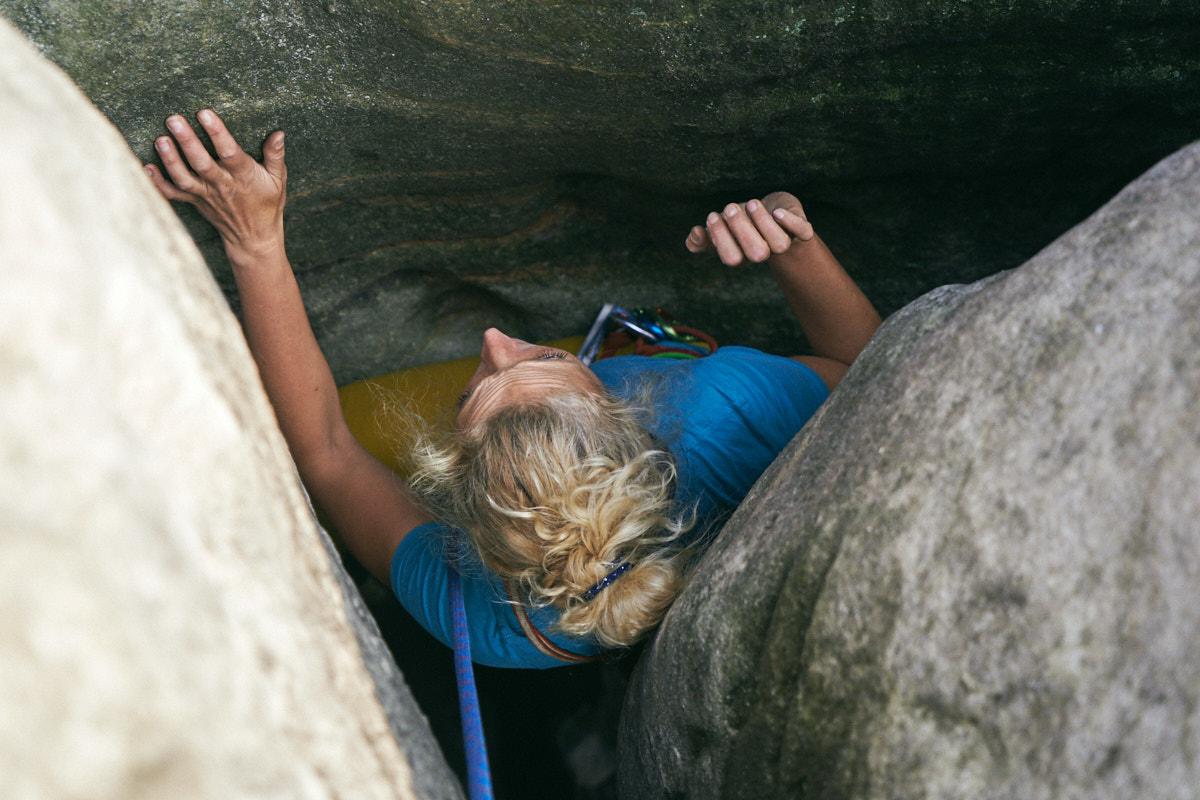
Or you wait for it. After all, the Old Route on Taktovka is graded VIIb. But the photo in the guidebook has completely bewitched you. You can recite the route description by heart. And then one day, under a favourable constellation set by Jupiter crossing Mars, you pluck up the courage to start. Up that nasty, crumbly little wall. On the traverse past the second ring you slot a bombproof knot into the crack, but on the run-out to the third you're still scared witless. And when, on the tiny summit cap, you take a stubby red pencil between your fingers, its lead disappearing into the wood, and immortalise your ascent in the register right after yesterday's strike team, you'll understand more than your paying predecessor – out of respect for the rock it would be better not to be up here at all. Since 1925, when Rudolf Hanke and his companions put up this route, millions of grains of sand have crumbled from Taktovka onto the slopes below. Every step has deepened the footholds by a few hundredths of a millimetre – over almost a hundred years, by several centimetres in total. And the rope rubbing on the traverse past the first ring saws through the tower like a two-man saw in a fairy tale. Saw, saw, saw...
"The root of evil is a lack of knowledge."
— Confucius
You'll build up a complete picture of climbing on the Czech sandstone towers, because you've been through the whole journey of discovery and learning. You know the dead ends, not the shortcuts. You'll understand that cries of "Put more bolts in those sandstone death traps! So we can climb them too," are calls from the gates of hell. There'll be more people on the walls, but less sand. And poor Hanke, who circled Taktovka for three long years from 1922 before he fought his way above the fourth and final ring, couldn't even defend himself against the bolts added later. The urge to be at the top right now – without fear, without obstacles – killed his legacy. The spirit of that route.
Safe adrenaline. That's the age we live in.
We have money, but no time.

Or are we just trading the time we could give to the mountains for money, so that we can buy the mountains with it? Upside down, isn't it? Cable cars to the summits, skywalks in the clouds, hotels in glaciers. Who built all that? We did, of course. Through our desire to use (and exploit) the mountains – here and now. Victory is certain, defeat is out of the question. Pride swells, the mountains submit. Humility, face-plants and listening remain merely the old-fashioned privilege of romantics for whom the slogan "Time is money!" has not yet become life's main mantra.
I climb mountains. I write about mountains. I photograph mountains. And I always come back happy. It's written in my name, after all.

Lowe Alpine Halcyon 35:40 climbing pack

Asolo Flyer trainers

Asolo Eiger XT EVO GV mountaineering boots
Bridgedale Hike Ultralight merino socks
My body is working exactly as I expect it to. Between the obstacles laid in my path by million-year epochs of eruptions, folding and weathering, my feet land precisely on the spots that then catapult me into the next stride up the trail. Again and again. The terrain is not the enemy. I am the terrain. But the real test is only just coming. My trainers no longer meet in mid-air so often, while the life-giving pump forces more and more oxygen into my clenching muscles. Faster and faster. Heavy lungs make me give up my upright stance and drop into a slight forward lean. Perhaps so I can take a really close look at this trail heading for the clouds.

As soon as I emerge above the dwarf pines, which, like the last of the Mohicans, stubbornly defy the harsh weather of the Jeseníky Mountains, an icy wind through my sweat-soaked T-shirt lets me know I'm nearing the end of the first eight-kilometre test. Or rather, ours? Because there were two of us running. Yet it felt as if I were alone on the trail. My partner kept a low profile. Just nodding along to the rhythm my legs set. Only here, on a windswept mountain meadow, where I so love repeating to myself: "What more do I need? Just this!", does my companion show how indispensable he is on outings like a run along the Jeseníky ridge. He readily hands over a light jacket, two decilitres of water – filled into a bottle back down at the spring – that wets my tongue like music, and half an energy bar. He'll carry the other half for the way down, when every step on the steep descent will stamp the last of my strength into the mud.

To be honest, I was a little worried about him. And about myself. Because with a pack that won't sit still on your back, you won't run for long. But he – the Lowe Alpine Aeon – stays calm. Our backs work in rarely synchronised rhythm. Feather-light shoulder straps hug my shoulders firmly, but never roughly or clumsily. And at the waist there's one good click and you can forget about it. He surprised me again – my partner!
But what tested our relationship most were the grains of Mars-red Jordanian sand in Wadi Rum, creeping into every corner, crack and crevice. When you're woken by the Muslim call to prayer echoing through the dusty streets of a grubby Bedouin village, and at breakfast, sitting on a green rope coiled up for carrying, you stare at walls several hundred metres high, you have only one worry in the morning: what are you going to climb today?

Jebel Rum, Jebel Um Ishrin, Jebel Khazali. Plenty of directions, plenty of routes, but no fixed protection. At most, at the end of a rope length, you'll find a thread in the rock wrapped in a few slings bleached by the Arabian sun, whose age not even an expert could determine. Will you trust them? You don't have much choice. So, apart from a fair dose of courage, these bare walls demand plenty of your own gear, which you have to bring to the foot of the wall. Cams, nuts, slings, karabiners, two half ropes. And not very often, but now and then, and always quite unexpectedly, a hold will leave the position it had kept for centuries before you came along. So bring a helmet too. And water! A litre is, of course, nowhere near enough in the desert. When did it last rain here, I wonder?

But my partner, the Lowe Alpine Aeon, carried all of it to the foot of the wall. Whatever didn't fit inside, he strapped on the outside – rope and helmet. And then, on the wall, he simply blended in. He let himself be carried upwards and knew he mustn't disturb me. That I needed complete calm to put my full concentration into every move on sandstone that was worryingly brittle in places and reassuringly solid in others. That was our teamwork.
True, he didn't leave the desert without a scratch. The finer the grains of sand, the harsher they battered his surface – on the wall and while we wandered through canyons in an endless, mood-souring quest to find the one gorge that doesn't dead-end in a labyrinth of rock but leads to the safety of the village. Grubby and scratched, he still did his jobs – sit tight and carry. And he showed particular stubbornness when we needed to haul dry wood, gathered in the dust below the cliff, up to the top of the sandstone massif: for a fire. He ignored the fact that the elastic cords on his sporty, sculpted sides are meant mainly for trekking poles. Instead of protesting, he grabbed the twisted desert branches and didn't drop a single one all the way up. And all the while a sleeping bag was swinging at his waist. What a foolish idea, heading out to sleep in the desert with an eighteen-litre pack.


But those 66 painful kilometres on foot from Liberec to Sněžka might have seemed just as foolish. On the hard tarmac of the Jizera Mountains, on Polish boardwalks and on the rocky Czech-Polish Friendship Trail, we faced the pitfalls of the terrain together. He even glided with me now and then through mountain air, always parted ahead of him by my body as it set chunky 27.5-inch tyres rolling along a dirt trail. And he always sat perfectly. And whenever the call was "Intensive training!", he cooled my sweaty back with doses of fresh air. He's a good partner. Together, anywhere!


Lowe Alpine Aeon ND16

Lowe Alpine Aeon 18
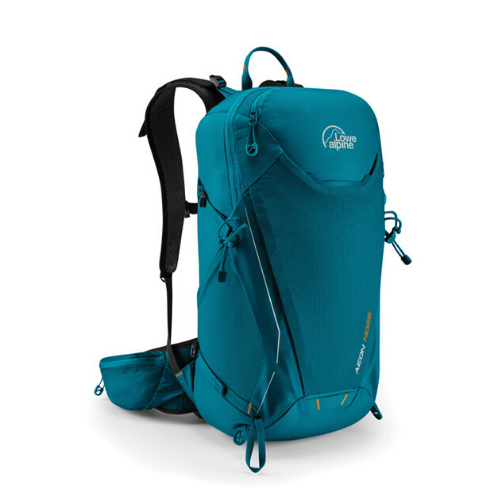
Lowe Alpine Aeon ND25

Lowe Alpine Aeon 27
I climb mountains. I write about mountains. I photograph mountains. And I always come back happy. It's written in my name, after all.
All things considered, though - isn't this exactly what I wanted this past year? To spend more time outdoors, to have room for my own writing, for work around the house (and there's plenty of it), for learning, reading books, heading out with my camera for sunsets. Covid may have shrunk the numbers on my invoices, but it may also have done something for me that I'd been edging towards in micro-millimetre steps.
"If you have a garden and a library, you have everything you need."
Marcus Tullius Cicero
There's nothing wrong with chasing income, social status, or outdoing the neighbours with a pool one metre longer. Sustainable economic growth demands it. If we all stop grafting, the system collapses. Probably. But the drop-in-the-ocean theory suggests the world won't fall apart if a few misfits choose the exact opposite: chasing the art of doing nothing.
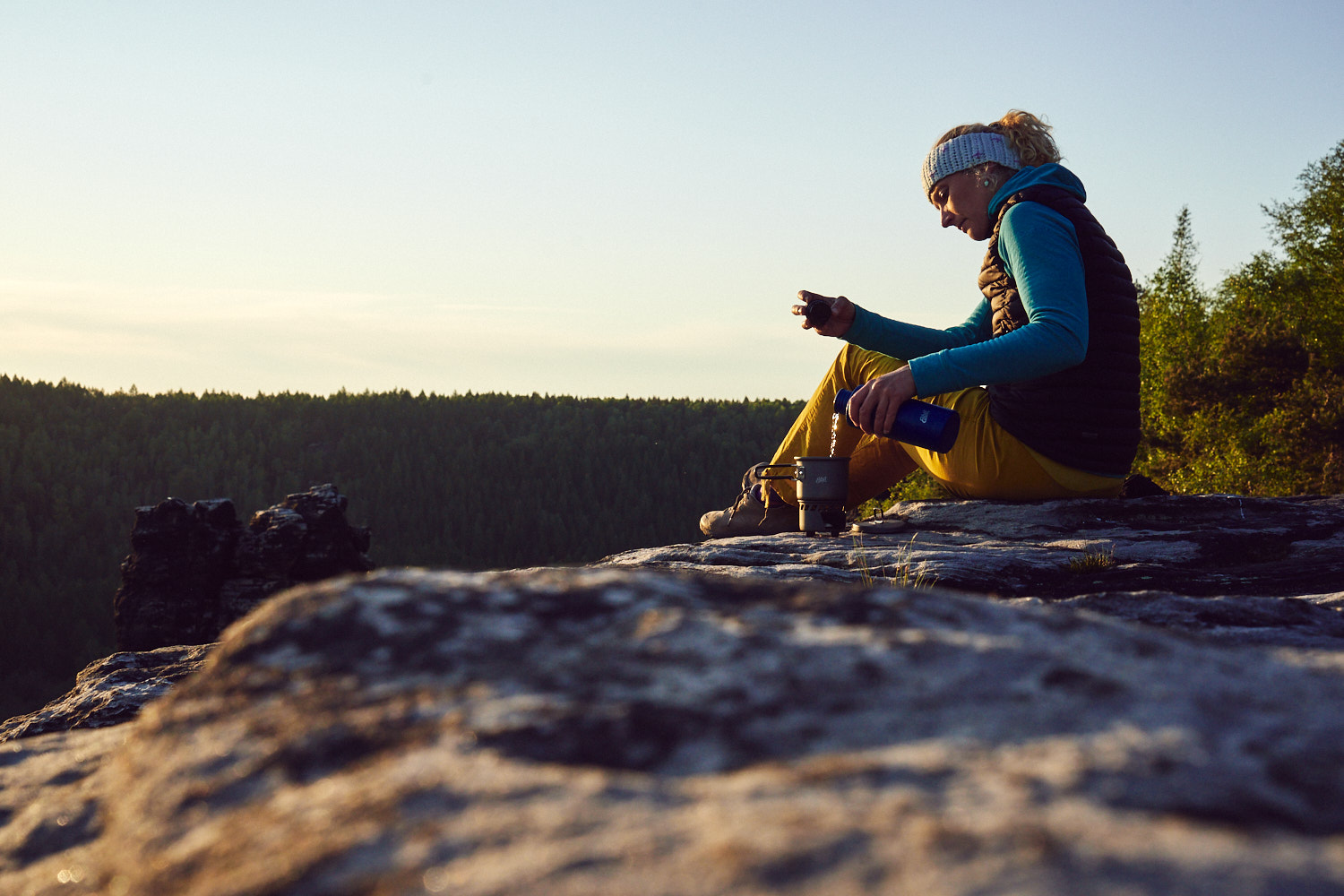
You don't have to be a freeloader on the system or, at the other end, a person of independent means. You just have to know what you want - and make everything else fit around it. Thousands, tens of thousands, maybe hundreds of thousands of nomads roam the world in battered vans, getting by on very little. Sometimes on a whole lot of very little. At the foot of the crag they pull on a shabby down jacket whose moulting through torn fabric has been fixed at least three times by all-powerful silver tape, and whose original Firecracker colour has, over six years of hard wear, acquired an outdoorsy patina of greasy basil pesto stains and repairs to a ripped-off exhaust. But it still works. It's still warm. So it doesn't look like it came out of a catalogue? You're hardly going to lock yourself in an office for a month just so that, two weeks later, you can stare at the hole left in your new six-grand down jacket by a spark that flew out of the campfire into a chilly autumn night.
"How can anyone want to trade a piece of life spent in strenuous, laborious work for better blinds? Are prettier window ornaments really worth so much time? Why add hours of work in the field just so you can buy a carriage?"
Henry David Thoreau
Back in the mid-19th century, the philosopher, moralist and poet Henry David Thoreau left behind life in Concord, Massachusetts, sped up by the Industrial Revolution, and on 4 July 1845 - symbolically, on Independence Day - moved into a wooden cabin by Walden Pond that he had built with his own hands for 28 dollars and twelve and a half cents. Read his book Walden; or, Life in the Woods and you'll be itching to pack an axe and a billy can into your rucksack and escape just like he did. Ideally today. And while we're singing Thoreau's praises, pack his essay Civil Disobedience for the getaway too. Just watch out that the tax office doesn't come down on you for not paying your taxes. Thoreau was a bit of a radical.
But back to doing nothing in the present day. Fancy a coffee? You've got a choice. An espresso "made with love" at 9 bars of pressure, in a porcelain cup with a saucer and a little glass of water, for 55 Kč. Or coffee "made with love for freedom" from your own moka pot and a kilo bag of Bellarom from Lidl, at about a crown a cup. Sparkling water free of charge. From a spring. As much as you like. What's it going to be?

That's exactly what I've been thinking hard about lately. And I'm trying to reprogram my long-standing mindset that a 7b onsight isn't the kind of result that fills a rumbling stomach. Of course it isn't. No pain, no gain - and no cake either. Nor pasta, nor a chop for the grill. But if you want to turn the norms on their head - climb five days a week and work two - it's not utopia. It just depends how much you're willing to sacrifice for it. Hunger on the way back from the crag is a beast, and the fried menu at the Koupák lake looks really tempting. But 140 Kč for fried cheese with chips and ketchup? That's an hour or two of work - after tax and contributions. Which way will the scales tip?
New trekking shoes would look nicer from above than your current grubby old clodhoppers, too. But are a hole by the little toe of your left foot and worn-through heels really such huge problems that you need new footwear again? Isn't it better to spend three days at the crag, where you lounge barefoot in the sand under the wall anyway, than three days grafting for new ones? Lots of people at the crag look like they're homeless. Bump into them at Prague's main station and you'd give them a few coins. But in their holey jeans, a harness with threads hanging out of it and karabiners as old as the hills, they climb two grades harder than you with your polished kit - so hard-won in the shackles of the system.
"How we spend our days is, of course, how we spend our lives."
Annie Dillard
Costs, costs, costs. It all revolves around them. The deeper you can push them down, the more freedom you gain. Rent, mortgage, energy - sure, you can't shake those off so easily. Except with that battered van. Savings are harder to find on the big things than on the small ones. So what about paid apps on your phone? Apple Music for 150 Kč a month? 1,800 Kč a year? Given how often I listen, I can probably put up with a few ads on YouTube. That 55-crown espresso twenty times a month also adds up to a tidy 1,100 Kč, or 13,200 a year. And once you've gained all that free time, couldn't you get to the crag by bike instead of by car? The combustion engine is a glutton.

Over the last three years, I've probably saved the most by not using soaps and shampoos. Believe it or not, your body doesn't need them. And then there's another saving on top - on creams. Soap dries your skin out, you see.
It's a process. And a matter of self-denial. Or modesty, minimalism, frugality. Call it whatever you like. You certainly won't become a financial rentier - that takes a long road of grafting from dawn till dusk, at the end of which your body and mind will be in such a state that you won't give a hoot about any performance on the rock anyway. More like a rentier of freedom - a decent chunk of it every day.
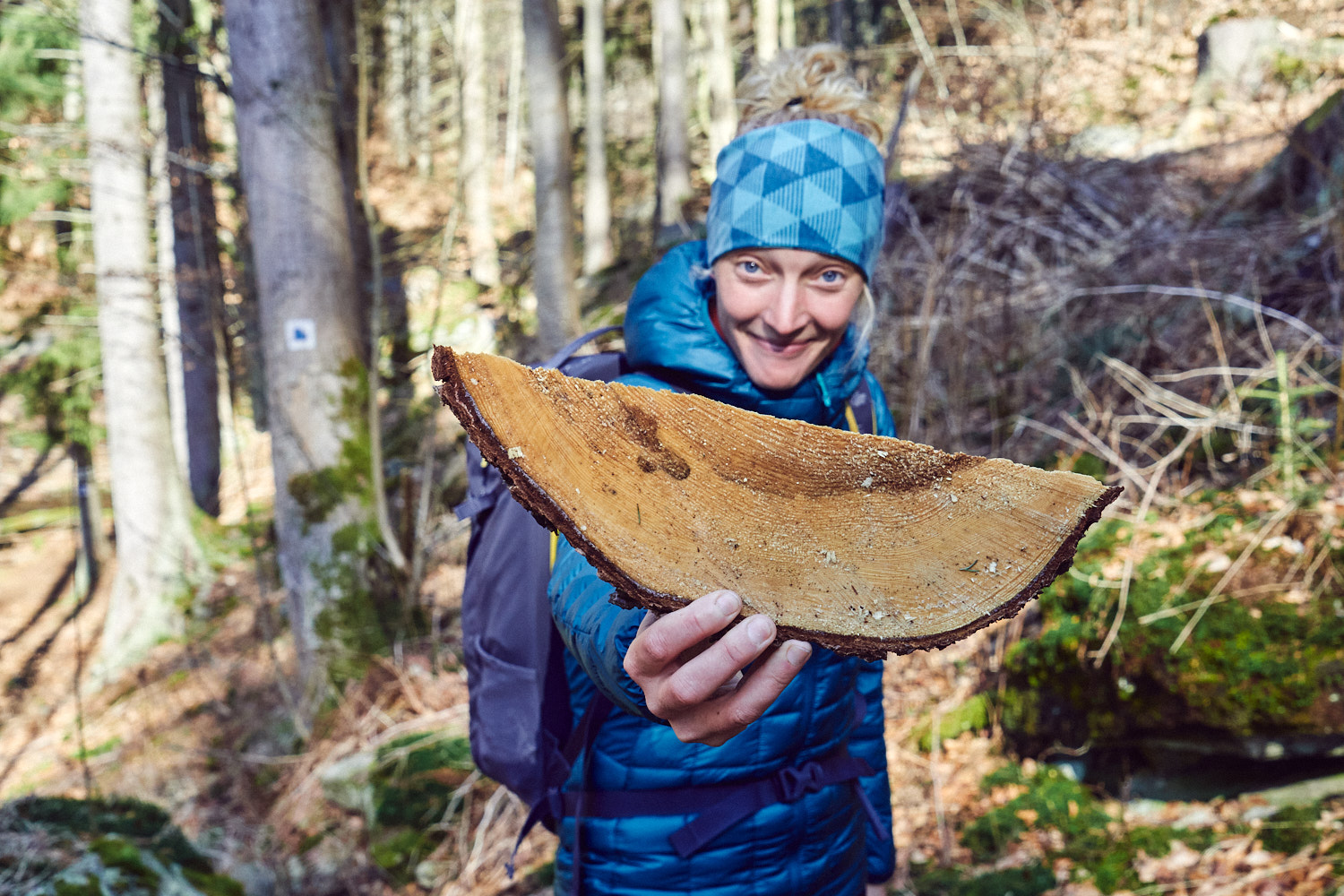
With all that, there's surely no need to hang your head over the dwindling stream of work emails. More of them always land in your inbox than a climbing person would like anyway. And anyone who built up a cushion in times of plenty (not the kind for sleeping in a hammock, but a financial one in the bank) can use the current crisis for a proper project. Project Freedom. You've already got everything else.
Disclaimer: The author has not yet reached the ideal of two working days a week; he is still in the process, so this article has no ambition to be a universally applicable guide. Please see it rather as a collection of ideas on how to get closer to the ideal. Which in itself can be considered a success.
I climb mountains. I write about mountains. I photograph mountains. And I always come back happy. It's written in my name, after all.
