
Fine. Cut down on waste. Let's say you manage it at home somehow. You shop at a zero-waste store, have your veg delivered in crates straight from the farmer or grow it in your own garden. You compost your scraps and only the last one flushes. 🙂
But how do you go zero-waste with a mountain and travelling lifestyle?
All you have to do is get on a train and they're pushing a 200 ml plastic bottle of water on you. Free of charge. You check into a mountain hut, order dinner and it all starts adding up. Coffee at the petrol station comes in a disposable cup – what else. And let's not even start on how badly we need a fourth pair of skis, a nicer Gore-Tex jacket and a new beanie. We're terrible consumers. And one day the planet will send us the bill. Unless we ease off a little.
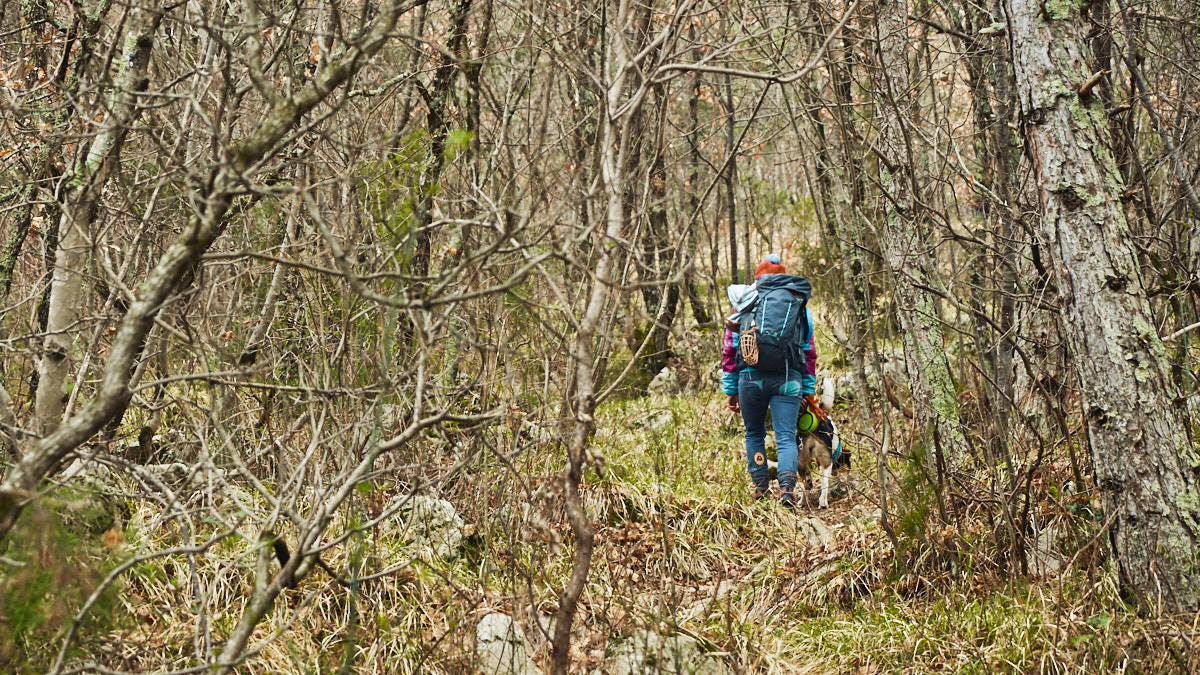
I said it last time: one of the main environmental problems is our rush. The phrase "fast food" says it all, and when I pop into McDonald's once in a blue moon for a cheeseburger, fries and a Coke, I'd rather sink into the ground with shame. All the rubbish I leave behind. That's a one-way ticket to hell. Why do they even serve the burger in a cardboard box?!
OK, we probably won't change the philosophy of McDonald's, KFC and Burger King. But we don't have to go there. Instead, we can pack a snack from home. In a box we'll use again.
And another culinary hell – napkins.
Do we really need to wipe our greasy mouths and floury hands after a margherita on paper napkins that go straight in the bin? What are those climbing trousers for? Just for show? OK, I get it, you want to keep your trousers clean. Me too. That's why I use an organic cotton handkerchief – I blow my nose into it, clean my ears, stop nosebleeds and give my hands a good wipe after a good meal. And after washing up in the loo your hands will dry. In about two minutes. Really. You can leave the disposable paper towel in the dispenser.
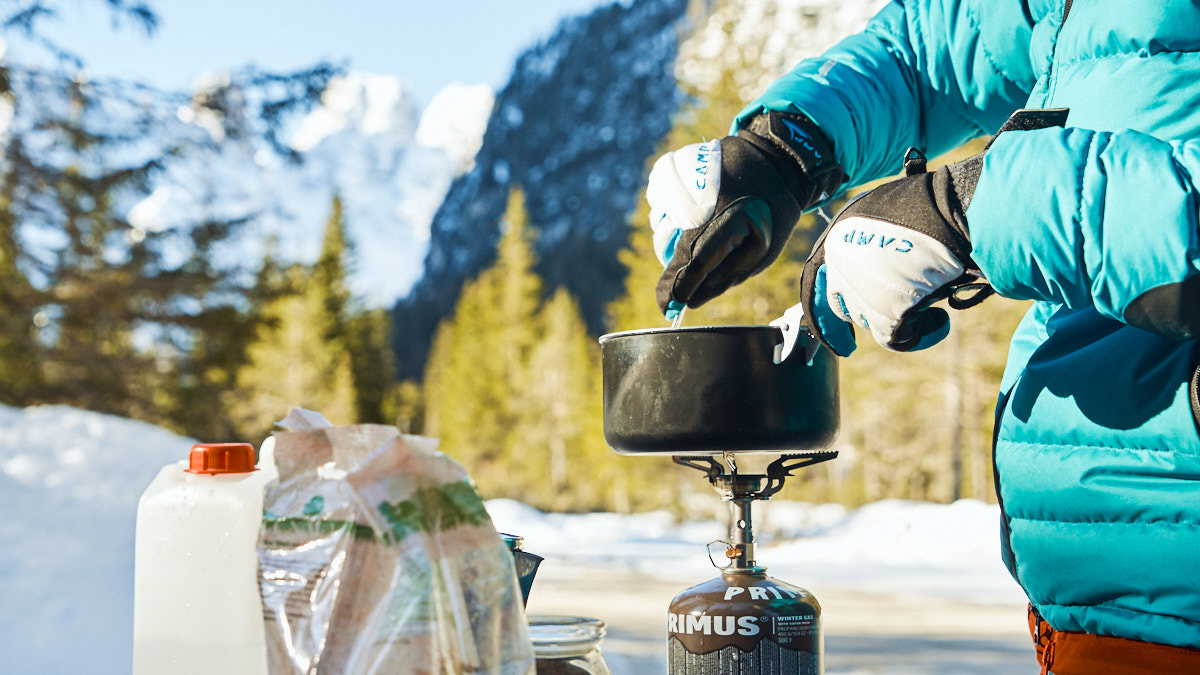
What's that in your hand? A disposable plastic cup? Surely not. Even Lidl has figured out that coffee from your own thermal mug not only tastes better but also spares nature. The petrol station staff will get it too when you slide your mug across the counter. Of course, most vending machines aren't built for your own mugs, and probably won't be for a long time. But if you're travelling by car, a small gas canister, a stove and a moka pot will easily fit. Not to mention that coffee like that tastes better than instant.

Here in Europe we've more or less learnt how to deal with plastic bottles. Still, every now and then on the way back from the mountains I fancy a Coke. A half-litre plastic bottle. Waste. What to do about it? No idea. Have sugar water instead?
Anyway, when travelling around Europe we don't have to buy bottled water. Mostly. And we don't have to take it on the train just because it's "free". Carry your own bottle and fill it from a tap, a spring, a well. There are options. It's trickier in exotic destinations, where a sip of tap water can send you straight to a Cambodian hospital. Which you really don't want. So there's not much choice but to buy bottled water. To cut the waste at least a bit, wherever we could we bought a five-litre jerrycan and refilled our own bottles from it. Not much, but better than nothing.
Maybe an even bigger hell in Eastern countries is plastic bags. They stuff everything in them. Even a can of Coca-Cola gets put in a bag at a Thai 7-Eleven. Two bags, just to be safe. With a straw as a bonus. As my bit of global awareness-raising, I always say: "No bag, please!" And I get a telling look: "Are you mad or what? Such a great thing, a plastic bag!" Is it worth it? It is. I believe that in the long run it is.
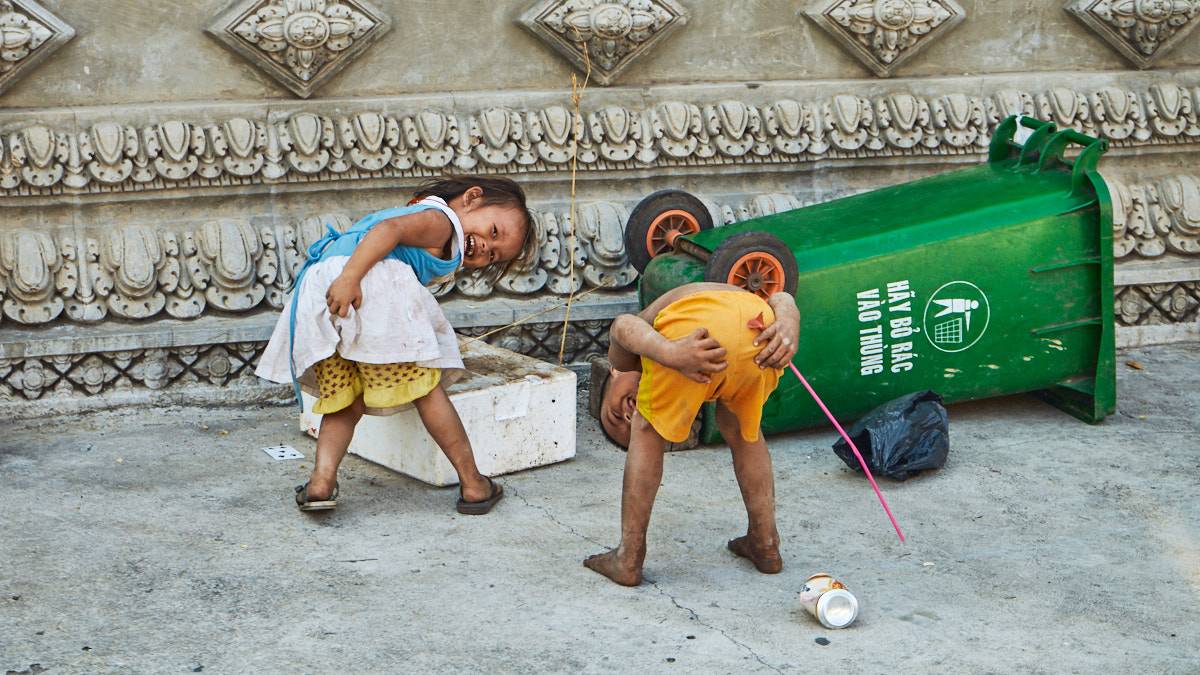
And the world at your feet. When it comes to sleeping, the most eco-friendly option of all is sleeping under the open sky. In the evening you heat up your own home-cooked food from a jar on a spirit stove (with a gas stove, the canister is the waste), bury your poo and leave the spot in the morning exactly as you found it the day before. Unfortunately, this often runs into nature protection laws, locals' hostility towards people sleeping in car parks below the crags and, on exotic trips, snakes, cockroaches and other creepy-crawlies. Simply put, more often than not it's not possible. Not everyone is cut out for this kind of night, and often it isn't even realistic. In the centre of Phnom Penh, for example.
Still, there are ways to reduce our footprint even when we sleep in a hotel, guesthouse or mountain hut.
For instance, we don't have to use the house towels. We can travel with our own instead. Especially when you move from place to place every day or stay in a hotel where they change the towels daily. And wash them daily. Such clean people.
Nor do we need disposable soap, shampoo, toothbrushes, toothpaste or razors. Leave them by the sink for someone less enlightened and use your own things.

Or better still – don't use soap and shampoo at all. I haven't touched either for more than a year and, lo and behold, I don't stink and my hair isn't greasy. On the contrary, my hair is healthier and I don't need body lotion for my skin (another packaging saved, by the way), because soap no longer dries it out. And body odour? What your body takes in, it gives out. Which brings us back to fast food and junk food, which then produce a junk stink. Unprocessed food, on the other hand, won't make you smell.
Especially not at a time when some fashion giants release a new collection every two weeks. And burn the old one. There's simply no keeping up with that, and we shouldn't even try.
You could talk for ages about the impact of conventional cotton farming on nature, farmers and our own health. In this article I'll stick to one example: defoliants. Cotton gets sprayed with them before the harvest. The defoliant burns off the leaves and makes picking easier. And defoliants included Agent Orange. The stuff the US army used during the Vietnam War to destroy whole jungles so the Viet Cong had nowhere to hide. Children with birth defects are still born in Vietnam today. So much for cotton.
Fast fashion just isn't the way. Certainly not for people who love nature.
And the saying "We're not rich enough to buy cheap things" is more relevant than ever. Or rather – this planet can't afford it any more. Buy clothes that last and have a simple, timeless design. A plain jacket will be in style today and in 10 years' time. And if you rip it on a rock, mend it. There are patches for down and membranes. You're bound to find a needle and thread at home. Or a handy seamstress in your town.
For a month in the Himalayas, we also don't need 10 T-shirts and 20 pairs of socks. Two of each will do. Bridgedale merino socks, for example, don't smell even after a week and are made to last up to 10 years.
And of course, we don't have to wash our clothes after every hike. Sunshine and fresh air work wonders.

Those four pairs of skis I mentioned at the start... I have them at home. And I'm not proud of it. I love skiing and spend half the winter on snow, but still – that's no excuse. Realistically, two pairs would do. Only now I can't decide which to sell. Not to mention that in the morning I can't even decide which skis to take out that day. Decision paralysis. Greed is a terrible thing.
Things only hold us back. And every new thing is potential waste.
As the Dalai Lama said: "If you have little in life, you also have little to worry about. If you have a lot, you also have a lot to lose."
So, enough about skis – moving on. Do we have to bring a souvenir home from every trip? Or are memories enough? Do we need a special backpack for every activity? Or will two or three versatile ones do? And anyway, do we have to own everything? We live in great times when borrowing, lending and sharing are so easy. People share cars, flats and things. If you don't have friends to borrow from, try one of the sharing platforms.
There's a whole lot we own and don't need. Sell it. Give it away. Or offer it for sharing. And you'll come out ahead. Both you and our planet.
So, travel and waste.
Maybe you'll come up with other ways to cut it down. On a climbing trip to Croatia, for instance, it broke my heart when we bought food for several days at a supermarket and the plastic waste just kept piling up. How to deal with that? Maybe shop from local producers and small shops instead of Kaufland. In the end it has other benefits too. But we'll save those for next time.
Postscript: None of us is perfect. Not me, not you. And we never will be. But every small change we make in our lifestyle contributes to a better, cleaner planet. Do what you can.
"Fine, you've got a point. It'll probably get a proper beating in Georgia anyway, so let's not go easy on it." Take-off! Crammed inside this bag is everything for 10 days of freeriding in the East. Ski boots, avalanche kit, crampons, an ice axe (yep, even that fitted), a 30-metre rope, a few karabiners, a bottle of slivovitz, clothes of course, and plenty of food. A whole box of energy bars. When I had it all spread out on the floor at home, it looked pretty hopeless. But in the end it all went in. With room to spare.
The weight is respectable, mind. I hope I won't go over 20 kg. But before I lug it from the Jeseníky mountains to Vienna on three buses... with skis over my shoulder too, naturally. You really appreciate that the bag has shoulder straps and can be slung on your back. Quite comfortably, too.
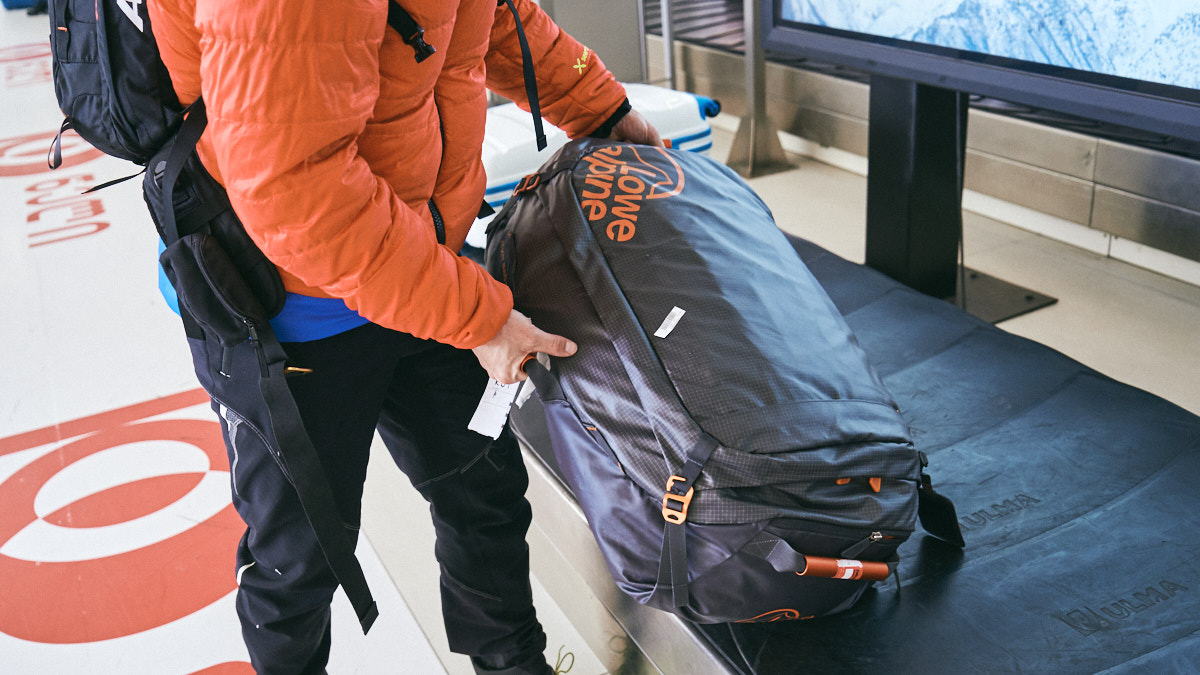
"Guys, I thought we were going freeriding. It's T-shirt weather here. Let's hope it's better up in the mountains. The taxi's waiting!" So, Georgia. As you can see, not even Wizz Air – the cheapest of the cheap – managed to chew through our bags. And without any cling film. Still, I'd rather lock the zips together with a little combination padlock. Since they went to the trouble of adding loops for one.
So once again I pull out the shoulder straps – tucked away in a special pocket during the flight – bag on my back, and we pile into a minivan. Ugh, a 6-hour drive into the mountains. If we even get there. "Hey mate, I was only sighing. We're happy to ride with you all day. Just please stop overtaking on blind bends."

2 tours, 3,400 metres of ascent, one pair of soiled boxers and not a soul in sight the whole time. That's exactly how I imagined it. You look at a mountain, pick a line, find the safest possible way up and... wow! Simply divine. And now it's time to move on. Our next base camp lies in a no man's valley.
Only I hate the endless packing. I'd just got nicely settled in here. Luckily this is a quick job. I just chuck everything in, zip it up and shape it neatly with the four compression straps. Look at that, what a beautiful piece of luggage. Even the cows in Adishi are taking an interest. But careful, girls! Licking is fine, no biting. Though you probably couldn't bite through this bag anyway. If it survived Wizz Air...
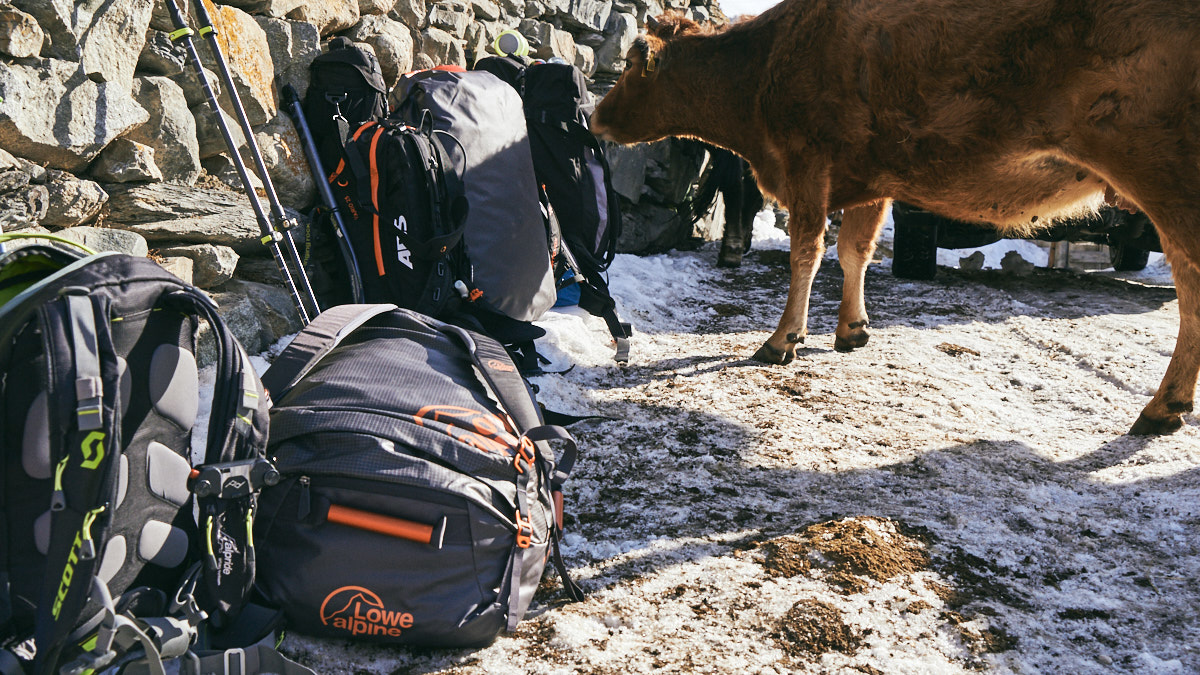
We sleep in the attic. And it's glorious here. No running water. It froze. Probably back in November. Our hosts put us up in their living room. On skis we whizz through the lanes right up to the house and our tiny little room. We don't even unpack. There's nowhere to put anything. So everything stays in the bag. Which, luckily, is so easy to rummage through. Better than any old suitcase.
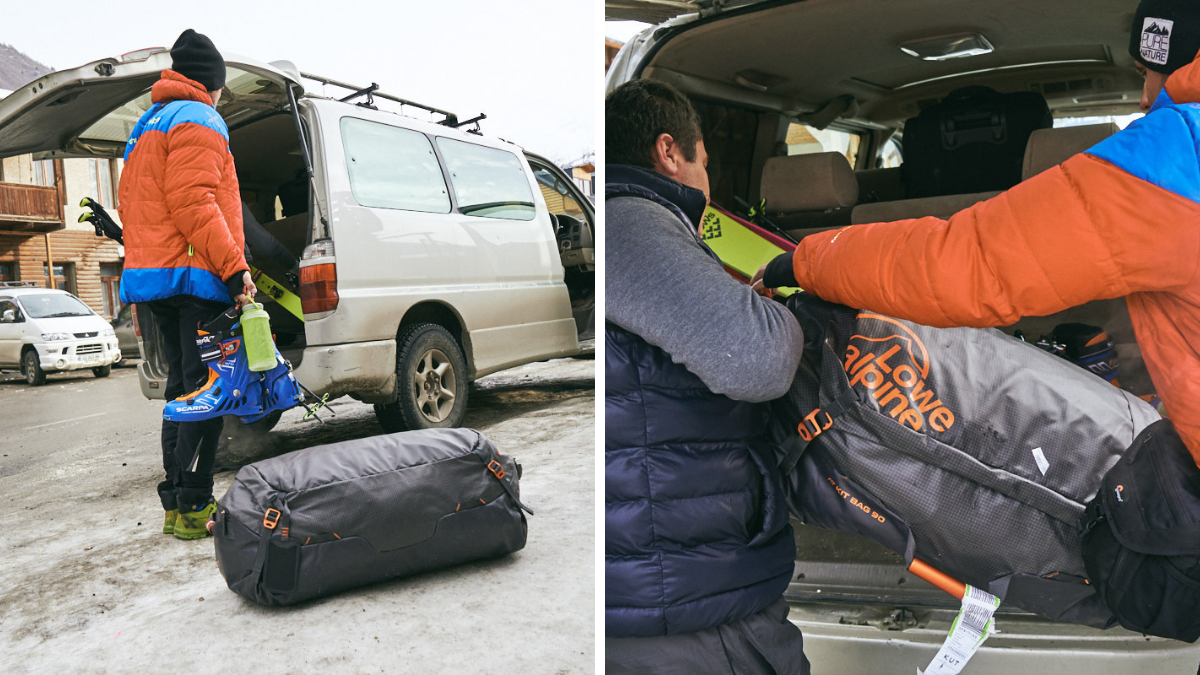
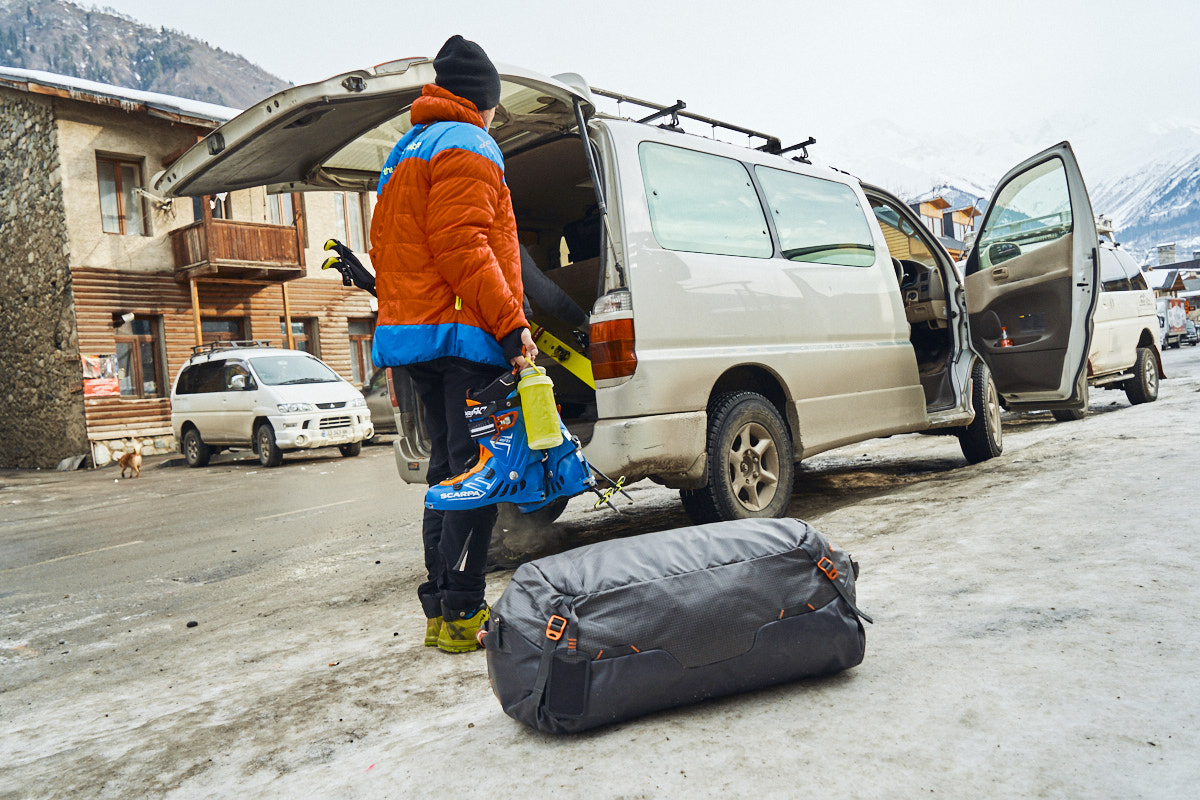
Or rather, I had a dream. And sadly it didn't come true – to ride a horse with my skis. And get a cracking photo of it. Unfortunately, instead of horses everyone here drives a Mitsubishi Delica van. Because where a horse would drop dead of exhaustion, this car is only just shifting into 4x4. Our stuff is thrown in the boot, which isn't exactly roomy for five people with skis. So the rest is spread over the seats. Which we're also sitting on. An unbelievable journey. We ford rivers. We drive over avalanche debris. We claw our way up.
Anyway, at least I imagine how nicely my bag could be loaded onto a horse's back by its three sturdy grab handles and tied down with rope. They're so great for hurling it into vans, yanking it off the airport carousel and dragging it up the stairs to our little attic den. Simply brilliant. I'm not travelling with anything else now.

With this Lowe Alpine bag on my back I travelled to Austria on three buses and a train. With a sleeping mat, sleeping bag, a small daypack, climbing gear and camera kit inside. It spent 5 days with me in a Volkswagen Caddy with a bed conversion on a ski touring trip in the Dolomites. A private wardrobe you can stuff everything into – as long as you can find it again. And I took it on the train to Liberec for a photo shoot. Laptop inside, wallet and headphones to hand in the little side pockets. Also good.
In short, what more can I say. Travel is a joy.
Let's be honest. Our travelling isn't a pretty business at all. Not for local communities, not for the environment, not for the planet in general. That became especially obvious once the news got out that Ryanair had become the 9th biggest air polluter in Europe. Ryanair's management objected, though, saying that they are in fact the greenest and cleanest airline in Europe, with the lowest CO2 emissions per kilometre flown.
Which may well be true. But that's not the heart of the matter. We travel too much.
Travel is cheap. It's never been cheaper. Convenient. You can buy a plane ticket in a few clicks. And tempting. In the age of social media, it looks as if everyone with an Instagram profile is travelling.
So we all travel. Me, you, them. An incredible 200,000 aircraft a day rush through the skies. Airbuses, Boeings, Tupolevs. In a single year, airlines carry over 4.5 billion passengers worldwide. And in 2017 aviation produced 859 million tonnes of CO2. That's a lot. Today it's almost 3% of greenhouse gas emissions – and we're flying more and more.
Probably not. I certainly don't want to sit at home. I love travelling. And chances are you feel the same. The question is, what are we going to do about it? We can forget about it entirely, not worry, and keep travelling knowing that we're helping to pollute the planet. Which we'll do anyway, as long as the world keeps pulling us. Unless we set off for the Dolomites on foot. Or we can give up a bit of comfort and travel at least a little differently. Responsibly. That's what I want to talk about. Or rather, write about.
You can manage without planes. You can manage without anything. You can take a train, a boat, a bus, and in a month you'll be in Peru. If all goes well. Still, that's hardly efficient, or even realistic. Even so, there are ways to cut down on our flying.
Domestic flights, for example. In South-East Asia they're unbelievably cheap, fast and comfortable. Certainly far more comfortable than 12 hours on wooden benches in a train, in 35° heat, with one working fan out of four. On the other hand – are you going to the other side of the world just so you can one day remember that the low-cost airline Nok Air hands passengers a small bottle of water? Or would you rather have it etched into your memory (and your back) – those unbelievably hard seats and the pushy hawkers who storm the train at every station it stops at?
There's no rush. You won't find the best experiences at your destination. You're far more likely to find them on the way there.
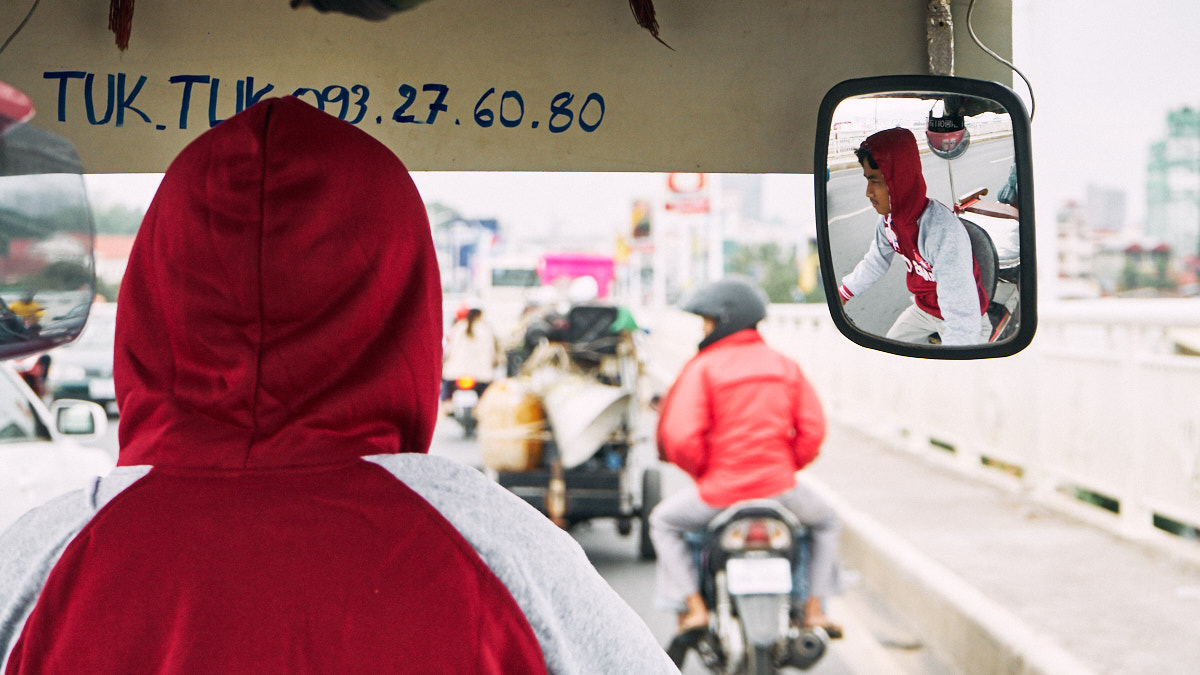
There's a classic piece of advice: Open your Lonely Planet guide, look at the 10 places you absolutely must see, and definitely don't go there. Unless crowds and the click of Japanese camera shutters are your thing, that is. What am I getting at? That it's much better for the planet – and for you, too – to stay in one place for longer.
When we travelled around South-East Asia, we didn't see anything like all of Thailand, Vietnam and Cambodia. We spent about a month in each country and lived in one place for a week to ten days. I say "lived" on purpose. Because the moment you settle somewhere for longer, you start dealing with everyday chores and getting to know the real lives of local people. Then the weekend comes and they invite you to breakfast with their whole family. Or you get to places ordinary tourists never reach, because they're rushing off to the next destination.

And besides all that, slow travel has another effect: you're not boarding a plane every third day, or a train or minibus, producing more and more emissions. Sure, it's a drop in the ocean. But drop by drop... and you've got a whole ocean.
I sold my car. And I've already made it by public transport all the way to a friend's place in Hallein near Salzburg. Three buses from the Jeseníky Mountains to Vienna. A train to Salzburg. And another little train to my destination. 9 hours. By car it takes 6. On the way I got a load of work done, read a chunk of a book, had a nap and just stared out of the window, letting my head breathe. You can't do any of that in a car. But yes, you're right. In a car you can take loads of stuff with you. Which you might not use – but just in case. You're not tied to departure times. And you don't have to spend time with strangers.
On the other hand...
... on a train, and on most buses, you can go to the loo whenever you like too.
... the steward brings coffee and food right to your seat.
... you don't stress about traffic jams or what the idiot in front of you is up to.
On public transport you can also try stepping out of your protective shell made of your own car, your iPhone and your headphones, and talk to other people. Actually talk. Not text them. And you might meet interesting people you'll have plenty to talk about with. The journey flies by and you're left with a nice warm feeling. Personally, I find it a huge challenge to strike up a conversation with strangers. But in the end it's great. Especially nowadays, when "find contact" means an icon in the bottom-left corner of your phone screen.
So travelling within Czechia and to neighbouring countries is easily done by public transport. Sure, you might give up a bit of comfort. But you'll gain other benefits. And the planet will thank you.

Get yourself one of Elon Musk's electric cars and drive to the Dolomites or the foot of the Matterhorn the green way. What do you say? Of course, it's a pipe dream. What's more, there's nothing green about electric cars in their current form – given how much electricity still comes from burning coal in power stations. And you could argue about how energy-hungry battery production is, too.
For car journeys around Europe, we'll struggle to find a sensible alternative that's kinder to the planet. Of course, you can share the car with more people. Offer lifts. Go easier on the accelerator and, instead of a frantic 180 km/h, cruise along the German autobahn at a leisurely 120. Swap the SUV that guzzles even the grass by the roadside for something smaller and more economical.
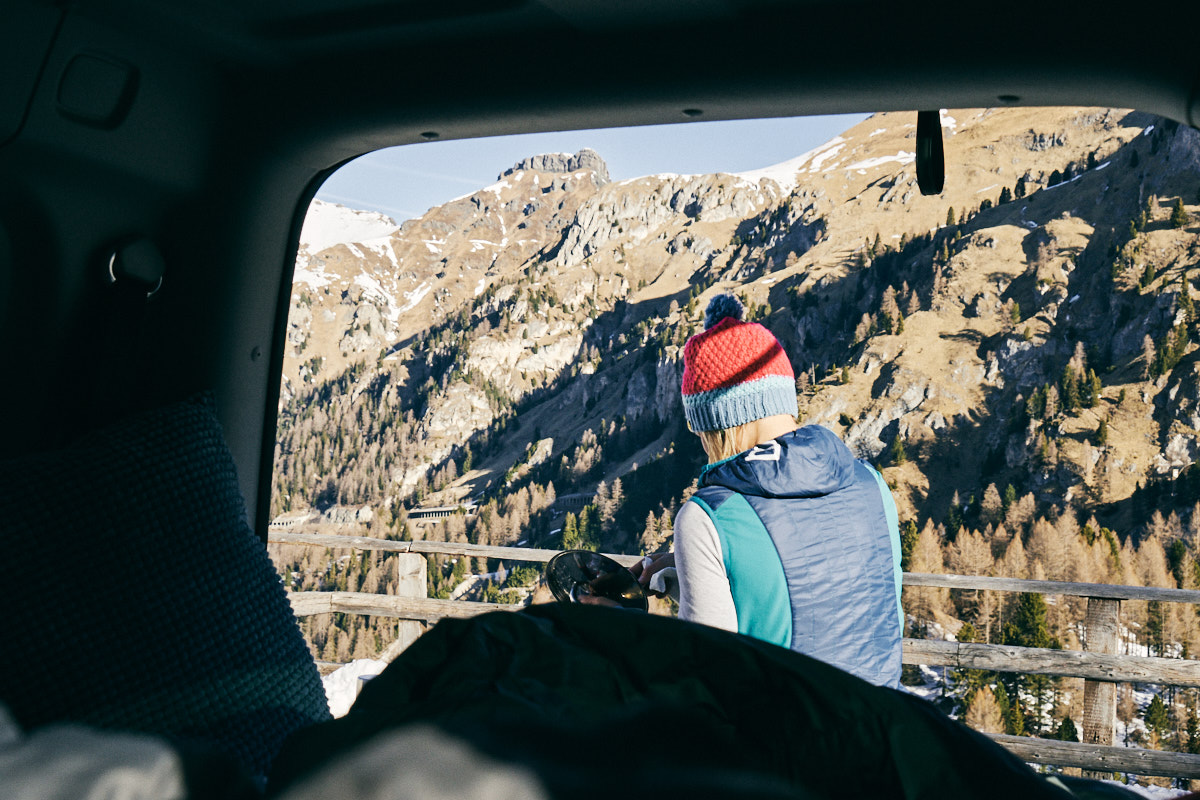
Or you don't need a car at all. There are car-sharing services such as Autonapůl, where you borrow a car only when you really need one. And the rest of the time someone else drives it. Which is green too, because making cars isn't free (for the planet, I mean).
Like going to the crag at the weekend. To the climbing wall during the week. Taking a parcel to the post office or popping to the shop. You can do that by bike, can't you? On your own, or in town on a shared Rekola bike. You're athletes, after all. True, there's no time. That's become one of the bad habits of our age – never having enough time. But what's the hurry? You'll never catch up anyway.
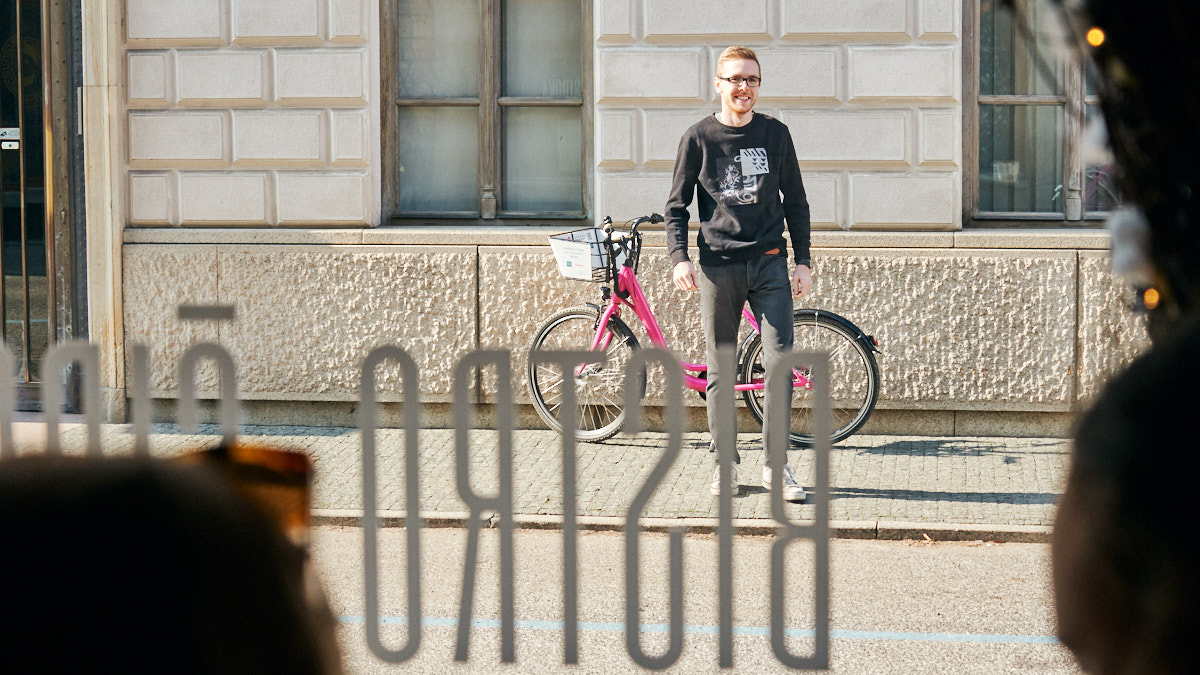
It's exactly this rush, the stress and the ever faster pace of everything – travel and mountain climbing included – that has become one of the main causes of pollution on the planet. Perhaps we should start thinking about where we're always rushing to and what we gain by it. And whether we actually lose more.
But that's for next time. We haven't covered nearly everything today.
Postscript: None of us is perfect. Not me, not you. And we never will be. But every small change we make to our lifestyle helps towards a better, cleaner planet. Do what you can.
But twenty years have gone by and something has changed. There I am, skinning up the Silesian Trail into Velký kotel on my touring skis. The weather's nothing special. The kind of fog only Praděd can conjure up. And it's a weekday. The mountains will probably be deserted today. But then, out of the fog ahead of me, the silhouette of someone on snowshoes starts to appear. We get closer, and when there are barely three metres between us, I say: "Ahoooj!"
And nothing.
Just a blank stare along the lines of: "Do I know you?"
Well, sure – maybe he was mute. Maybe deaf. Or maybe Hungarian.
But I don't think there are that many deaf-mute Hungarians wandering the mountains. Because it happens to me quite often: "Ahoooj!" And nothing. A blank stare. That's the better outcome. In the worse one, the person I've greeted doesn't even look up from their phone.

I mean, I get it on the way up Sněžka or on the tarmac road to Praděd. You'd never stop saying hello. Though I usually can't resist greeting people anyway. But it seems absurd to me when two people meet on a deserted mountain ridge and don't even mumble at each other.
OK, maybe "ahoj" (Czech for "hi") is too familiar. But believe me, I didn't improve my score with "dobrý den" (good day) either.
And so it occurs to me: if people don't even say hello any more, would they help if someone got into trouble? After all, statistics say that only one driver in ten stops at a road accident. Don't we like each other as people any more? Probably not. More likely a lot of people just don't know that you say hello in the mountains.
So please, say hello. It's polite. It's nice. And it's always been part of the mountains.
People can tell from your face that you're greeting them. Whether you say "ahoj" or "ciao" to an Italian doesn't matter. They'll get it. Still, it's a nice courtesy to greet people in the language of the country you're in. So here's a little guide.
"Cześć!"
"Hallo!" ... "Grüß dich! ... "Servus!"
"Salve!" ... "Ciao!" ... "Buongiorno!"

"Zdravo!" ... "Dober dan!"
"Salut! ... "Bonjour!"
"Salü!"
"Здравствуйте!" 🙂
And if, like me, you run into someone deaf, a slight raise of the right hand and a nod will probably be understood internationally.
So, here's to the mountains!
“Coming with us to Elbrus?” Well, why not. I spent the winter sweating in Cambodia, so in summer I'll be shivering in the Caucasus. Sounds like a good plan. “I'm in!”
But let's be clear: if my feet start freezing, I'm turning round and heading down. I have no intention of pulling any heroics on that hill. It's enough that at that altitude I'll struggle just to catch my breath.
And so off we went.
To Elbrus. To Russia. With Pegasus – the lowest-cost airline of all the low-cost airlines.
Right after landing in Mineralnye Vody, the barbed wire, the plain-clothes guy with a leather briefcase and the little room you don't get sent to as a reward made it crystal clear what kind of country we were dealing with. Lads, shall we just turn back?

Luckily, Osman saved the day. Our Russian contact cranked up a proper Kabardino-Balkarian disco in the car straight away and promised vodka, beer and shashlik. Then for 10 days he drove us around, fed us, hosted us and kept us entertained. He also took our passports. Who needs a passport when you know Osman, and Osman knows everyone?
First, to Russia as such.
So what did I manage to pick up in those first 12 hours? Cows are a normal part of road traffic. Nobody ever wears a seatbelt, because this isn't Europe, it's Russia. Yellow gas pipes form the backbone of local architecture. And a European toilet bowl concreted into the ground is nothing to be surprised about.

Anyway, when it comes to food, all is still right with the world here. The shops may be smaller than a newsagent's kiosk, but the fresh fruit, the veg and the homemade cheeses… brilliant!
Stock up on supplies and up we go.
Acclimatisation number two.
A three-day trek with a high point of some 3,800 metres. Up there on the meadows, horses graze freely and even let you stroke them. The paths are trodden only by the few mountain folk who pass through, and often we have to find our own way. Because someone must have built those cairns just to piss us off.

But we won't be beaten. Not even by the all-night rain that turned normally calm mountain streams into raging rivers. Well, we waded across with our buttocks firmly clenched.
We got a bit lost, too. Two heads are better than one… more are useless.

But we made it. And the washed-out roads and torn-away bridges in the valley suggested we couldn't have picked a better time for a trek in deserted mountains. The glaciers just happened to be melting a bit faster than usual.
“Disrespectful to the mountain, they say. Look at those Taiwanese. They're taking a snowcat all the way to the top. We're taking the cable car. We can play heroes up there.”
So here we stand at 3,800 metres at Garabashi, and our ribcages, so nicely expanded until now, start gasping for air again. After ten changes to the ascent plan, it's finally clear: climb as high as we can, acclimatise, sleep at Priyut 11 and set off for the summit early in the morning.

The first spanner in the works comes from the “landlord” at Priyut: “Mest net!”
What do you mean, no room, mate? We phoned you ahead.
In the end a room for the two of us turned up and we can carry on upwards. Making red blood cells. And it goes pretty well… in the ruts left by the snowcat. Above the Pastukhov Rocks we turn round and head down. To sleep. Or at least to try.

Hmm, no luck.
It's one in the morning, and half an hour's sleep before the summit push probably isn't ideal. Oh well, we'll see.
I strap on my crampons, pull on my beanie, step out of the door and... Two snowcats are flashing outside the hut and our neighbours from Taiwan are waving at me from the back. They're “going” up Elbrus too.
That really gets your goat. Oh well. We'll do it our own way.
We plod, plod, plod. For 4 hours now. “Bloody hell, that slope didn't look this endless on the map.” I lean on my ice axe like an old granny and wonder in vain where I've put my lungs. I can't feel the toes on my right foot. My snot has frozen into my beard. And for getting that dried apricot down I'd deserve a Piolet d'Or.

Watch out, snowcat!
About the fifteenth today.
And instead of giving those “mountaineers” waving from the back the middle finger, I wave back. Bloody mittens!
The sun comes up. Finally, the traverse. It should be plain sailing now.
It isn't.

We keep overtaking someone, then they overtake us again, and the hill seems to have grown overnight. Morale is gone. We're done. Turning back. This isn't fun any more. And I'd probably throw up any minute anyway. We're heading down.
Squeezing through a crowd and getting honked at by snowcats – that's really not what I'm after. We'd rather clear off to some deserted hill. Just because. To have a nice evening.
And that's just what we did.
As soon as we'd more or less pulled ourselves together, we pack the tent and sleeping bags and make a run for it. Well, run… more like limp. Elbrus must have squeezed us dry. On top of that I've got a cold, so I keep swallowing one garlic clove after another. It burns like hell. And what burns heals, right?

On the meadow above the weather station we can barely put one foot in front of the other. Above us, once again, is Elbrus. I collapse among the boulders like a sack of potatoes: “This is where we stop!”
Evening is drawing in and there's no one around.
Except for those old telegraph poles. “Hey, shall we make a fire?”
Judging by how few were left, we probably weren't the only campers with that idea. So: dry grass, a fire steel, and how did that old scouting handbook put it?
It's burning!

At 3,000 metres below the glacier. Deserted four-thousand-metre peaks all around us. We're completely alone here. Totally wrecked, curled up around the fire. The best evening of my life. And I don't even need Elbrus for it. No rush in the morning. So a dip in the little lake, lazing in the sun, and around noon we can start packing. Osman is already waiting for us.
On the way to Mineralnye Vody, Osman treats us to one last slalom between the cows. A Lada fleeing a police patrol whizzes past us on two wheels, and a girl waves from under a tree, offering herself for 500 roubles. 150 Kč. Good thing we slept through the journey there.
Spasibo, Osman. It was awesome.
And now come on, lads. Before they bill us for those telegraph poles.
text and photos: Honza Navrátil


Leave us your email and get good tips straight to your inbox
