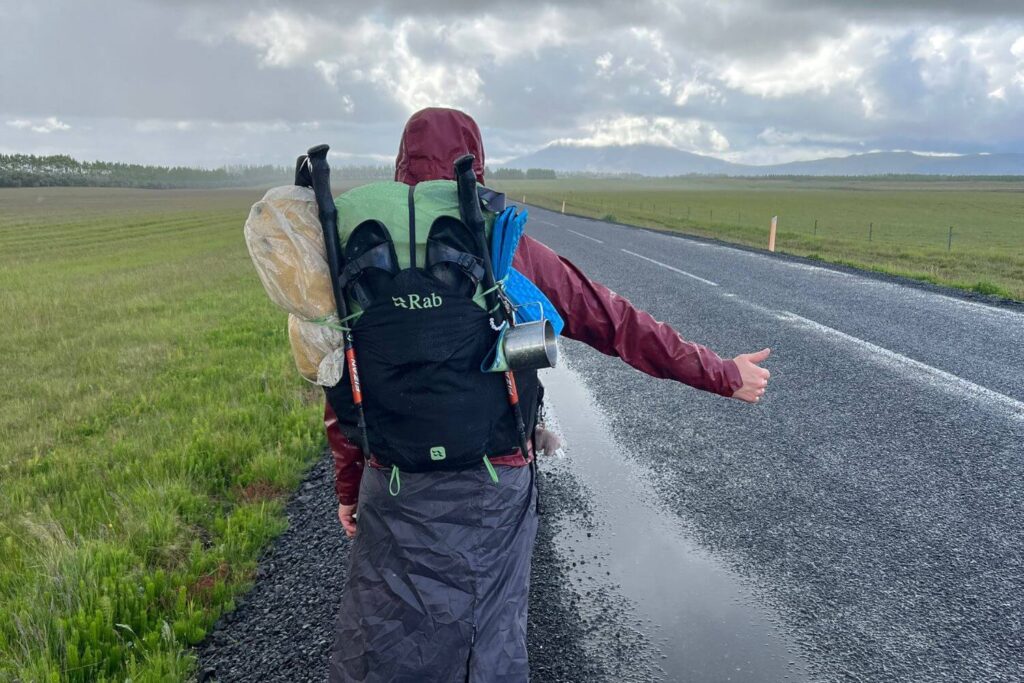
Filip was surprised the moment he first put the pack on. “It felt as if I had nothing on my back,” he says. The Rab Muon 50 is ultralight, yet sturdy. It holds its shape, you barely feel it on your back – and you quickly get used to not lugging any dead weight around.
Rab Muon 50 weighs 995 grams with a volume of 50 litres. The Spectra® Ripstop fabric is tough and resistant to tearing and UV light. The pack has a simple single-compartment design with several easy-access pockets. It's built mainly for long-distance trails – with the focus on low weight, stability and durability.

Out on the trail the pack sat on his back as if it had grown there. “The pack fits the body perfectly. I often felt like it was hugging me,” says Filip. And he adds that the more it was loaded, the better it carried. The unusual chest strap design takes a little getting used to, but then it comes naturally: “After a few days I'd got the hang of it with no trouble.”
The TRI-FLEX™ carry system sits snugly against your back and follows your body's movement even under heavier loads. Stability comes from a shaped lumbar pad and a wide hip belt that spreads the weight evenly. To save weight the back length isn't adjustable – it's fixed at 48 cm.

Everything in the pack had its place. “I'd say the organisation is its strongest point,” says Filip. A stretchy front pocket for a fleece or loo roll, a sleeve for a hydration bladder, shoulder pockets for your phone and a snack bar, and a lid split into two parts. On top of that, plenty of loops for carabiners or lucky charms. “Not everyone will like that there are no pockets on the hip belt, only on the chest,” Filip points out, “but over time I got used to it and ended up loving those chest pockets.”
The Rab Muon 50 has a removable lid with an outer pocket and an inner mesh one, two large side pockets and a roomy front pocket. Inside there's a sleeve for a three-litre bladder with a hose port on both sides. Top and bottom compression straps keep the load stable – and can even hold a sleeping mat.

On a long-distance trek through the New Zealand wilderness, the pack took a real beating. Filip carried it every day for almost three months. 1,300 kilometres, 76 days straight. Rain, scratches, mud, branches. “And it held up without any problems,” he says. The only casualty? A side pocket that fell victim to thorny bushes. “I was worried the hole would get bigger, because I kept using the pocket for my tent. But it didn't. The hole stayed the same and I could keep using the pack to the full.”
Spectra® Ripstop is a fabric designed for tough conditions. At minimal weight it resists tearing, abrasion and UV light. The pack isn't waterproof, but it dries fast. It's meant to be used with dry bags inside.

The Te Araroa long-distance trail also means stretches carrying 10–12 days of food. Filip overloaded the pack quite a bit. “I had 18–20 kilos in it and it handled it brilliantly,” he says. Even fully loaded it lost neither its shape nor its comfort. “Not only did that weight not faze it, it showed no signs of wear even at the end of the trek,” Filip notes. “And on top of all that, even loaded like that it was still incredibly comfortable.”
The back system and shaped lumbar pad hold up even under heavy loads. The Muon was designed for multi-day routes with changing loads – and when packed properly it keeps its shape and stability. How much it can carry depends more on your body than on the pack.

Filip used to carry a heavy, robust 65-litre pack. He thought long and hard about switching to the Muon – and has no regrets. “Getting the Rab was probably the biggest upgrade in my kit,” he says. Above all he appreciates the much lower weight, the cleverly designed pockets and the smart use of space.
The shoulder straps are wide and firm. The bladder has its own sleeve and a dual hose port. The hip belt has no pockets – storage is spread across the chest, shoulders and lid.

Right at the start of the trip, Filip accidentally set up a special durability test. Without realising, he left a pear in the pack, which quietly fermented in the inner pocket for a month. “I'd put the pack away nicely in a cupboard, where the pear lived its own life for a whole month. I was horrified and threw myself into cleaning it,” he recalls. In the end, lukewarm water and a cloth were all it took – and there wasn't a trace of the disaster.
The inner fabric has a smooth surface, is easy to clean and doesn't hold odours. Even fermented fruit didn't faze it. The pocket survived. The pear didn't.