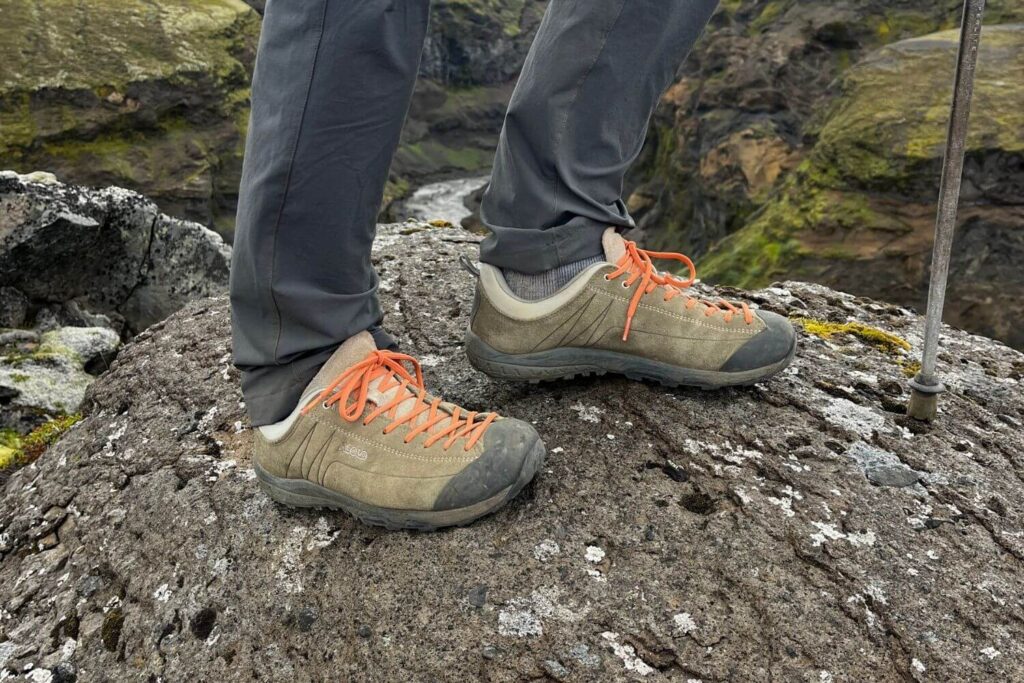
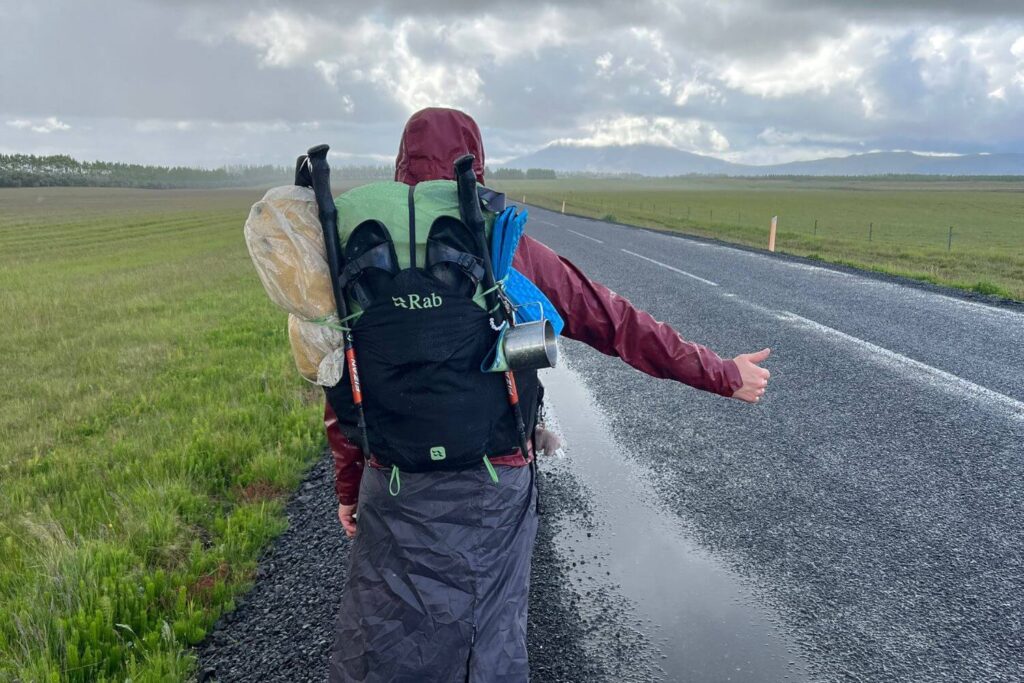
First impressions? "They fit like a glove. No pressure points anywhere, they hug your foot beautifully," Filip and Kika agree. Both packed several different Bridgedale models from Newtownards in Northern Ireland – different weights, heights and colours. "I had four pairs with me and only wore through one – the lightest one. But no wonder, I didn't exactly go easy on it!" says Filip.
Besides the comfort, they both loved the range of designs: neutral or wild colours, yet always functional. "I even wore a red pair that made me absolutely glow. Well, until it was covered in mud," he laughs.
In Newtownards, Northern Ireland, socks have been made for more than a hundred years. And in a completely different way from most other socks in the world. So in the end you only need a handful of Bridgedale pairs – and you save money.

On the Te Araroa, dry feet are a utopia. There's water everywhere – no bridges, no detours. That's where the trail goes, so that's where you go. "There were days when we had to ford more than seventy times," Filip recalls. Even the tiniest stream could turn into a torrent. "At first we tried to keep a dedicated pair of socks for crossings. But after a few weeks on the trail and several hundred fords we gave up and always used whichever pair was closest to hand – sometimes even the wet ones from the day before. And despite all that, the socks lasted the whole trail."
"We always took our shoes and socks off for lunch," Kika describes. "And even when the socks were completely soaked from the crossings, after wringing them out and an hour in direct sun we were putting on dry ones." Kika also compared them with the bamboo socks they had brought along: "The Bridgedales dried much faster, and partly thanks to that they didn't smell."
It all starts with natural merino wool fibre. During production it is "wrapped" in a tougher synthetic fibre, and this combination produces a dense, hard-wearing material that lasts for years of use.

It sounds unlikely – but that's exactly what happened on the Te Araroa. "I went through two pairs of shoes. Totally destroyed them. For the last few dozen kilometres I felt like I was walking more outside the shoe than in it," Filip laughs. "But the socks survived."
And it was the same story for Kika. Over 1,300 kilometres she rotated three pairs of Bridgedale – and all of them survived the trail without a single hole. Even though they went through hundreds of river crossings, mud, rocks and scrubbing in dodgy hostel washing machines. "Unlike our other friends on the trek, we didn't have to buy new socks because the old ones had holes in them," she says, comparing Bridgedale's durability with other brands, and adds: "Since we spent a lot of nights in huts with other hikers, we can also confirm that Bridgedales smell a lot less than the rest."
Straight after knitting, the socks are still considerably bigger than the finished product. Only after being steam-washed repeatedly and shaped on a last several times do they reach their final size. So they never shrink and keep their shape for good.

The toughest test of all? Longwood Forest. A place no ordinary walker in their right mind would ever go voluntarily. "Among hikers, Longwood has a reputation as the muddiest section of the whole trail," Filip explains. "And the stories definitely weren't lying."
Ahead of them lay two days and almost forty kilometres of terrain where there was no chance of a firm footing. Just mud, mud and more mud. "At first we tried to jump over it. But there was nowhere to jump to. So after a while we gave up and just waded through." Most of the time they sank in up to their mid-calves. Sometimes up to the waist. And they could never be sure what the next step would bring. "Luckily we were walking with our trail family and could help each other out of the worst bogs."
They spent the night in a hut with no water. They had to crawl into their sleeping bags covered in dirt. And in the morning? "There's nothing worse than pulling on frozen socks that are caked in mud through and through first thing in the morning," says Filip, and Kika continues: "When I was putting them on, I couldn't hold back a few tears. The socks were wet and icy. I thought my feet were going to fall off. Luckily the merino kicked in quickly and after a few hundred metres the socks were keeping me warm, even though they were soaking wet."
The natural antiseptic, antifungal and antibacterial properties of merino wool prevent odours from forming. So you can air your Bridgedale socks on the tent guyline or slip straight into your sleeping bag in them – and carry on in the same pair the next morning.

They reached the highest point of the trail – Stag Saddle – in exceptional conditions. Almost twenty centimetres of fresh snow had fallen on the summits overnight, and they ploughed through the fresh powder by headtorch. In lightweight trail shoes. "My shoes were nothing but holes by then, with my socks sticking out in every direction," Filip recalls. At sunrise it finally cleared up. Everything around them sparkled and little icicles were growing out of their shoes.
Filip and Kika originally wanted to include the number of river crossings in their trail stats. "But then we forded so often that we'd probably have lost count," says Kika. "And the trail builders threw a spanner in the works too – sometimes the route went straight down a river, and we had no idea how to count that."
Every pair of Bridgedale socks goes through a hand inspection before leaving the factory in Newtownards, Northern Ireland. And with socks checked like this, you also get a lifetime guarantee on workmanship and materials.