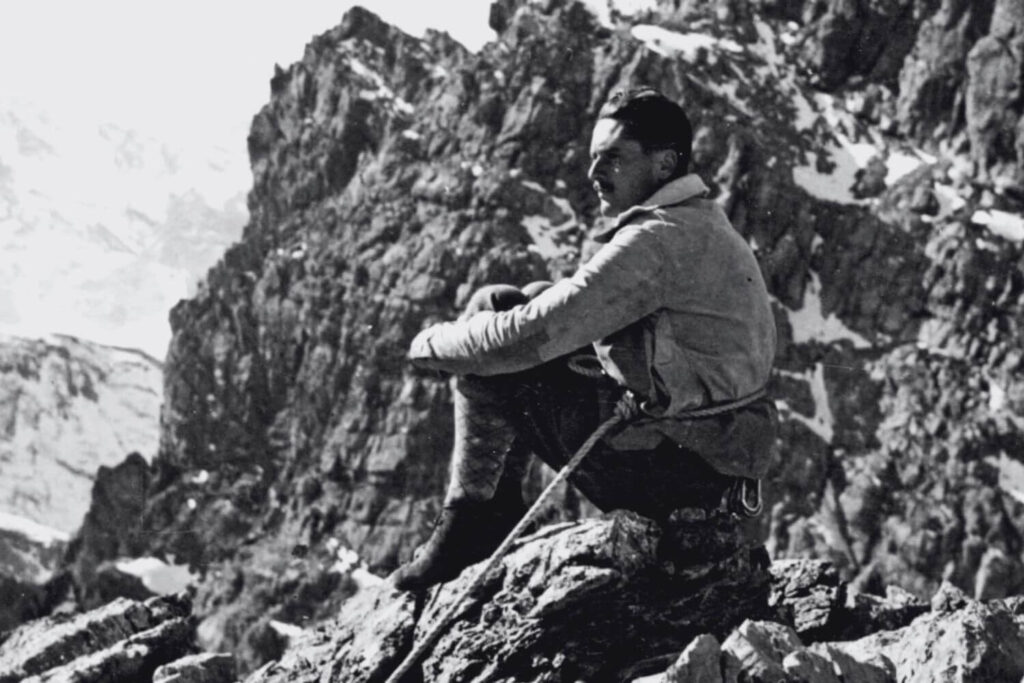
Dust. Dry, grey, clinging to his boots and to his soul. Gravel crunches under the wheels. A Puch 250 motorbike rocks along a road that leads nowhere – and yet people still ride it. A young man gazes out over the Kashmiri landscape. In one saddlebag, geological samples – in the other, a few books and a small notebook. On his face, the marks of wind, sun and solitude. Eyes that aren't looking for results, but for depth.
Herbert Tichy. A traveller who lays claim to nothing. He just looks. And heads into the unknown.
“I don't need a destination,” he reportedly once told a friend. “The urge to keep going is enough.”
He roamed Burma. He crossed the land of the Naga headhunters. Disguised as an Indian pilgrim, he circled sacred Mount Kailash. He rode across Afghanistan on his motorbike. And the Himalayas? They had been in his sights for a long time. But he didn't force the idea. He let it grow quietly. Until it ripened. No checklist, no fanfare. Just a quiet longing to head upwards.
“What if we gave it a go?” he suggested to Jöchler.
The Austrian climber, who had climbed the North Face of the Eiger, smiled. “Just like that? No oxygen? No big entourage?”
“Just us. And Pasang Lama. And a few more Sherpas.”
And so an expedition was born that had nothing to prove. It only wanted to get closer. To nature. To themselves. To the gods. Quietly.

Cho Oyu. Eight thousand one hundred and fifty-three metres. The sixth-highest mountain in the world. Locals call it the “Turquoise Goddess”. It is quiet and dignified – without the pomp of nearby Everest, which Hillary and Tenzing had climbed to great acclaim a year earlier. Perhaps that's exactly why it felt closer to them.
On 2 September 1954, seven Sherpas, two climbers and one doctor of geography set off from Bhaktapur. Eight hundred kilograms of gear – a mere crumb compared with the mammoth expeditions that crept into the mountains with dozens of tonnes.
“Namche,” whispered Pasang Lama as they reached the village beneath the mountains. “This is where the world above the world begins.”
The route to the Nangpa La. The glacier crunched underfoot. The horizon opened up. And there it was – Cho Oyu. Unveiled. Without pride. It just stood there. And waited.
“We'll go from this side,” said Tichy, pointing to the western ice face. “It's a labyrinth, but it goes. I believe it.”
“And if it doesn't?”
“Then we turn back. And say thank you.”

A camp at seven thousand metres. The tent stands firm, the snow beneath it hard as stone. Everything seems to be in its place. A quiet day, a clear sky. Ahead of them, only a mass of ice – and a direct line to the summit.
“Tomorrow we'll nail it,” Jöchler remarked, smiling beneath his icy beard.
“If the goddess allows it,” Pasang Lama added quietly.
But in the night, the sky changed.
At first just a rustle. Then a whistling. And finally a force that tore away everything that wasn't tied down.
“The pole's cracking!” Tichy shouted. The tent began to ripple like a belly dancer in the wind. Pegs flew out of the ice. The canvas above their heads danced a crazy dance. Tichy reached out to hold it down. At that moment, the wind snatched both his gloves.
“Scheiße!” he hissed. With bare hands he tried to save whatever he could. “We have to get out!” he shouted.
“We will die here,” Pasang Lama said quietly. And nobody contradicted him.

They descended back to Camp III. The snow crackled underfoot; otherwise there wasn't a sound. All the storm left behind was a ringing in their ears and a fatigue that had seeped through their whole bodies.
Heuberger was waiting at camp. “Show me your hands,” he said. Tichy said nothing. He just sat down and started rubbing them against his thighs.
They pulled three pairs of gloves onto him. Everyone tried to warm him up. But his hands stayed foreign – pale, stiff, unresponsive.
“Should I go down?” he asked later, more to himself than to the others. Nobody answered straight away.
Meanwhile, the weather calmed down. Jöchler and Pasang Lama set off upwards again. They established Camp IV – seven thousand and a few more metres above sea level. Everyone faced a decision: take Tichy with them, or not?
That evening, Tichy sat in the tent, hands in his lap. His mind somewhere between fear and defiance. “The route isn't difficult,” he told himself. “But these hands are dead.”
In the end, he decided.
“I'll go. And if it doesn't work out – I'll come back. I don't want to put you in danger.”

They climbed again. Not as victors – but as people going to fetch an answer.
Camp III – where the tent once stood, they now dug into the snow. A cave. Safer than flimsy tent canvas exposed head-on to the fury of the elements.
“This time we'll make it,” said Heuberger. A silent nod. The body was coming to terms with the altitude, the head with the decision.
The weather turned bad again. They huddled in the cave, sheltering from the wind. Endless hours without moving, and Tichy's hands still had no feeling. Then the wind died down. Three in the morning. Freezing, but calm. The moon floated over the Tibetan Plateau and the mountains around them glowed red.
“It's a good day for the summit,” said Pasang Lama.
They set off. Sepp Jöchler, Herbert Tichy, Pasang Lama.
The ice crunched under their crampons. Shadows stretched and shrank like breathing. The first section went smoothly. Their bodies soon gave in to the altitude. They were silent. Just breathing heavily. Always more ice ahead. And beyond it, more. And more. As if the mountain would never end.
Jöchler stopped several times. He was thinking of turning back.
“Don't turn around,” whispered Pasang Lama. “Not yet.”
On the so-called shoulder, they sat down. For the first time. Briefly. Then upwards again. Tichy tried to clamp his fingers around the ice axe so that his hand worked like a vice. On the ice, they were still moving without trouble. The problem was the rocky section just below the summit. Without hands, you couldn't hold on to the mountain.
Tichy forced himself on. He scrambled upwards with his shoulder, his forehead, his elbow. Not to win – but to be there.
Just below the summit, they stopped talking. There was no need any more. They knew it would work out. That this was it.

Suddenly the slope eased. No more ice ahead of them. Just a vast view too wide for the eyes to hold.
“Der Gipfel, Sahib! Der Gipfel!” shouted Pasang Lama. The first time he had shouted. Otherwise he stayed as quiet as the mountain.
They embrace. They laugh. Three people in a place where no one has ever stood before. The mountain is present. Not defiant. Just quiet. And close.
Tichy knelt down. Not from exhaustion. From gratitude.
“The closeness of heaven is overwhelming,” he later wrote.
They planted an ice axe. Tied on a little flag. Hid a piece of chocolate under the snow. A gesture of thanks. To the gods, to the wind, to themselves. They just stood there. Without words. Because everything had already been said.

Many years later. The hands are no longer so steady. The heart beats more slowly.
“I don't consider myself an extreme alpinist,” Tichy said shortly before his death. “It wasn't about performance. It was about beauty. About people. About the views.”
He doesn't just remember the summit. He remembers the shade of the tents. The human warmth in the cave. The silence between sentences. The hands of others.
“It wasn't heroism. More a harmonious passage into the heights.”
And perhaps that's exactly why he came so close. Not to the mountain. But to himself.
Herbert Tichy (1912–1987) was an Austrian geologist, writer, journalist and traveller. He studied geology and philosophy in Vienna. From a young age he made journeys to Asia – to Tibet, Burma and Afghanistan. He travelled intuitively, with an emphasis on understanding both the landscape and its people. He wrote reportage-style books, the best known of which is Cho Oyu – Gnade der Götter (published in English as Cho Oyu: Gift of the Gods).
Tichy's writing stood out for its simplicity and depth. He had no need for big words. His reportage was sensitive, vivid and free of self-importance. Rather than “conquest”, he wrote about inner landscapes and the silence that movement brings.
Cho Oyu (8,188 m) is the sixth-highest mountain in the world. It lies on the border of Nepal and Tibet. Its name translates as “Turquoise Goddess”. It is known for its “accessibility” – compared with the other eight-thousanders, it offers relatively gentle terrain, but still extreme conditions.
The first ascent of Cho Oyu took place on 19 October 1954. The team was Herbert Tichy, Sepp Jöchler and Sherpa Pasang Dawa Lama. The ascent was made in so-called alpine style – without oxygen, fixed ropes or support teams, in a minimalist spirit. At the time, it was an exceptionally clean way of climbing.
Sepp Jöchler was an Austrian mountaineer and alpinist. Among other things, he took part in the first ascent of the North Face of the Eiger. On the Cho Oyu expedition he was Tichy's main climbing partner and companion at the decisive moments.
Pasang Dawa Lama (1912–1982) was one of the most important Sherpas in history. He took part in dozens of expeditions and was valued for his calm nature, endurance and experience. Cho Oyu was his personal high point – the first time he stood on the summit of an eight-thousander, which held deep spiritual meaning for him.
Alpine style is a minimalist approach to mountaineering. Unlike “expedition style”, it relies on small teams, speed, independence and no artificial aids such as fixed ropes or bottled oxygen. In 1954 it was an innovative and bold choice.
The 1952 British expedition, which included Edmund Hillary, reached around 6,800 metres on Cho Oyu. The attempt had to be abandoned because of an icefall that seemed impassable at the time. In 1954 Tichy's team got through it in a single day.