First there was the wind. Then the ice. And only at the very end – the mountain. Nobody knows exactly when a human first set eyes on it. Maybe a shepherd. Maybe a wanderer. Maybe someone who got lost – and never came back. A mountain that rarely shows itself whole – only fragments, flashes, jagged shadows between the clouds.
The Tehuelche called it Chaltén – the Smoking Mountain. And to them it was sacred.
Sometimes it looked like a tower, sometimes like a beast. Sometimes like a dream, sometimes like a threat. It was never the same. It was always hiding. And whoever came closer learned that it couldn't be fought.
In the first half of the twentieth century it was drawn onto maps and named Fitz Roy – after the English captain who sailed to Patagonia with Charles Darwin. But a name alone isn't enough to understand a mountain. Least of all this one. It stood alone, guarded by glaciers, surrounded by winds that tear up trees. A tower of granite. And at the same time something more.
And then – in 1951 – the French arrived. Not as colonisers. Not as conquerors. But as pilgrims who wanted to go up.
They won the backing of Argentina's president Perón himself – a former Andean mountaineer. All the logistics were in the hands of his military government. He said only: "We'll get you to the mountain. You take care of getting up it."
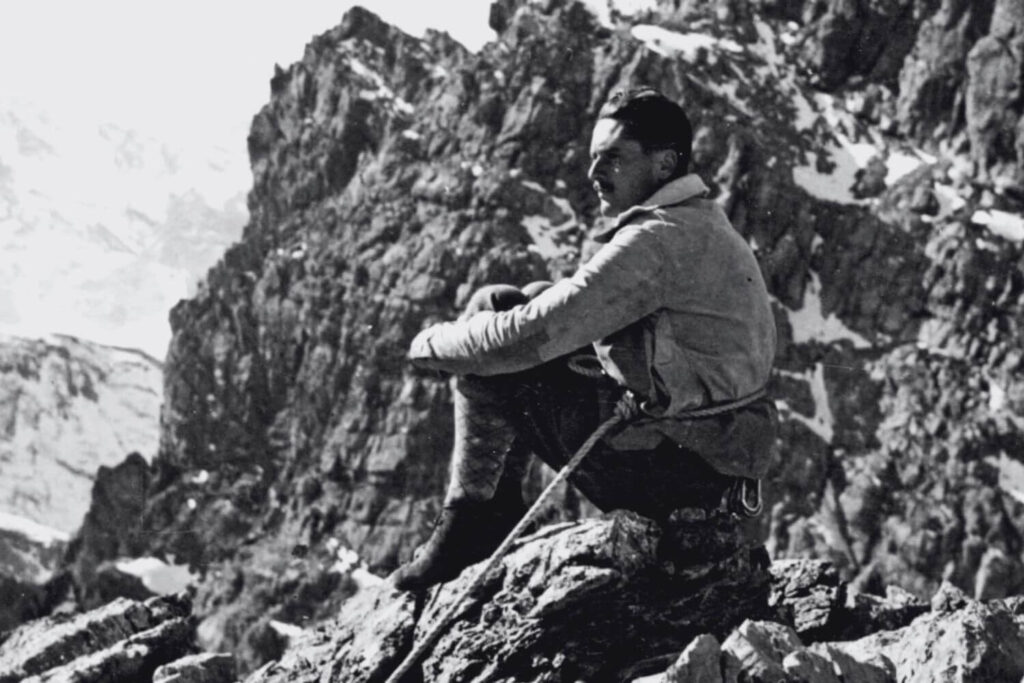
Elite alpinists, every one of them. Guido Magnone, Lionel Terray, René Ferlet, Jacques Poincenot. They brought ice axes, ropes, tins of sardines – and dreams in their heads that nobody had yet carried into that landscape. Which is exactly why they came.

A few days before the end of the year. Rain drummed on the tent canvas, water trickled down the taut guy lines. The Fitz Roy River was in flood – foaming, murky, wild. The waiting couldn't go on any longer. The supplies had to get closer to the mountain. Time was running short. And the weather could turn even worse at any moment.
Jacques Poincenot – a young climber with the soul of a poet and a body as supple as a bowstring – was among the first to reach the water. Rope wrapped around his chest. Steps against the current. The water up to his waist, muscles tense. And then – a jolt! A slip, a fall.
Poincenot was gone.
Sudden silence. And the current rolled on – as if nothing had happened.
They had lost a friend. The young voice of their evening debates. A climber who could have stood on the summit – and instead the water was playing with him somewhere beneath the surface. He left without a trace, without a goodbye.
A few days later they named the new camp by the Río Blanco: Campamento Poincenot. And then they packed up the ropes. The pitons. And their dreams. And set off towards the mountain that had just claimed its first victim.

Wind in Patagonia isn't just a sound. It's a state of being. It never dies down. It only grows stronger and tears at everything. Whatever isn't tied down flies away. Whatever isn't rock bends and twists.
The French expedition settled in a sheltered, quiet cove by the Río Blanco. A tent camp with a view of the glacier. Above it stood the mountain. In the mist – just like before. Just like always.
First they had to go round it. Study its precipices. Get a feel for the terrain.
They made it right up to the foot of the face. To the base of the granite tower. A col called La Silla, which an Italian expedition had already reached fourteen years earlier. That's where their plan began. They built the first high camp in a cave they dug out of the snow. Tents couldn't be relied on. One night a storm ripped them apart – and from then on they slept only in holes. An icy den. Two sleeping bags, damp, cold, a flask of tea.
On their backs they hauled ropes, pitons, karabiners, radios. They secured the route to the face with fixed ropes, cut steps in the ice, crossed snow bridges. Work in silence. Ten hours on the mountain every day. And then back – to the cave.
The summit attempts came one after another. 6 January. 11 January. 22 January. A little higher every day. A little further every day. But the mountain still had the upper hand. Fingers got frostbitten. An ice axe vanished into the void. They ran out of pitons. The wind tossed the rope from side to side like washing on a line. Lost crampons, frozen karabiners, a mist that seeps right into your lungs.
Terray and Magnone got the highest – but even they had to turn back. In a day they managed twenty-five metres. Out of seven hundred. And by the end of January they were all back at base camp. Tired. Wet. Exhausted.
The barometer fell, and so did their hopes. Magnone said nothing. Terray wrote in his diary: "Our hope of climbing Fitz Roy is as faint as the breath of a dying man."

30 January. The sky opened. For the first time in twenty days it stopped raining. The clouds drew back. The wind dropped. And something like calm settled in the air. Not real calm – but the kind only someone who has survived a Patagonian storm knows.
The French rose as one. Heavy packs on their backs. Inside them ropes, pitons, food for three days. Total focus in their eyes – and in their legs a fatigue that had long since become a habit.
Terray, Magnone and Lliboutry set off upwards. To Camp III, which until then had been more of a longing than a reality. One more time, one last time, they hauled everything up: ropes, gas stoves, the radio, spare crampons. They knew this was the last window. The last chance.
The next morning Lionel Terray and Guido Magnone head onto the face.
They know the first sections – they prepared them over the previous days. But now they're going further.
First pitch: a slanting crack, forty-five metres. Poor rock, corners glazed with ice. Terray hammers in pitons, Magnone is wedged in a chimney. They move slowly – tapping the rock like sculptors of antiquity. Piton. Karabiner. Another piton. And another. No time to talk. No time for doubt.
All day they wrestle with overhangs, icicles, razor-sharp granite. They inch upwards. In daylight they manage a hundred and twenty metres. Nothing more. But enough to carry on in the morning.
They return to Camp III. Exhausted. Breathing deeply. Bits of ice in their beards. Empty stomachs. Silence in the sleeping bags. And in the morning it all starts again – for real. No more fixed rope. No retreat. Tomorrow – they go all the way to the top. And Fitz Roy won't give them anything for free.

1 February 1952. 7:15 a.m. Lionel Terray and Guido Magnone leave the ice cave at Camp III. Outside it's quiet. That uncertain, tense silence before a change. The clouds hang low. The barometer says nothing – and they climb.
For the first four hours they climb the section they prepared the day before. They get through it fast, teeth gritted. At the end of the known route they exchange a look. Everything beyond is virgin rock. And hard.
The face is smooth, the rock crumbly. Icicles hang in the cracks, the corners are coated in a glaze of ice. They climb metre by metre. Traverses. Cracks. Sloping ledges. Five hours for twenty-five metres. A mix of fear and focus. The pitons are running out. Magnone pulls out his last thin piton. He's about to hammer it in – but at that moment he realises it's the wrong type. The face demands something else. As de cœur. The Ace of Hearts. Without it, there's no way. No way on.
He searches desperately – and finds nothing. He looks at Terray. Silence.
And then Lionel remembers.
Two days ago. Down at the bivouac. That tin of sardines. He needed to open it – and instead of a knife he used exactly this piton – As de cœur. Maybe he never put it back. Maybe it's – right at the bottom. At the bottom of the pack. His hand slides inside. Reaches deeper and deeper. Right down to the very bottom. He feels metal. Pulls it out. The blade is bent. But it'll hold.
Magnone grips the piton between his fingers – sets it against the rock – and swings the hammer. Clink, clink, clink! And hope moves a little higher again. The hardest part is behind them. From here the face loses its steepness. The ridge arrives. One more ledge. One more crack. One more layer of ice. And then – suddenly – the sheltered side opens up.
Evening is approaching. And Lionel Terray and Guido Magnone are standing on the summit of Fitz Roy.
Below them – mist. Above them – nothing. And all around – a wind slowly picking up.
No flags fluttering. No anthems playing. They just build a stone cairn – and tuck a note inside. Their names. And the date. That's enough. A summit isn't an explosion. It's an exhalation. And they still have a long way down.

Fourteen abseils. Each one long, endless. Each one shrouded in mist. Before midnight they're back at Camp III. For two days they've had almost nothing to eat. But they're back.
On 6 February they leave base camp. They pack everything – ropes, tents, sleeping bags, empty sardine tins. They descend to the Río Blanco. They cross the river that took their friend weeks earlier. And when they climb onto the back of the truck, they look back one last time. Fitz Roy is shrouded again. As if nothing had happened there.
But something did change up there. Something stayed behind.
A line winds up the face. The imprint of a tent lies in the snow. A steel peg hangs in the granite – bent, but solid. As de cœur. The Ace of Hearts. And a name that never existed before has appeared on the maps: Campamento Poincenot. In memoriam.
Fitz Roy stood. Stands. And will stand.
No matter who comes next. It doesn't need people. It doesn't need to be conquered. Only now and then, for a moment, does it open the gate. And then – only then – does it let someone in.
One February afternoon in 1952, it happened. Two men stood at the top. Tired. Exhausted. Happy.
Fitz Roy (3,405 m) is the dominant peak of the Cerro Torre Massif in southern Patagonia, in the Argentine province of Santa Cruz. The Tehuelche called it Chaltén, which in their language means “Smoking Mountain” – because of the frequent clouds that shroud its summit. It got its English name from Captain Robert FitzRoy, who mapped the area during his voyage with Charles Darwin in 1834.
The 1937 Italian expedition led by Renato Chabod and Giusto Gervasutti was the first to reach the La Silla col below Fitz Roy. Their climb ended at a spot later generations named Brecha de los Italianos. In 1952 the French picked up right where they left off.
The first ascent of Fitz Roy was made by Guido Magnone and Lionel Terray on 2 February 1952 as members of a French expedition. They climbed the south-east ridge and spent several days battling their way into the summit section. At the time the climb was considered one of the hardest ever – thanks to its combination of technical difficulty and extreme weather.
Jacques Poincenot (1925–1951) was a young French mountaineer who died on 27 December 1951 while trying to cross the flooded Fitz Roy River during a supply run. Today his name lives on in the popular base camp by the Río Blanco – Campamento Poincenot.
Lionel Terray (1921–1965) was one of the greatest alpinists of his time. With Louis Lachenal he made the second ascent of the Eiger North Face, and in 1950 he was part of the very first ascent of an eight-thousander – Annapurna (8,078 m). In 1954 he and Jean Couzy climbed Makalu (8,485 m). His book Les Conquérants de l'inutile (Conquistadors of the Useless) remains essential reading in the climbing world.
Guido Magnone (1917–2012) was a French mountaineer who combined top-level climbing with fine art – he studied at an academy of fine arts and worked as a sculptor. On Fitz Roy he led the key pitches and was the driving force of the expedition at moments when the others were sinking into scepticism.
Patagonian weather is known for its unpredictability and the extreme strength of its winds. The expedition faced many days of persistent rain, storms and violent gusts. Lionel Terray described the wind as “an endless force of nature that can't be beaten, only sat out”.
As de cœur (ace of hearts) is the French term for a type of very thin piton. Exactly one of these, forgotten in a pack after opening a tin of sardines, allowed Magnone and Terray to complete the last key pitch to the summit of Fitz Roy.