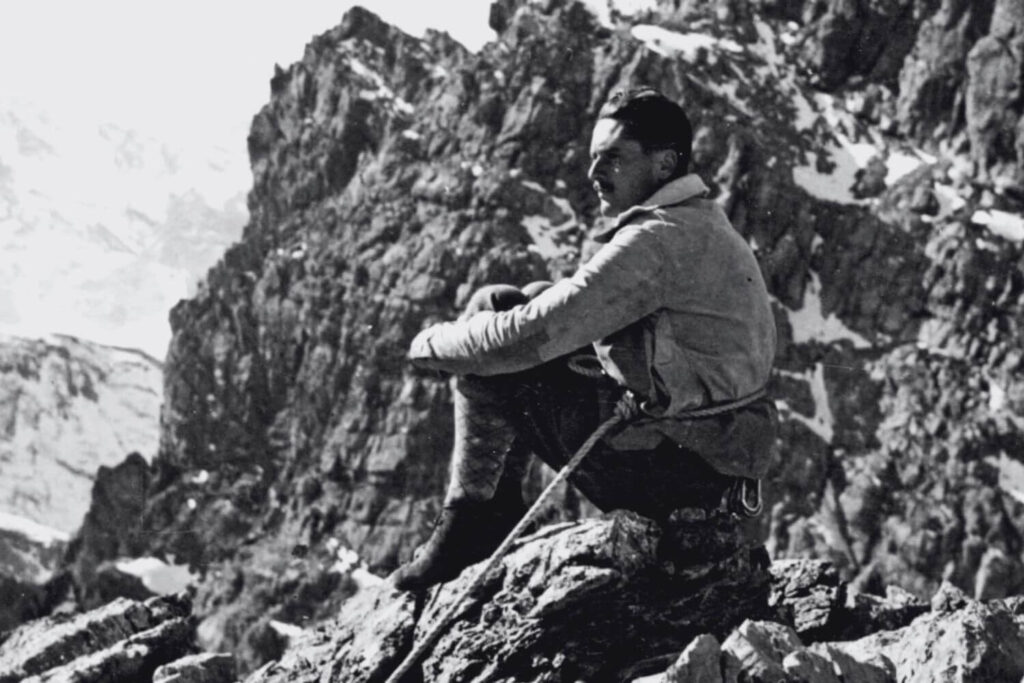
Willi Unsoeld turned up in Yosemite Valley just as twenty-something youngsters Royal Robbins, Chuck Pratt, Tom Frost and Yvon Chouinard were throwing themselves into vertical granite seas hundreds of metres high that no one had yet crossed. And he himself immortalised his name in a new chapter of climbing with several ascents of his own. Besides that, he also studied at three universities, and it was at Oregon State College in the autumn of 1950 that he first set eyes on his future wife. Her name was Jolene and, like him, she loved the mountains. Their first climb together soon followed, on the lonely, broad-shouldered summit of North Sister. According to Jolene, Willi fell in love with her GI climbing trousers, while she fell for his campfire stories.
Perhaps even then Willi talked about the spell cast on him by a 7,800-metre mountain in the Indian Himalaya, which the first adventurers and explorers had once looked up to as the highest peak in the known world – Nanda Devi. He was captivated by that stone face, whose sharp features and fine wrinkles bore millions of years of experience of bitter frosts, lashing blizzards and piercing sun – dazzled by the necklace of eternal snow swaying on the mountain's bare shoulders, its beauty deepened further by the orange tones of the setting Garhwal sun. Perhaps even then, to the crackle of wood in the flames lighting up their bivouac below North Sister, Willi and Jolene decided that if they ever had a daughter together, she would be called Nanda Devi.
And sure enough – in 1952 a son, Regon, was born, and two years later the Bliss-Giving Goddess, as the mountain's name translates, took shape in the body of little Nanda Devi Unsoeld.
The Unsoeld family of six – over the next four years a son, Krag, and a daughter, Terres, were born too – lived in a world of their own, full of mountains and adventure, which Willi himself pushed all the way up to the highest peaks on Earth. In 1954 he made an unsuccessful attempt on the still-unclimbed eight-thousander Makalu, he stood on the summit of Pakistan's Masherbrum, and in the spring of 1963 he sacrificed nine toes for a traverse via a bold new route that he and Tom Hornbein pioneered on Everest's West Ridge.

Once Willi had recovered from frostbite after several months in hospital, he set off for Nepal again. But this time for work, as deputy director of the Peace Corps volunteer organisation, with the whole family and for three long years. Returning from a simple world where people know nothing of stress, hoarding and lack of time to the wasteful American culture of the late sixties came as a real shock to the four children. Nanda Devi was a teenager by then, and on the day the deputy head introduced her to her new classmates, hardly anyone failed to feel the impact of her presence. Behind her wildly flowing blonde hair, boldly curious eyes and friendly smile, she left a deep furrow in the school corridor that was hard to miss. While most girls spent hours in front of the mirror every day trying to achieve the casual, carefree look of the flower children, meant to feign indifference to how they looked, with Nanda Devi it seemed genuine – she really didn't care what anyone thought of her.
The girls in her class were baffled by her; many of the boys were smitten.
Devi was different. She wore ragged khaki shorts or a skirt that looked as if she had roughly snipped off the hem with scissors that morning. She wore no bra under her loose, faded T-shirt, blonde hair peeked out from her armpits, and her torn canvas trainers had no laces. She cycled the thirteen kilometres from home to school in all weathers – perhaps that's why she sometimes smelled as if she had just come back from a three-day camping trip in the mountains. Once she arrived in class slightly late, water squelching in those rag trainers and leaving wet footprints on the floor behind her. Fifteen centimetres of snow had fallen that day, so she had pushed her bike through the drifts.
The ever-laughing girl somehow naturally leaned towards thrift and consideration – she hardly bought anything new and never threw away things that could still be useful. Her brothers, meanwhile, dug discarded unsold food out of the bins behind supermarkets. Devi got involved in social justice issues, took part in rallies against the Vietnam War and against famine in poor countries, and volunteered at a soup kitchen. But she never pushed herself into the limelight. So while her classmates enjoyed their moment of glory in mortarboards and gowns at graduation, Devi was sitting with her father on the summit of Mount Rainier.
Then, in the summer of 1976, the mountain whose name she had proudly borne for twenty-two years called Nanda Devi to itself.

Devi set off for base camp with her father and many other climbers, among whom twenty-eight-year-old John Roskelley stood out. Largely thanks to his incredible determination and climbing skill, the trio of Roskelley, Lou Reichardt and Jim States reached the summit of Nanda Devi on the first day of September – by a new route on the north-west face. Otherwise, though, the expedition was mired from the start in disputes and problems with gear and timing relative to the monsoon. On top of that, on the second day of the trek to base camp Devi developed an inguinal hernia. And during the subsequent climb up the mountain's slopes she was plagued by relentless diarrhoea. But Devi didn't let it show – she gritted her teeth and headed resolutely towards her destiny. After meeting the descending Roskelley and his partners at Camp III, on 3 September she summoned all her strength to reach Camp IV – the last before the summit. She battled difficult rocky terrain and her own body, and only collapsed into the tent, which two faster teammates had pitched in the meantime, after midnight. She had a tough day behind her and the weather was starting to turn. A summit attempt was out of the question.
For the following days, too, dark clouds gripped the tiny tent anchored high on the mountain's slopes, and the wind pounded the thin flysheet relentlessly. Three days later Willi Unsoeld also came up with supplies and gear to help the group to the summit. But the restless mountain had no intention of opening the way up, and the four of them decided to leave the exposed camp in the morning and descend. During the following night, though, Devi barely slept. Her stomach swelled fit to burst, so she had to sit and writhe until dawn to ease the abdominal pain even a little. In the morning she felt exhausted. Still, she believed she could manage the descent to the safety of Camp III. But just before noon, as the four were getting ready to leave, the drained Devi staggered and released a single word into the thin air in a quiet voice – her last: "I'm going to die." Then she collapsed into the snow.
The local porters, enchanted by the generous, ever-smiling girl with curly blonde hair, saw her death as a purely mystical event – the reincarnated goddess Nanda Devi had, they said, returned to her original home. So Devi did not die – for twenty-two years she had simply been the goddess in human form, and her temporary physical shell will rest forever on the slopes of the mountain, which people have been forbidden to approach for several decades now.
Willi Unsoeld successfully reached the summit of Nanda Devi even after his daughter's death. Three years later, at the age of 52, he was killed in an avalanche on Mount Rainier – a mountain he had climbed more than two hundred times in his life – while guiding a group of students to the summit.
Jolene Unsoeld lost both her daughter and her husband to the mountains, but with the motto “we must get up” she carried on living a full life devoted to public service. She was involved in many environmental and feminist causes and served as a member of the United States House of Representatives. She died on 28 November 2021 at the age of 89.
In 1983 the Indian government recognised the religious significance of Nanda Devi and, to protect its fragile ecosystem, banned both locals and climbers from entering the whole area around the mountain, which is a UNESCO World Heritage Site.
In 1979 Lowe Alpine decided to honour the memory of Nanda Devi Unsoeld with a new line of women's packs labelled ND – Nanda Devi. The company still uses this label today.