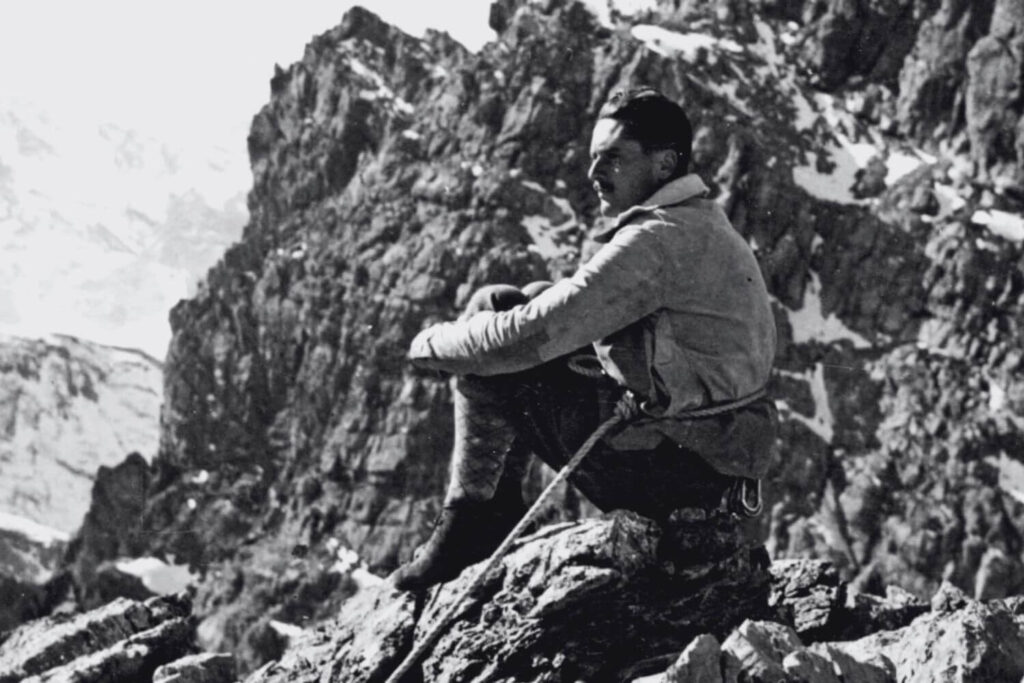
Hello Tenzing, how are you?
My life has returned to normal in my quiet Switzerland, far from Everest, where we lived through those intense moments. Not a day goes by without me remembering the moment we turned back, just as we were about to reach the summit. But at least we're still here to tell the tale.
Miss Henderson told me how you are hesitating to return to Everest with the English. They say you are too tired and don't want to go back without us.
You, Tenzing, tired? That's hard to believe. Just in case, here is a tin of Ovomaltine to perk you up. And as for the rest of us… After the English, the permit belongs to the French, come what may. So for me the roof of the world will remain a dream for ever. But for you anything is still possible: your journey is not over. A mountain awaits you that no bird can fly over. And if you reach the top, my friend, part of me will be on the summit too.
I enclose my scarf. It has been with me on all my summits. I will never take it to the roof of the world. But you can do it for me. Please! I will be waiting eagerly for the moment you bring this summit scarf back to me.
Ah-CHA, my mountain brother.
Your sincere friend,
Raymond Lambert

In that freezing February the sun had kept them company all day long. Just like yesterday and the day before. But now it's evening, and darkness will soon swallow the orange horizon behind the great Maudit. Time to find a bivouac spot.
Raymond Lambert stands on Pointe Médiane, the latest in the string of four-thousand-metre granite spires of the Devil's Needles they have conquered. Three quarters of the hellish traverse, which nobody has yet completed in winter, are behind them. Him, twenty-four years old, freshly graduated top of his class from Switzerland's renowned mountain guide school. His colleague Marcel Gallay, six years older. And young Erica, a wealthy girl from Geneva who did twelve serious Alpine climbs with Lambert last year alone.
So most of the technical difficulties are behind them. And ten metres below the summit they find a spot where they can sit out their third night.
Around ten o'clock they're still watching the moon. Moments like this are why they scramble all the way up there. But around midnight – it's as if someone has started hammering on a sheet of tin. Only a wind gone wild can make a racket like that. Gallay reaches in vain for the stove as it flies through the air. This isn't wind any more. It's a gale. And it's snowing heavily.

Lambert and Gallay have been through several bivouacs like this before. Only young Erica is frightened by the half-metre dump of snow. The rock, which had been dry for three days and could be climbed without gloves, now lies buried. Everything is white, cold, terrifying. The world seems to have suddenly shrunk. As if it were closing in on them from all sides.
They have three ways out of there. And none of them is good. They rule out retreating over Pointe Chaubert straight away. For a while they hesitate over the couloir between two summits, but with that much fresh snow? The risk of setting off an avalanche is too high. All that's left is to keep going. They have to finish the traverse all the way to Mont Blanc du Tacul.
Raymond Lambert leads. Fragile snow cornices make terrifying sounds under his weight, though he can't hear them over the roar of the wind anyway. The ropes are frozen so stiff they're more like iron wire. If only they don't snap. “Careful now!” They send the rucksacks across on them like a cable car. A Tyrolean traverse, it's called. And still – one of the packs tears open on the rock and the tins of food, all their supplies, vanish into the depths. They bounce off the stone armour of Pointe Carmen, and after the last bounce the grey fog gobbles them up. Chomp!
On the open slopes below Mont Blanc du Tacul they're an easy target for the gale. It lashes their faces. It stings and bites. It knocks their already weak legs from under them and forces them to bow before its power. On the final ridge it's so strong that it literally lifts Erica, walking between Lambert and Gallay, and flings her over the crest to the other side. “Phew, good thing we roped up!”


Another freezing night, backsides squeezed onto a small rock ledge. The wind blows straight at them; their sleeping bags are full of snow. They tie Erica in again, so the next gust doesn't carry her off like that stove. It's night and they should be sleeping. Gathering strength for the next day. And yet they're straining every nerve to do the exact opposite. “Whatever you do, don't fall asleep,” Lambert mutters to himself. At minus forty degrees, that would mean never waking up.
In the morning they can't see much more than in the middle of the night. Everything merges into one single colour; only the black has been replaced by white. But they have to keep going. Blind, if need be.
They wade through the snow towards the Col du Maudit. Their clothes are as stiff as sheet metal. Everything on them has got wet and frozen. They still haven't managed to drop below four thousand metres. They're trapped in conditions the human body was never made for. And then – they don't even know which way to go. “Where the hell does the snow end and the sky begin?”
Lambert spots a small crevasse. A short hollow, which they widen at the end into a cave with their ice axes, sealing the entrance with blocks of hard snow. Inside it's noticeably warmer. Three little flames of human life are still glowing. Their warmth heats the surrounding snow and ice – but that's not good. Everything melts, everything is damp. Their sleeping bags are more like wet floor cloths than a warm refuge from the fury of the mountains.

A few squares of chocolate, a handful of dried fruit, a packet of Maggi soup and some aspirin. That's all that's left. Desperately little to satisfy hunger and give them strength. They can't get a fire going from an ice axe shaft either. Even that is too damp. So they just stir the soup into snow and stuff the icy mush into their mouths. Their throats burn; the thirst is so strong they start drinking their own urine.
Lambert gives the place a name: the Hotel of Slow Death. Because of frostbite he can't feel his feet at all, and he can't move several of his fingers either. Gallay is losing the feeling in his left foot. Only Erica's blood is still flowing into the furthest extremities of her body – partly because the two guides take turns massaging her feet. They look after her.
After three days Gallay breaks a hole through the cave wall – and sunlight pours in. The storm is over. But their hopes of returning to the world of the living haven't grown one bit. Neither Gallay nor poor Erica can stand on their own feet any more. And on top of that, that damned, impenetrable pea soup is rolling in again!
“I'll try it alone,” Lambert wheezes.
He wanders among seracs and crevasses. He wades through snow. At every step he sinks in, each time to a different depth. “Damn it!” He's like a drunk staggering home at dawn after a night on the town. But while the drunk can sleep it off and the world will set itself straight again, Lambert must not stop. To stop means never getting up again. He fights on and doesn't give in – until a group of Geneva rescuers on skis spots him on the glacier below the Gros Rognon.

Fourteen years later, Raymond Lambert feels much as he did back then – in the crevasse on the Col du Maudit. They have no sleeping bags, no working stove – and so nothing to drink. All night long they try to melt snow over a candle, the only tiny flame they've managed to coax into life at 8,400 metres. But it's desperately little. So little against the thirst an eight-thousander can bring on.
The oxygen sets lie ready by the entrance to the small tent where, on the south-east ridge of Mount Everest, they're exposed to a brutal wind. It's clear that in such cold the valves meant to let the life-giving gas flow into their tight lungs won't work reliably. If at all.
Lambert pulls out his last piece of cheese – and shares it with his friend.
They don't really understand each other. Lambert speaks only French, and Tenzing Norgay only broken English. But sometimes two people don't need words to find a common language.
When Tenzing arrived on foot from Darjeeling a few weeks earlier to join the Swiss Everest expedition along with thirteen other Sherpas, he immediately noticed Lambert's tiny feet. As if he were wearing children's boots. As if that part of the body didn't belong to the mountaineer at all. After the Devil's Needles, the sap of life could never be made to flow in Lambert's feet again – he lost all his toes and had to learn to walk again.
It was also the first expedition on which Tenzing was accepted as a full member. Not just a mere porter. To the Swiss he was an equal partner – and he spent most of his time with Lambert. They broke trail for each other, melted snow for tea and pitched one tent after another together on the slopes of the Mother Goddess of the World. This one was the seventh. The last.

Morning confirms what they suspected. They can breathe a little oxygen from the sets while standing still. But as soon as they need to take a deep breath, the apparatus seems to clog up. In practice they're climbing in the death zone without oxygen – just with dead weight on their backs.
At the end of the snow ridge, the South Summit of Mount Everest takes shape before them. So close. And yet infinitely far. They'd love to. They'd so love to. “The first people on the highest mountain in the world” – how wonderful that would sound. But their tongues stick to the roofs of their mouths, their eyes keep closing, and when it won't go any further – which is most of the time – they crawl on all fours along the back of the Mother Goddess of the World. The wind is picking up, the monsoon is coming; a mountaineer can tell. The first clouds roll over the mountain and the temperature drops again.
Raymond Lambert and Tenzing Norgay are standing higher than anyone has ever stood. But they're not on the summit.
They look each other in the eye and understand without words that going on means plunging into a deadly state from which there's no return. They descend, knowing that the way to the summit of Everest is possible. With working oxygen sets, better hydration, perhaps a better plan too.
Yes, it's possible to climb the highest mountain in the world. Just not for the two of them together. For the two highest friends in the world. Because they both also know that next year the British will be back beneath the mountain.
Tenzing Norgay (1914-1986) returned to India in a badly weakened state after the two Swiss attempts on Mount Everest in 1952. A combination of extreme altitude exhaustion and tropical malaria meant he spent the following months in hospital. When the offer came to join the British expedition in spring 1953, Tenzing turned it down, saying he would rather wait for the Swiss to return.
Raymond Lambert (1914-1997), at the request of the British liaison in Darjeeling, Miss Henderson, sent Tenzing a letter trying to persuade him to accept the offer to join the British expedition. He also asked him to bring back from the summit the scarf Lambert had taken on all his mountain expeditions. He thus played a key role in Tenzing joining the British expedition at all.
After the successful British expedition of 1953 (Edmund Hillary and Tenzing Norgay himself reached the summit on 29 May 1953), Lambert and Tenzing met again in Zurich. Tenzing symbolically returned the red scarf that, at his friend's request, he had carried all the way to the top of Mount Everest. In the years that followed, Tenzing came to Switzerland several more times and stayed with Lambert's family. Lambert helped him in his new role – he became director of the mountain guide school for Sherpas in Darjeeling. And Tenzing repeatedly called Lambert his best friend among Western mountaineers.
In February 1938 Raymond Lambert, Marcel Gallay and Erica Stagni attempted the first winter traverse of the Aiguilles du Diable (Devil's Needles) ridge above Chamonix. They set off on the morning of 7 February. On the evening of 9 February the weather took a sharp turn for the worse.
On 13 February Raymond Lambert came across a group of rescuers who were already thinking of calling off the search. They took him to the safety of the Requin hut, where he lost consciousness.
On the morning of 14 February the rescuers found Marcel Gallay and Erica Stagni in the crevasse. Temperatures dropped as low as minus 40 °C. Erica Stagni was carried down to the valley first. Gallay stayed in the crevasse with a few pieces of dried fruit and some rum, and the rescuers promised to return within a few hours. But avalanches had partly buried the first rescue team's tracks, and the second team struggled to find Gallay. In the end they heard him calling. Without that, they probably wouldn't have found the crevasse.
Lambert, Gallay and Stagni ended up in a clinic in Geneva, along with several rescuers who had suffered severe frostbite themselves. Lambert had all his toes and several finger joints amputated. A year later he had special “children's” boots made and returned to climbing and to work as a mountain guide. Marcel Gallay lost all the toes on his left foot and never returned to alpinism. Erica Stagni left the clinic after three weeks with no lasting effects and went on climbing intensively (among other things, she made the first female ascent of the Brandler–Hasse route in the Dolomites in 1964).