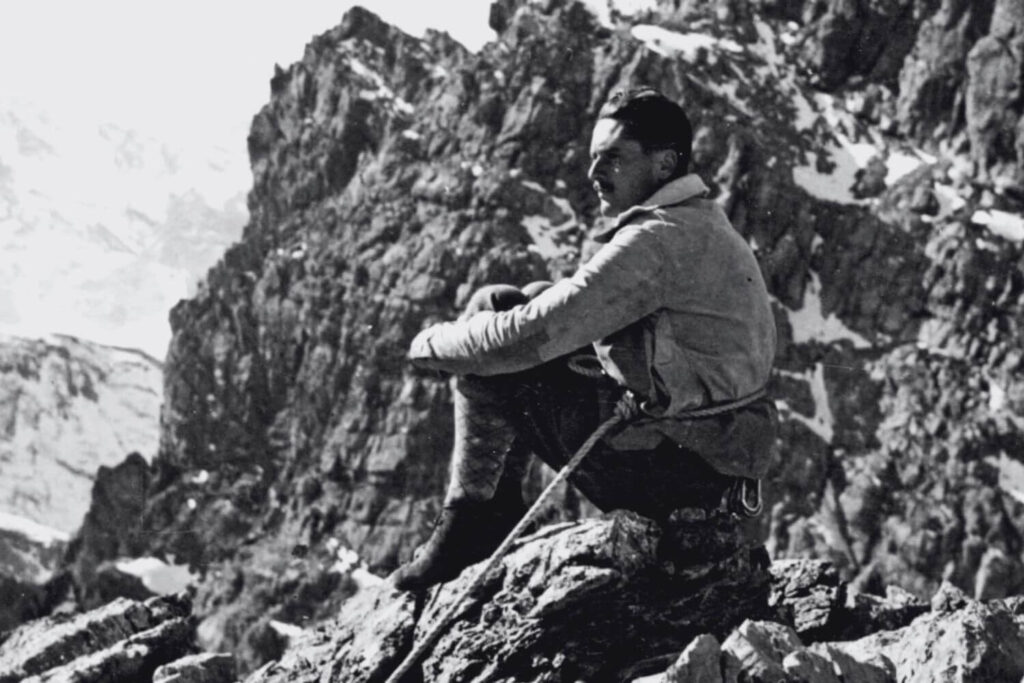
Poor Gousseault hasn't let a single syllable slip from his frozen lips since yesterday. Is he still alive? It seems so. Judging by the faint little clouds squeezing between his lips into the stifling air just below the summit ridge of the Grandes Jorasses, Gousseault is still alive. He sits there, huddled, on a rock ledge barely a metre wide. Wrapped in ropes, his back frozen to the wall.
Desmaison sits beside him in his blue sleeping bag, trying over and over again to wiggle his fingers and toes. He doesn't want to lose them. There is still hope. The summit seems so close. Some eighty metres. So very near – and yet so far. After nine days of exhausting climbing – after a thousand metres of sky-high toil – the steep, smooth slab that suddenly loomed in front of them seems to be laughing at them. It stood in their way and put an end to everything. They couldn't go up – the utterly drained Gousseault could barely stand – and they couldn't go back either. All they could do was stay put – and wait.
The great French climber René Desmaison is dozing off. The cold is lulling him to sleep, just as it lulled poor Gousseault. His eyelids, weighed down with frost, are getting harder and harder to prise open. Desmaison drifts up – and then sinks. He tumbles into the arms of ghostly visions that carry him far away from the cold, the kind of cold that never lets go once it has you in its grip. But a rumble carried on the air brings him back to the icy ledge. Back to the face where the sun never shines.
As if someone were hammering on a tin roof. It seems to be getting closer and closer.
A red machine emerges from the clouds. The clatter of rotors bounces off the wall. Desmaison is still dazed. Reality, or a dream? But the pressure pounding on his eardrums is far too convincing. And then a man appears. The side door of the helicopter slides open and the figure of a mechanic takes shape in it. He is so close that, if it weren't for the roar of the rotor, they could almost have a chat.
The mechanic gives a thumbs up, then turns it downwards. That's how he asks: "All OK? Or do you need help?"
Desmaison wriggles his limp arms out of the warmth of the sleeping bag. He waves them in a few gestures and points an outstretched finger at the sleeping Gousseault. The helicopter shudders and suddenly pulls away from the wall. As if blown off by the wind. Whoosh... and it vanishes behind the clouds. Leaving the two of them alone again, in the embrace of their mountain.
The rumble fades and Desmaison tucks his hands back into the sleeping bag, again trying to move his waxy white fingers, which the frost has instantly sunk its teeth into. But suddenly the rumble grows louder again. It's coming back. The helicopter re-emerges, appears right in front of them, and for a moment Desmaison stares into its glazed nose, which looks like the eyes of a fly. Their gazes meet, and then he just listens as the clatter fades and fades – until silence returns to the face for good.

"They're fine, he gave a thumbs up," reports gendarme Monet after climbing out of the helicopter in Chamonix. "Eighty metres from the summit. You know Desmaison, how he hates to lose."
So they don't need rescuing, that's that. They want to keep fighting for the summit on that terrifying Walker Spur. Desmaison has a reputation that goes before him. He is a professional climber. And a media star, too. Three years ago, several times a day – for a whole week – he reported from that very same face of the Grandes Jorasses to eager RTL radio listeners on how their first ascent was going. And two years before that, French television followed his expedition on the Italian side of Mont Blanc.
Now, too, journalists and reporters are gathering in the valley. René Desmaison – the name is a licence for drama that brings in the ratings. But it's been thirteen days since they left the Leschaux hut before dawn. Three days since the encounter with Monet's helicopter just below the summit – and still no news of the two climbers. Serge Gousseault's wife begins voicing her fears in front of the cameras and microphones. But by now the wind on the French side of the mountain is blowing far too hard for the helicopters from Chamonix to land on its ridge and drop off rescuers.
The days add up. The climbers stay silent, the rescuers just stare at the dark sky, the media smell blood. And pilot Alain Frébault, called in as reinforcement from Grenoble, heads for the mountain from its far, Italian side.

A flicker of life still shows in René Desmaison's eyes. In the tiny, ice-laden slits a familiar face is reflected. Gérard Devouassoux. The two have met before. Five years ago on the west face of the Dru, when together they tried to rescue two German climbers and Desmaison tried to grab the credit for himself in front of the cameras. Now the roles are reversed. René Desmaison is the victim, and Gérard Devouassoux is about to become the one the journalists will call a "hero".
The wind slams into the face. An icy, choking blast that sucks everything alive out of the human body. From Gousseault it has already taken all it could. He stopped breathing long ago.
Gérard Devouassoux tries to wriggle Desmaison out of his sleeping bag and tie him onto the rescue rope, which hangs from the top of the mountain like a spider's thread. But the groggy shell is only a shadow of the Alpine giant and doesn't make the job any easier. Desmaison is aware, but has no control over himself. He lies there on the snow-covered rock ledge, balancing with one foot in life and the other in death.
At the last moment his rescuer pulls him over to the better side. And up they go. Where René Desmaison wanted to climb under his own steam, others are hauling him. Alain Frébault's helicopter has nested in a small col near the summit. His remarkable calm – and the weaker turbulence on the Italian side of the mountain – allowed him to land in an eagle's eyrie his Chamonix colleagues never stood a chance of reaching. He made it just in time. In time for Desmaison. Poor Gousseault will have to wait for better weather.

"Slowness and an evident lack of conviction," René Desmaison vents from his hospital bed, live on ORTF radio. Once the microphone goes quiet, he is even sharper: "Somebody wanted me dead!"
The rescuers hit back: "Why did Desmaison wait so long to call for help? Why didn't he use the standard distress signals?" And Captain Mollaret himself, who thoroughly examines and investigates the whole affair, reaches a conclusion that can only be called devastating: René Desmaison is to be charged with manslaughter!
Maurice Herzog, mayor of Chamonix and the first man ever to stand on an eight-thousander, adds a more philosophical note to the stormy waters: "How would we ourselves behave in such a situation? These are inner debates that touch on people's deepest motives, and they can only be discussed with the utmost discretion." Why is it so hard for climbers to ask for help? It is the realm of personal choice, the realm of one's own ego and cognitive biases, where you end up eighty metres from the summit. How can you accept turning back and failure in a situation like that? Why does the summit of a mountain polarise human desires so strongly?
A few weeks later the prosecutor drops the whole case. The media find another morsel. The world rushes on. René Desmaison leaves hospital. An outcast to some, but he sees it differently – and heads upwards once more. For his own glory, and in Gousseault's memory.


René Desmaison (1930-2007) was a French mountain guide and top climber. Over his career he climbed more than a thousand summits and made 114 first ascents of previously unclimbed routes in the Alps, the Andes and the Himalaya. He also had several winter first ascents in the Alps to his name. As a climber with a very high media profile, however, he was also caught up in several controversies.
Serge Gousseault (1947-1971) was a French mountain guide who was only 23 at the time of the winter ascent of the Walker Spur on the Grandes Jorasses with René Desmaison. Before that he had climbed the Grandes Jorasses in summer by the Cassin route and soloed the Gervasutti Pillar on Mont Blanc du Tacul.
Desmaison and Gousseault began their attempt at the first winter ascent of the Walker Spur on the Grandes Jorasses on 10 February 1971. During the difficult climb their ropes were damaged by falling rocks, and bad weather slowed them down too. Serge Gousseault began to succumb to exhaustion and hypothermia, his hands were frostbitten and the climbing grew harder and harder for him. They were running out of pitons, their food supplies were dwindling and they also lost radio contact. Gousseault died of hypothermia and exhaustion eighty metres below the summit. The exhausted Desmaison was left stuck on the rock ledge, waiting for a rescue that only came on 25 February – after two weeks on the face.
After the return to the valley a fierce media and public controversy flared up. Desmaison publicly accused the authorities and rescuers of a far too slow, half-hearted response and claimed that this was exactly what had cost Serge Gousseault his life. The authorities, on the other hand, asked why Desmaison had hesitated so long before asking for help and why he hadn't given clear SOS signals. It all culminated in a manslaughter charge and a nationwide trial by media.
In the end, the affair contributed to a fundamental reorganisation of mountain rescue in France. Rescue operations passed from the hands of local mountain guides mainly into the hands of professional, centralised bodies such as the PGHM de Chamonix.
On 16 February 1973 René Desmaison, accompanied by Italian guide Giorgio Bertone and Chamonix native Michel Claret, managed to complete his direct route on the Walker Spur of the Grandes Jorasses, which he named the Gousseault route.
342 Hours on the Grandes Jorasses (342 heures dans les Grandes Jorasses) is the title of the book René Desmaison wrote about the whole affair. In 1994 it was also published in Czech.