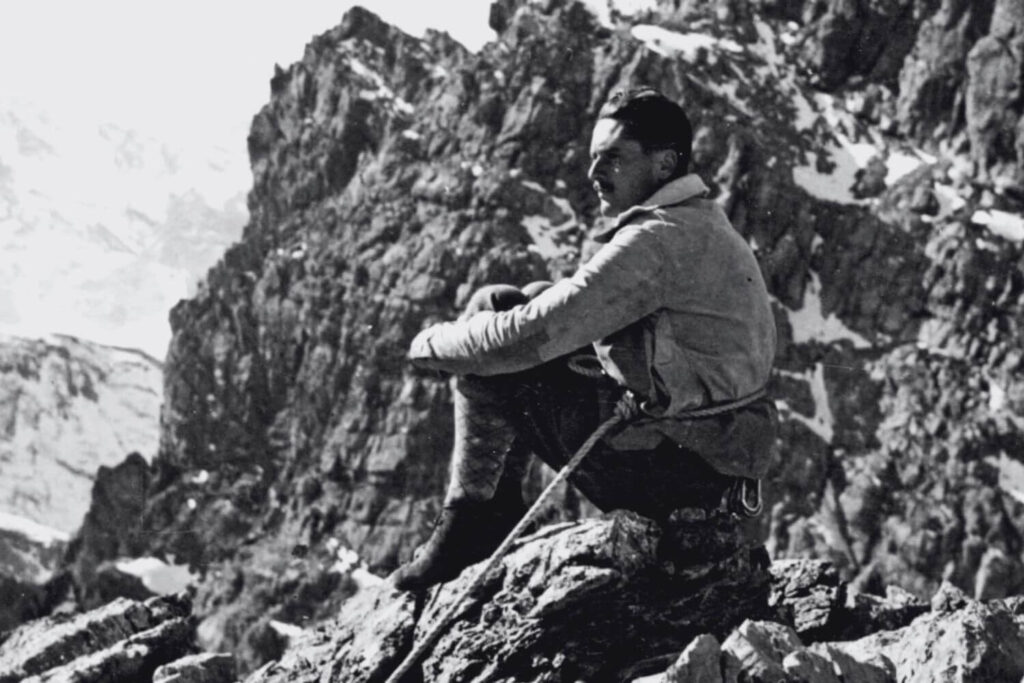
Philadelphia winters were never the legendary kind. Snow simply fell quietly asleep on the rooftops, carriages left grey ruts between the houses and the ice on the river looked bored – like icicles on a cathedral wall. But in one small bedroom a different frost held sway. Feverish, burning.
Little Elisha lay under a blanket pulled right up to his chin. His forehead was damp, his fingers cold. On the opposite wall hung a map – yellowed paper with wax seals along its edges. The dots of cities sat in the lower part, but across the top, from right to left, there ran only a white band. A world without names.
The fever buzzed in his ears and his heart beat unevenly, as if it wanted to run away. His father's voice drifted up from downstairs – Judge John Kintzing Kane was talking to someone in a low voice in the hall. "He must take it easy," slipped up the stairs to his ears. "No great exertion. Otherwise it'll get him faster than a bullet."
He lay there, listening to other people's conversations that were about him and yet didn't belong to him. Others decided what he could and couldn't do, how many steps were safe for him, which profession wouldn't upset his heart. Meanwhile he watched that white patch on the map as if it were a crack in the wall. An escape to a place where everyone decides for themselves.
He was nine years old. And he hoped he would go there one day.
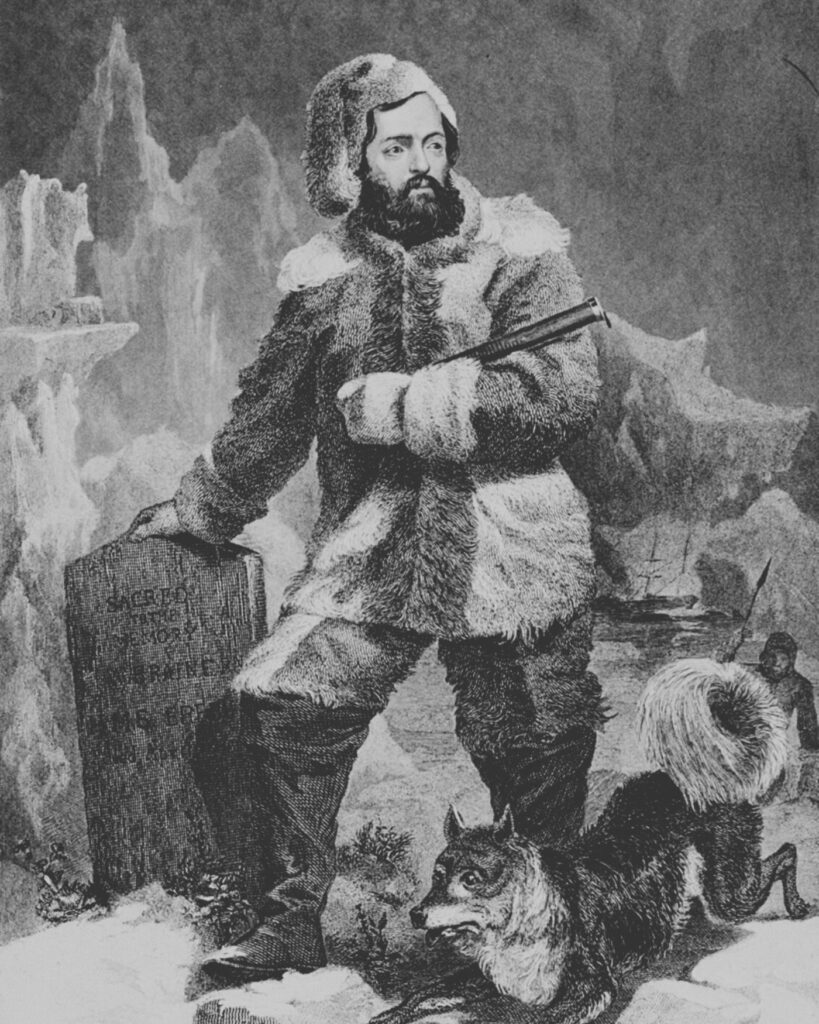
Years later the white band was no longer just a vision on paper. It had become the edge of the world – something you could glimpse but not cross. The brig Advance pushed between the floes as if trying to squeeze between two herds. And then it happened – the ice wouldn't give another inch. The ship stopped – and the world around it turned into a prison.
The creaking of the hull could be heard even over the gusts of wind. Not loud, but relentless – like someone slowly snapping a dry branch and taking their time so that everyone gets the message. The men tried to find reasons for optimism, because laughter is sometimes the last way to hold on to hope. But a smile grows brittle quickly in the frost.
Elisha Kent Kane stood on deck, gripping the rail. As commander, you can't afford to waver – not even in your own convictions. All you can do is look steadily at the ice, at the men and at what needs to be done. The Second Grinnell Expedition had a name, a purpose and a plan – and yet it was already turning into something else.
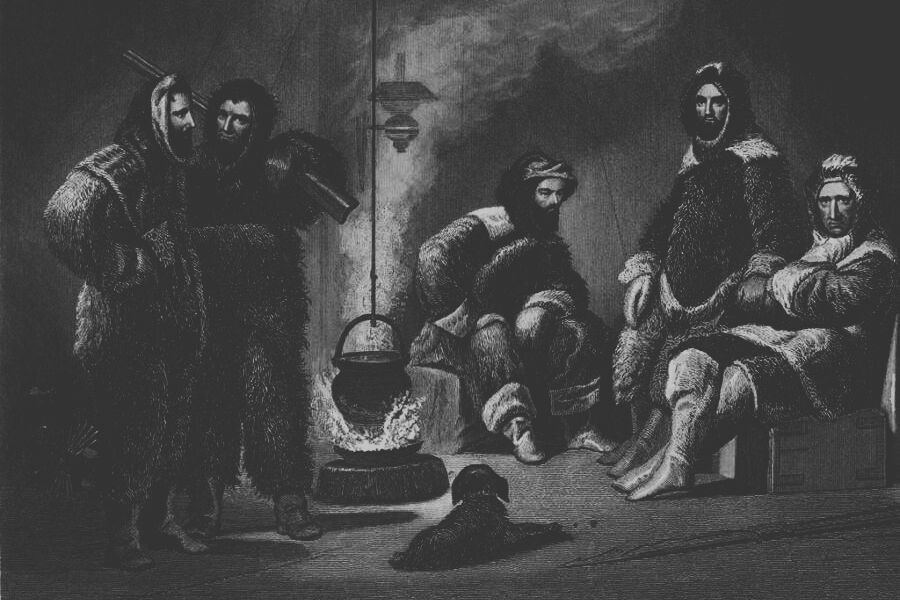
With the polar night, warmth vanished from the cabins faster than words. Water froze in its containers, iron turned brittle and breath became something you could see and touch. Kane wrote, because writing is a way of giving thoughts a shape. Alongside practical records of temperatures and supplies, his notes began to fill with sentences that were less reports than prayers – that the men would hold out, that the ship wouldn't give way, that he himself wouldn't make a mistake that would cost everyone else their lives.
And somewhere in the background, very quietly, like a whisper under the floorboards, that old familiar call demanded his attention. Not joyful. Not romantic. Just persistent. As if the ice wanted to tell him: "You're here now. This isn't a map any more."

The darkness made no dramatic entrance. It didn't fall like a curtain. Rather, it spread day by day, until one morning nobody was sure whether "morning" was still the right word. Time became mere habit. Kane measured it in duties, watches, food rations and log entries.
At first it was little things. Tiredness that wouldn't go away, loss of appetite, irritability that stuck to the tongue. Then came the first signs that a doctor recognises before the patient does – gums that bleed with an ordinary bite, bruises without a blow, swellings that neither work nor frost could explain. Scurvy wasn't a disease. It was a sentence written in slow handwriting.
Kane tried to stay the same. Always "the one who knows". But sometimes at night, when everyone was asleep and the ship groaned under the pressure of the ice, he would lay a hand on his chest and try to catch the rhythm of his heart. He couldn't. It was like trying to hold water in his hands. And he told himself, sternly: "If anyone has to stay standing, it has to be me."
The first funeral took place without grand words. In a land of ice they don't mean much. The men stood in a line, lowered the body into a hole in the snow and covered it quickly, so the frost wouldn't take their fingers too. Kane lowered his eyes for a moment and realised that here death wasn't an event. It was part of nature.
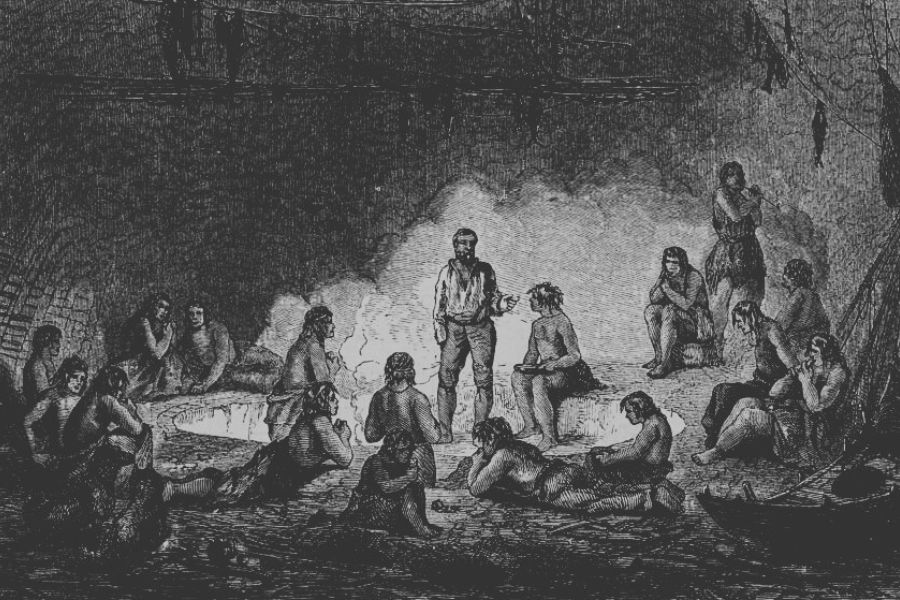
Hans Hendrik didn't turn up on the Advance by chance. The crew had hired him back in Upernavik – a young Inuit hunter from the Etah area. Kane knew that without someone who knew this land they wouldn't stand a chance. And as another winter approached and the ship was still locked in the ice, the nineteen-year-old became the link between them and hope.
One day he brought walrus liver – raw, cold, bloody. Kane looked at it with disgust. But reason told him that raw meat contains exactly what their bodies were losing. Vitamins that dissolve into nothing over a fire. Hans said it plainly: "Raw meat stops scurvy. Every Inuit knows that. Only Europeans die, because they cook their meat."
He bit into it. The taste was metallic, alive. But his body got what it was missing. And after that, everyone ate raw meat.
Kane didn't remember it as a humiliation. He remembered it as a turning point. For the first time he wasn't asking how to be master of the North. He was asking how to be part of it. And in that lay a humility that civilisation mistakes for weakness.
The second winter brought no surprises – only more suffering. Supplies dwindled, the sick multiplied, morale crumbled like stale bread. The Advance was no longer a symbol of the way home. It was a lump of wood trapped in the ice – and they were trapped with it. Kane bent over the map and saw that the only way across the white band was to abandon the ship.
He told his men simply. No pathos. No big speech. Some sentences aren't meant for an audience, but for survival: "The ship stays here. We go." And precisely because he used so few words, his men could cling to them as their last fixed point.

The first step away from the ship was the worst. Not physically – physically it was hell from the very start. The worst was the moment you turn away from something you've been calling home and tell yourself: "Now there's only the journey." Kane didn't look back for long. If he had, he might have been overwhelmed. And being overwhelmed meant dying.
The sledges rasped over the ice like a file. The dogs pulled as long as there was still fire in their eyes. And when they dropped, the men pulled alone. The air was sharp and empty at the same time – it offered the lungs nothing but work. Sometimes water gurgled under the snow, sometimes the ice cracked in a silence that felt far too eerie. But Kane kept a simple rhythm in his head – step, breath, step.
There were moments when morale breaks over small things – a glance at the last of the supplies, a cough that won't stop and only gets worse at night, the question "how much further?". Kane didn't even try to talk about hope. He talked about direction. He pointed forward, because there was nothing left behind them. And when they had to make decisions that hurt – sacrificing the dogs, leaving things behind, speeding up even though their bodies begged for the opposite – he made them in a way that they simply happened, with no time to dwell on them.
In the end, Upernavik didn't emerge as a triumph. It appeared as something ordinary. Smoke from chimneys, low houses, the voices of people who had no idea what it took to get this far. That was the strangest part – the world didn't stop to applaud them. The world just was. Elisha Kent Kane stood at the edge of the settlement and felt that something of him would stay trapped in the ice for ever. Something that would never return to any drawing room.
And when, later, in a warmer room, he finally sat down for a moment and allowed himself to close his eyes, he didn't see rescue. He saw the white band. The same as on the map. Only it was no longer empty. It was full of names – names that are never spoken aloud.
Back in New York the crowds came flooding in. Words. Lectures. People wanted to hear a story they could retell over dinner. Kane gave it to them, because that was what the world wanted from him – and because he, too, wanted to believe that suffering has a shape that can be sold as meaning. His book Arctic Explorations took the form of stories that are meant to outlive their authors.
And then came Margaret Fox – not as a "romantic muse", but as the other pole of his life. Their relationship was full of tension and conditions, as if even love had to be an expedition – who would save whom, who would remake whom, who would believe whom. And yet there was tenderness in it, because someone returning from the white solitude needs someone to remind them that the world has colours too.
But the body couldn't be fooled. What had survived the Arctic later began to fall apart in the warmth with almost ironic thoroughness. He was thirty-seven when he left for Havana. A warm climate is often the last hope for the sick who no longer have the strength to fight the cold again. But he died there soon after – far from the ice, yet not so far from its power.
Elisha Kent Kane (1820–1857) was an American physician, naval surgeon and polar explorer from Philadelphia. He grew up in the prominent family of Judge John Kintzing Kane and from childhood suffered from a weak heart after rheumatic fever – which, paradoxically, led him to his greatest adventures. After studying medicine at the University of Pennsylvania, he served on naval missions in Asia and then devoted himself to the search for the missing Sir John Franklin.
The First Grinnell Expedition (1850–1851) sailed on the ships USS Advance and USS Rescue. As chief surgeon, Kane discovered Franklin's first winter camp on Beechey Island, with three graves. The expedition did not uncover Franklin's fate (that only became clear decades later), but Kane earned the respect of British polar explorers.
The Second Grinnell Expedition (1853–1855) was led by Elisha Kent Kane himself aboard the 144-ton brig Advance with a crew of seventeen. The ship became trapped in Smith Sound between Greenland and Ellesmere Island. After 124 days of the first polar night, scurvy struck the expedition during the second winter. Three men died. Their key saviour was the Inuit Hans Hendrik, who taught the crew to hunt walrus and seal. Kane mapped 960 miles of unknown coastline and reached a record northern latitude of 82°N.
Hans Hendrik (1819–1885) was a Greenlandic Inuit who joined the expedition in July 1853 as a nineteen-year-old hunter and dog driver. He taught the crew to hunt walrus and seal and became the first Inuit to take part in Western polar expeditions. He later served on five more expeditions.
Margaret Fox (1833–1893) was a spiritualist and co-founder of the Fox sisters' movement. Kane met her in 1852 during séances in Philadelphia. Their controversial relationship culminated in a secret Quaker marriage in September 1856. Kane's family never recognised the marriage. After his death, Margaret published their correspondence as The Love-Life of Dr. Kane (1866).
Elisha Kent Kane became a national hero. His book Arctic Explorations (1857) was a bestseller. He died of heart failure on 16 February 1857 in Havana, Cuba, aged 37. The funeral procession from Havana to Philadelphia was a national event – comparable to Lincoln's funeral eight years later.
Kane Basin in the Arctic, the US Navy ship USS Kane and Kane crater on the Moon all bear his name. His expedition popularised American polar exploration and proved the effectiveness of Inuit survival methods.