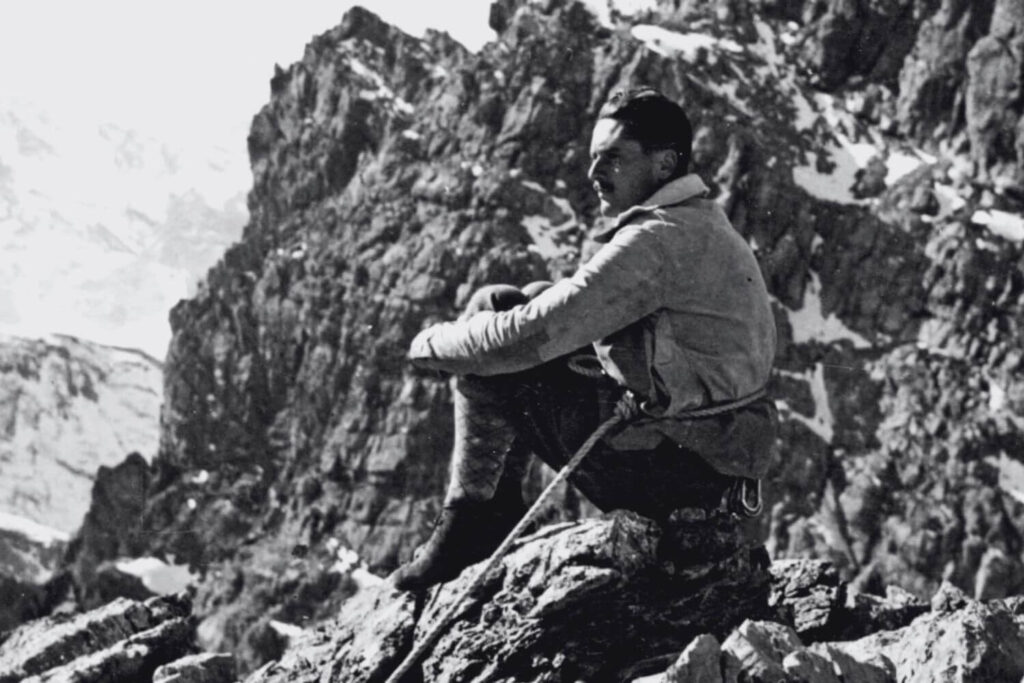
The sun was blazing as if they weren’t at four and a half kilometres above sea level at all. Eric Shipton stopped on a small rocky ledge poking out of the snow of the Menlung Basin and ran his fingers over his lips. They were rough and cracked. He pulled his dark glacier glasses off his eyes, but the harsh light reflecting off the snow quickly made him put them back. He knew all too well what snow blindness was.
Peaks covered in eternal snow and ice towered high above him. Jagged rocky ridges, black overhangs and menacingly leaning seracs only underlined how inaccessible they were. He felt a pressure in his forehead that he couldn’t shake off. His body hadn’t yet fully adjusted to the thin air.
“Mr Shipton!” The voice of Dr Michael Ward, a young British doctor, snapped him out of his thoughts. He was standing a little way off, hunched over something in the snow. “You have to see this!” he beckoned, his voice trembling with mild excitement. Shipton hitched his rucksack up on his shoulders and something rattled inside. He began wading through the snow, slowly softening in the sun, towards Ward. Ward didn’t move. He stared at Shipton, stony-faced. “Look,” he said quietly, barely audibly.
There were tracks in the snow. They ran down the glacier, each one deep and distinct. They were bigger than a human’s. Much bigger. So broad and splayed that Shipton could have fitted his own boot into one twice over. The toes were spread in a wide arc and the big toe stuck out oddly to the side. “A bear?” Shipton suggested. He rubbed his beard and looked into Ward’s stunned face.

Ward shook his head and laid the head of his ice axe next to one of the prints. “See? It’s longer,” he said, pointing to the gaps between the toes. “A bear doesn’t leave tracks like these. This… I don’t know. It’s something else entirely.”
Shipton said nothing. His gaze was fixed on the print in the snow. Its edges weren’t at all sharp, rather a little warped by the sun beating down on it. Another day and it would be wiped from the snow completely. He looked around – the tracks carried on across the untouched expanse of snow until they disappeared over the horizon. “True, that’s no bear,” he said at last. His voice was calm, but the look in his eyes said otherwise.
He called the others over. Bill Murray, another member of the expedition, came running with his ice axe in hand. “What the hell is that?” he asked, wiping his sweaty forehead with his hand.
“I’d like to know that too,” Shipton shrugged. He bent down, put his rucksack in the snow and took out his camera. On his travels he recorded everything that might matter. And this definitely mattered. To show the size, he took the first photo with his ice axe next to the print; for the next he made Ward take off his boot. They had no better measuring device with them – they had to make do with what was to hand.
“I’ve seen all sorts of tracks,” Murray declared, running his hand over the stubble on his chin. He wrinkled his nose, which deepened the lines the Himalayan wind had given him on his expeditions. “But this? A monkey? A big bird? Or some damned monster?”
Ward looked up from the print. “No monster. It’ll just be some large animal,” he replied drily. Shipton raised his head from the camera and gazed for a long time in the direction the tracks were heading. His expression was unreadable. “Let’s go!” he then said quietly, swinging the straps of his rucksack over his shoulders. They followed the tracks down the glacier for about a mile until they stopped at its edge. Evening was drawing in – it was time to pitch camp.

When the orange glow of the flames lit up the camp, everyone gathered round the fire. Britons and Sherpas alike – the flames danced on their faces, worn out after another long day in the labyrinth of glaciers and rocky moraines below the highest mountain in the world. Shipton sipped tea from a tin mug, the men beside him chewed the last of the hard biscuits. “What do you make of it?” he finally asked, breaking the long silence.
Ward looked up, drew a breath, but in the end just shrugged. The Sherpas leaned towards each other, whispering something. Shipton shot them a glance. “Hey!” he called out.
One of them, the leader of the porters, straightened up and looked into Shipton’s blue eyes. “Yeti,” he said, tracing an arc in the air with his hands as if sketching the outline of a figure. Then he pointed a finger at the mountain tops.
Shipton gave a faint smile and nodded. But from the other side of the fire came Murray’s voice. He was sitting on a blanket thrown over a rock, arms folded across his chest. “If you want to call it a yeti, fine. But if you ask me, it’s just some animal. No spirit – that’s nonsense.”
Shipton put his mug down on the ground and gazed up at the star-studded sky. The fire crackled. Silence returned to the camp, but the questions remained.

The Khumbu Icefall was like a kingdom of glass, threatening at any moment to collapse into destructive chaos. Gigantic ice towers loomed high above the men’s heads. They swayed and creaked ominously. Crevasses opened beneath their feet like insatiable jaws – so deep they couldn’t even see the bottom. Every step was a test – not just of strength, but of courage too.
Whatever ground they gained, they soon lost again. With terror in their eyes they slipped between unstable seracs, only to have to make the same journey back moments later. The icefall gave them nothing for free. It was as if it were mocking them. All it offered was a host of dead ends, disappointments and terrifying moments when it seemed the world was falling on their heads. “This way!” Shipton called. His voice echoed off the ice walls and was swallowed by their cracking. He pointed to a narrow gap between two ice towers. “But quickly!” he waved again and again. The air around them was cold and heavy; every movement took twice the effort of the one before.

When they finally reached a high point, they saw the Western Cwm below. A huge, captivating valley surrounded by steep walls plunging down from the summits of Everest, Lhotse and Nuptse. Fresh snow sparkled like crystal, reflecting the harsh rays of the sun. Shipton stopped and just stared in silence. “We’ve found it! The way to the summit!” he called after a while, but his voice was almost lost in the vastness of the space.
Ward came up beside him and leaned on his ice axe, exhausted. “Really?” he wheezed, breathing heavily, his cheeks flushed. Shipton pulled off his hat, wiped his forehead and gazed into the distance. “I can feel it,” he said quietly. “I can’t explain it, but yes.”
Ward smiled out of the corner of his mouth. “Like with those footprints?” he added with a hint of teasing.
“Maybe,” Shipton smiled. “The mountains have their secrets. And sometimes it’s better to leave them be.” Above them towered Mount Everest, vast and silent. And that was enough.
Eric Shipton (1907–1977) was a British mountaineer, explorer and cartographer, famous for his minimalist approach to expeditions. He was born in Ceylon (now Sri Lanka) and moved to England as a young man. His climbing career began in Africa, where he successfully reached the summit of Mount Kenya (5199 m). In 1931 he took part in an expedition to Mount Everest for the first time, which opened the door to further exploration of the Himalaya.
Shipton was known for his ability to navigate unexplored terrain. He led several key expeditions, including the 1951 reconnaissance expedition that revealed the route up Everest from the Nepalese side via the Khumbu Icefall, the Western Cwm and the South Col. This route later became the main way to the summit of Everest, used by Edmund Hillary and Tenzing Norgay on the first successful ascent in 1953.
In 1951, during an expedition on the Menlung Glacier, he also discovered mysterious footprints in the snow, attributed to the legendary Yeti. The find became a worldwide sensation and is still debated to this day.
Shipton preferred small, lightly equipped expeditions to large, logistically demanding ones, which was unusual at the time. This approach inspired many other climbers and laid the foundations of modern mountaineering. Besides the Himalaya, he was also active in other parts of the world, such as Patagonia.
Eric Shipton remains one of the key figures in mountaineering history – not only for his explorations, but also for his philosophical approach to the mountains. His legacy lives on in the stories and routes he opened up.