
Many years have passed since then. I remember first reading about this route in Radovan Kuchař's book “Ten Great Walls” (Deset velkých stěn). I knew straight away that this was exactly the goal I wanted to attempt one day. And so here I am, standing on the Leschaux Glacier - just like Cassin years ago - looking up. All sorts of feelings are mixing in my head. Humility, determination, fear. All of it spinning round in my noggin like a chair-o-plane ride. The face makes a big impression on me. Exactly the kind you want to make the first time you meet your girlfriend's parents. It's going to be a big challenge. Ideal for testing not only my own resilience, but also my new Asolo Eiger XT EVO GV mountaineering boots.

On a face as big as the Grandes Jorasses, anything can happen to you. Especially when you spend three days on it, during which just about every season of the year comes round. We were hot, then cold. One moment we were drowning in sweat and the next - for a change - in the water pelting us as raindrops. We didn't escape some snowy fun either. But in all these conditions my feet stayed warm. The very first time I put on the Asolo Eiger boots, my feet felt like never before. That warmth! Since I've had them, I haven't come anywhere near the point where you lose the feeling in your toes. Even when I stood in wet snow for an hour belaying Ondra on probably the craziest pitch of the whole route, my feet didn't freeze. I'd love to say the same about my fingers and the rest of my body, but sadly I can't. It was bitterly cold.
Comfort on the face also gets a big boost when, in the morning after an emergency bivouac, you can jump into your boots and warm up your numb toes. Or when, after a whole day in climbing shoes, you slide into a comfortable boot that doesn't pinch or squeeze anywhere. This is probably the Asolo Eiger's biggest asset. But perhaps also a small pitfall. The climbing itself really took it out of us. But not as much as the descent that followed. Three hours of trudging across the glacier in darkness, fog and heavy rain took its toll - absolutely everything got soaked, boots included. The material forming their outer insulation soaked up water and kept soaking it up, and afterwards I spent a long time drying the boots in the sun. In the same breath, though, it has to be said that even when the boots ended up soaked like a sponge, the thermal comfort didn't change.
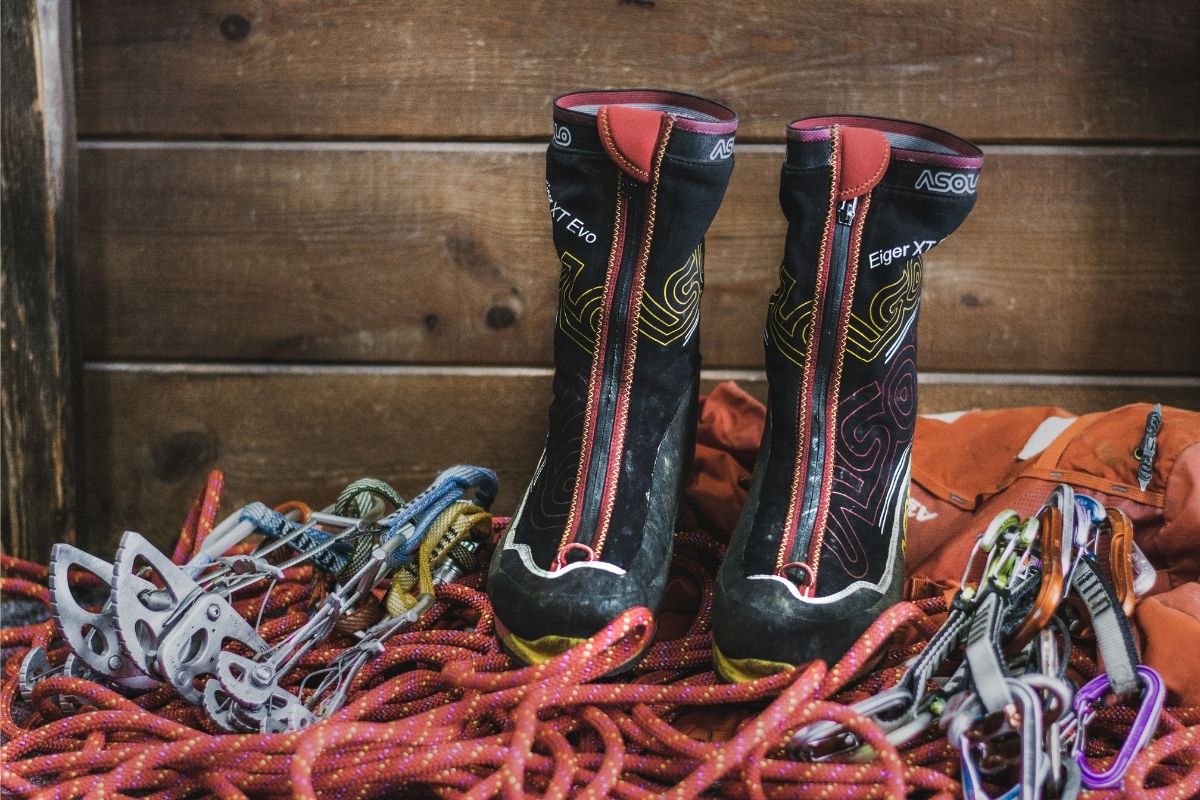
Fast and light - the style in which the world's best climbers try to tackle big faces - demands low weight from all your gear, while keeping the highest possible performance. Even though I climbed the Grandes Jorasses more in the old-school slow and heavy style, I still couldn't avoid worrying about weight. From harness to rucksack to boots, I needed to have technical, functional kit with me. The Asolo Eiger ticked that box in every respect. At 710 grams, they really are among the lightest in their category. When I wasn't wearing them, they hung clipped to my harness and didn't spoil the joy of climbing one bit.
Of course, the boots have welts for step-in crampons and a climbing zone in the toe of the sole. Another nice feature is the quick-lace system, which means you have no trouble lacing up your boots even in thick mitts.
What I really enjoyed about the Asolo Eiger XT EVO GV was the small fabric loop at the toe - at the start of the outer zip. A seeming trifle that you'd dismiss at first glance as completely useless. Ha! Quite the opposite. The loop lets you hang the boots up safely and conveniently anywhere. On your harness, on the belay, on your rucksack or on a line to dry. You see, if you hang boots by the laces, they stay with the opening facing up, and rain gets in. But if you use this little loop, they'll hang upside down - opening facing down - and in the morning your feet slip into something dry. I love it when a manufacturer actually thinks about what it makes.
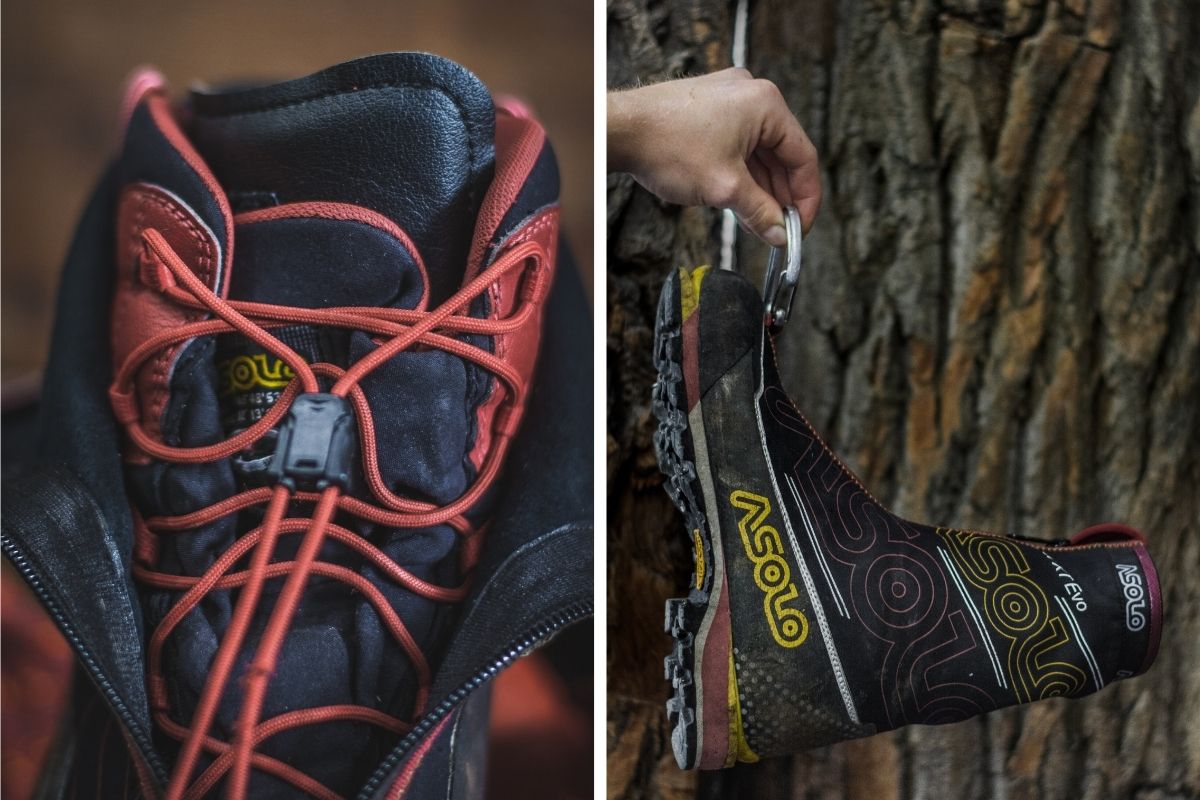
Even though the Walker Spur is largely rock, I had climbing shoes on for barely half a day. For most sections, it was these Asolo Eiger rockets that carried me. On low-angled scree, on wet rock, in thawed slush that looked like snow and also on fairly hard climbing sections, I felt comfortable. Perhaps that's because these boots aren't among the stiffest on the market. I was surprised myself at how relatively flexible the sole is. But that's exactly what you need when you're standing on a smooth slab and want to make a friction step. And standing on a small edge wasn't a problem either.
I also wore the Asolo Eiger XT EVO GV in the Tatras when climbing the route "Havraní vlasy" (Raven's Hair, M5) and when drytooling right behind our house in the Jeseníky Mountains, and even on more technical stuff at M7 I didn't find the softer sole a problem. If anything, I see it as an advantage. When you have to walk on harder ground, on scree or across a glacier, your feet don't suffer as much and walking becomes a lot more comfortable.
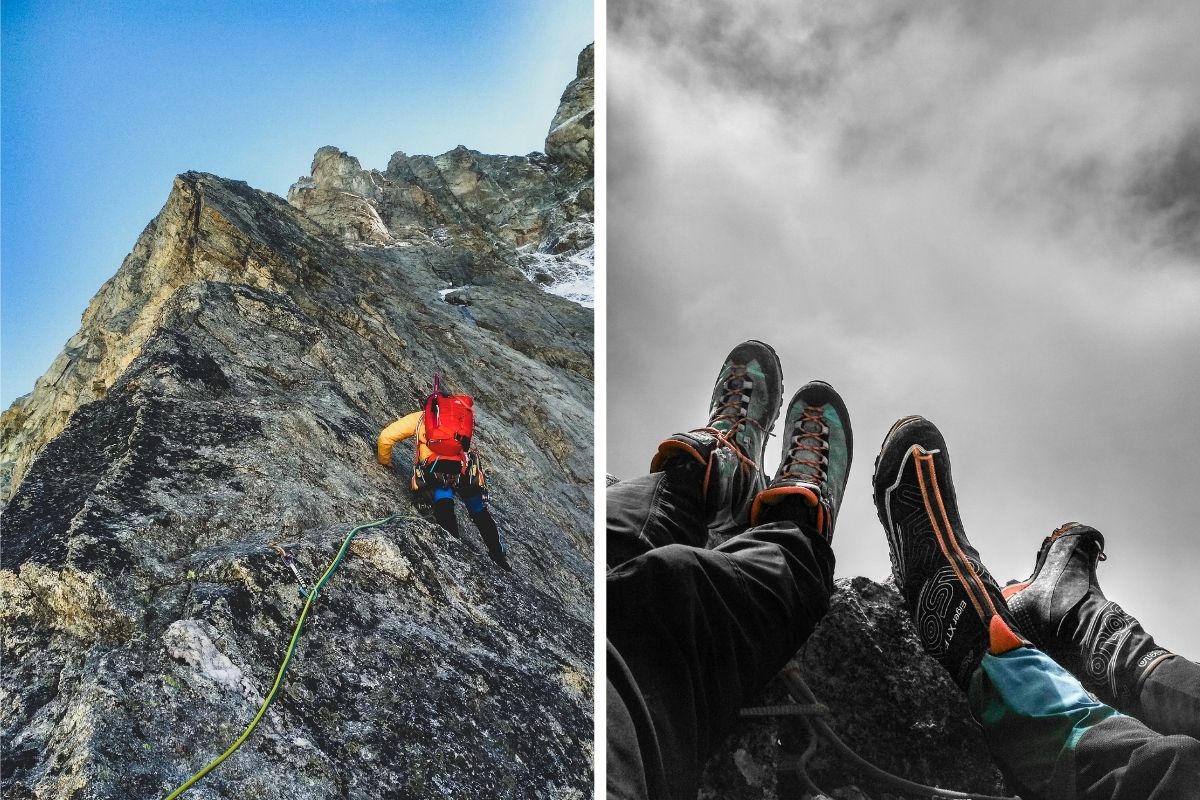
Nothing and no one is perfect, so even these boots have a few minor shortcomings. Though shortcomings is a strong word. The very strengths they excel in simply predispose them to these weaker spots. These are light boots. Low weight is their strongest weapon, but it also hides that small weakness. The softshell outer gaiter insulates brilliantly against the cold and weighs nothing. Unfortunately, that means lower tear resistance. It isn't leather. But if the Asolo Eiger XT EVO GV were made of leather, they'd lose exactly the elegance and lightness they excel in.
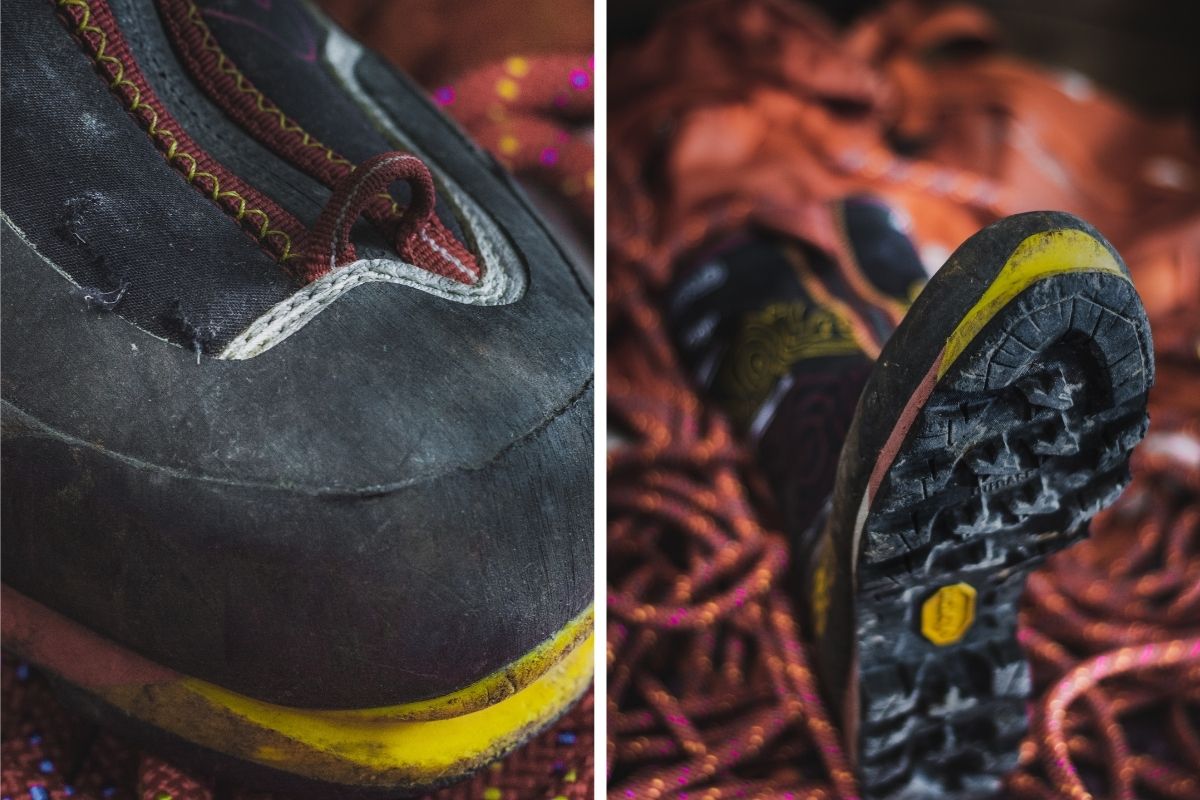
The worst thing about climbing the Grandes Jorasses is the descent. Endless trudging, abseiling, scrabbling around in scree. Something is always falling on your head, or you're ankle-deep in gravel. After that slog, a few small torn holes appeared on the toes of the boots. Nothing a needle, thread and a bit of glue couldn't fix. Still, it's worth bearing in mind that if you plan to stumble around in scree for a long time, these problems can crop up. To complete the picture, though: my helmet came off far worse than the boots.
And the winner is: the Asolo Eiger XT EVO GV!
These boots taught the face a lesson. The face fought back and tried to resist. It didn't give in easily, but it stood no chance against these boots. But can you really call it a victory? Yes, at times it was a fight. But when we topped out, I didn't feel victorious. I wasn't racing the mountain. We lived together. For three whole days we got to know each other, teased each other and sized each other up. At the start there may have been ambitions to conquer one another. But in the end we parted more like good friends than as winner and loser.


