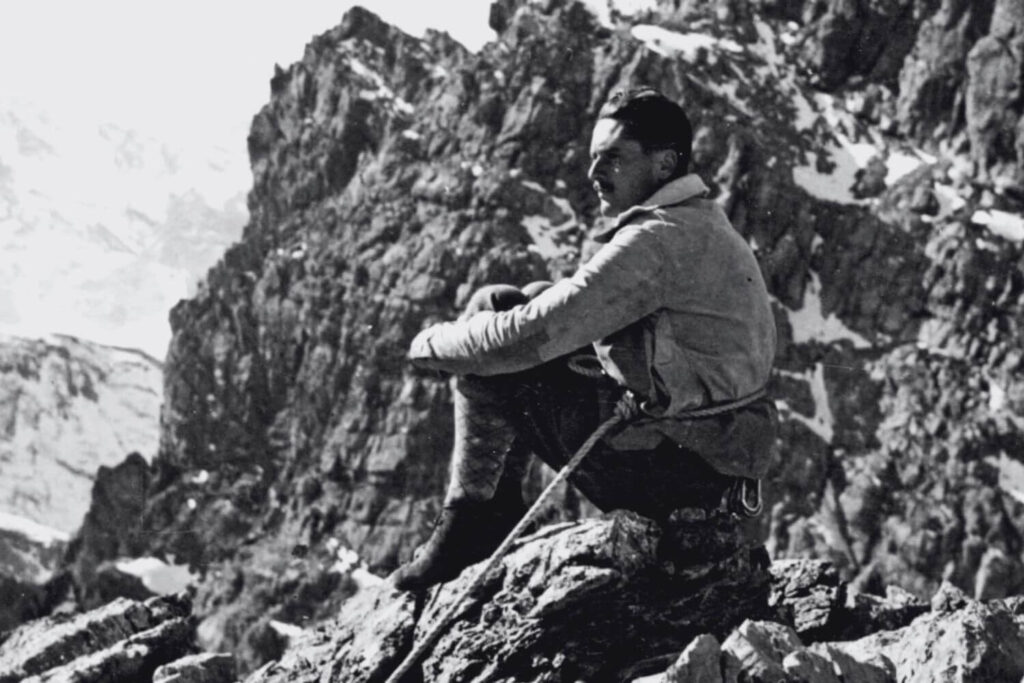
He looked like a tough guy. The rough skin of his big hands pressed against her forearm as he showed her how to thread the climbing rope through a karabiner. She got the feeling that this Stanford boy would stop at nothing. He tied her to the other end of the line hanging from his waist. She had to follow him. He was handsome, sure. But she also thought these performance-obsessed strongmen weren’t for her. Yet when he paused during the climb to find the words that would sensitively capture the strange shape of a gnarled tree, or when a little later he gushed over the colours of the flowers growing nearby, she began to feel a certain liking for him.
He did play on the university football team. But at Stanford he also studied art and fashion design. And it was precisely these contrasts in his soul that made Marilyn fall in love with him. And a year later – when they were a tender twenty – she married him too.
John Harlin could be surprisingly sensitive. No doubt about it. But he could also be hard. And intolerant of any sign of weakness. When Marilyn gave up an attempt on Yosemite’s Higher Cathedral Spire because of the intense heat, he couldn’t understand her reason. And when a week later their friend Ann Pottinger succumbed to exhaustion on the same climb, he cruelly reminded Marilyn of her own failure: “At least she tried!”
Simply put, this John Harlin expected the people around him to push themselves as hard as he did. A few years later – by then a bomber pilot posted to a base in Germany, clawing his way up Alpine faces at every spare moment – he would tell Marilyn: “You dress beautifully, my wife. One day you’ll make a gorgeous widow.”

Eiger. Mordwand. The Murder Wall. To many ears it sounds terrifying. But John Harlin rolled those words around on his tongue as if they were the sweetest he knew. He caressed them and turned them over and over until the longing for the hardest of all Alpine faces settled in the deepest recesses of his mind. That’s why, after leaving the military, he dragged Marilyn, little John and even littler Andrée off to Leysin in Switzerland. A town of four thousand on a hillside above Lake Geneva. He wanted to be close to the mountain of his dreams.
As early as 1962, with Munich rock master Konrad Kirch at his back, he crept cautiously up to the foot of the Eiger. They trod lightly – so that the giant who never sleeps and who had already devoured so many human lives wouldn’t notice them. They slipped onto the face, and those standing in the valley watching through telescopes said it was a brilliant spectacle. They shook their heads at the ease with which the audacious pair overcame the mythical places that had once shredded dreams and, in some cases, even killed: the Difficult Crack, the Hinterstoisser Traverse, the Rote Fluh, the Flatiron, the Spider, the Corti Bivouac. They dealt with all of it effortlessly and then celebrated.
And so John Harlin became the first American to climb the Mordwand. “A thunderous success!” screamed the headlines, especially those across the ocean. But it wasn’t enough for him. A single route seemed inadequate for the eternally gloomy north face of such an enormous mountain. He longed to add something new. Bold and modern. And after he and the great Yosemite hero Royal Robbins, sharing one rope, climbed the west face of the French Les Drus by the American Direct, he began dreaming of slicing the Mordwand in two. “It’ll be a pretty much direct line,” he drummed into the head of anyone who could bear listening to his Eiger ravings, “a direttissima, straight up the middle!”

“The Germans, that lot!” John Harlin fumed in the autumn of ’65. “So they want to beat me to it?” Perhaps he had talked about his dream a little too much, because a group of eight Germans decided to go for the very same thing. And how they prepared for that mountain! A full-blown expedition – fixed ropes and high camps. “They want to turn the Alps into the Himalaya!” John Harlin tore at his blond hair. He couldn’t allow it – someone snatching his plan and, on top of that, dishonouring the giant by binding it with kilometre upon kilometre of rope. He immediately began calling up reinforcements – his own team, with whom he would set out on the face with all the courage and daring in the world, but also with respect. In Alpine style, that is.
Twenty-five-year-old Scot Dougal Haston was to fight his way mainly up the ice sections, for which his home turf of Ben Nevis had drilled him well. And at twenty-eight, Layton Kor was already a legend of American rock. So it fell to him to keep the team going on even the smallest rock holds of the Eiger’s eighteen-hundred-metre north face. Thirty-year-old John Harlin, the eldest, then thought it all through and planned it. He pictured a ten-day push. One swift assault – and they’d be at the top.
But the giant Eiger would have had to be having a very weak moment to let such a plan be forced on it. When the three of them arrived at its foot in February, the mountain hid in the clouds and shook one rock after another out of its innards. No way were they going onto the face for two weeks in that mess. John Harlin’s plan got its first crack. And a second one straight away, when the Germans took Alpine style with a pinch of salt and, expedition-style, kept leaping onto the face and quickly vanishing again – depending on when two- or three-hour windows of good weather opened up in the storm. There was no competing with that. But nor could they just stand by and watch. So the three changed tactics. They brought in more ropes and began fixing them too – many times right next to the German ones – so they could flee the face whenever the mountain shook and dash back up whenever it calmed down. All the while, though, John Harlin kept telling himself that once things broke one day – once the storm passed – they would shoot upwards Alpine style again and, as a trio, race past the eight lumbering Germans to the summit.

Dougal Haston and Layton Kor huddled in a snow cave they had dug at the spot known as Death Bivouac. Squeezed between them was John Harlin. An unhappy John Harlin, because in four weeks they had barely scraped halfway up the face. And instead of showing the Germans how it’s done, between the thunderclaps they listened to their chatter from the cave that lot had dug right next to them. “At least three days of good weather,” John Harlin pleaded. And who knows whether it was the mountain itself that heard him or the One upstairs, but the clouds disappeared, the sky turned blue and the snow sparkled with the beauty of it all.
John Harlin shot off before the Germans had even sorted out their ropes. On the ice glazes he drove Haston ahead of him, and when dry but steep rock appeared, he chased Kor upwards instead. It looked as though they really would pull off the great work. All that was missing was to stretch the direct line on the north face just a little – a tiny bit – further. But on 18 March a scruffy John Harlin, cross-eyed with hunger, pressed his face to the receiver in one of those grand hotels on the Kleine Scheidegg and sighed to Marilyn: “Why didn’t I wish for four days. Or five. We’d have made it.”
“Then come home,” Marilyn begged him, “we’re waiting for you.”
“I will,” he said, “of course I’ll come back. As soon as I’ve finished here.”
The Eiger had taken far too big a chunk of John Harlin’s life for him to coil the ropes and simply walk away. Besides, he somehow sensed – God knows how – that things would go smoothly in the days ahead. Or maybe he just wanted to believe it. Hard to say. Either way, the Eiger opened its arms to them once more. And so magnificently that the very next day Kor put on a delicate three-hour show traversing the Central Pillar. And because Haston didn’t want to be left behind, he pulled off an equally delicate feat, heading up wafer-thin ice that constantly threatened to break away from under his feet and fly down to the valley with him. With that, they unlocked the gate to the upper part of the face. The Germans could only stare at the show from far below, just managing to shout up that another cold front was about to hit the face and bring the icy hell back with it. But John Harlin already had champagne in his pack.

He flashed Haston a smile. And it was clear what that meant. Haston set off up the rope, while John Harlin watched him from the bivouac for a while, spinning on the rope like a weathervane in the open space beneath the overhangs, with fifteen hundred metres of nothing below him. Seven millimetres, to which they had to entrust their entire lives. That was how thick – or rather thin – the fixed ropes were that they had left on the face during the last push. When Haston switched to the next section of rope, John Harlin followed him. Like two inchworms they edged upwards – into the parts of the face that remained the last unknown challenge.
Haston hauled his body up to the spot down which endless streams of snow pour during storms. Climbers call it the Spider. There he clipped his jumars onto the next thin strand, and when John Harlin, a few dozen metres lower down, tugged on the line and found it slack – that Haston was already moving up the next section – he swung out into space on his jumars. “We can do it,” he encouraged himself under his breath, “we’ll finish the greatest climb of our whole generation!”
He moved rhythmically, sliding the jumars up the rope – left, right, left, right. Reach up, push with the leg, reach up, push with the leg. And so, over and over, he gained metre after metre towards fulfilling his dream – towards satisfying his obsession with the north face of the Eiger. He toiled. He breathed hard. He fought gravity and struggled to stop his body constantly spinning on the rope, because that ate up precious strength all the more. Twenty-five metres to go. Between breaths, John Harlin smiled. Twenty. He was getting closer. Fifteen. Soon only fourteen. And suddenly – it was all gone. And this John Harlin fell onto the Third Icefield. And then on down to the foot of the mountain, in whose embrace he had not shown a grain of weakness. Hard and sensitive John Harlin.
John Harlin (1935 - 1966) died on 22 March 1966 when, roughly 600 metres below the summit of the Eiger, the rope he was jumaring up behind his partner Dougal Haston snapped. A few days later – on the day of Harlin’s funeral – Haston, together with four members of the German team, completed the route and named it the Harlin Route (John Harlin route) in his honour. It was only the second route on the Eiger’s north face, and completing it took more than a month.
Harlin’s son, John Harlin III, who was nine when his father died, also became a climber. He was editor-in-chief of the American Alpine Journal and climbed the Eiger himself via the original Heckmair Route. He wrote about his experiences in the book The Eiger Obsession, and in 2007 the film The Alps was made about his ascent and his coming to terms with his father’s legacy.