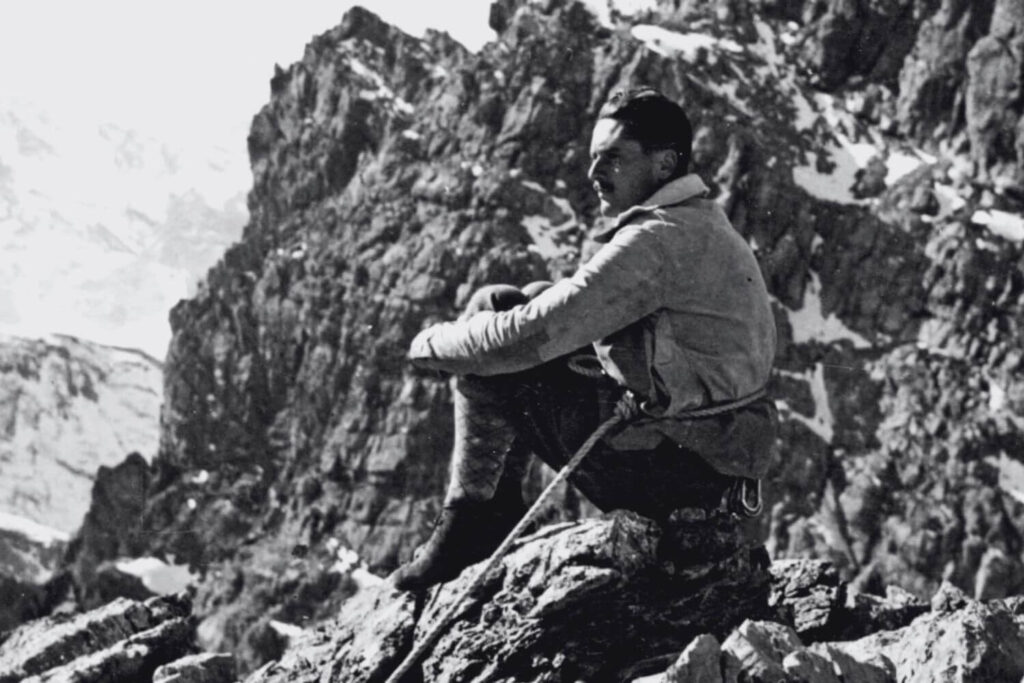
"No, Jalovec is not an easy mountain, and let us not underestimate a single ascent of it! There is something defiant and swaggering in its form. It looks and behaves like a provocative brawler, boasting that it is invincible: 'Come on then, come on, if you dare!'"
Julius Kugy knew every steep flank of this 2,645-metre mountain, and to this day he gazes at its proud sculpture from the second hairpin bend of the mountain road that winds up from the Trenta valley to the Vršič pass. Accompanied by poachers – hunters of mountain chamois – he climbed Jalovec perhaps fifteen times in his life. The first time was in the summer of 1877, when, guided by Černuta, a strong, grey-haired, broad-shouldered herdsman, he came to know the precipices of the Koritnica valley.
"Then came the most hazardous spot, a narrow ledge of slabs tilted towards the abyss and, in one stretch, wet with trickling water. Černuta had climbed this far in his wooden clogs. Here he took them off. He asked me, too, to go barefoot."

Back then they managed two thousand metres up and the same helping down in a single day. As they stumbled, battered, down the dark valley back to Bovec, Kugy kept hunger and thirst at bay with a mixture of vinegar and snowmelt and raw white turnips he had pulled out of the ground belonging to sleeping herdsmen.
"Černuta asked me whether two florins for the guiding was too much. I gave him three. On parting he embraced me with elemental tenderness and the iron grip of a vice; with the wiry bristles of his roughly clipped moustache he planted two kisses on me that burned on my cheeks for a long time afterwards. That is how Jalovec let me go the first time."

Either way, the western route up the Koritnica valley isn't exactly popular these days. It's simply an endless slog. But if you set off from the north – from the mammoth ski-flying hill in Planica – the crystalline lines of Jalovec soon start to shine through the branches in the Tamar valley, and they'll pull you upwards with magnetic force. And they won't stop urging you on from above until, after hours of hellish climbing on loose scree and across green meadows that appear out of nowhere, you stand on the steps of a heavenly staircase – the mountain's north shoulder. From there it's just a short way to the cairn on the summit. Well – short. The rock still knows how to give you a hard time.
"Getting back on my feet, I saw Oitzinger's face below me. It was white as a wall. He was hanging safely, and after a little while he too got to his feet. Man and rope had done their duty in every respect. When Jože climbed down to me, he was still trembling with fright in every limb. For a long time we stood in silence, staring out at the sunlit world, glad that we had, in truth, come into the world a second time."
You see, the path zigzagging up the ever-steeper slope quietly, almost unnoticed, begins to turn into climbing. At first you just steady yourself on the rock with your hands and feel the touch of sharp limestone on your skin. Then the first iron staples and pegs appear – hammered into a short but overhanging corner. And suddenly your pack starts tipping you backwards – its weight pulling your body into the depths of Tamar. You have to grip the cold iron firmly and haul with your arms – there's nothing else for it.

Once you cross Škrbina v Prode, you get to measure the depth of the Koritnica valley beneath your feet for a change. When all that bottomless space makes your head spin, you grab another of the many pegs. Or a steel cable. And from the top of Mali Jalovec you won't have much left to go.
"Above an easily reached scree terrace began crumbly chimneys and cracks, and then, close to the edge of the ridge, horizontal scree ledges led to the right towards a steep, deeply cut snow gully that slices through the west wall. On the far side, the summit horn appeared in all its astonishing wildness."
In fact, all you have to get past is that gully between the two summits. You climb down into it and out again using steel cables – that's fine. But the firn field at its bottom tilts at an angle that doesn't do your head any good. And where does it end? Nowhere! – Beyond it there's just one big nothing. So take care – an ice axe and microspikes come in handy. But if you don't lose your nerve here, nothing tricky awaits you after that. Just a few ledges carved into the rock by nature – criss-crossing the summit pyramid back and forth. And then – the summit of all your efforts. The summit of Jalovec!
"In that first hour on the summit of Jalovec, indescribably happy at my victory, I turned my wistful attention and tenderness to the cairn. I carefully built it up higher, and in later years I often came back to visit it."
If you carry a bit of Julius Kugy's romanticism in your soul, and a sleeping bag and, above all, enough water in your pack – there are no springs up there –, you needn't hurry down from the summit. Seven hundred metres lower, on Kotovo sedlo, you'll find a bivouac. A little box for people – three fit inside, maybe four if you squeeze. The tin hut crouches beneath a huge boulder that looks as if it wants to crush it into the ground for ever with its weight. In reality, though, it shields it from wind, storms and avalanches.

And you'll find a bench there too. A wooden, sun-dried plank that Jalovec, dipped in the orange glow of the setting sun, will nail you to. You'll sit there and sit there – and the mountains will fall silent.
"When I stood at the mouth of the valley and looked back at it, its black horn towered high into the starry sky. 'Thank my magnanimity!' it called after me."
Climbing from the Tamar valley (from Planica) you gain 1,670 metres over just under 10 km. The only water you'll come across on the way is the spring at Dom v Tamarju – practically at the start of the climb. The upper sections of Jalovec are protected with steel cable, pegs and staples – grade A/B. (route on the map)
The bivouac on Kotovo sedlo lies a short way off the path at 1,950 metres. It sleeps 2-3 people comfortably, 4-5 at a pinch.
Climbing from the Koritnica valley you gain 2,000 metres over 9.5 km. On Kotovo sedlo (2,138 m) you join the route from Tamar. There is no hut on the route, but from the summit of Jalovec you can descend via Veliki Ozebnik southwards to the small mountain hut Zavetišče pod Špičkom (open in July and August) and continue back to the Koritnica valley the next day. (route on the map)
Climbing from Trenta you gain 1,600 metres over 6 km. Roughly two thirds of the way up stands the aforementioned mountain hut Zavetišče pod Špičkom. (route on the map)
Dr Julius Kugy (1858 - 1944) was a pioneer of climbing in the Julian Alps. With his guides he opened more than fifty new routes, mostly on unclimbed peaks. He wrote about his mountain ascents – not only in the Julian Alps – in his book Alpine Pilgrimage (Czech edition: From a climber's life), from which the quotations in this article also come. As an amateur botanist he became obsessed with searching for the mystical flower Scabiosa Trenta. In time, however, it turned out not to exist. A majestic bronze statue of Julius Kugy stands at the start of the climb from Trenta to the Vršič pass – its gaze directed at Jalovec, which held a special place in Kugy's heart.