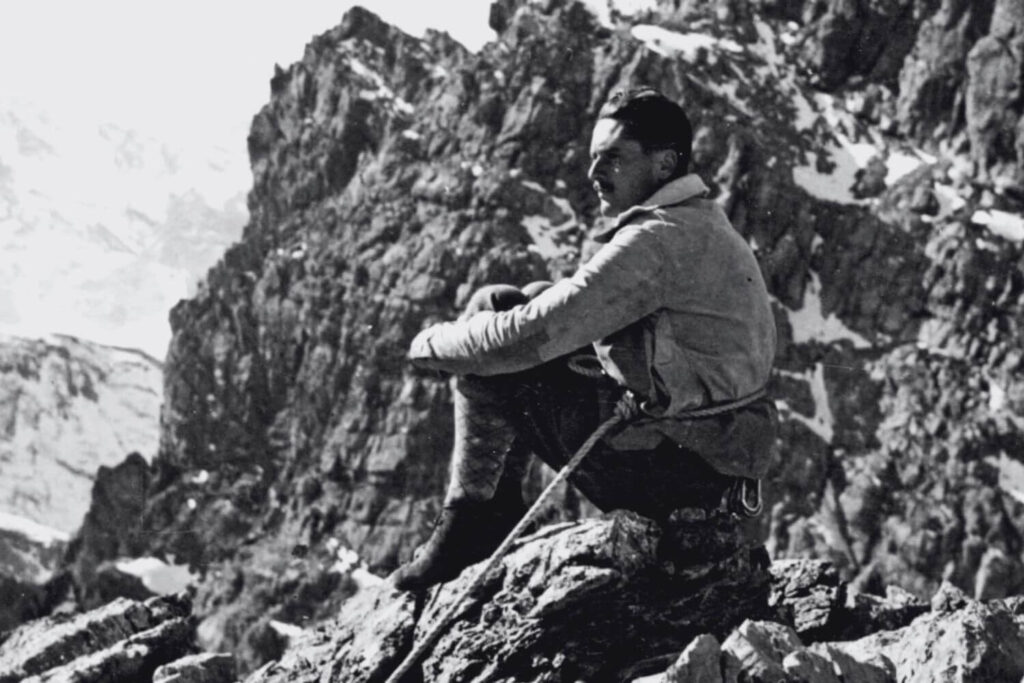
Fog, snow, a gale. We had to bivouac unexpectedly. The wind ripped our tent apart straight away. Then again, on that sharp ridge we'd never have found enough room to pitch it anyway. It was a futile attempt. So we used the tattered flysheet at least as an improvised bivvy bag to keep the damp off. For the first time in my life I climbed into a sleeping bag wearing crampons – taking them off in a place like that would have been far too risky. Strapped to the last boulder on a small sloping slab, we huddled together and didn't dare move. We melted into the rock and prayed that lightning wouldn't strike us. In the end we survived that night too. But it was a close shave, I'd say.
How many sleepless nights out in the open have there been? A thousand and one! I could tell tales like Scheherazade. It doesn't always turn into such a drama, but I always come away with stories. One night that dragged on especially long was an unplanned bivouac around the winter solstice in the Bucegi Mountains. Darkness caught us on the second-to-last pitch of the Costila Galbinele route, just below the plateau. We couldn't find the final pull-up – we were fifty metres short. Three of us got stuck there. In our sleeping bags we hung tied to the rock above a steep slope like unhatched cocoons. It wasn't snowing, but a biting wind was blowing fresh snow off the surrounding slopes – straight into our faces. What I'd have given to be baking Christmas biscuits instead.
But a bivouac doesn't have to happen by mistake or out of necessity. On the north face of Piz Badile in the Engadine, halfway up the famous Cassin route, we spent the night quite deliberately. We'd sensibly split the thirty pitches over two days. At the end of the first one we settled on the only ledge where you could more or less sit down. We clipped into the belay right next to a snowfield. We'd taken just one sleeping bag up the face for the two of us – to save weight, which matters when you're climbing. It covered each of us about halfway, and at almost three thousand metres we shivered our socks off, waiting for the dark horizon to catch a pink glow again. Luckily summer nights are short and you can shorten the vigil by chatting.

Compared with a night in the middle of a rock face, a night on a rubbish dump somewhere in Chile or Bolivia – I can't remember exactly where it was – is a pretty cosy pad. Or a night in the middle of the Romanian mountains in a kuška – a wooden crate covered in plastic sheeting and fitted with a lid – curled up under a single fur with an old shepherd. Still better than having a bear snuggle up to me. And the bivouac huts tucked away in remote corners of the Alps have saved me plenty of times too. If you're lucky, you'll even find a bit of food in them.
Freezing in a bivouac is something I now consider normal. But I can tell you that a leaky valve on a self-inflating mat while sleeping on a glacier is an unnecessary escalation of an already tense situation. It also pays to have a sleeping bag with at least a bit of down left in it, because the shell on its own doesn't keep you very warm. In a moulting sleeping bag, about the only thing that helps is curling up around a PET bottle of hot water, which stays warm until roughly four in the morning. After that it starts to feel cold rather than warm, but you'll survive the remaining two hours somehow – you watch the stars and dawn brings the "wake-up call".
Discomfort can be a lifestyle too. Something along the lines of Diogenes spending his nights in a barrel, or the game of "does it bother you or not". It's not for everyone, though. Colonel Pickering and Miss Chalmers, for instance, had a bed carried for them on their travels through the Himalaya in the nineteenth century. Yes, comfort is a big deal and there's nothing like a good night's sleep. But those bivouac experiences! – nobody can take those away from you.