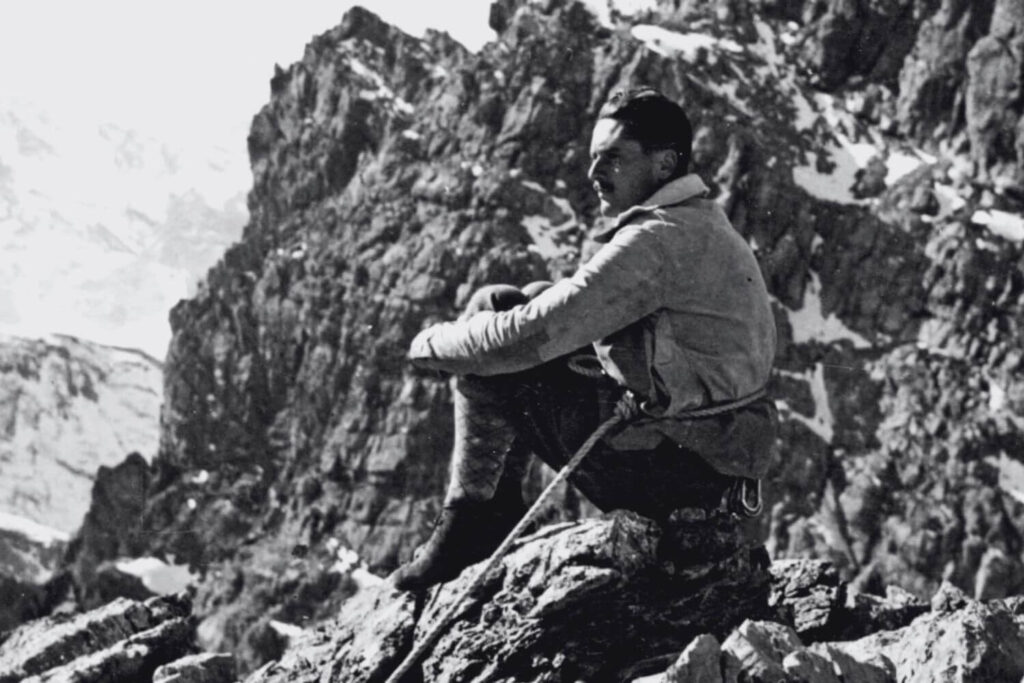
A childhood like that leaves scars. But because of those early scars, such a person later stops feeling many others. Where others would suffer, he took whatever came with a stony face. By the age of six, the young boy from the village of Savorgnano already knew pain at close quarters. First his father – he was four at the time – perhaps a badly timed dynamite blast, an unexpected rockfall or one stray stone. How and what exactly happened, he, his mother and his sister never found out. The letter from the Canadian mining company said only: "We regret to inform you that... as a result of an accident at work." And then, two years later, war came to their home on the banks of the Tagliamento, the river that winds blue between gravel beds all the way down from the Dolomites. The Great War. A world war.
Young Riccardo Cassin was used to taking punches. In the ring of life – and, once he moved to Lecco at seventeen, in a ring fenced off with ropes, too.
He also tested the toughness of his soul thoroughly and regularly on the rocky summits of the Grigne massif above Lake Como, from where a straight road led to the biggest walls of the Dolomites. The north-west face of the Civetta, the north face of Cima Ovest di Lavaredo, the south-east arête of Torre Trieste. Once he had ticked off nearly all of those walls – by then his knuckles were scraped raw from climbing sharp rock rather than from punching an opponent's bones – he set his sights on one of the last great problems of the Alps. One of the six great north faces. The as yet unclimbed, eight-hundred-metre north face of Piz Badile.

It was nearly mid-July. Twenty-eight-year-old Cassin sat on a hard oak bench in the Sciora hut, watching through the window as the storm lashed the glass. His companions from Lecco – Gino Esposito and Vittorio Ratti – were hunched over a deck of cards that was nowhere near as much fun as it had been a few days earlier. The wait was long. And what they really wanted to know was what cards the mountain had in store for them – but it was still hiding in the clouds.
On Tuesday 13 July, stars finally appeared in the night sky above Piz Badile. So early the next morning, still in the dark, they set off. Three determined climbers made their way up the scree to the foot of the dark granite wall. But below the start of the route, two more lights were flickering. When the five men's eyes met just a moment later, every one of them knew the race was on. Mario Molteni and Giuseppe Valsecchi – two equally determined, if somewhat poorer, climbers from Como – had been bivouacking in a damp shack near the face and, just like the three men from Lecco, were waiting for their chance to be the first to conquer the unclimbed giant.
Cassin's trio went first. Molteni and Valsecchi followed.
On the first day, in unknown terrain, they got through some genuinely hard pitches, where every metre was won very, very grudgingly. They were making good progress. But the mountain started dealing bad cards. They spent the whole endless night sitting on a rock ledge while torrents of water poured over their shoulders, gushing down the face as if someone had opened a dam's sluice gates. And that night Molteni and Valsecchi were caught by an exhaustion that had been building up, bit by bit, in their bodies during ten uncomfortable days at the foot of Badile.
In the freezing morning, Molteni's lips, trembling with cold, let out a single but enormous plea to Cassin: "Can we climb with you? Together?"
Cassin hesitated for a moment. Five people on one rope – that of course means far slower progress than three men in top form. And slow progress brings risk. But he knew there was no other possible answer. He nodded and looked up at the water-soaked wall.

The climbing got harder and harder. Wet rock and frozen hands – not a happy combination. And for the night the mountain had another stormy card up its sleeve. This time, though, the rain turned to snow and the wall above their heads became coated in a shiny glaze. In that terrifying theatre, Molteni and Valsecchi gave up completely. Their strength deserted them and, worse still, so did the will to dig any more strength out of their bodies. But the only way to safety led upwards. So, up an iced-up chimney, Cassin, Esposito and Ratti suddenly had to haul not only their own bodies but two failing ones as well.
In the end they managed it. The north face of Badile yielded to the human urge to achieve something. But no glory awaited the five men up there. Only a continuing snowstorm and a desperate search for a way down to the valley. So desperate that the raging elements gradually brought the weakest to their knees.

Molteni was the first to kneel before the power of the mountain. Without a word – without a sigh. Suddenly the tension that had kept him upright vanished from his body. Not even the cognac that Cassin tried to trickle into Molteni's mouth, hoping the alcohol would get his freezing, thickening blood flowing, could do anything. Nothing helped. He simply lay there. And for a moment emotion defeated reason. Cassin tried to carry his dead friend on his back, to bring him down the mountain, but the storm quickly made it clear that if he carried on like this, he would die too. So he and Esposito tucked Molteni under a boulder, where he was at least partly sheltered from the storm – perhaps they would come back for him.
They told Valsecchi nothing. In his state, such a shock would not have helped him. But when yet another obstacle blocked the way and the men gathered in one spot, Valsecchi worked out the truth. He wept quietly for a while, and then gravity claimed his body too – just like his friend Molteni's.
Not long afterwards, the darkness of night caught up with the three remaining men. For the third time they had to endure a wet and utterly miserable bivouac. Nobody slept. Their frozen bodies shook with cold under their sodden clothes, and thoughts of their friends, resting for ever just a short way from their nest, kept coming back and rattling their wilting heads.
After midnight the storm died down. Better cards were dealt again, and towards morning life-giving sunbeams fished their numbed bodies out of hibernation. Cassin rose heavily from his hard stone bed, looked around and recognised the snowfield at the foot of Piz Badile. They only had to descend a hundred metres.
Riccardo Cassin, Gino Esposito, Vittorio Ratti, Mario Molteni and Giuseppe Valsecchi spent 52 hours on the north face of Piz Badile between 14 and 16 July 1937. Cassin, Esposito and Ratti brought down the body of Giuseppe Valsecchi on the last day of the descent. They returned for the body of Mario Molteni the following day together with a rescue team.
Besides the north face of Piz Badile (3308 m), the six great north faces of the Alps include the north faces of the Matterhorn, the Eiger, the Dru, the Grandes Jorasses and the Cima Grande. The north face of the Grandes Jorasses was also first climbed by Riccardo Cassin. When he set off up it with Ugo Tizzoni and Gino Esposito on 4 August 1938, they were seeing the face for the first time in their lives. Until then they had only known it from a postcard and didn't even know how to get to its foot.
Besides climbing the great alpine walls, Riccardo Cassin also took part in the partisan resistance during the Second World War (his Badile partner Vittorio Ratti was killed in one of the resistance operations), and after the war he organised expeditions to Gasherbrum IV, Denali and the south face of Lhotse.
In 1987, at the age of 78, fifty years after the first ascent, Riccardo Cassin repeated his climb of Piz Badile.