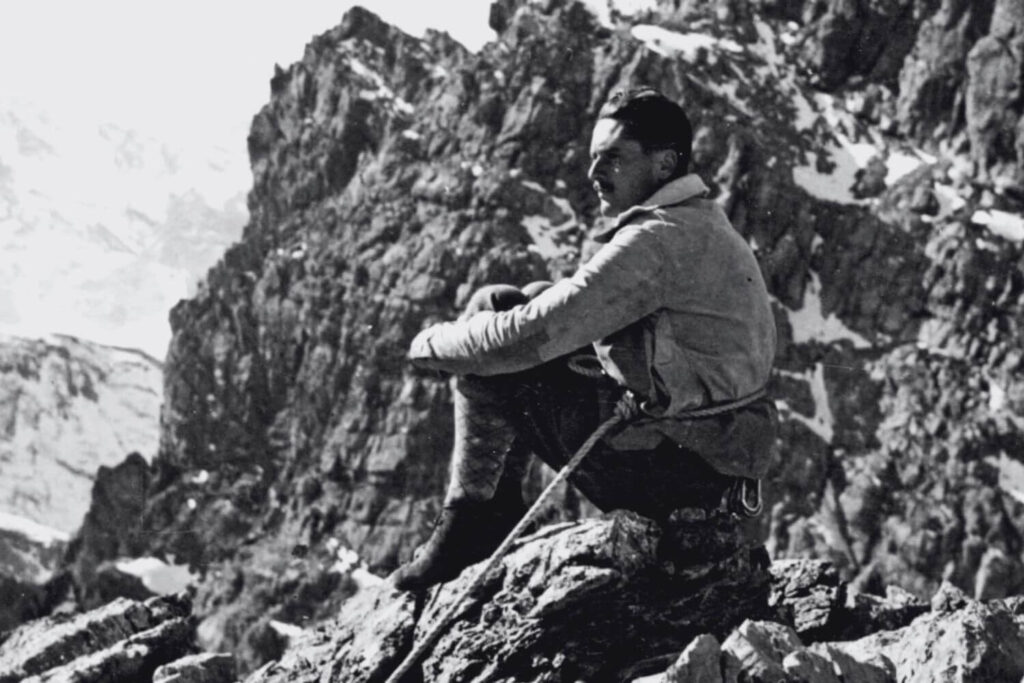
He had been living in Nome, Alaska, for thirteen years when gold prospector Jafet Lindeberg entrusted him with raising fifteen puppies he had brought over from Siberia for Amundsen's expedition to the North Pole. And while the mushers mocked this oddly small breed – compared with the typical teams of the day, these dogs were maybe half the size – Leonhard Seppala fell in love with them. Perhaps because he himself was no giant among his fellow Scandinavian immigrants. Despite his modest build, though, he had real grit. Everyone had known that from the moment he arrived in Alaska.
Back in the spring of 1899, Jafet Lindeberg had returned home to Norway with his pockets stuffed with dollars. And with his tales of riches that literally anyone could dig out of the ground, he persuaded the twenty-three-year-old Seppala to swap his father's forge in the village of Skjervøy for veins of gold somewhere in the Yukon. Gold didn't fill Seppala's pockets nearly so easily, though. Cleaning out the sluices, on the other hand, was never-ending work, and in Anvil Creek he shovelled tons and tons of rock. What's more, the bangs of dynamite and the swirl of gravel at the bottom of a metal pan didn't satisfy Seppala half as much as the rhythmic patter of dogs' paws on snow.
During his very first winter, instead of a gold digger he became a dog-sled driver. And although most mushers didn't go on runs longer than thirty miles, Seppala blazed trails through the frozen wilderness three times as long. He and his dogs achieved great things. Unusually for the time, he kept them in shape over the summer, too – when other teams mostly rested. And instead of a sled, he had them pull a wheeled cart.
That's exactly why Jafet Lindeberg entrusted him with the new breed for Amundsen.
But the famous explorer cancelled his expedition just a few weeks after Seppala had taken on the puppies. So they stayed with him. Lindeberg gave them to him as a gift.

In April 1914, Seppala and his pack of unusually small Siberian huskies stood at the start of the annual sled-dog contest – the All Alaska Sweepstakes. Their very first race. A long route lay ahead – with only a few checkpoints scattered along the Bering Strait. From Nome to Candle and back, 204 miles of wilderness. And every musher had to finish the race with as many dogs as he started with – alive, injured or dead.
That year, though, the race was ruled above all by a snowstorm.
Seppala's young dogs lost the trail in the blizzard, and the cliffs above the raging Bering Sea loomed dangerously close. But how close? Nobody knew – until the wind briefly blew the clouds apart and opened a window onto a terrifying future.
The team was racing along the foot of a hill straight towards the cliffs. And just a few metres from the drop, Seppala managed to avert what had looked inevitable. The wind-whipped waves were already reaching for them when they finally came to a stop on a sheet of ice and began clawing their way back up the slopes. The sharp snow cut the dogs' paws until they bled, and many broke their claws in the frantic braking. Seppala felt ashamed. He blamed himself for abusing his dogs' loyalty and putting them in danger. He couldn't come to terms with it. So he withdrew from the race.
For the next several months he did nothing but tend the dogs and wait for them to heal. They weren't ready to train again until autumn. In the years that followed, however, Seppala's team was always first back into Nome. Until the World War put an end to the race for good.

Around that time, a little runt with grey patches on his head, chest and front legs appeared among Seppala's dogs. An unruly puppy who refused to sit bored in the kennel with the other dogs and always found a way out – and then straight into Seppala's house. Togo was so different from the rest of the well-drilled pack that Seppala had no doubt this rascal didn't belong in the team. And certainly not at its head. But Togo demanded attention for so long that Seppala finally realised what game the dog was playing with him – he wanted to stand by his side, right at the front of the team. Like a loyal friend.
Together they raced through many Alaskan winters. Through blizzards, gales and whiteouts. And then, in the winter of 1925, they set out on their greatest race. The last race for the ageing Togo. The Great Race of Mercy.
A shortage of diphtheria antitoxin in completely cut-off Nome sent Seppala and his team on a rescue mission several hundred miles long. During the coldest winter in twenty years, no less. Along the 674-mile route, mushers passed along the serum – the only thing that could save the epidemic-stricken town from tragedy. The experienced Seppala was given the longest leg, between Nulato and Nome. He knew he had to hurry. And he knew that taking the shortcut across Norton Sound would gain him a whole day – or he could lose everything out there.

Sea currents keep the ice covering Norton Sound in constant motion. On the slippery, wind-polished glass, dogs struggle to find reliable footing. But far worse are the small cracks that suddenly open up under the sled, swallowing the team beneath the ice. Or leaving it stranded on a detached floe that the wind pushes out into the open sea. Far, far too risky – even for the most experienced mushers. But Seppala had used the shortcut across Norton Sound several times before, and now he could gain a great deal of time in a race for the lives of dozens, maybe hundreds of people – including his eight-year-old daughter.
In temperatures of minus sixty, Seppala and his dogs squinted against the icy wind that blasted mercilessly into their faces. There was nowhere to shelter. And on top of that, night caught up with them before they set out onto Norton Sound. Blinded by the blizzard and the darkness, Seppala couldn't watch for any warning signs. He had to trust his lead dog's instincts completely. He had to believe that Togo would find the way across the heaving ice to Isaac's Point on the far side of the bay.
When dawn broke, they were still racing across the sea. Wet patches under the sled and open water just a few metres away – everything told Seppala that he was now racing for his own life, too. The ice was breaking up under the dogs' feet into floes that ground against each other with an ominous wail. But they still stayed close enough together for the dogs to leap the cracks and the sled to cross them.
Just a few hours after Seppala, Togo and the whole pack reached solid ground, not a single stretch of unbroken ice remained on Norton Sound. All of it had drifted out to the open sea.
The exhausted dogs had already covered 260 miles in a frost that sucked the life out of their bodies. They had been running over snow and ice for four and a half days, and one last obstacle rose before them – the ridge jutting out of Little McKinley. The slope seemed steeper than ever that day. But the pack followed its leader – Togo couldn't let his master down.
And he didn't. That very afternoon – it happened to be a Sunday – Gunnar Kaasen took over the serum. He harnessed other, still-rested Seppala dogs to his sled, and they reached Nome early the next morning. Before noon, the first patient received the thawed serum.
Twenty teams took part in the relay that saved the town of Nome, and none of them covered more than 53 miles. Only Leonhard Seppala and Togo covered a full 264 miles. Later, a statue of a dog was erected in New York's Central Park to commemorate the serum run – the dog who led the team carrying the serum into Nome on 2 February 1925. His name was Balto.

Leonhard Seppala won many more races with his teams, and in 1932 he even took part in the Olympic demonstration event at Lake Placid, where he finished second. Sadly, Togo was no longer with him. But his descendants helped spread the sought-after breed known as the Seppala Siberian Sleddog. In 2001, Time magazine named Togo the most heroic animal of all time. In 2019, a film about his and Seppala's life was made: Togo.
In 1964, Leonhard Seppala settled with his wife in Seattle, where he died in 1967 at the age of eighty-nine.
The All Alaska Sweepstakes was held again in 1983 and 2008 to mark the 75th and 100th anniversaries of the first race.
In honour of the serum run, the Iditarod Trail Seppala Memorial Race sled-dog race was held in 1967. 58 mushers lined up at the start of the 938-mile (1,510 km) route from Anchorage to Nome. The race is still held today under the shorter name Iditarod.