The mountain road twists through a few airy hairpins above the gorge of the Le Vénéon river into the village of Saint Christophe en Oisans, and from the driver's seat things suddenly start to look grim. An ordinary car surely can't squeeze between the walls of these tightly packed houses! At the narrowest point the buildings will probably pinch it between them and that'll be the end of the road. At one moment you get a very close look at the roughly hewn granite blocks the Oisans houses are built from – and they've most likely stood here for a good few decades, maybe even centuries. But in the end you, too, just about slip through and follow the direction in which the wide-open, sun-dried oak shutters of the houses are gazing. And then the road keeps pushing upstream along the river for quite a while, until a glacier on the horizon finally freezes its drive.
The granite needle hides deep in the mountains. You can't see it well from anywhere. Perhaps only from the hills opposite, which you can reach only under your own steam and with the good judgement to guide you past lurking crevasses and steep rock steps. Maybe that's why it isn't as celebrated as other mountains that preen for tourists at easy-to-reach viewpoints. The jewel of the Écrins park has to be earned. Getting even close to it costs at least a bucket of sweat. And trying to climb all the way to the summit? – Until 1913, nobody even dared.
It's precisely this inaccessibility that adds to the beauty of the three-thousand-metre spear. From the Les Étages plateau a stony path climbs as steeply as it possibly can. You soon lose count of how many times the trail has turned into yet another switchback. There's no escaping the sun – it fixes its rays straight on the back of your neck, trapped on the south-facing slopes, so you just squint as salty sweat runs over your eyelids. You stare at the ground, watching the dust swirl under your feet – the view ahead wouldn't thrill you much anyway. Now you just have to hang on and keep walking. Only a gorge lined with waterfalls finally refreshes you. At its lowest point it's spanned by a footbridge whose metal frame glitters with droplets of water dancing in the sunbeams. And on the far bank you at last catch sight of THE reason you're putting yourself through all this.
And if you keep your Dibona in front of your eyes from now on, maybe the next hundred switchbacks won't sap your spirit.

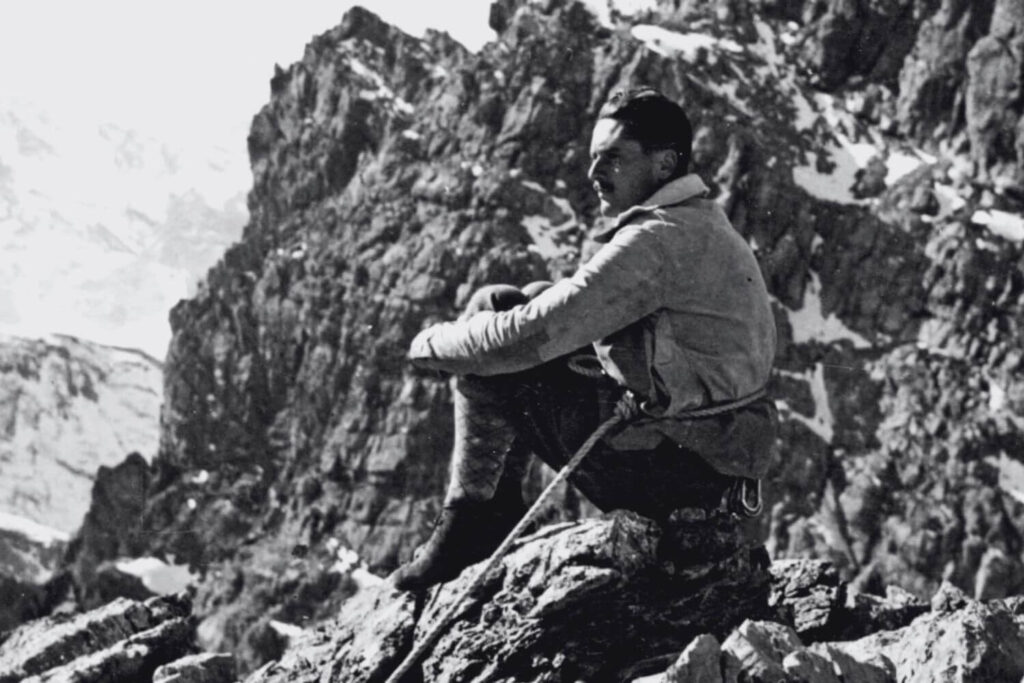
The tower above the Soreiller plateau was originally called Aiguille du Pain de Sucre, and anyone who even scrambled up to its foot admitted that their route ended there, no question. But when the Italian mountain guide Angelo Dibona arrived in the Écrins, he already had to his name an ascent of the highest tooth of the Tre Cime di Lavaredo, the west face of Croz dell'Altissimo in the Brenta and the thirteen-hundred-metre face of La Meije. And Aiguille du Pain de Sucre didn't seem as terrifying as people down in the valley tried to paint it. In the granite walls he spotted weaknesses that hinted at a way through, and on Friday 27 June 1913, early in the morning, he set off upwards – together with his Austrian client Guido Mayer.
They climbed the west flank of the mountain – over rock steps that from afar looked like three enormous stairs. Literally giant stairs! But the only possible way up led much too far from the summit, so Dibona committed to a bold traverse to get closer to the mountain's north ridge – the gateway to the top. In that sea of granite Angelo Dibona found perhaps the only possible gap, but the real test of resolve was still to come. The unyielding soles of his stiff boots were reliable on scree and rock ledges, but on the smooth slabs below the summit he had to rely purely on the friction of skin against rock. Meanwhile the view down into the valley kept deepening on both sides of the ridge. In places Dibona was literally hugging the mountain. He sat astride it – like on a horse – and inched his way up towards the sky. And then – suddenly – the ridge ended – beyond it gaped only the abyss of the south face. Angelo Dibona and Guido Mayer were standing on the summit. And there was room for both of them.
Black alpine choughs then circled the two unknown creatures who had taken their seat without permission that June day. Another alpine unknown had been revealed. And not long afterwards the rock needle got a new name – in honour of the man who refused to accept that there might be no room for him at the top – Aiguille Dibona.

After coming down from the summit, Angelo Dibona and Guido Mayer crawled into a bivouac under an overhanging boulder at the foot of the mountain, which had perhaps once broken off the great south face. They could celebrate their success only with broken chunks of bread and bacon unwrapped from greasy paper. A hard night on the stones awaited them, but their backs had long since got used to it over years spent in the mountains. The Refuge du Soreiller hut wasn't built by the mountain folk of the Dauphiné until 1957 – just a short way from Dibona's overhanging boulder. So if you decide to climb the highest south face, you don't need to dig yourself out from under the itchy blankets in the dormitory particularly early – you'll be tying into the rope five minutes after the hut door clicks shut behind you.
The first direct – and difficult – line up the exceptionally good granite of this south face was established by Andéol Madier and Maurice Fourastier on the first day of September 1937 – and the classic Voie Madier is still a solid challenge today. As are the Voie des Savoyardes from 1967 and the most popular route, which by its name is apparently compulsory: Visite Obligatoire (meaning Compulsory visit). Not one of its thirteen pitches lets you rest much – but plenty of fixed bolts won't drive you into a corner of fear either. And when at last – after hours of toil and with a parched tongue – you look down from the top at the speckled little ants busily scurrying along the zigzags below the Soreiller hut, you'll agree with the words of the mountain poet Gaston Rébuffat:
“This needle is a monument given to mankind by the Earth itself and by time. An extraordinary sculpture in the sky – the light and silence of the Oisans. Equally difficult climbs on other mountains are nowhere near as wonderful. This needle is like a question – and climbing it is a fitting answer.”

Angelo Dibona (1879 – 1956) was one of the best climbers of his time and a devotee of pure free climbing without technical aids. He became a respected mountain guide (his clients included King Albert I of Belgium) and was one of the first three ski instructors in Cortina d'Ampezzo. In 1976 a bronze bust of him was erected on the main square in Cortina, and the square was later renamed Piazza Angelo Dibona.
Aiguille Dibona is far from the highest mountain in the Écrins National Park – it stands 3131 metres high, while the highest peak, Barre des Écrins, towers almost a thousand metres higher (4102 m). Even so, it's the symbol of the park and one of the most beautiful towers in the world. Only climbing routes of grade IV and above lead to the summit. In 2014 base jumpers Bertrand Givois and François Gouy leapt from the top of the Dibona (video).
The Refuge du Soreiller hut (hut website) is open from early June to early October. You can sleep in the shared dormitory or (by arrangement with the hut keeper) on one of the bivouac spots around the hut. And watch out – the local dry toilets are a model of how to deal with human waste in the middle of the mountains. You'll even get to exercise your right leg while you're at it.