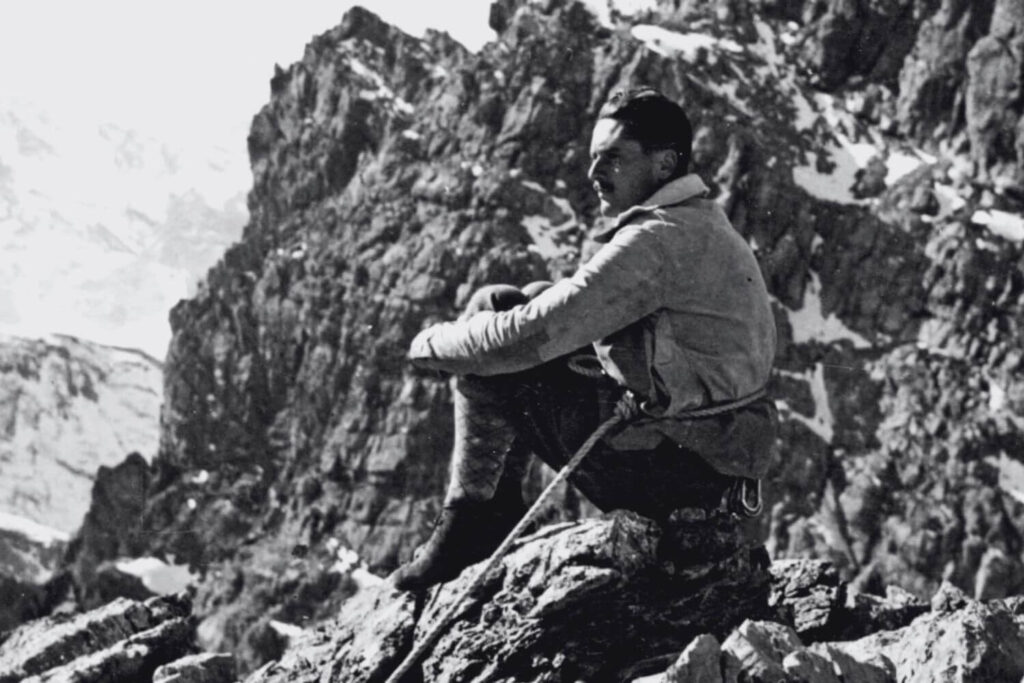
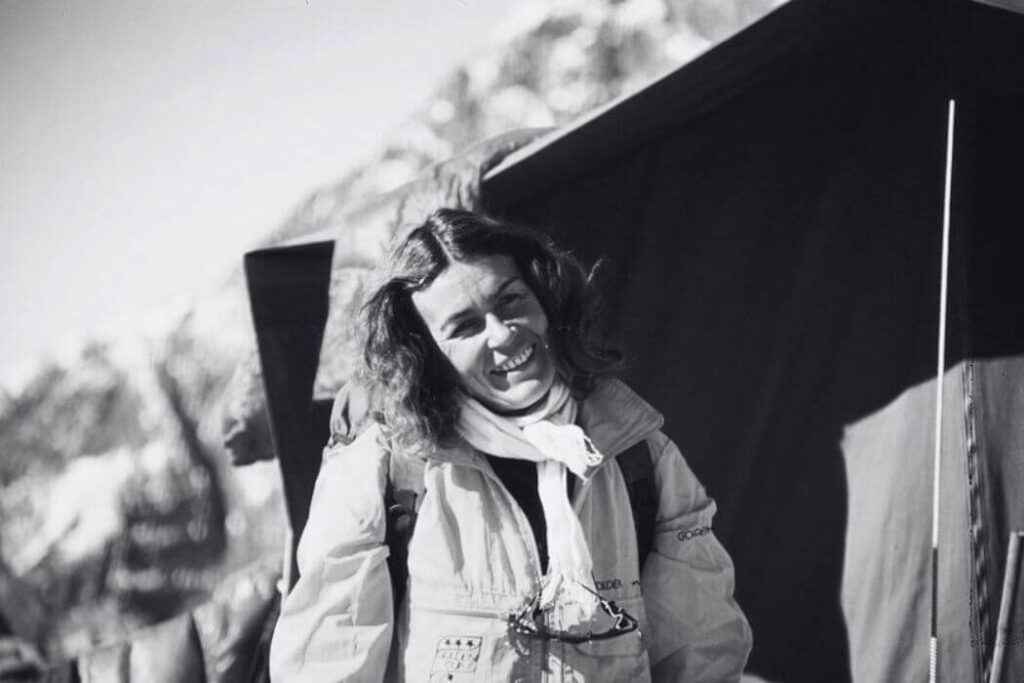
It was 16 October. A Monday. The year 1978. Wanda Rutkiewicz stood on the summit of the highest mountain in the world – Everest. Only the third woman ever. The very first European woman. And above all – the first person from Poland. Her first eight-thousander, and nothing but firsts along with it. She had done it, and she had even kept pace with her male partners on the German expedition. Then again – she'd been trying to match and outdo men ever since she was a little nipper. At first probably just to prove to her father that she could replace his firstborn son – her brother Jurek – who was blown apart by an unexploded bomb in 1948. Later, though, the rivalry turned into an obsession. And it's true that some of the expedition members were a little irritated that thirty-five-year-old Wanda had endured what young, strong men often struggled with in vain.
On top of that, she had gone to the Himalayas against the will of her doctors and all the sports bigwigs, without an athlete's licence. They had diagnosed her with anaemia. But with a stash of injections in her rucksack, she dealt with that minor hitch. Nothing could dent her iron will.
And so Wanda Rutkiewicz descended the glittering snows of the Khumbu Glacier towards a fame no other climber in grey communist Poland had ever known. Let alone a woman climber. They barely seemed to exist. The moment she crossed the border into her homeland, reporters of every kind were shoving microphones in her face and stuffing invitations to TV and radio shows into her pockets. Everyone wanted a piece of her. Everyone fussed over her. And the gentlemen climbers just mumbled and were a bit jealous, too. To which she replied with an ostentatious wink – as if to say: “Boys, if you want something badly enough in life, you can always have it!”
She knew perfectly well what else she wanted from life. Another eight-thousander, of course! And having climbed the highest, she now meant to take on the hardest. The sinister pyramid of K2, which keeps one human life for every two little people who reach the top. That's its arithmetic.
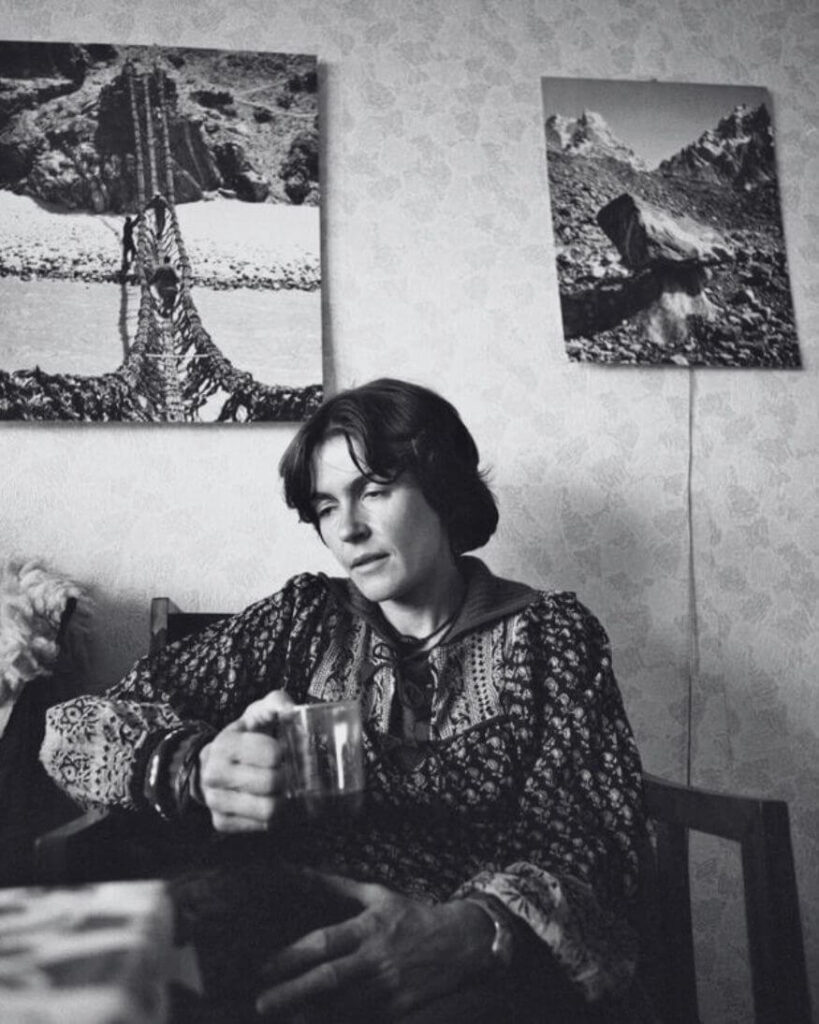
Except that men kept getting in the way. She had already learnt that she could barely stand having one beside her – and that a man could barely swallow her single-minded devotion to the mountains and nothing else. In 1970 she married a handsome blond, Wojciech Rutkiewicz, whom she had met in the Falcon Mountains on a joint trip of the Wrocław High Mountain Club. They gazed lovingly at each other for a little while and then divorced. He walked away with old memories, and Wanda Błaszkiewicz with a new surname.
It was worse when, in the Caucasus, a man threw himself straight into her arms. He came hurtling down from above on skis – and wham, right into her! The two of them tumbled down the slope together for two hundred metres. From that union Wanda came away with a shattered thighbone and two annoying crutches. Men – what a jinx!
One operation. A second. And finally a third. In summer she was supposed to be standing at the foot of K2. So she was racing against the clock. But endless rehabilitation still lay ahead. As a celebrity, she was sent to Innsbruck, where Europe's top athletes supposedly went to recover from injuries. She grafted. She grafted so hard, in fact, that she cracked the leg again. But you should have known that will of hers! A metal plate in her leg, forearm crutches in her hands, painkillers on her tongue – and the porters on the Baltoro Glacier just goggled, and for a long time afterwards they remembered the crazy Polish woman who – admittedly sometimes on Jerzy Kukuczka's back – hobbled all the way to the foot of K2.
For sixty-nine days, the all-female Polish team Wanda had put together tried to scramble to the top of K2. She commanded them from base camp and drove those poor girls upwards like a bulldog. All in vain. If only she could have run up that mountain herself! But when Halina Krüger-Syrokomska's heart stopped from sheer exhaustion in Camp II, she decided to call it a day, and they went home.

“Big, brutal K2 has to be earned,” Wanda told herself when she came back four years later, with another failed attempt from 1984 weighing on her shoulders. Facing those masses of eternal ice plunging steeply down over the darkest rock, you had to show you had the courage to stand up to them again and again – that's how she thought. “You're playing with death, Wanda,” the other Polish climbers warned, wagging their fingers. “Don't forget the toll that mountain takes.”
But they still didn't know her well enough. They didn't know that, just as some people get hooked on cigarettes or slot machines, Wanda Rutkiewicz had become hooked on the risk and danger that spilled over from places like K2.
The Black Summer. That's what 1986 on that mountain later came to be called. Wanda barely staggered back down to base camp. Step by step, again and again – with the greatest effort – she found her balance in a fierce snowstorm and scraped the last scraps of strength from her wasted body. Her gaze had gone completely blank. You couldn't read anything in it. “Did you make the summit?” they pressed her. She looked as if she'd fallen from the Moon. Her nod was barely visible in the blizzard, which looked like billowing curtains. “And the Barrards? Liliane and Maurice?” This time she shook her head. That they understood all too well. Her climbing partners had not come back from the mountain. Nor had eleven other climbers that summer.
Frostbitten and exhausted, Wanda Rutkiewicz. With a huge tragedy behind her and, at the same time, the greatest success of her career on her shoulders. Why did she do it? Why did she pack up straight away and set off alone to conquer Broad Peak as well? Why didn't she grieve with the others at base camp? Maybe she wanted to tease death a little more. To let the volcano of her energy erupt in full. But she got no further than Camp I.
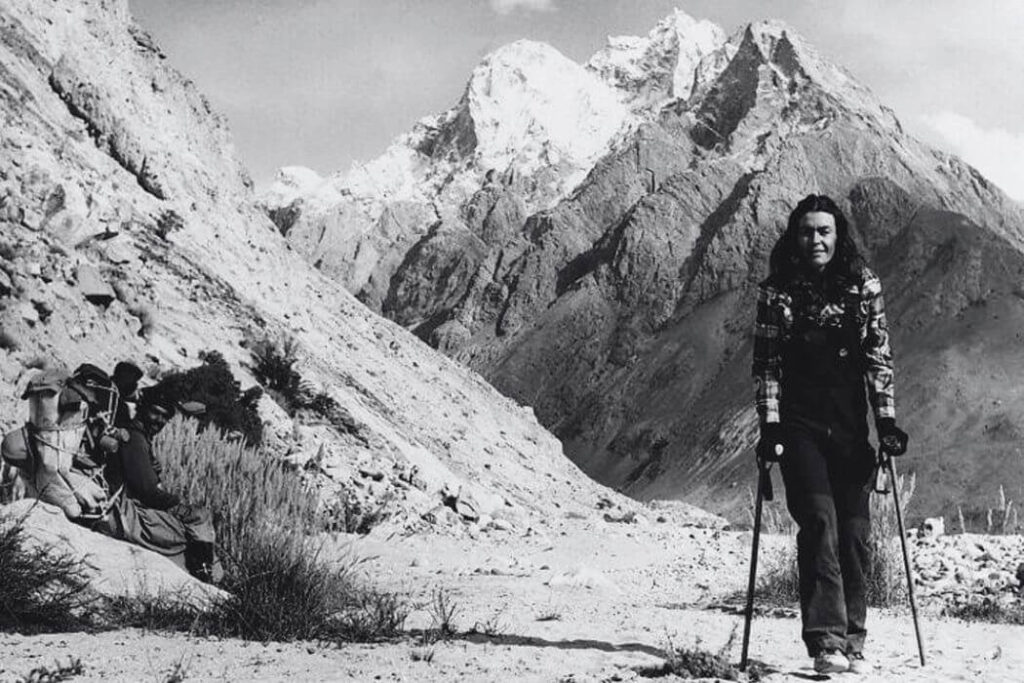
Shishapangma. Gasherbrum II. Gasherbrum I. Cho Oyu. Annapurna. Between 1987 and 1991, Wanda's list of eight-thousanders grew to a respectable seven. But there were two people walking the earth – men – who had climbed all fourteen. Sadly – one of them, and a good friend of hers at that – had already paid for his obsession with his life. Fourteen wasn't enough for him. He wanted more. And he wandered all the way up to heaven. Jerzy Kukuczka's death was a heavy blow for Wanda. And another came a year later. At last she was truly, genuinely in love. And he – he just slipped and fell to his death at her feet.
When her last great love, the handsome German Kurt Lyncke-Krüger, was gone too, Wanda Rutkiewicz began to laugh in the face of death. She had nothing left to lose. And she decided that over the next two years she would collect the remaining seven eight-thousanders. That at forty-eight she would charge upwards with her Caravan of Dreams. That's what she called the ambitious project.
So what if more than one seasoned Polish climbing veteran told her what a madwoman she was and why it couldn't be done. Seven eight-thousanders in under three years! Insanity! But Wanda had never listened to anyone much, and now she'd gone completely deaf. It looked like an attempt at self-destruction – during which, however, she managed to slip up the south face of the fearsome Annapurna to its summit entirely on her own. Even though many didn't believe her. “That summit photo is dark and hazy,” they said doubtfully. “You can't see a thing.” But Wanda knew what she knew, and that was enough. And now the third-highest mountain in the world stood in her way – Kangchenjunga. The three highest mountains in the world on one list – a challenge no other woman before her had even attempted.
Before she started climbing, she fed her body painkillers. The leg broken long ago, forever heavier than the other by a metal brace, had never stopped aching. But with fifty approaching, it felt as if it were breaking again with every step at that enormous altitude. That's how bad the pain was. Either way, the north-west face of Kangchenjunga bit into every member of the expedition and in the end tore apart almost all their summit dreams. It left them to only two – Carlos Carsolio and Wanda Rutkiewicz.
Fresh, deep snow cut the two struggling figures in half. It kept their legs to itself up to the waist. Only their torsos and heads stuck out towards the sky. Hard! – It was damned hard to fight through the new snowfall to take the next step forward. At times it was as if Wanda were switching her body off. Consciousness came and went. Instead of the distant tip of the mountain, she was watching a film in which she rode a golden yak along a glittering white track towards the heavens and eternal glory. The hallucinations overwhelmed her completely when, at eight thousand three hundred metres, she plunged her frozen hands into the snow and began digging a cave.
She saw Carlos Carsolio again only when he was coming back from the summit. “Wanda, come down with me!” he pleaded. But she felt her addiction had not yet been satisfied. It would have been easy to go down now. But she would have been left empty. She needed to fill the vessel with risk. “I'll rest – and tomorrow – I'll go – up,” she answered him weakly, haltingly, and he had to try hard to catch all her words in the rising Himalayan wind. “Describe – the route to me,” she squeezed out. He couldn't do a thing with her. So he did what she asked and went down. Then he waited for her for three more days in the high camp. Over and over he pulled back the tent flap and peered out to see if he could glimpse a mottled dot moving on the white slope. But Wanda Rutkiewicz had long since been riding on the back of the golden yak in her Caravan of Dreams.
Wanda Rutkiewicz (4 Feb 1943 – 13 May 1992) most likely died the very next day after Carlos Carsolio last saw her. At that time there was not a single other person on the whole mountain who could have gone up into the death zone to help her. Wanda Rutkiewicz's body has never been found. Whether she reached the summit of her ninth eight-thousander before she died remains a mystery.
The list of climbs by Wanda Rutkiewicz includes, besides eight eight-thousanders (Mount Everest, Nanga Parbat, K2, Shishapangma, Gasherbrum II, Gasherbrum I, Cho Oyu and Annapurna), the first female ascent of the east pillar of Trollryggen in Norway and the first female winter ascent of the north face of the Matterhorn. She also stood on the summits of the seven-thousanders Lenin Peak (7134 m), Noshaq (7492 m) and Gasherbrum III (7946 m).
The family of Wanda Rutkiewicz tried to put together an expedition to find her missing body, but in the end it never took place because of insurance problems.
Wanda Rutkiewicz's mother refused to accept the news of her death and believed until the end of her life that her daughter had left the Western world to live a quiet life in one of the Buddhist monasteries.