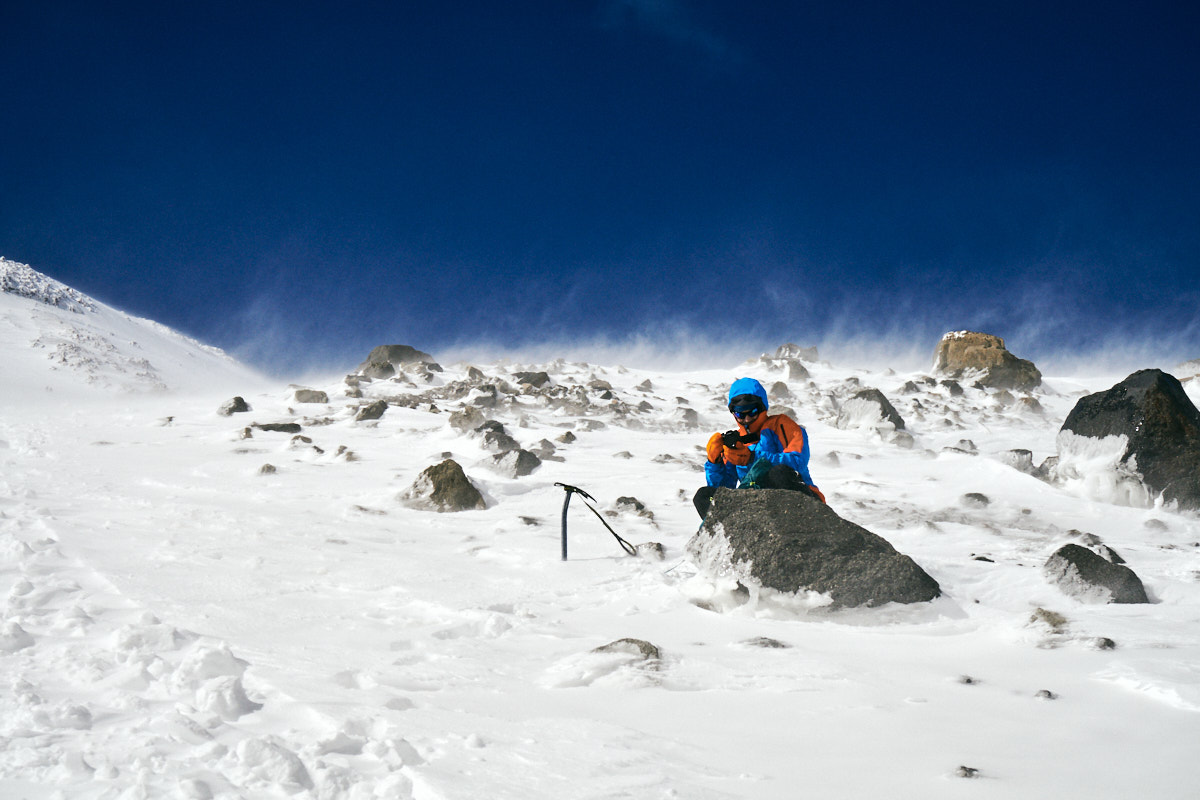
But it really is just a little further. One last breather and... yes! It really doesn't go any higher. With the creak of crampons leaving nothing but a jumble of geometrically regular marks in the snow, you turn towards the sharp ridge behind you. To mark your shared success, you stretch your right hand out to your partner, who is two steps short. For a moment your fluffy mittens merge into one. Done! Not a soul anywhere. Apart from the two of you. Before your four feet stood this high, they had to cover a long, long way. Five years? Ten? Fifteen? How long did your preparation take?
4,000 kilometres further west, another pair – quite possibly better equipped – is just joining a train of headlamps sliding steadily up towards the roof of Europe. Those two will get nausea too. They'll leave the same crampon marks in the snow. And on the summit they'll shake gloved hands. Everything the same. The same snow, the same views, the same joy. Only their journey took four days – including acclimatisation on the Argentière glacier. Next week they've booked a skydive, and in a month they're flying to Egypt for a freediving course.
"Many paths lead to God, one leads over the mountains."
— Rudolf Kauschka's gravestone and the first page of the author's diary
Those other two live a colourful life full of experiences. While you spend your whole life just learning how to tie a prusik from the free end of the rope, digging in the snow on every ski tour so that a look through a magnifying glass tells you whether the snow crystals have changed shape again, and spending your evenings poring over guidebooks and flicking between browser windows, trying to find as much information as possible for your next foolish expedition.
You could have hired a guide, you know. They're professionals.
But you've got a mind of your own.

You stubborn mule! Going your own way again. A long, long way on which, despite all your experience, you'll still do something stupid. How many times have you been stopped by one of the many dead ends? Just as the Swedish writer August Strindberg found out by experiment that blowing tobacco smoke into water does not make gold, you managed to verify with scientific precision that as a grade-7 sport climber you are a complete zero on sandstone. And you start again from scratch. For the umpteenth time? From sevens you've dropped to fours. You learn to place knotted slings and so fool your frightened mind. A ring bolt! Where's the ring? On a grade four? There isn't one. Once your feet get used to the uncertain friction of sandy little ledges, you can move up to fives and sixes. There you'll find a ring. One. You have to grow up to rings.
And growing up takes time. Sweet seventeen, what lovely memories. You can't just skip this stage in one go. True, you could. 250 euros and two hours later you're signing the summit register on Kapelník. And maybe in the afternoon you'll bag Taktovka too.
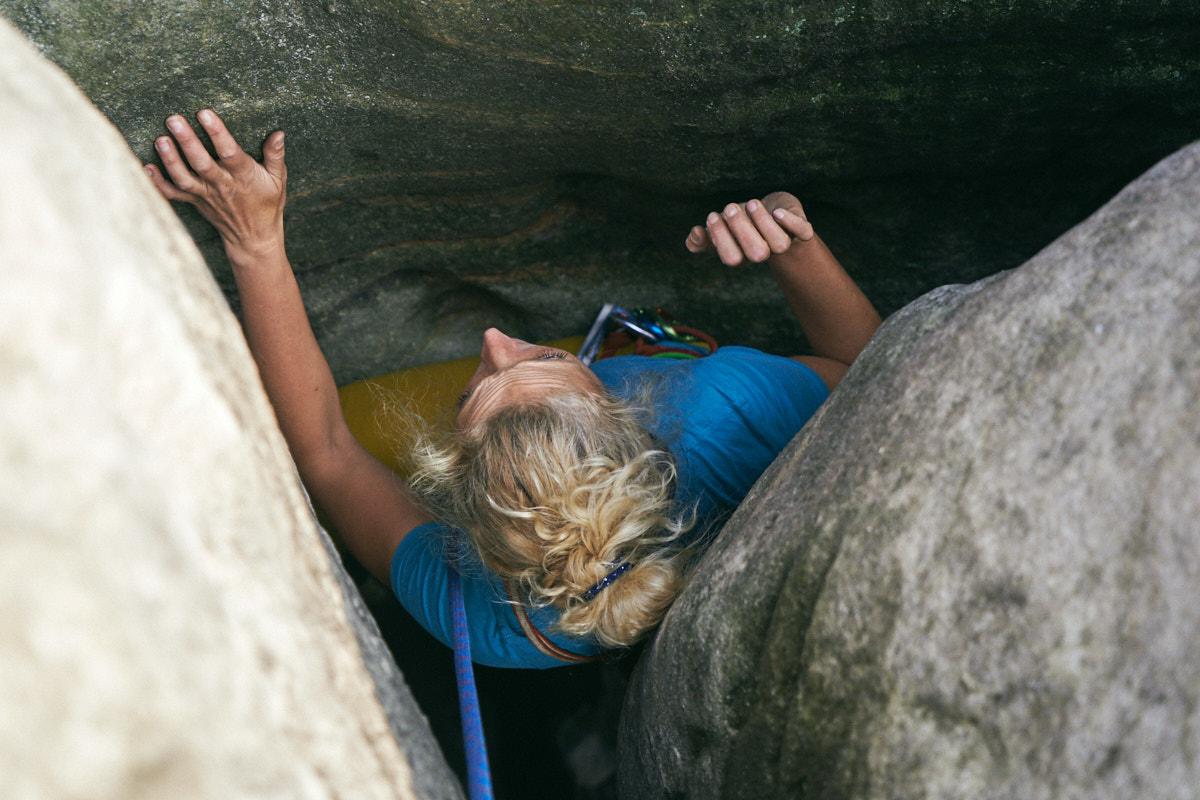
Or you wait for it. After all, the Old Route on Taktovka is graded VIIb. But the photo in the guidebook has completely bewitched you. You can recite the route description by heart. And then one day, under a favourable constellation set by Jupiter crossing Mars, you pluck up the courage to start. Up that nasty, crumbly little wall. On the traverse past the second ring you slot a bombproof knot into the crack, but on the run-out to the third you're still scared witless. And when, on the tiny summit cap, you take a stubby red pencil between your fingers, its lead disappearing into the wood, and immortalise your ascent in the register right after yesterday's strike team, you'll understand more than your paying predecessor – out of respect for the rock it would be better not to be up here at all. Since 1925, when Rudolf Hanke and his companions put up this route, millions of grains of sand have crumbled from Taktovka onto the slopes below. Every step has deepened the footholds by a few hundredths of a millimetre – over almost a hundred years, by several centimetres in total. And the rope rubbing on the traverse past the first ring saws through the tower like a two-man saw in a fairy tale. Saw, saw, saw...
"The root of evil is a lack of knowledge."
— Confucius
You'll build up a complete picture of climbing on the Czech sandstone towers, because you've been through the whole journey of discovery and learning. You know the dead ends, not the shortcuts. You'll understand that cries of "Put more bolts in those sandstone death traps! So we can climb them too," are calls from the gates of hell. There'll be more people on the walls, but less sand. And poor Hanke, who circled Taktovka for three long years from 1922 before he fought his way above the fourth and final ring, couldn't even defend himself against the bolts added later. The urge to be at the top right now – without fear, without obstacles – killed his legacy. The spirit of that route.
Safe adrenaline. That's the age we live in.
We have money, but no time.

Or are we just trading the time we could give to the mountains for money, so that we can buy the mountains with it? Upside down, isn't it? Cable cars to the summits, skywalks in the clouds, hotels in glaciers. Who built all that? We did, of course. Through our desire to use (and exploit) the mountains – here and now. Victory is certain, defeat is out of the question. Pride swells, the mountains submit. Humility, face-plants and listening remain merely the old-fashioned privilege of romantics for whom the slogan "Time is money!" has not yet become life's main mantra.
I climb mountains. I write about mountains. I photograph mountains. And I always come back happy. It's written in my name, after all.

Lowe Alpine Halcyon 35:40 climbing pack

Asolo Flyer trainers

Asolo Eiger XT EVO GV mountaineering boots

Bridgedale Hike Ultralight merino socks