
My body is working exactly as I expect it to. Between the obstacles laid in my path by million-year epochs of eruptions, folding and weathering, my feet land precisely on the spots that then catapult me into the next stride up the trail. Again and again. The terrain is not the enemy. I am the terrain. But the real test is only just coming. My trainers no longer meet in mid-air so often, while the life-giving pump forces more and more oxygen into my clenching muscles. Faster and faster. Heavy lungs make me give up my upright stance and drop into a slight forward lean. Perhaps so I can take a really close look at this trail heading for the clouds.

As soon as I emerge above the dwarf pines, which, like the last of the Mohicans, stubbornly defy the harsh weather of the Jeseníky Mountains, an icy wind through my sweat-soaked T-shirt lets me know I'm nearing the end of the first eight-kilometre test. Or rather, ours? Because there were two of us running. Yet it felt as if I were alone on the trail. My partner kept a low profile. Just nodding along to the rhythm my legs set. Only here, on a windswept mountain meadow, where I so love repeating to myself: "What more do I need? Just this!", does my companion show how indispensable he is on outings like a run along the Jeseníky ridge. He readily hands over a light jacket, two decilitres of water – filled into a bottle back down at the spring – that wets my tongue like music, and half an energy bar. He'll carry the other half for the way down, when every step on the steep descent will stamp the last of my strength into the mud.

To be honest, I was a little worried about him. And about myself. Because with a pack that won't sit still on your back, you won't run for long. But he – the Lowe Alpine Aeon – stays calm. Our backs work in rarely synchronised rhythm. Feather-light shoulder straps hug my shoulders firmly, but never roughly or clumsily. And at the waist there's one good click and you can forget about it. He surprised me again – my partner!
But what tested our relationship most were the grains of Mars-red Jordanian sand in Wadi Rum, creeping into every corner, crack and crevice. When you're woken by the Muslim call to prayer echoing through the dusty streets of a grubby Bedouin village, and at breakfast, sitting on a green rope coiled up for carrying, you stare at walls several hundred metres high, you have only one worry in the morning: what are you going to climb today?

Jebel Rum, Jebel Um Ishrin, Jebel Khazali. Plenty of directions, plenty of routes, but no fixed protection. At most, at the end of a rope length, you'll find a thread in the rock wrapped in a few slings bleached by the Arabian sun, whose age not even an expert could determine. Will you trust them? You don't have much choice. So, apart from a fair dose of courage, these bare walls demand plenty of your own gear, which you have to bring to the foot of the wall. Cams, nuts, slings, karabiners, two half ropes. And not very often, but now and then, and always quite unexpectedly, a hold will leave the position it had kept for centuries before you came along. So bring a helmet too. And water! A litre is, of course, nowhere near enough in the desert. When did it last rain here, I wonder?

But my partner, the Lowe Alpine Aeon, carried all of it to the foot of the wall. Whatever didn't fit inside, he strapped on the outside – rope and helmet. And then, on the wall, he simply blended in. He let himself be carried upwards and knew he mustn't disturb me. That I needed complete calm to put my full concentration into every move on sandstone that was worryingly brittle in places and reassuringly solid in others. That was our teamwork.
True, he didn't leave the desert without a scratch. The finer the grains of sand, the harsher they battered his surface – on the wall and while we wandered through canyons in an endless, mood-souring quest to find the one gorge that doesn't dead-end in a labyrinth of rock but leads to the safety of the village. Grubby and scratched, he still did his jobs – sit tight and carry. And he showed particular stubbornness when we needed to haul dry wood, gathered in the dust below the cliff, up to the top of the sandstone massif: for a fire. He ignored the fact that the elastic cords on his sporty, sculpted sides are meant mainly for trekking poles. Instead of protesting, he grabbed the twisted desert branches and didn't drop a single one all the way up. And all the while a sleeping bag was swinging at his waist. What a foolish idea, heading out to sleep in the desert with an eighteen-litre pack.


But those 66 painful kilometres on foot from Liberec to Sněžka might have seemed just as foolish. On the hard tarmac of the Jizera Mountains, on Polish boardwalks and on the rocky Czech-Polish Friendship Trail, we faced the pitfalls of the terrain together. He even glided with me now and then through mountain air, always parted ahead of him by my body as it set chunky 27.5-inch tyres rolling along a dirt trail. And he always sat perfectly. And whenever the call was "Intensive training!", he cooled my sweaty back with doses of fresh air. He's a good partner. Together, anywhere!


Lowe Alpine Aeon ND16

Lowe Alpine Aeon 18
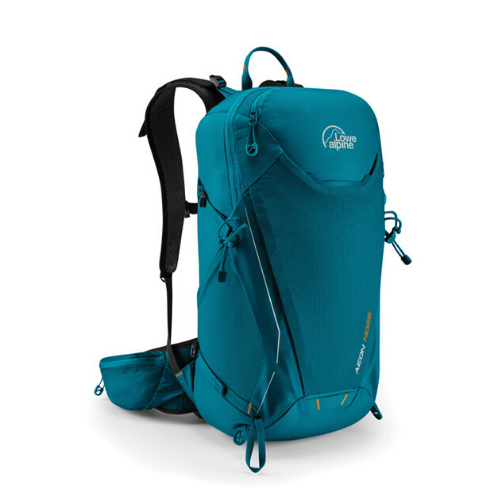
Lowe Alpine Aeon ND25

Lowe Alpine Aeon 27
I climb mountains. I write about mountains. I photograph mountains. And I always come back happy. It's written in my name, after all.


