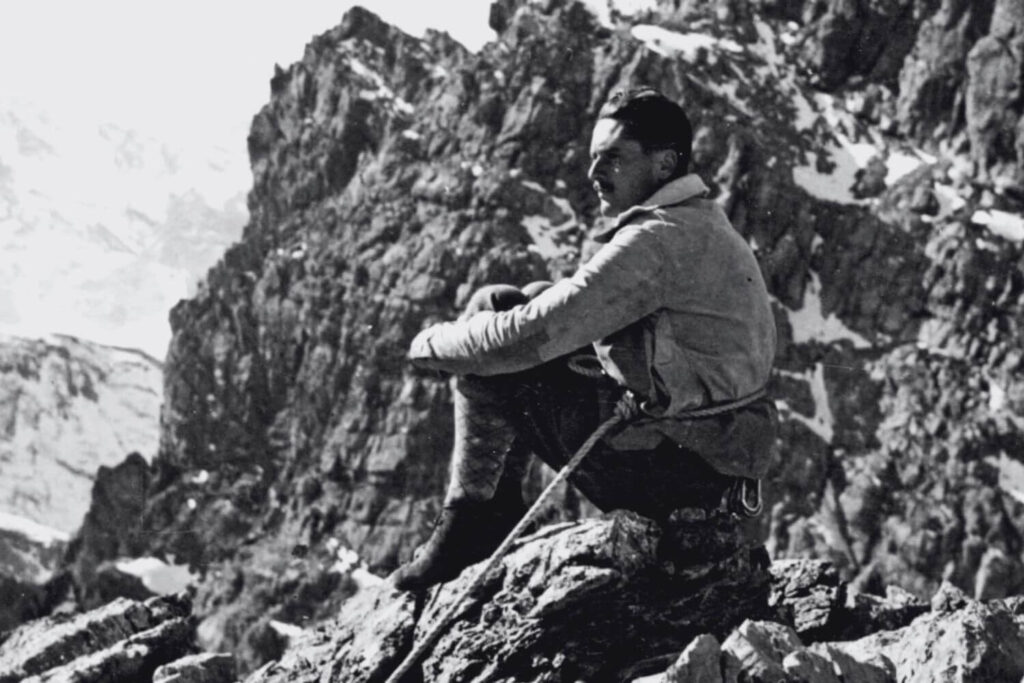
They say time heals everything. But four years apparently weren't enough. After all, it was the Killer Mountain that had sunk its teeth into his body in fifty-three. And he was grateful to have got away with only passing hallucinations and frostbitten toes – which were making themselves felt again right now. He sat hunched in an A-frame tent. The canvas flapped in a wind as strong as it can only be at seven thousand nine hundred metres. It slapped against his back. He was chilled and hungry. Not that he could have forced anything into his clenched stomach. On his spread-out sleeping bag he examined his bare toes. They had turned white. They looked as if they were coated in wax. He touched them and felt nothing. As if they didn't belong to him. Following the doctors' advice he rubbed his feet, and rubbed them for a good half hour, but nothing changed. Not one of the toes that had frozen on Nanga Parbat would answer to him.
If he went up in the morning, there was a chance he'd add a second eight-thousander. No one had ever done that before him – climb two eight-thousanders! But it would also raise the odds that once he got home, a saw would bite into his feet. For every thousand metres he'd hand over one black toe at the hospital. Then he'd have to learn to walk again. He'd never climb alpine walls the way he used to. And no new route would ever bear his name. Buhlriß, Buhlkante, Buhl-Dach. None of that would happen.
Reason decided. Kurt Diemberger, Marcus Schmuck and Fritz Wintersteller would go to the summit alone. They were well acclimatised. There was no reason this eight-thousander should resist them. Meanwhile he'd sit in camp. He'd brew tea so that his friends, on their return, could wet their frost-parched throats and soothe their wrecked stomachs with something warm. And now and then he'd stick his head out of the tent to check whether they were already waving from the top.

He'd sit in the tent and wait. A cruel thought for the climber who was the first in the world to overcome the Killer Mountain. Back then he'd wrestled with it for forty-one long hours. Until then it had strangled thirty-one men. And he had been alone against it. Utterly alone. His mate Kempter was in a bad way and refused to leave the last camp. Twelve hundred vertical metres for one man. But the Killer Mountain had no idea that he of all people had such steam in him. He stood on its crown and took a stone from its head. A keepsake for his wife. And then he fought his way back, because the mountain may have been conquered, but it didn't feel defeated. Yet he was no longer alone. Another climber was with him. He'd come to urge him not to give up when he fell to his knees in the snow. He followed him until he'd clawed his way back to camp. Then that climber vanished and he never saw him again.
Back then he'd fought hard. Now he watched his friends move away from him. Three people became three dots on a white canvas. It was unbearable. Reason had decided. But his heart shouted it down. “Go on, take my damned toes,” he said to the mountain, when he could no longer bear to watch that opportunity slipping away. He forced his feet into his frozen leather boots, pushed aside the tent flap, put on his dark glacier glasses and set off for the summit of Broad Peak. Diemberger was more than a little surprised when, coming back with the summit in his pocket, he found this Buhl – who that morning had been reluctant even to stand up – suddenly climbing towards him just below the top.
“Hermann,” said Diemberger, when they braced their shoulders against each other on the slope, “du bist verrückt!” Crazy – that he truly was. But crazy about mountains. Ever since childhood. His parents told him he didn't belong up there. In vain. He couldn't live without mountains. And now he had bet his ten toes against one of the highest of them.
Diemberger couldn't leave him alone in that. So he turned round and went back up to the top with him. It hurt them both. Buhl probably a good deal more, as he was almost dragging one leg behind him. But pushing himself to the limit – that he could do. In the Alps he'd often pedalled a hundred and forty kilometres on his bike to climb some wall, and then pedalled the same hundred and forty kilometres back. And he only fell asleep doing it once. Coming back from Piz Badile, fifteen kilometres from home, his head dropped onto the handlebars and he rode straight into the Inn. He then walked home with the bent frame on his back.
So this time, too, he toiled to the last drop of sweat. And the sunset that crowned it all in orange made up for every bit of that toil. Towards evening he walked down as the first man with two eight-thousanders, and across the drowsing Baltoro Glacier he gazed at the glittering roofs of Chogolisa. His heart was whispering something to him again.

So Broad Peak went splendidly. In fact, nobody had ever pulled off anything like it on an eight-thousander. Climbing up – all the way from the foot of the mountain to its top without a single porter. And without a whiff of bottled oxygen. They won it only with what they carried on their own backs and in their own lungs. And still they hadn't had enough.
Schmuck and Wintersteller fell in love with the seven-thousander Skil Brum, from which you could perhaps throw a snowball all the way to K2 – if only you could take a proper swing in that thin air. As soon as they'd fattened themselves up a bit, off they went. And within a few days they were waving from the summit. They climbed it entirely on their own and, as one would have said back then, durchweg. In one push. Today we'd call it alpine style.
But Buhl, whose toes had meanwhile all thawed and turned red with life again, was gazing at Chogolisa. It had bewitched him. His eyes darted between its two summits. The left one seemed slightly higher. He ran his gaze along the kilometre-long ridge, sharp as a razor. Back and forth. Below it he counted overhanging seracs. He watched glittering ice flow down the slopes and where the avalanches poured down in the afternoon. He pondered the easiest way to slip up to the summit without angering the mountain. And when he felt he'd read the mountain well, he nudged Diemberger to go and pack his rucksack.
Three days later they were at six thousand seven hundred metres. Buhl had read the labyrinth well and their lungs were stretched from Broad Peak, so the going was quick. All that remained was to finish it off from the last camp to the top.

By two in the morning Buhl was already shaking Diemberger, who was bundled up in his sleeping bag. At such altitudes everything takes time. Just waiting for water to start bubbling eats up a good hour. And they had to melt snow, pour some tea down their throats, the rest into bottles, and set off as soon as possible. After five o'clock they stood in front of the tent and Buhl was as excited as a puppy. “Kurt, das ist der glücklichste Tag – the happiest day,” he said, gazing at the summits of Chogolisa, “it's always been my dream to climb to the top durchweg from base camp.”
But mountains – least of all the highest ones – have no sympathy for human dreams. And although they pushed as hard as they could, the pair got no further than seven thousand three hundred metres. Three hundred vertical metres were missing when a cloud settled on the mountain. And from that cloud came flakes as fat as bumblebees. Buhl and Diemberger could barely see each other. And they mustn't stand more than ten steps apart. This time reason took command again, and even the heart didn't try to outvote it. It, too, mainly wanted to survive.
Diemberger led, Buhl tried not to lose the track. On the way up they'd walked along a honed snow blade. On the left a steep slope fell away, on the right a sheer drop gaped. But now that blade had vanished. Earth merged with sky into one continuous white. Up was down and down had flipped up. Buhl's head was spinning. If he could, he'd have lain down in the snow and waited for the world to straighten itself out. But then Diemberger would have got away from him. So he trudged and staggered. When he wanted to push off with his legs or lean on his ice axe, the mountain turned slightly and his foot or hand travelled through the air longer than he expected. Like when you walk down stairs in the dark, miscount them and forget the last step.
Until then Buhl had always found something to hold on to. Then something cracked. And his right leg sank deeper – and deeper – until it broke through completely. His body suddenly lost all its weight. It didn't weigh a single gram. He floated, and all around he saw only that endless white. White, white, white – and then – darkness.
Hermann Buhl (1924-1957) is considered one of the greatest alpinists of all time. In 1953 he set off alone from the last high camp to the summit of Nanga Parbat (8125 m). He got there after seventeen hours of climbing, helped among other things by the stimulant Pervitin. He then spent another twenty-four hours descending, having to bivouac without gear at 8000 metres, and on the way down he hallucinated a partner who accompanied him. In the end he made the first ascent of Nanga Parbat and became the first person to climb an eight-thousander solo and without oxygen.
The 1957 expedition to Broad Peak (8047 m) included, besides Hermann Buhl, Kurt Diemberger, Markus Schmuck and Fritz Wintersteller. They climbed the previously unclimbed mountain via the west spur, setting up three high camps along the way. During the ascent they used no high-altitude porters and no one on the expedition used supplementary oxygen.
Hermann Buhl and Kurt Diemberger set off for Chogolisa (7665 m) two weeks after their success on Broad Peak. On the first day they climbed to 6350 m, where a storm forced them to spend the whole next day in the tent. On the third day they continued upwards, but three hundred metres below the summit the weather turned again and forced them to retreat. On the descent a snow cornice broke away under Buhl and he fell down the north face. His body was never found.