It was a raw autumn morning. In the streets of Paris, damp fog mingled with the last of the night's gloom, so the gendarme on his regular round along the Route de la Pyramide couldn't see the obelisk of Louis XV – the famous Pyramide du bois de Vincennes – until he was barely twenty metres away. Even so, in that grey start to the day, he noticed something moving among the ancient oaks of the Bois de Vincennes, through which the gravel carriage road ran – and suddenly, from behind one of the gnarled, centuries-old trunks, out stepped a little girl in a frilly pale-blue dress trimmed with white lace. She might have been six. Certainly no older. And judging by that dress, she was no child of the poor.
"What's your name, petite?" asked the gendarme, kneeling beside her in the wet grass. But the chubby-cheeked girl with a little button nose and ringlets in her hair just stared at him and said nothing. Her look made it clear that she was lost and in no hurry to trust a stranger – but there was not a trace of fear in those eyes.
That autumn of 1873 was the first time Alexandra Marie David ran away from home. Not even her father's strict upbringing could rein in her restlessness. So at fourteen she boarded a train to Switzerland at the Gare de l'Est in Paris, planning to follow the tracks on into Italy. It was her mother who brought her home, having set out after her daughter in a panic and finally catching her at the station in Geneva. In the summer of 1886, though – Alexandra was a grown-up eighteen by then – nobody spoiled her trip. She cycled from her new home in Belgium all the way to Spain and came back via the French Riviera and the Alps. Her father was furious. It was scandalous. Irresponsible. And most unbecoming for such a young woman. "Mon Dieu! Why do you do this to us?"
But that was nothing. While studying at the Sorbonne, Alexandra Marie immersed herself in Asian religions, which eventually led her to renounce the Catholic faith her father had drummed into her and become a Buddhist instead. "Diantre!" raged her father when she refused to kneel piously in the pew with the family at Sunday Mass, as was only right and proper. And then – instead of wisely investing the modest inheritance from her late godmother, as her father advised – at twenty-three she sailed off to India with the money to study Sanskrit and learn yoga from the famous Swami Vivekananda. "La folie! Madness!" She travelled until the money ran out. Then she came home with empty pockets and an empty stomach.
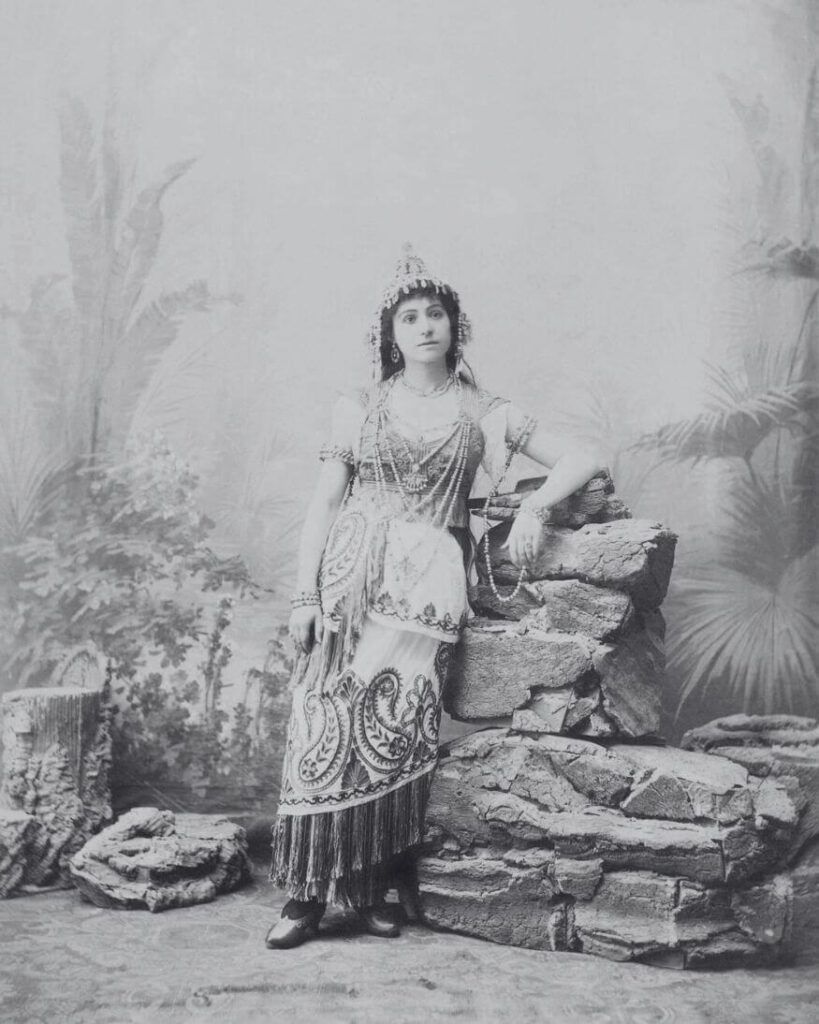
They call it a marriage of convenience. Until the age of thirty-six, Alexandra Marie David guarded her freedom fiercely. After returning from India she enrolled at the Royal Conservatory in Brussels and then made her way through the world as an opera singer, spending eight years touring the French colonies and entertaining high society with the riches of her voice. For a while she also lived in Hanoi, Vietnam – in her beloved, tranquil East. And even her marriage to Philippe Néel – an ageing playboy and director of the French railway that was soon to lace together all of North Africa – didn't have the effect such a union usually has. Alexandra – now Alexandra David-Néel – still had no intention of settling down, embroidering lace and having children.
Still, for seven years she played the respectable married woman rather well. She entertained her husband's business partners, studied, lectured and even wrote her first book, Le Bouddhisme du Bouddha. And then she couldn't stand it any longer. She missed Asia. And she wanted to study Buddhism at the source. So on 12 August 1911 she set sail for India once again. According to Philippe, it was to recover – and to have time to put her thoughts in order. That's why he paid for the trip. But poor Philippe had no idea; he didn't understand that Alexandra saw her future quite differently.

Holy men believed she had been reincarnated because she had work from a past life left to finish. Alexandra David-Néel headed for Sikkim – an independent kingdom in northern India – to attain Buddhist enlightenment. But before she withdrew into the gloom, cold and utter austerity of a cave she had found in the mountains – a good 4,000 metres above sea level – she met the Thirteenth Dalai Lama, Thubten Gyatso, who had recently fled from the Chinese invaders in Lhasa to India. Only after spending some time listening to Buddhist teachings from the most qualified mouth of all did she retreat for a year of solitary meditation and the practices that help people survive in the thin air and freezing cold of high altitude. She learned to master tummo – a peculiar breathing technique used to generate body heat. Buddhist monks can sit naked outside for hours this way, in sub-zero Himalayan temperatures – and even dry wet cloth wrapped around their bodies.
Alexandra David-Néel spent a year alone in the cave. Just once a day, a fourteen-year-old monk, Aphur Yongden, climbed the mountainside to bring her the only meal of the day. When Alexandra finally came down from the cave and returned to the world of people for good, she was ordained a Tibetan Buddhist lama – and went on to adopt young Aphur Yongden. The two of them had big plans. They were about to set foot in Tibet, which was still closed and forbidden to foreigners. And they did just that. They secretly clawed their way up to the border, which Mother Earth had piled up from rock and ice to heavenly heights of many thousands of metres, where a person could barely snatch a single fresh breath, let alone any other comfort.
The Sikkim authorities had no sympathy for such adventures. She's a spy, they thought. And in September 1916 the British envoy expelled them both from Sikkim.
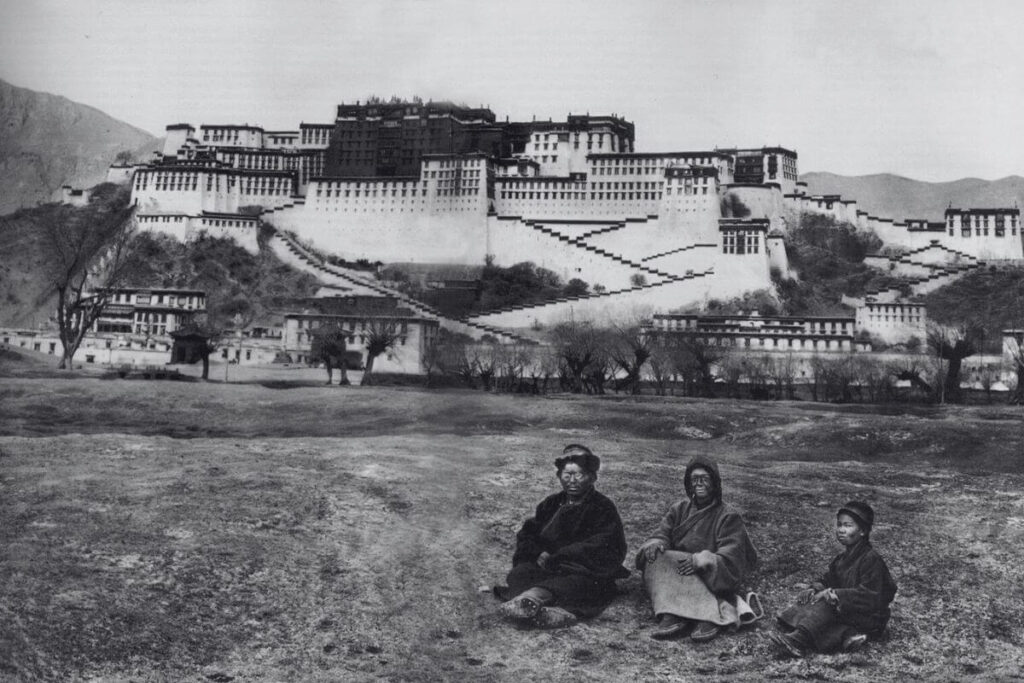
But where could Alexandra and Aphur Yongden go? Back home in Europe, shells were flying between the trenches, and nothing good would have awaited either of them there. So they carried on east. To the Land of the Rising Sun – the Empire of Japan. There they met a monk who told them how he had made it all the way to Lhasa – the forbidden Tibetan city – disguised as a Chinese doctor. His story gave Alexandra faith that she might yet fulfil her dream – that she might see with her own eyes the Potala, the palace of the Dalai Lamas, whose golden roofs glitter in the sun shining over the Red Hill. But first they faced a gruelling journey across China, which was being torn apart by civil war. More than once they witnessed shameless murders and fierce fighting, and several times they themselves crossed swords with wild warriors. And then the endless Gobi Desert stretched out before them, its sandpit nearly starving them to death. They covered a good three thousand kilometres, mostly on foot, before in 1924 – Alexandra was fifty-six by then – they once again found themselves close to the Tibetan border.
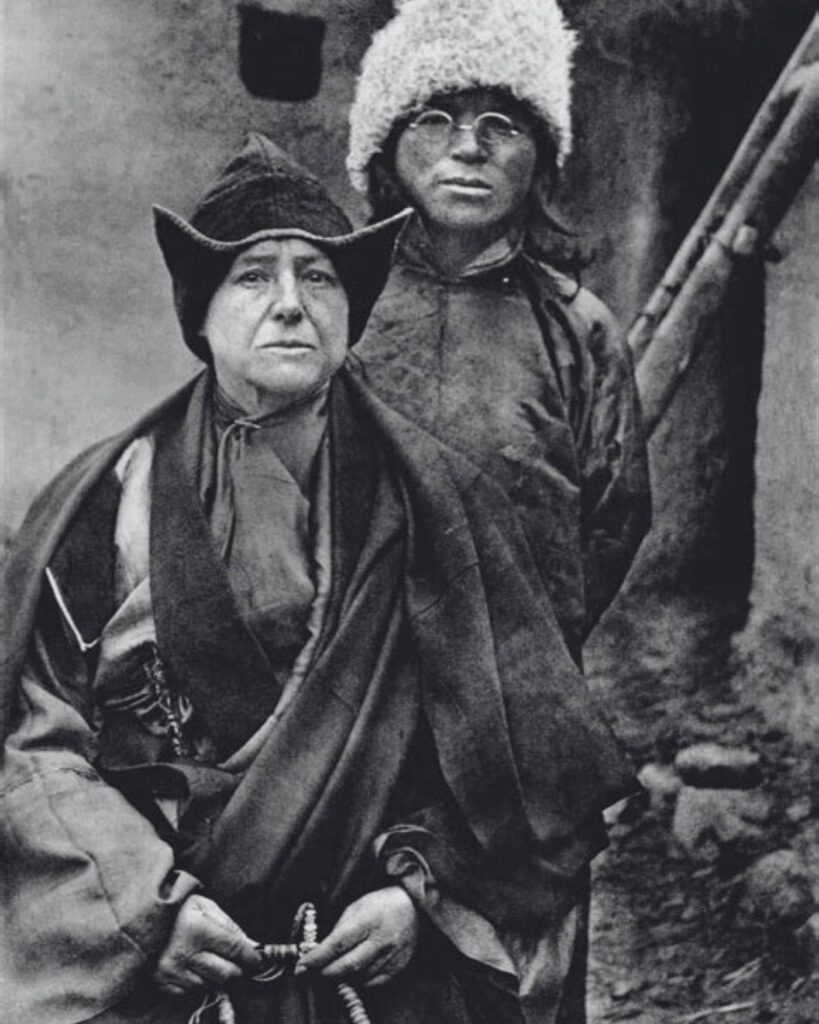
If they really wanted to reach Lhasa – and both she and Aphur Yongden did – they would have to push deep into the very heart of Tibet. Much, much further than they had got from Sikkim years before. That meant more weeks, and more likely months, of walking. And along routes patrolled by mounted soldiers guarding the country against unwelcome guests. All they could do was trust that their disguise would be convincing if they ran into them. Aphur was to pose as a Buddhist lama and Alexandra as his Tibetan servant – a poor peasant woman from the roof of the world. So she daubed her fair hair with Chinese ink, and since her short haircut would also give her away, she plaited herself braids from yak hair. And her face and hands? She smeared them every day with the grease that collected at the bottom of the pot. Even so, in the end they preferred to travel by night and rest by day in some remote cave or a well-hidden tent.
And after all, soldiers weren't the only danger that could wreck their journey. Wild rivers surged through their beds and deep gorges whose edges here and there collapsed into the foaming waters rushing down from the melting snows at the feet of the mountain giants. And crossing a mountain river like that was never safe. So one day Alexandra found herself in a wicker basket swinging on ropes over an abyss. Terrifying enough. And then – just short of the far bank, where the horror would have been over – the hauling rope snapped. "Aide!" she cried in her native tongue. "Help!" Suddenly she was hurtling back along the sagging cableway – right above the raging rapids. It was a moment that felt like an eternity. She hung there, helpless. She was finally rescued by a wiry little Tibetan who hooked himself upside down onto the cable like a sloth and inched towards her with a new hauling rope, while the water – thrown up by the violent crashing against the rocks – licked at his back.
As they climbed from the rivers higher into the mountains, the paths leading them to the forbidden city first vanished beneath a dusting of snow – which kept growing until they were sinking thigh-deep into thick white cotton wool. For hours on end, without rest or food, they dug their way up to the high passes that stood between them and their goal. Endless toil. Then an avalanche slammed into their tent, and Aphur sprained his ankle falling into a crevasse, so they sat for days in a cave. With nothing to eat, they finally cast hungry eyes at their own feet and boiled up the yak leather their boots were sewn from.
They went through every hardship a determined pilgrim can endure – they even had to fend off thieves with the pistols they carried for just such an occasion. Until at last – after four months of walking, suffering and at times fighting for their very lives – from yet another hard-won pass they saw the sun's rays glinting off the golden roofs of the Potala.
"Lha gyalo! Di tamtchen pam! – The gods have won! The demons are defeated!" they wept, when the outline of the Red Hill, on which the palace of the Dalai Lamas stands, told them that none of what had tormented them for so long, none of what had tested their will to live and survive again and again, had been in vain. Alexandra David-Néel's heart began to beat as fast as a prayer wheel sending the eternal Buddhist mantra Om mani padme hum up to the sky over Tibet. And suddenly she was standing at the gates of the city – the forbidden city, which was no longer out of her reach. It rose right in front of her. And she was about to lift the veil of its secrets and discover yet another new truth about her own life.
Alexandra David-Néel and Aphur Yongden ended up staying in Lhasa for two months, hiding out in monasteries. By the time the authorities learned of their presence, they had already left Lhasa, and Alexandra decided it was time to return to Europe. What had originally been planned as a short trip of just a few months had turned into fourteen years of wandering the East.
Alexandra David-Néel (1868 – 1969) returned to France in 1925 and, after newspapers and magazines published reports of her travels, became a national celebrity. She settled with Aphur in the town of Digne-les-Bains in south-eastern France, and over the following years wrote several books about her travels in India, China and Tibet.
Alexandra ended her marriage to Philippe Néel for good. Her passion for the East, however, never faded, and in 1937 the sixty-nine-year-old Alexandra and Aphur returned to China – this time amid even greater turmoil in the middle of the Sino-Japanese War – and spent eighteen months travelling through a country gripped by violence, famine and epidemics. A year later they made it back to Tibet – to the town of Tachienlu, where they stayed another five years. They did not return to France until 1946.
Aphur Yongden – Alexandra David-Néel's adopted son – died of kidney failure in 1955. He was forty years old.
At the age of 100 Alexandra applied for a new passport with a view to returning to Tibet once more. Her application was granted, but she died a few months later. As she had wished, her ashes were scattered on the Ganges together with those of her adopted son Aphur.
Over her lifetime Alexandra David-Néel wrote more than thirty books on Eastern religions, philosophy and her travels. After her death her deeds were celebrated in books, plays, documentaries and films, and an opera was even written about her life. She had a great influence on the Beat writers Jack Kerouac and Allen Ginsberg, as well as on the philosopher Alan Watts.