It was the morning the monsoon overslept. The air hung over Meerut like a wet bedsheet. The garden smelled of lemon leaves and a dog lay by the wall. Jeanne stood on the veranda – in a light dress, one hand resting on the railing. Her belly was no longer easy to hide beneath the fabric.
"You're leaving?" came a man's voice behind her.
She kept her back to him. She knew that tone. Calm on the surface, but with sharp edges grinding underneath. Henry Percy Douglas-Willan, an officer of Her Majesty, a man of polished boots and carefully suppressed feelings. Exactly as he was supposed to be.
"I won't stay somewhere there's no place for me," she answered simply.
"But you have everything here."
"I have twelve servants and one child who mustn't exist." She took a breath. "And a man who has never told me what happens next."
Henry leaned against a pillar and stared into the garden. "You'll be alone. And pregnant."
Her hands tightened on the rail. "Yes," she said. "But alone on my own terms."
The silence between them was as heavy as the air. A horn sounded in the distance. The curtain stirred just enough to hint that the wind was still making up its mind.
"Where do you want to go?"
She shrugged.
"You can stay. We can arrange something."
"You maybe. Not me. I can't live as your oversight."
Henry wanted to say something, but swallowed it. In Her Majesty's uniform there was little room for mistresses and none for children. Especially not ones that came too soon.
Jeanne turned back into the house. She crossed the threshold, past the suitcase that was already waiting. In her head was a name she no longer spoke aloud. Her firstborn son, whom she had left behind in Africa. This was a different pain. Not smaller – but private. And irreversible. When she left, she had no certainty. Only a decision. And in her mind, mountains where names were still waiting for someone to say them first.

In Switzerland the silence was different. It didn't sit on your shoulders the way it did in India. It was airy. Spacious. Unreproachful.
Jeanne settled in a valley above Lucerne – in a guesthouse with a garden and a view of the glittering lake. She had an upstairs room with two doors – one to the staircase, the other to the balcony. And in the drawer beneath the writing desk, a folded letter with a London address and a bank draft. The money arrived on time. Every month.
Louis was born in an attic room with wooden ceilings. In the morning light, while the town was still shrouded in mist. He arrived quietly, without complications. And Jeanne held him in her arms for a long time before telling anyone he'd been born.
For a few weeks the world shrank to a warm blanket, a baby's breathing and quiet reading. But outside – beyond the windows, on the horizon – something else was taking shape. Dark blue lines. Ridges. Distant white streaks. Mountains.
The first time she walked up the slope above the town with Louis in a sling, she didn't go far. Just to the edge of the forest. But with each passing day the route grew longer. First field paths. Then pastures. Then rocky trails.
She began writing down routes. Timing them. Keeping a diary.
Money gave her freedom, but it wasn't extravagance. Jeanne designed her own practical clothing. She had high-waisted trousers made – sturdy, with a leather seat. She was the first woman to wear them right from the start of a climb. And with that came the contemptuous looks. Some pitied her, others gossiped about her – and some, the ones who climbed, started asking questions.

"Madame Immink?" said a man with a rough palm and a furrowed brow. "I'm told you're looking for a guide."
"Yes. Are you Hans Pösche?"
"I am. But I'm not sure you know what you're letting yourself in for."
"That's what they all say," she replied calmly.
"I don't usually take beginners on the route you've chosen."
"I'm not a beginner. Last year I climbed the Antelao. And before that the Ortler."
Pösche narrowed his eyes. He sized her up for a while. Trousers, a straight posture, no airs and graces. Neither pride nor fear.
"All right," he said at last. "Tomorrow at five by the church. And bring proper boots. Up there, there's nowhere to back off."
"That suits me," she nodded.

The morning was pale and sunless. The kind when the body wakes before the day does. Jeanne stood by the church. Her hair tied in a knot, wearing trousers that had already known gravel, snow and looks that stung more than an icy wind. A pack on her back, an ice axe in her hand. All around, only silence.
Hans arrived on time. He nodded, looked her over, without wasting words. They both knew that little is said in the first hours. Important things are settled with your legs.
They went through the forest first, then along a sloping hillside among dwarf pines. They said nothing. Jeanne walked steadily, surely. Not too fast, but without faltering. When they crossed the first little ridge, Hans slowed down and glanced back briefly.
"Not feeling unwell?"
"No. I'm just breathing deeply."
He smiled. That was the first time.
Around noon they reached the foot of the wall.
It was a grey rampart, sharply cut, still without a name. Just a spot height on the map. Some called it "that thing to the right of Campanile Basso", others overlooked it entirely. But not Jeanne. Jeanne always looked at the things nobody had chosen yet.
"This is where the section begins with no way back," said Hans.
"And where it starts to get interesting," she agreed.
They tied into the rope. Jeanne checked the belt she'd had made in Cortina on Hans's recommendation. Leather, with metal eyelets. No more painful chafing between the legs. A practical solution that might one day become more common – but for now, she was the only one who had it.

Hans led off. Jeanne followed – calmly, smoothly, without hesitation. The rock was brittle, the climbing slow. A few metres below the high point, a loose stone hit her on the shoulder. She hissed. Closed her eyes. But kept going.
They stopped on a small ledge with barely room for the two of them. Hans watched her. Her chest was heaving, her forearms scraped. But something glowed in her eyes that he didn't see in others.
"Why do you climb, anyway?" he asked. Seriously this time.
For a while she said nothing. Then she reached for her water, took a sip – and looked up at the wall.
"For the silence up there."
Hans didn't reply. He just nodded. And he thought to himself that if everyone who talked about "mere women" had climbed with her today, they'd keep quiet too.
When they stood on the summit, the wind was blowing. Light but steady. The horizon was overcast, but the Dolomite peaks could be made out like a row of hushed witnesses. Jeanne sat down to catch her breath. She took a piece of parchment from her pocket and wrote two words on it: CIMA IMMINK.
And tucked it under a stone.

The descent was quiet. Not even Hans spoke. The wind was cold only up there; down in the valley it was still summer. When they got back to the path, Jeanne stopped for a moment and shook a pebble out of her trouser leg. It had stayed there from somewhere on the wall – ordinary, but sharp.
In the evening she sat alone at a wooden table in the guesthouse. Her hands were scratched, her skin cracked from the sun, and the wind still clung to her hair. An open map lay in front of her. Not today's – another one. Folded in a different place.
Her pencil paused above one of the summits. For a moment. Then it carried on, along the ridge, to a col nobody had named yet. In the corner of the page she drew a little cross. Small. Inconspicuous.
The beams overhead creaked. A heavy cloud rolled past the windows. The mountains made themselves known one last time that day.
Jeanne blew out the lamp. Tomorrow she would rise before the day.
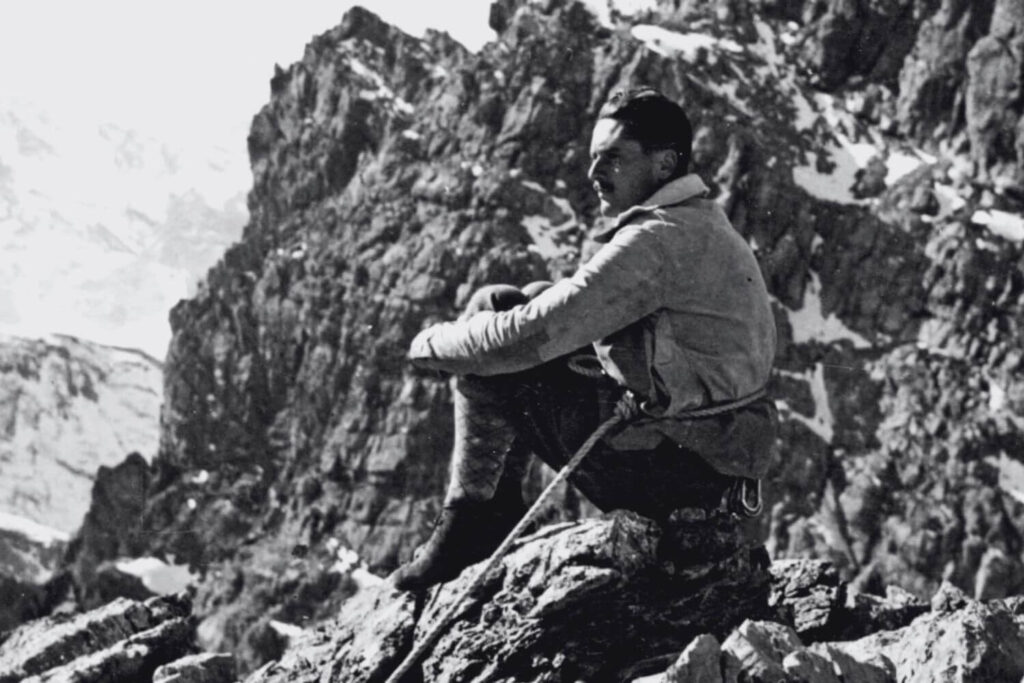
Jeanne Immink (1853–1929) was a Dutch mountaineer and one of the first women in the second half of the 19th century to regularly undertake demanding Alpine climbs. After leaving colonial India she lived in Switzerland, where she devoted herself not only to climbing but also to innovating climbing gear. Although she often climbed with mountain guides, she made a number of ascents in her own style and paved the way for future generations of women in the mountains.
Henry Percy Douglas-Willan (1856–1936) was a British army officer who served in British India. Jeanne had a son, Louis, with him, but their relationship was unofficial. Henry never publicly acknowledged his child – like many officers at the time who led parallel lives with local or European women outside official marriage.
Hans Pösche (surname according to some sources, not given elsewhere) was one of the mountain guides who worked with Jeanne. Jeanne carefully chose reliable, open-minded guides – others refused to climb with her because of her trousers, her sex or her independence.
Cima Immink (2,879 m) is a rock tower in the Brenta Dolomites. It is named after Jeanne Immink, who made its first ascent in 1891 with the guide H. Pösche. Jeanne thus left an indelible mark on the landscape – a mountain that bears her name.
The Brenta Dolomites are a range in northern Italy. At the end of the 19th century there were only a handful of established routes here. Over a few years, Jeanne Immink made dozens of ascents here – often pioneering and physically demanding.
Trousers for women climbers were a radical novelty at the time. Jeanne had them made to her own design with an emphasis on practicality – including a leather seat and a high waist. In conservative society this caused a wave of disapproval, but it also inspired other women to get out into nature.
A climbing belt with leg loops was not standard equipment at the time. Jeanne had one made to spread the load and stop the rope from cutting painfully into her body. It was a forerunner of the modern harness.