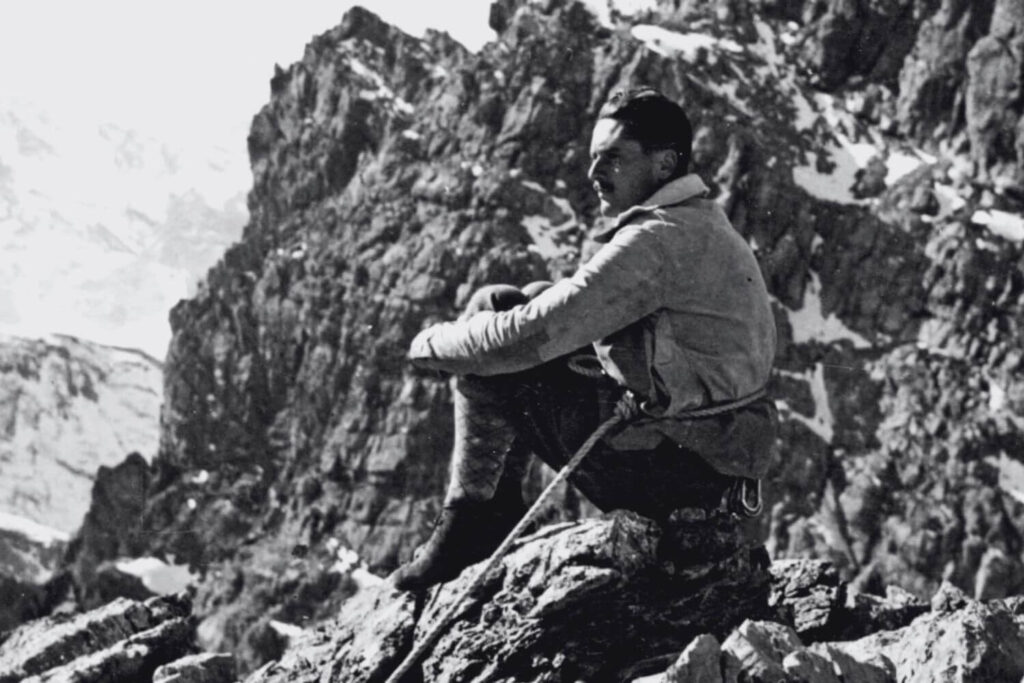
Now he sits cross-legged, hunched in a shallow snow cave he dug out with exhausted hands three hundred metres below the top of a wall almost two kilometres high, a rampart of dark rock and treacherous ice. They call it, ominously, the Mordwand. The Murder Wall. On the eighth day of the climb a freezing December storm has trapped him in the bowels of this terrifying giant, whose first defeat cost so many human lives. Karl Mehringer, Max Sedlmayr, Willy Angerer, Edi Rainer, Anderl Hinterstoißer, Toni Kurz. Like a memento of man's unequal battle with nature, the ghosts of these tragic heroes prowl the frenzied wind that scours the walls of the Eiger. Will Jeff Lowe become the next victim of bold climbing ambition?
Climbing always came so naturally to him that anyone watching him had to think it was nothing difficult. In a photo taken in 1979, during his stunning solo on the almost seven-thousand-metre Ama Dablam, Jeff Lowe stands on a rocky ridge, blond curls poking out from under a crocheted hat into the thin Himalayan air, thick mist wrapping the depths below him in bottomless mystery, and he – right knee braced against the wall, left sole on a wobbly snow-covered stone – is hammering a piton into the rock. It ought to be an extremely precarious stance, yet he looks completely at ease. Quite rightly, he was recognised as the finest American alpinist of his generation.
At just seven years old, Jeff Lowe climbed the majestic pyramid of the Grand Teton with his father and his brother Greg. As a teenager he put up plenty of new routes around the family home in Ogden, Utah. And when he turned twenty-one, he and his cousin George set out to attempt the first winter ascent of the imposing west face of the Grand Teton, a mountain he already knew well. After three days of climbing they stood on the summit in a fierce wind, but the real trouble was still ahead of them. Jeff later admitted it was the worst descent he had ever experienced. Through the misery – battered by insane weather, near-zero visibility and endlessly tangled ropes – what kept them going was the thought of the skis stashed below the face and the fresh powder in Garnet Canyon. He loved skiing.
"I always saw first ascents as works of art. Not as a competition for trophies."
Back then many people wanted to repeat famous climbs, but Jeff was always drawn to discovering something new. So in the winter of 1974, he and Mike Weis unpacked their gear in the snow beneath the frozen Bridalveil Falls in Colorado. At the time, the ice above them was a complete unknown to climbers. Not even the two of them knew whether such a technically demanding climb was within their repertoire. But when, after ten and a half hours of hard fighting, they planted their ice axes above the top of the icefall, they started laughing and rolling around in the snow like puppies. They were as thrilled as if they had just pulled off the crime of the century. And their feat was perhaps no smaller, only legal – they had snatched the title of the hardest ice route in the world. Four years later, though, the achievement had become a mere memory, so Jeff Lowe went back. This time alone. And by soloing the 120-metre icefall he pushed the limits of the possible once again.

Like a knife blade, the 2,500-metre north ridge of Latok I (7,145 m) slices the sky above the Karakoram – an impregnable mass of granite carelessly splashed with a glaze of snow. In 1978, when Jeff Lowe, Jim Donini and Michael Kennedy arrived at the foot of the mountain, the plan to climb this provocative blade to the summit in pure alpine style seemed ambitious, to say the least. But expedition style, with its gradual build-up of high camps, fixed ropes on the hard sections and endless load carries, was a clumsy relic as far as this trio was concerned. And together they really did reach their second bivouac at six thousand metres quickly and almost without a hitch.
But a six-day storm had no sympathy for their plans. On half rations and with only a handful of hope, they huddled in a tiny tent waiting for the weather to improve. When the sky cleared on the seventh day, they quickly got through the crux of the face, despite a virus that had been weakening Jeff Lowe's body since the start of the expedition. They had originally reckoned on two weeks at most, but after twenty days on the face they still had 250 metres of hard climbing to the top. And Jeff had run out of energy completely. Even so, they made a summit attempt the next morning, but a few dozen metres from the goal Jeff's condition deteriorated catastrophically. Nobody gave another thought to going up. They had to get their helpless friend down. A fight for life began, with four days of descent and an almost unimaginable eighty-five rappels ahead of them. Jim Donini later confided that, up there below the summit, he thought Jeff Lowe wouldn't survive the night. He did. And to this day no one else has tried to finish what they started.
"Latok showed me how far I can go with a team of true friends."
A year later Jeff Lowe joined a large expedition to Ama Dablam (6,812 m) and, as one of its members, reached the summit of the mountain whose name translates as "Mother's Necklace". But while everyone in base camp celebrated, he sat apart, sulking. A climb run in what you might call siege style left him utterly unsatisfied. At three o'clock the next morning he set off for the summit again. On his own. And by the unclimbed south face. After 1,300 metres of climbing over rock, snow and ice, he stood on top of Ama Dablam once more, and was back in base camp that same afternoon. Now – by his own rules – everything was in order.

Jeff Lowe soloed lines that many thought unclimbable. But to do it, he needed gear that met his exacting standards. Gear that didn't exist until Jeff Lowe and his brothers designed it. "He had the ability to find great lines. He had the ability to climb them, and he could make the tools that let him do it," said climbing writer Doug Robinson.
In 1967 Jeff's older brother Greg Lowe created the world's first internal-frame backpack – the foundation of every modern pack – and in 1972, together with another sibling, Mike, he founded Lowe Alpine, the brand under which they launched further innovations that came hand in hand with their ambitious new goals in the mountains. While Mike and Greg took care of the business side, Jeff climbed mountains, designed and tested. And thanks to achievements that reached far beyond the climbing community, he naturally became the face of Lowe Alpine.
Jeff's own business ventures, however, didn't work out. The innovative successes of his companies Latok Mountain Gear and Cloudwalker were overshadowed by one big financial disaster. In 1988 – the same year his daughter Sonja was born – he organised the very first sport climbing competition in the USA, at Snowbird in Utah. Climbers themselves loved the event, but Jeff Lowe lost a fortune, and by 1991 he was bankrupt and divorced. All he had left was climbing.
"When things in my life got worse, I found that long, hard climbing would help me get back."

Under the mask of ice covering his face and behind the scratched lenses of his white-framed Swans ski goggles, you would hardly recognise the eternally grinning man Jeff Lowe undoubtedly was. He has been shivering with cold all night and all day. The blinding blizzard, relentlessly grinding at the slopes of the Eiger, doesn't let up for a moment, and fine powder snow works its way under the fly sheet meant to guard the entrance to the cold bivouac cave. Another bitter night is coming. The hours drag by, and he fixes his gaze on a picture of his two-year-old daughter – the only bright spot in the dark void, lit by the yellow glow of his headtorch. And suddenly it is as if his consciousness has split away. He feels low, deep vibrations. A sound he hasn't heard since that incredible solo on Ama Dablam. At first he can't make sense of it. But then...
"At last I had met myself, vibrating at the centre of my universe."
The next morning he can't wait any longer. The weakening snowstorm offers him a narrow window to finish the climb. But the fatigue of the previous days – alone, metre by metre, forcing his way up untouched sections of this alpine face so hostile to the daring – dulls his senses. The pick of his left axe glances off a hard bulge and Jeff falls. He spins through empty air until, in a flash of clarity, he glimpses the town of Grindelwald two kilometres below. After tumbling helplessly for some twenty metres down a wind-packed snow slope, the belay rope comes tight and swings him like a pendulum straight into the ice wall. Barely conscious, he gasps for breath. But the pain sharpens his attention again. With precise, brisk movements he now chips away at the last metres of height to the shoulder of the Eiger's west ridge. Not much further now.

Within sight of the top, though, the rope won't let him go any further. Its other end is tied to his pack, which he buried in the snow fifty metres below. So he has to anchor his end of the rope where he is now, rappel back down for the pack and climb the whole pitch again – belayed from above. That is how he self-belayed his way up most of the face. As on all his climbs, Jeff Lowe insisted on the purest possible style – no drilled bolts or other technical aids. But right now the storm is gathering strength again. Twenty damned metres short of the top! His team of friends at the foot of the mountain radios up a radical suggestion: "Untie from the rope and climb up to the ridge unprotected. We'll send a helicopter for you." "No way," is his first thought. But the cosmic revelation in the ice cave and the picture of his daughter's angelic face outweigh every other consideration. Jeff Lowe throws off the rope, abandons the pack he will no longer need to the eternal snows of the Eiger, and climbs into the helicopter on the shoulder of the mountain.
The mission is over. Nine lonely days on the hardest face in the Alps put Jeff back on track. This climb was his masterpiece. And a spiritual transformation, too.
"It was the beginning of a changed perspective that has illuminated the rest of my life."
To the classical Greeks, metanoia meant a change of mind. And that is exactly the name Jeff Lowe gave his extremely difficult direttissima on the north face of the Eiger. A route at the edge of the possible that has been repeated only once – a full twenty-five years later, on the third attempt, by the world-class alpinist trio of Thomas Huber, Roger Schaeli and Stephan Siegrist.
Around 2000, Jeff unexpectedly fell for the first time. On flat ground. His body was sending him a warning. From then on his motor skills and balance began to deteriorate rapidly. At first doctors suspected multiple sclerosis, but as his condition kept getting worse they recognised the symptoms of amyotrophic lateral sclerosis – also known as Lou Gehrig's disease. Jeff Lowe, who had once moved with remarkable ease on the hardest walls in the world, was confined to a wheelchair, and a computer voice called Ryan relayed his thoughts to the world. Even more than his feats in the mountains, though, the people around him were astonished by the courage with which he faced his illness. His sense of humour never left him.

In his obituary of Lowe for Rock and Ice magazine, Michael Levy recalls how, at their last meeting at the Outdoor Retailer show in Denver in 2018, he asked Jeff how his summer had been. After a minute of silence, Jeff answered with a cheeky smile: "I didn't climb much this year."
Otherwise, he climbed for as long as he could. Utterly admirably.