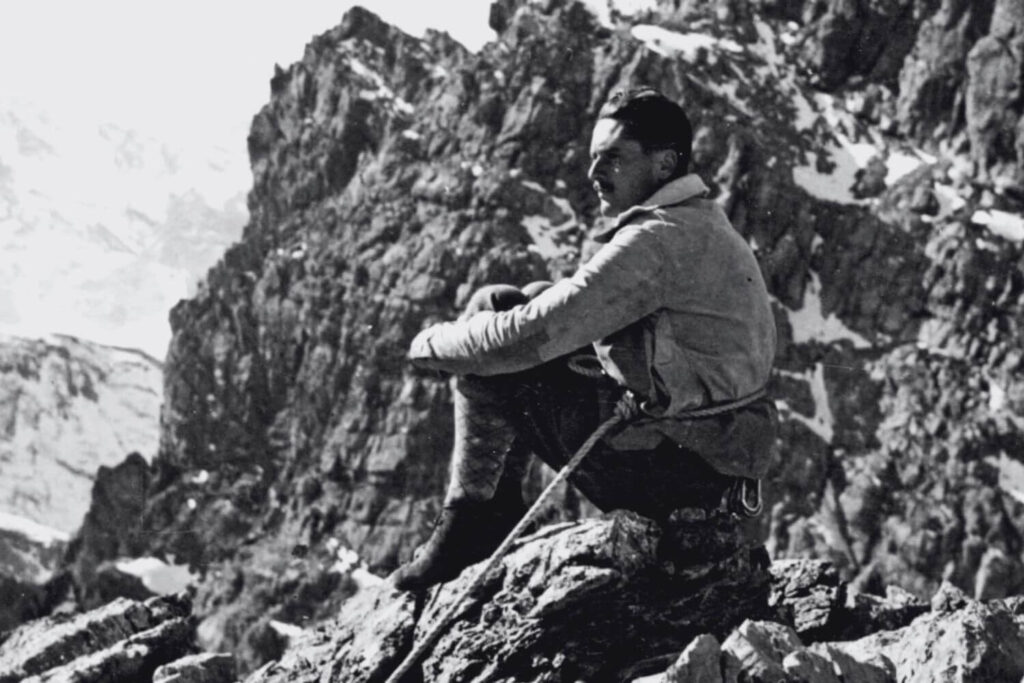
It was a game. An adventurous game among the rocks and on steep mountain slopes covered only in dwarf pine and the hardiest plants that had managed to take hold in the cracks of the stone. While still a young teenager he shot his first grouse this way and began contributing to the family table, which in Sexten, hemmed in by mountains, was always fuller in summer than during the long, harsh winters. Later he carried chamois he had shot down from the mountains on his shoulders, and eventually he learned to track and bring down even majestic ibex.
It was his uncle Hans who made a hunter of young Sepp Innerkofler.
But another uncle shaped him too. The mountain guide Michael Innerkofler. A man who became famous for one of the most important climbs of his day – the first ascent of the smallest of the Drei Zinnen towers, the Kleine Zinne, in 1881. A man who was also the first to stand on the western tower, the Westliche Zinne, and who guided other great contemporaries in the Dolomites, such as Julius Kugy and the brothers Emil and Otto Zsigmondy. A man who then died tragically in a crevasse on the Cristallo glacier when a snow bridge gave way beneath him.
In 1890, two years after his uncle Michael’s death, Sepp Innerkofler became a mountain guide too. And that same year he made the first ascent of the Kleine Zinne by its difficult north face. A visionary feat! Back then nobody went looking for harder routes up mountains that had already been climbed. It was all about new summits – not new routes.

The name Sepp Innerkofler was gaining a reputation in the Dolomites. He moved along sharp ridges and up dark rock chimneys as nimbly as the chamois he shadowed. Those who hired him to climb one of the peaks – his beloved Paternkofel, for instance, whose summit he stood on perhaps a hundred times or more – could be sure they were placing their lives and their purses of florins in the right hands.
It was right at the foot of the Paternkofel, looking out at the kilometre-high walls of the Drei Zinnen, that Sepp Innerkofler and his wife Marie built a stone refuge. The Dreizinnenhütte mountain hut. A safe haven where the weariness of a hard day in the mountains always dissolved in wine, hungry stomachs were filled with polenta and a little roast meat, and tourists from Vienna and Venice fell asleep squeezed side by side on the bunks. Italian and Austro-Hungarian breathing blended into one steady, peaceful tone.
But in the spring of 1915 it was replaced by the bloody sounds of machine guns and artillery.
As if the white flag with the red cross flying over the Dreizinnenhütte meant nothing. On that Tuesday, 25 May, Italian cannons fired salvo after salvo – straight at Innerkofler’s hut. He watched the destruction from the summit of “his” Paternkofel, where he was huddled behind rocks trying to shield his frozen body from the icy wind. His army-issue uniform did little to keep him warm. And although the flames from the burning hut rose high – high above the snowfields – not a breath of warmth reached him up there on the Paternkofel. Only a breath of ruin.
When Italian troops decided in May 1915 to surprise Austria – which at the time was sending most of its soldiers to the Russian front – with a cunning offensive right in the mountains, Sepp Innerkofler was already fifty. So he wasn’t called up; he was too old for that. Even so, he joined the third company of the Austrian Standschützen – the Alpine militia in his native Sexten. His experience and knowledge of the local mountains were vital for defending his homeland. Nobody could move up there the way he could. That’s also why he was made a sergeant – Zugsführer of the Flying Patrol. Twelve men – mountain guides and porters, foresters, poachers and smugglers – who were the most at home on steep rock faces.

Barely a few days after the destruction of the Dreizinnenhütte, the Paternkofel fell too. In appalling weather, with torrents of heavy, icy drops swirling in the howling wind, none of the Austrian soldiers managed to scramble up to the summit and occupy the key defensive positions there. Not even Sepp Innerkofler. And the Italians seized the chance. From their side the mountain was far more accessible than via the steep northern precipices facing the Austrians.
With a cannon they hauled up into the Gamsscharte notch just below the summit, the Italian troops soon blew apart the Austrian headquarters by the Bodensee lake and the positions below the Toblinger Knoten.
Simply put, the Paternkofel was key.
But winning it back meant sending in the very best men – climbers. With no guarantee of success.

Sepp Innerkofler disagreed with the planned assault up the walls of the Paternkofel. It seemed too risky to him. So Captain von Wellenfried gave him the option of sitting the attack out. But he refused. And on Sunday 4 July, at four in the morning, he and five other men began weaving their way up through rock chimneys and clefts towards the summit. In the half-light of the breaking day they climbed a route first discovered by none other than Sepp Innerkofler in 1896. And he had climbed it countless times since.
Suddenly gunfire tore through the silence. The rattle of machine guns, the whistle of cannonballs, the shattering of rock. Instinctively he flung himself against the rock face. But the shooting was coming from the other side of the mountain. It was his comrades on the Rautkofel. What luck – he had feared they’d been spotted.
And after a while – as if on command – everything fell silent.
Dawn began to break. The horizon turned red. The men of the Flying Patrol were nearing the summit when this time it was the Italians positioned on the towers of the Drei Zinnen who opened up with their machine guns. Perhaps they had glimpsed their shadows outlined in the morning sun. The Austrian guns on the Rautkofel and the mortar on the Sasso di Sesto couldn’t stay silent in the face of such a challenge. That roar – that terrifying roar. The six men dashed between rocks that splintered under the machine-gun fire. A shard of stone hit Sepp in the head. And a moment later he felt a strange warmth on his eyelids. Blood was running down his forehead – straight into his eyes. He wiped the trickle of sticky liquid away with his coat sleeve and hurried upwards – as long as he could still hope that the handful of Italian soldiers on the summit had no idea he was there.
Suddenly – as if someone had turned a knob again. The thunder gave way to silence.

Sepp Innerkofler stayed hidden behind a rock – barely ten paces from the Italian positions. He crossed himself. And with a wide swing he lobbed a grenade into the summit fortifications.
Nothing.
There should have been a deafening explosion. Instead there was only the dull thud of an unexploded grenade bouncing off the rock. Could the men above have seen where it came from? They were bound to find his hiding place any moment. He didn’t have much time. Quickly he threw a second grenade. And straight away a third. And again nothing. Nothing, nothing, nothing!
Suddenly the Italian soldier Pietro de Luca appeared above him, his face streaming with blood – the only success of the three grenades. Holding a huge rock in his arms stretched above his head, he shouted: “I’ll get you!” And those were the last words Sepp Innerkofler heard in this world. He threw up his hands to fend off the rock hurled at his face, but his reflexes, honed by hunting chamois and ibex, didn’t respond in time. He staggered and, his eyes wide open to the red Dolomite sky, vanished deep into the Oppel chimney.
The Paternkofel stayed in Italian hands. And when later that day the guns fell silent and for a while there was nothing to fight over, men abseiled down from the summit of the Paternkofel to recover the wedged body of Sepp Innerkofler and, with all due respect, buried him on his beloved mountain. Over the stone grave they placed a simple cross with the inscription: “Sepp Innerkofler – guida”.
Sepp Innerkofler (1865 - 1915) was posthumously awarded the Gold Medal for Bravery. In August 1918 several local men exhumed his body and carried it down from the summit of the Paternkofel to the cemetery in his native Sexten.
There are two versions of the death of Sepp Innerkofler. The one described above, in which he died after being struck by a rock, was reportedly confirmed by Pietro De Luca himself at the age of 82. According to the second version, Sepp Innerkofler fell victim to Austrian fire. This version was described by his son Pepi, who supposedly watched everything through binoculars.
During the First World War a million Austrian and Italian men died in the Dolomites. Avalanches, lightning strikes, blizzards and bitter frost killed more of them than the fighting itself.
The Dolomite front barely moved. Only on the morning of 1 November 1917 did the Austrian forces discover that the Italians had abandoned all their positions. In the wide-scale retreat after the Battle of Caporetto they had lost a quarter of a million men and could no longer hold the long front at high altitude.
The via ferrata De Luca – Innerkofler runs up the walls and through dark tunnels dug deep inside the Paternkofel.