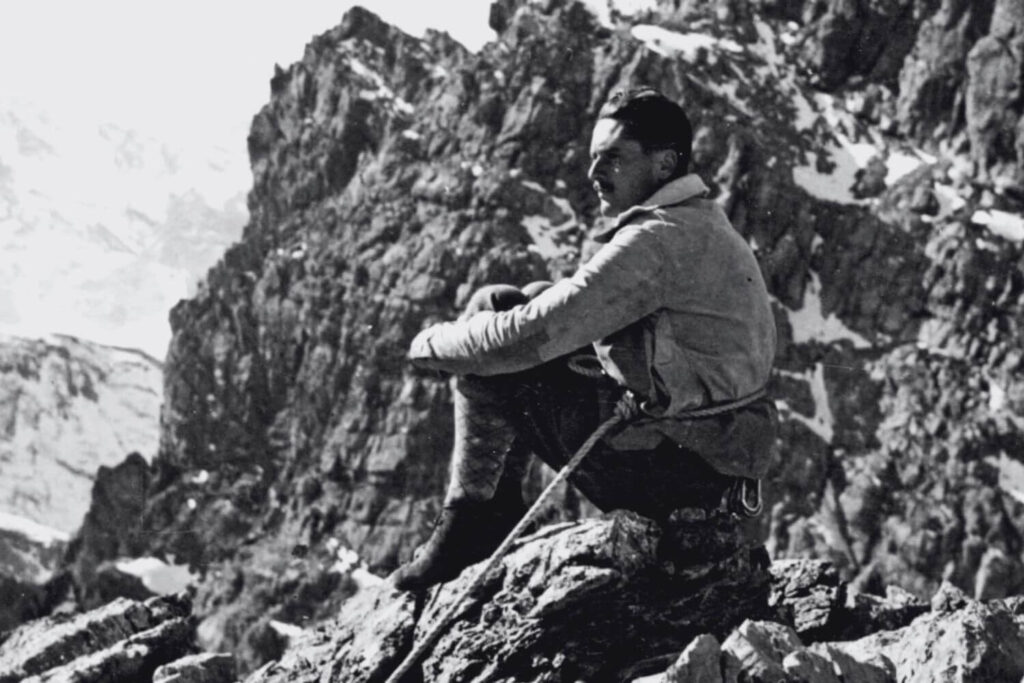
Campanile Basso is not a mountain just anyone gets to see. John Ball first glimpsed it in the maze of the Brenta in 1864, and its walls didn't strike him as particularly welcoming. After all, the mist creeping over the grey cliffs devours all the sunlight, and among the peaks you sometimes feel as if you're caught in a vice. If you want to see Campanile Basso, you'll have to sweat through at least one T-shirt on scree, rock and snow. Starting from Molveno, maybe two. Two thousand metres of ascent will take it out of you. And if you want to stand on the summit, there's climbing ahead.
Still – at least nobody will be pointing a pistol at you. Unlike poor Nino Pooli. Then again – he shouldn't have pretended to be something he wasn't.
Who would be first to the top? The Italians, or the German-speaking climbers? From 1848 onwards, the whole Austro-Hungarian monarchy was seething – northern Italy included. So climbers from the Società degli Alpinisti Tridentini and the German Alpine Club preferred to build their own, nationally segregated huts in the mountains. Often just a few hundred metres apart. They even called the still unclimbed slender spire by different names.
Campanile Basso, or Guglia di Brenta?
Campanile Basso, obviously! It might not have sounded terribly grand – the Low Bell Tower – but that invention of some little professor Schulz from Leipzig – pah, Guglia! – the Germans could stuff into those knee-high socks of theirs.

Twenty-eight-year-old Carlo Garbari was the first to set out to win the spire's summit for his nation. The Italian one. He should perhaps have checked more carefully whom he was hiring as companions. He had already climbed a few Brenta peaks with Nino Pooli, seven years his senior, but Pooli was no experienced guide. More of a porter. In those days he was handier with a corkscrew than with a rope and pitons. And the third member of the party, Antonio Tavernaro, wasn't exactly brimming with experience either. Even so, that Thursday morning, 12 August 1897, they fought their way through the hardest part of the climb – a yellow, slightly overhanging wall they had been eyeing nervously from the very start. Grade IV climbing was cutting-edge back then. And Pooli still managed to keep Garbari believing that he was being led by a seasoned guide.
On the roomy rock ledge of the Stradone Provinciale, which circles the spire, they drank two bottles of wine, and as they say – in wine there is truth. Pooli still squeezed up the chimney in the west face, but when barely a few dozen metres of the summit wall stood between him and an Italian victory, he started shaking like the entire Habsburg monarchy. He simply couldn't go on. The Brenta mist buried everything. The rock was beyond Pooli's abilities. He couldn't even place any protection, and if he had fallen, he might well have dragged them all into the abyss. So the desperate Garbari, huddled on the small platform under the weight of dark clouds, reached into his rucksack for a revolver:
"Finish the climb, or die!"
He finished nothing. The terrified Pooli barely managed to climb back down to the ledge, where Garbari built a cairn and hid a note on a scrap of paper under one of the stones: "To those who make it this far, we wish you better luck!"
Garbari's only victory was that, after the revolver episode, no fake guide ever again dared to lead him up the garden path.

To make matters worse for Carlo Garbari and all the Trentino alpinists, two years later a pair of Tyrolean students from Innsbruck – Carl Berger and Otto Ampferer – reached the note below the summit. They were so utterly sure they would reach the top of their Guglia that they lugged a long wooden pole on their backs, intending to plant it on the summit. Perhaps to rub it in even more for the defeated Trentino climbers. But mainly to hang their Germanic flag on it.
In the end, though, the ambitious Tyroleans were stopped at the same spot as the frightened Pooli. However, Ampferer had the idea of traversing round the corner onto the north face, where the endless depths of the Val Brenta Alta opened up beneath his feet, but a recess above his head promised an easier way to the summit. Yet the oppressive mist had once again brought that drowning feeling to the Brenta towers. And both of them were parched with thirst. So they went down. To gather strength for a new assault.

After a rest day, they were standing below the Guglia again. And if, right at the start, Berger hadn't come tumbling down onto Ampferer because of a broken foothold – leaving Ampferer with a nosebleed – the second attempt might have gone quite smoothly. Then again, what kind of heroism is it without a bit of blood? From the small platform where all previous attempts had ended, Ampferer climbed along a narrow ledge onto the north face, hammered in one good piton and then hauled himself over an overhanging roof onto easy ground.
It was Friday, 18 August 1899, and German singing rang out from the summit of Campanile Basso. Alas!
But it didn't break the Trentino climbers. A few days later they repeated Berger and Ampferer's ascent and replaced that little Germanic flag of theirs with a proper yellow-and-blue Trentino banner. Ten metres wide.
Campanile Basso (2883 m) translates from Italian as the Low Bell Tower – because it is lower than the neighbouring Campanile Alto. The name Guglia di Brenta was coined in 1884 by the German alpinist Karl Schulz – guglia means spire. Local people and Italian climbers, however, considered the name inappropriate and never accepted it.
Nino Pooli returned to Campanile Basso in 1904 with Riccardo Trenti to finally climb – with better protection – the summit section he had failed on in 1897. The result was the Via Pooli-Trenti variant, graded V+, which nobody repeated until 1932. The difficult opening wall that Pooli overcame during the 1897 attempt bears his name – Paroi Pooli.
Carlo Garbari climbed several Brenta peaks during his lifetime – for example the range's highest mountain, Cima Tosa, Punta dell'Ideale and Campanile Alto. On all these climbs his partner was Nino Pooli. After the failure on Campanile Basso, however, they never climbed together again. The small platform where Carlo Garbari allegedly pulled a revolver on Pooli is called Terrazzino Garbari.
Karl Berger died during the First World War – he was accidentally shot by a friend while on sentry duty. Otto Ampferer became a renowned geologist and a member of the Austrian Academy of Sciences. The route by which they reached the summit of Campanile Basso is known today as the Via Normale, graded IV+.
The Via delle Bocchette via ferrata runs directly below Campanile Basso. The starting points are the Rifugio Alimonta (2580 m) and Rifugio Tommaso Pedrotti (2491 m) huts.