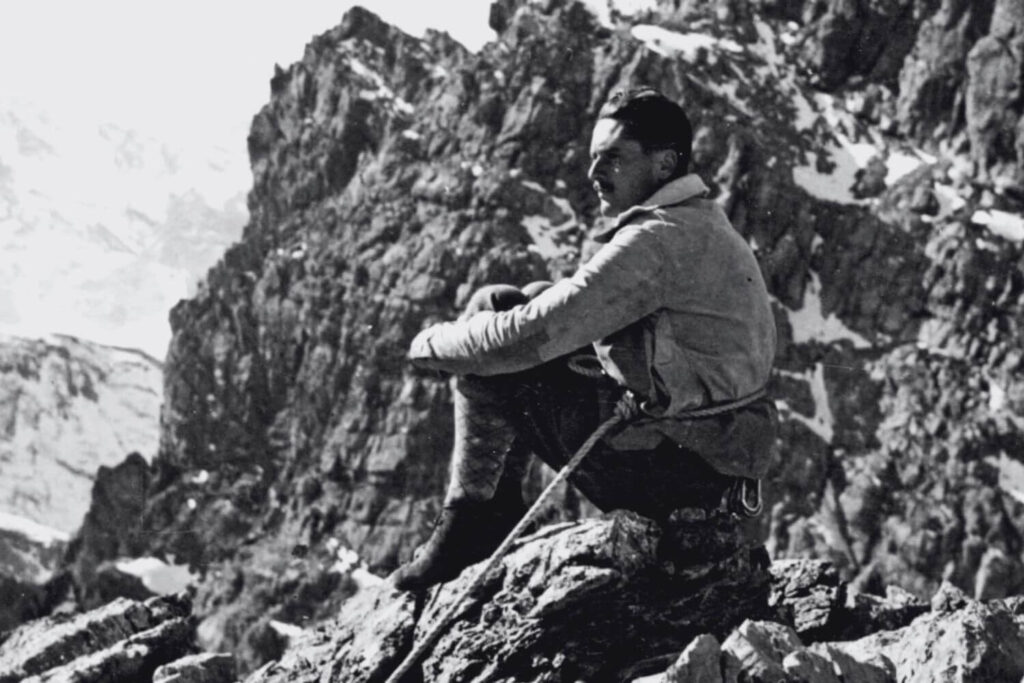
“I don't want to work in that stuffy old museum. And I certainly wouldn't want to work for some crazy mountain climber.” That's how, one grey autumn morning in 1939, she brushed off the postwoman who stopped outside her parents' house in a Boston suburb to tell her about a vacancy for a secretary to the director of the New England Museum of Natural History. Even so, 25-year-old Barbara Polk went to the museum. And her fate was sealed. That same winter she and the museum's director – four years her senior and the “crazy mountain climber” Bradford Washburn – announced their engagement, and from 27 April 1940 Barbara was getting used to a new surname: Washburn.
Before she met Bradford, she had never spent a night outdoors in a tent. She had never had a climbing rope tied round her waist and had never had to melt snow on a spirit stove just to make a bit of tea. And now, all of a sudden, she was heading with her husband and six other men to south-east Alaska – to the foot of Mount Bertha, a 3,110-metre peak covered in snow all year round.
After a month on the move, by the end of July they were closing in on the summit. The first people ever to get that far. “I didn't feel like a pioneer – like part of a serious mountaineering expedition,” Barbara recalled later. “I just told myself that, as the only woman, I had to try to keep up with the others.” On the summit push, though, they were moving too slowly, and the whole team had to turn back five hundred metres below the top. And with night hard on their heels, Bradford decided to speed up the descent by abseiling over a large open crevasse. The trouble was, Barbara had never abseiled. “Hold the rope tight and just swing over that icy edge,” Bradford coached her. Then on Tuesday 30 July 1940, on their second attempt, they stood together on a summit no human foot had touched before.
A month in the wilderness was a huge slog for her. Toil and hardship that, until she met Bradford – a trained cartographer – she had thought were reserved for male adventurers. After all, in the 1940s women were expected to fill more traditional roles – above all at home. Despite all the effort and discomfort that must have taken its toll on her body, Barbara felt that her strength was coming back far more slowly than it was for the rest of the team. So as soon as they reached Juneau, the first sizeable bit of civilisation, she went looking for a doctor. Only to find out she was several months pregnant.

Little Dottie was three months old and most of the world was reeling in the thunder of war. In the summer of 1941 America was still standing more or less on the sidelines, but plenty of people suspected it wouldn't stay that way for ever. Threatening clouds hung constantly on the horizon, and if the sky did darken over the American continent too, it would probably mean the end of Bradford's climbing expeditions. His adventurous soul was not prepared to accept that, so at home he started talking about another expedition – one that, with the war approaching, might be their last for a long time. Barbara, however, was against it – she wasn't going to leave a three-month-old baby for several weeks. But Bradford's insistence, perhaps her own inner longing to breathe in the aura of wild Alaska again, and finally the promise from Bradford's parents that they would look after Dottie, all led Barbara to say yes in the end.
But Mount Hayes – the highest point of the eastern Alaska Range – is an unwelcoming mountain. Two expeditions before them had already come to grief on its steep snow slopes and razor-sharp ridges reaching up to 4,216 metres. And then there was the approach. You'd be hard pressed to find a more remote, less accessible mountain. For a team made up of the Washburns and five other men, it was simply impossible to get all the supplies and gear needed for such a demanding climb to the foot of the mountain under their own steam. So on 17 July 1941, crates dangling from parachutes floated down onto the Hayes Glacier, dropped by pilot Johnny Lynn as he circled the mountain. Yes, when it came to organisation, Bradford Washburn was a master.
The first summit attempt, however, failed once again. A ridge as sharp as a knife – a wafer-thin white blade slicing the thick clouds in two – and strong, gusty winds forcing the daring climbers at times to cling to the slopes on all fours: conditions like that made them humbly admit defeat and retreat. On the second attempt the sky showed its kinder face. But that snow-and-ice crest – as narrow as a sheet of paper, with a terrifying drop on either side – was still waiting up there. And Barbara had to step onto it first. If the thin crust gave way beneath her feet, the men agreed, it would be easier to hold the weight of her light female body than the bulk of one of the men.
On such a narrow ridge – built by the wind out of fragile snow – it was, of course, utterly impossible to put your feet side by side. One foot had to carefully go in front of the other. “I tried to look calm and confident, but in fact I was shaking with fear at every step forward,” Barbara later recalled of her greatest climbing achievement. In the end the snow held for every member of the team, and by afternoon there was nowhere higher to climb. The summit of Mount Hayes welcomed its first visitors.

Bradford's hunch proved right. This really was their last expedition for a long time. Not only did the war turn all their big plans into idle dreams. But what kind of expedition can you set off on when you've got three children at home? Still, the spring of 1947 and an offer of funding from RKO Pictures steered Barbara and Bradford back to Alaska. And this time straight to the highest summit of all. The people at RKO Pictures wanted to use their ascent of the six-thousand-metre Mount McKinley – now more often called Denali, its name in the native Athabascan language – to draw attention to the film The White Tower, which was soon to hit the silver screen.
Besides – the first woman on the highest mountain in North America – that would be something! But Barbara hesitated again because of the children. Of course the chance to return to Alaska tempted her. Memories of previous expeditions were still far too vivid for her to forget what the wilderness gave her. She just wasn't sure it was right to go – at a time like this. She only agreed once the family doctor assured her that being away for a few months wouldn't harm the children.
And so began Operation White Tower, which brought together several different interests. The New England Museum supported the scientific and surveying work – which, incidentally, was an integral part of every expedition Barbara and Bradford undertook together. The US Air Force, interested in research into cosmic radiation and sleeping at high altitude, helped the seventeen-strong team of adventurers with logistics. The Alaska Communication System provided the team with radio contact, and four people from RKO Pictures were tasked with taking photographs and shooting film footage. It all added up to a grand expedition, for which Barbara – once again the only woman among men – trained by pushing a pram uphill.

It was Friday afternoon – 6 June 1947 – when Barbara Washburn, after two months on the move, during which first mosquitoes and then only the bitter frost bit into her body, was approaching the summit of Mount McKinley. For the great heights, where the temperature drops towards minus thirty and your lungs can't get enough oxygen, Barbara was dressed, as usual, in warm men's clothing, because nothing of the kind was made for women back then. Just below the highest point, prompted by one of the team, she took the lead, and moments later she became the first woman to look out from the highest point in North America. Thanks to the radio link, the very next day she shared her feelings with the whole world via an international news agency in Seattle:
“What's it like to be the first woman to reach the summit of Mount McKinley? Well, it was a tough challenge, but I couldn't let myself think about it too much, or the fear of failing would have overwhelmed me. So I decided to live from day to day – to enjoy the climb and get as high as I could.”
Either way, the ascent of Mount McKinley wasn't Barbara Washburn's last big adventure. In 1970 she and Bradford disappeared into the depths of the Grand Canyon for seven long years – and mapped it completely for National Geographic. Just as they did the White Mountains in New Hampshire, Denali and even Mount Everest. There, in 1984, she was only slowed down by a rare blood disorder and an emergency evacuation back to Boston. But she soon returned to measure the depth of the snow on the world's highest mountain.
Barbara Washburn died in 2014 – seven years after Bradford and two months before her hundredth birthday. In her memoir you can read that her life “was full of great adventures all over the world.”

Barbara Washburn was born on 10 November 1914 in Massachusetts and died on 25 September 2014. Although in 1947 she became the first woman in the world to reach the summit of the 6,190-metre Denali (then Mount McKinley), she said she had become a mountaineer by accident. Even so, no other woman reached the summit of Denali for the next twenty years.
Bradford Washburn (1910 – 2007) founded the Boston Museum of Science, where he worked as director from 1939 to 1980. In 1985 he was named its honorary director for life. From the 1920s to the 1950s he was regarded as one of America's leading mountaineers, and he pioneered the use of aerial photography for analysing mountains and planning climbing expeditions. He died of heart failure on 10 January 2007 at the age of ninety-six.
In 1988 Barbara and Bradford Washburn were among fifteen adventurers – including Edmund Hillary and Jacques-Yves Cousteau – who received the National Geographic Centennial Award.
In February 2008 the American Alpine Club, the Colorado Mountain Club and the National Geographic Society jointly opened The Bradford Washburn American Mountaineering Museum in Golden, Colorado, dedicated to mountaineering, mountains, science and art.
The film The White Tower, which the 1947 Mount McKinley expedition was meant to promote, was released in 1950. It tells the story of a group of six people who travel to the Swiss Alps to try to climb a mountain that no climber has yet conquered.