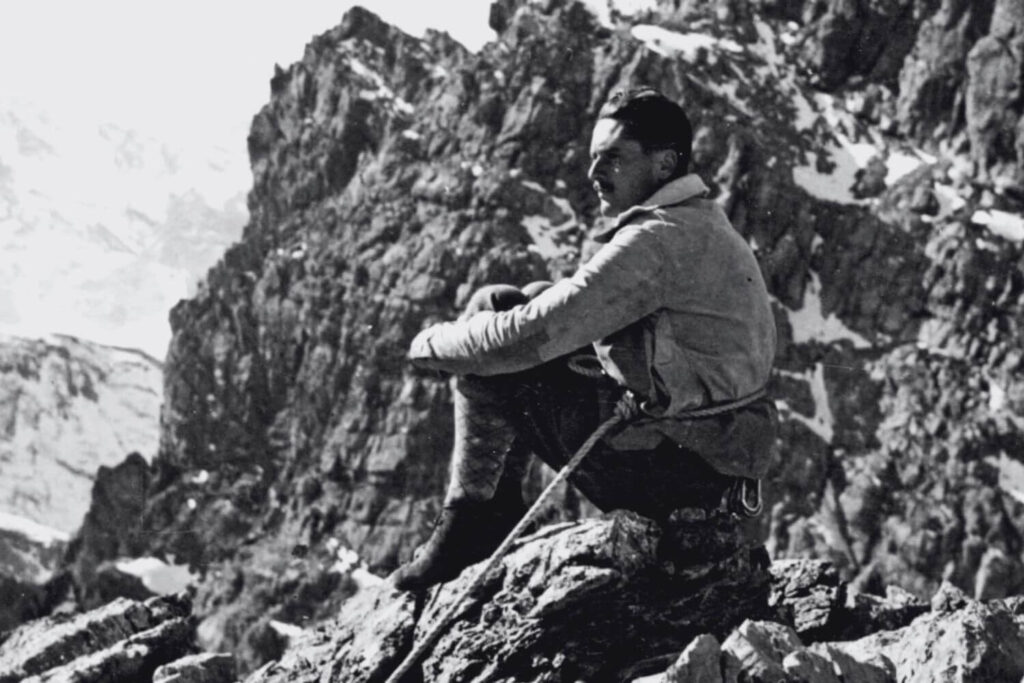
They set off from California through Mexico. They crossed every Central American country, wild Colombia and endless Brazil. Until, in Buenos Aires, the Patagonian spires were almost within sight. The remaining two and a half thousand kilometres to the village of El Chaltén were nothing compared with what they had covered in the previous weeks. And absolutely nothing compared with a year of preparation and squeezing money out of hard graft on building sites and in Sheffield's steelworks, where – apart from a few quid in a dusty pocket – you also came away with an aching back, calloused hands and black grime in your ears. All that was behind them now. All that was left was to wait for the expedition gear they had shipped across the ocean.
But the crates never arrived.
The goal that had been within arm's reach just days before was suddenly further away than when they had started planning the trip back home in the British Isles. Rab Carrington and his partner were stuck in the middle of a buzzing hive of three million people called Buenos Aires.
Because of a dock strike, Rab's most precious possessions were stuck somewhere in Liverpool – on the other side of the Atlantic. So instead of watching for a several-day window of good weather in which to glimpse the longed-for granite giants, he had to work out where and how he would survive the weeks remaining until the flight he had a ticket for. Naturally, he couldn't afford a new one. He couldn't afford a hotel either. He had been counting on a bivouac in an ice cave rather than a bedroom in the city. Luckily, help came from the one and only person he knew in that teeming chaos. Hector Vieytes took Rab to his sewing workshop, where the staff were working on an order of military down sleeping bags. And so, in the winter of 1973 – a total write-off as far as climbing was concerned – Rab Carrington at least learned how to make a proper sleeping bag.

Six months later he was back in the Peak District – the stronghold of bold, traditional climbing, where he had moved from his native Scotland. He had neither the appetite nor the money for another Patagonian lottery, so Rab Carrington spent the following winter in the Alps with Al Rouse. Back then they fell for the style of fast ascents. Even so, on their first attempt they ended up spending two days on the face – only to find out later that Patrick Vallençant had whizzed down it on skis in fifteen seconds.
In the years that followed, though, they pulled off some really big things – in really big mountains. Just look: Jannu in 1978, Kangtega and Nuptse with Doug Scott a year later, Makalu in 1980, and Everest was supposed to be next. But by then things weren't working between them. Al Rouse craved glory – he wanted something even bolder, even riskier – but Rab saw it differently. His daughter had been born and he had a family to support. So by day he toiled on building sites, and in the evenings he shut himself away in the attic of the small terraced house they lived in in Sheffield. There he sewed for friends, and later for friends of friends – just as he had learned at Hector Vieytes's in Argentina and as he had tested everything on himself on his own expeditions – sleeping bags bearing his name: RAB.

Paul Braithwaite, Nick Estcourt, Joe Brown – these and plenty of other climbers threw themselves into business in the 1980s. It seemed the best way to fund their passion and stay true to it even away from the mountains. But that's not how the business world works. And Latok in 1981 was Rab's last big expedition. After that, the company swallowed him up. He moved from the modest attic to a rented workshop, hired his first employees, and the fame he had refused to chase with Al Rouse on Himalayan faces eventually caught up with him right there at home. His products quickly earned a reputation as honest, durable gear that would stand up to any mountain test. Nobody made down jackets like Rab back then. And quite possibly nobody does forty years later either.

The fine clusters of down that nature has spent thousands of years developing on birds' bodies are the very best protection against icy mountain air. But to keep their unique ability to trap a large amount of air, they have to be protected from ever-present moisture.
Rab Carrington knew this, of course. He had been through a lot in the mountains in his home-made down jackets and sleeping bags. That's why back in the 1990s he approached Pertex® to develop together a tough yet light fabric to wrap the down in. They did find such a fabric, and Rab still uses it today. And not only Rab. And so that a down jacket wouldn't turn into a sodden rag even in the worst downpour, Rab and the people at Nikwax came up with a water-repellent treatment that keeps the down clusters as warm as ever – regardless of the humidity and weather out there.

When rain is lashing your face, your teeth are chattering, you can barely clip a karabiner with frozen fingers and gusts of wind try to blow you off the ridge with every blast, over-engineered gear is more of a hindrance. Those are exactly the moments when it shows. If a zip jams, a plastic buckle snaps or you start wrestling with the hood drawcord, it may not be life-threatening – but it won't make you any calmer either.
From the very beginning Rab Carrington bet on simplicity. That's how he tried to eliminate the weak points of gear. On his expeditions he had learned that in situations when something is really at stake – when you're being put through the wringer – simple things work best. And that they also last longest – that they simply hold up.
In 2001, a long-standing partnership with Polartec® also began. Just as with Pertex®, Rab became one of the first not only to use their fabrics but also to help develop them in the uncompromising reality of the outdoors. Many hard-working fabrics have also been – and still are – born right in Sheffield, at Rab's headquarters. Take the light, tough Matrix™ softshell, which you can drag through the roughest rock chimney with no ill effects. Durability is another of Rab's big bets in the mountain game.

Where does the down in your jacket actually come from? Ever stopped to think about it? Of course – it grows on birds, living creatures. And the Responsible Down Standard, which Rab has met for years, guarantees that the down used in its jackets and sleeping bags comes only from European farms where ducks and geese live in a healthy environment, get no hormones in their feed, suffer no pain or fear, and where plucking down from live birds is forbidden. Some Rab jackets and sleeping bags are even filled with recycled down – collected from old duvets and pillows.
That's simply what Rab gear is like – simple, functional and durable. You'd rather repair it than throw it away. After all – there's no need to make a big science of it. You always have to climb up under your own steam, and the mountains have the last word anyway.
"The greatest thing I've ever got out of climbing is friendship."
Rab Carrington
Rab Carrington retired in 2003 and handed the company over to Equip Outdoor Technologies Ltd. He still turns up now and then at the Sheffield headquarters of the company that bears his name.
In 2020, Rab became a certified climate-neutral company. By using ever more recycled and recyclable materials, Rab aims to reach net-zero greenhouse gas emissions by 2030.
Rab was one of the first to stop using fluorocarbon water-repellent treatments – long before sustainability became trendy.
In 2011, Equip Outdoor Technologies Ltd. bought the Lowe Alpine brand, so today's Rab packs build on more than fifty years of tradition and know-how from the company founded in 1967 by Jeff, Greg and Mike Lowe.