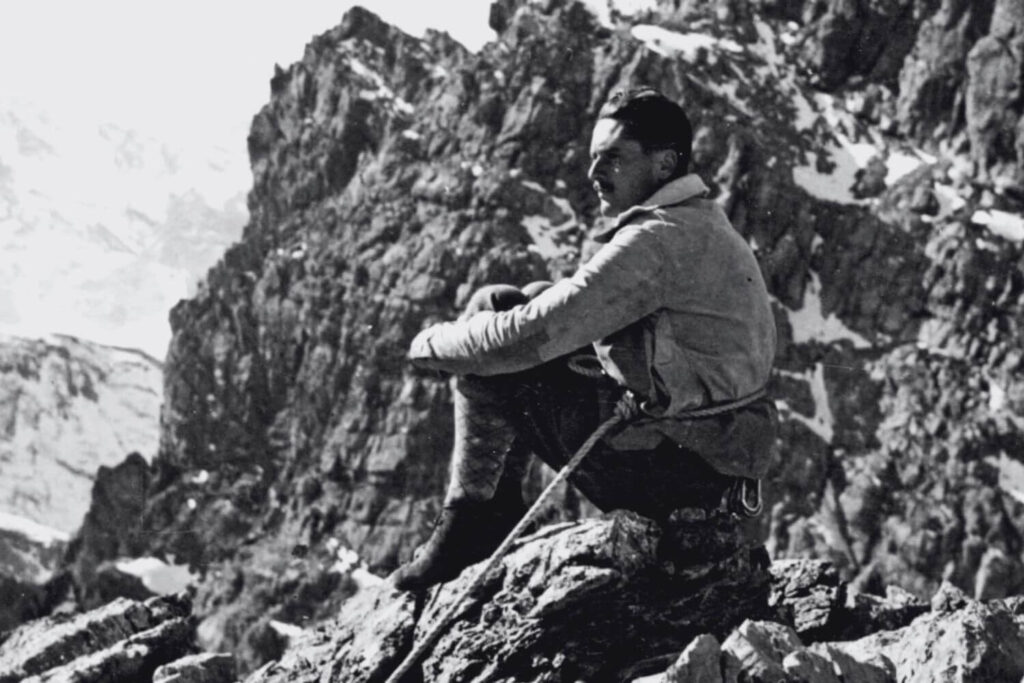
Four days and four nights. Every muscle ached from crouching on that tiny rock pulpit, which, in the middle of the storm, also sloped away into the depths. But when morning finally broke, the sky was at last clear. Still, the only way to safety led upwards. Over holds and footholds they first had to dig out from under a layer of fresh snow, and over rock coated in a glaze of ice. Only the knowledge that they had to get away fast to save their lives gave them the strength to keep going. In the end, Willo Welzenbach – on a desperate escape with Willy Merkl – got over this barrier too. Yet such an ordeal was far from typical of his climbing – apart from this one episode, his ascents were free of drama. Willo Welzenbach only ever set foot on Alpine faces with the utmost caution, and he would rather retreat when the conditions didn't look friendly.
Willo Welzenbach was, in fact, a rather different kind of climber. He was no "climbing bum" or "Wanderkind" pedalling across the Alps on a bicycle to reach the faces of his dreams. A degree in civil engineering from the Technical University of Karlsruhe and a subsequent job as a technical engineer with the Munich transport company spared him any money worries – even during the Great Depression, which threw so many people out onto the street. And although he spent much of the week bent over plans and drawings, at weekends he managed to climb Alpine faces that others only tiptoed beneath.

Repeats of Dülfer's routes on the east face of the Fleischbank, the west face of the Totenkirchl, the east face of the Lärcheck or the south face of the Schüsselkarspitze in 1923 – that's just a snippet from the climbing diary of the then twenty-three-year-old student. That same spring he also climbed several four-thousanders in the Monte Rosa massif and the Bernese Alps, and finally, with his Alpine teacher – as he himself called Hans Pfann – he took on harder ascents in the Pennine (Valais) Alps. But even that wasn't the high point of the summer. That came with the ridge traverse from the Matterhorn to the Dent d'Hérens. And it was during this campaign that Welzenbach's rope partner – Fritz Rigele, a remarkable thirty-two years older and blind in one eye – challenged him to head together for a still unclimbed gleaming suit of armour in the Grossglockner group: the north-west face of the Wiesbachhorn.
But centuries had sheathed the north face of the Wiesbachhorn in ice, and climbing something like that meant mastering a technique that was far from common at the time. Fritz Rigele, however, had a smith in Saalfelden forge tools that would make progress on such terrain easier – the very first ice pitons, eighteen to twenty centimetres long. And perhaps partly thanks to Rigele's invention, Willo Welzenbach notched up his first great first ascent on ice, a hint of the terrain he would one day rule. Besides that, he also learned that bold mountaineering demands a fair dose of luck. An hour after they left the summit, a huge ice avalanche swept down their line of ascent. An hour. That was how thin the line between life and death was.

Easy – moderate – difficult – very difficult – extremely difficult. That was how the five-grade scale introduced by Hans Dülfer in 1913 expressed the difficulty of a climb. But in 1925 Willo Welzenbach took on the job of revising the outdated climbing guidebook to the Wetterstein range, and while conscientiously mapping the existing routes he also managed fourteen new routes of his own. He concluded that Dülfer's five grades no longer came close to covering the difficulties climbers were reaching more than two decades after the scale was introduced. So for the first time he rated a climb grade VI and introduced a new scale – the Welzenbach scale – which lasted until the 1970s.
And although 1925 was, thanks to the guidebook, above all the year of the Wetterstein, Willo Welzenbach still found time to visit the icy faces of the Western Alps – most notably the huge, thirteen-hundred-metre north face of the Dent d'Hérens – where Rigele's new ice pitons came into play again. Welzenbach was tough on himself, though, and on principle used pitons only for protection – never for upward progress. As if he were ahead of his time. "What counts is not only what is achieved, but also how it is achieved," Willo Welzenbach used to say – for him, deeds were everything and fame nothing.
A year later, though, his climbing looked bleak. True, he climbed another hundred and twenty or so summits, and above all his autumn tour of the Glockner group – when, with Karl Wien, he climbed the north-west face of the Klockerin, the north face of the Eiskögele and finally the north face of the Grossglockner itself within a few days – earned well-deserved admiration. But that summer he also badly dislocated his shoulder, and then, at the end of October 1926, a fierce pain bored into his right arm. For months he was plagued by bone tuberculosis, at the end of which his right elbow was completely stiff. And steep rock faces are not kind to limitations like that. Should he give up climbing? Now, when in his own words he had "attained values that make life worth living and give existence a lasting meaning"?

After all, a person has four limbs. And if one arm doesn't work properly, the legs have to work all the better. So Willo Welzenbach's physical handicap developed in a peculiar way, sprouting into a new ability: to make unusually good use of a secure stance on his feet on steep ice, which took the strain off his weakened arms. He quickly regained his lost confidence in the Pallavicini Couloir on the Grossglockner and on the Brenva Face of Mont Blanc. In the spring of 1931 an attempt on the north face of the Ortler with Willy Merkl failed because of avalanche danger, but in the first days of July the newspapers were already reporting how Welzenbach and Merkl had been hanging for four days on that storm-shrouded north face of the Grands Charmoz.
Yet even this "reprimand" from the mountains themselves didn't break Willo Welzenbach, and he kept striving for the purest style of climbing with a minimum of gear: "If you take bivouac gear with you, you'll end up using it," he used to say. At that time his mind was also filled with the highest peaks – the summits of the world itself – mountains that rise above the clouds, into air where you can barely catch your breath. But a little luck was exactly what such an expedition lacked. As early as 1928, that cursed stiff arm stopped him travelling to the Pamirs, and the same happened a year later with Kangchenjunga, the third-highest mountain in the world. Only in 1932 did it look as though he would go – and as expedition leader, no less – to attempt the first ascent of the eight-thousander Nanga Parbat. But the city of Munich refused its civil engineer special leave, so Willy Merkl took over the leadership of the German-American expedition. Not until the spring of 1934 did Welzenbach finally leave for the Himalaya. For the first time. And the last.

On 6 July 1934, three Germans – Willo Welzenbach, Willy Merkl and Uli Wieland – two Austrians – Peter Aschenbrenner and Erwin Schneider – and eleven Sherpas stood on the Rakhiot Ridge below the Silver Saddle. After Alfred Drexel's death from pneumonia, the expedition had lost three weeks, and every one of the men now felt mobilised for a national ideal – the conquest of Nanga Parbat. So the expedition's main forces concentrated on the way up. The strongest men headed for the summit and the intermediate camps were left empty. The group was entirely on its own. If anything happened, no one could back them up. Base camp lay too far below and too far away.
Peter Aschenbrenner and Erwin Schneider did an enormous amount of work in snow no human had ever touched. They were the first to reach the Silver Saddle and even carried on towards the rocks of the north-east summit. In the clear afternoon they could already picture themselves on the top, but reason – and perhaps respect for the expedition leader Willy Merkl – told them to go back down to 7,700 metres, where the three Germans and the Sherpas had already pitched the eighth – and final – high camp. Tomorrow they'd go for the summit? But once again the mountains were against them. Strange weather. Could it be the herald of a storm? After all, the sky above their heads was still blue. Suddenly the wind slammed into the tent where Willo Welzenbach, Willy Merkl and Uli Wieland were huddled. Crack! The poles snapped. They had to hold the tent's shape with their own bodies. The night was sleepless and the morning hellish. The storm wouldn't even let them melt water, so vital at that altitude. Every hour felt like an eternity. Hope turned to fear. Another night came. More tent poles snapped under the onslaught of the wind.
Willy Merkl was not properly acclimatised, and the lack of oxygen was starting to tell on his body and his mind. He asked Welzenbach and Wieland to decide what to do instead of him – the expedition leader. As agreed, Peter Aschenbrenner and Erwin Schneider – experienced mountain guides – set off down with several Sherpas. The three Germans and the remaining Sherpas were to follow in their tracks shortly. "Let's leave as much stuff here as we can," Willo Welzenbach suggested to his two friends, reasoning that if the weather suddenly improved, everything up there would be ready for the summit push. But the hurricane had more staying power than any of them could imagine.
On the night of 12 to 13 July, after a terrifying five-day struggle through a storm that gave nobody a single metre and sucked the life out of the climbers bit by bit, Willy Merkl turned his gaze to his friend, with whom he had once already survived four gruelling days and nights in raging mountains. But back then it was the Alps. This was the Himalaya. Willo Welzenbach, who had spent several nights on bare snow, just like that, without a sleeping bag, was staring blankly. Willy Merkl ran his frostbitten, numb hand over his face. Nothing. No reaction. Seized with horror, he called out to him: "Willo! Wach auf!" (Willo! Wake up!) In a frenzy he shook the stiff body. But Willo Welzenbach was no longer alive. And Willy Merkl was left on the mountain, utterly alone beside the lifeless body of this hero of the German nation.
During the descent from Nanga Parbat, Uli Wieland, Willo Welzenbach and finally Willy Merkl died one after another. Seven Sherpas also never made it back to base camp, so ten men lost their lives.
In Germany, the disaster caused a great stir, and a court of honour that was set up found Peter Aschenbrenner and Erwin Schneider guilty of breaching mountain ethics because they had not helped their companions and the Sherpas. It is hard to find a similar precedent in the history of mountaineering.
Nanga Parbat (8,125 m) became, in the eyes of the German nation, a symbol of an insurmountable obstacle – even though it was supposed to be a springboard for confirming their superiority. Another tragic German expedition to Nanga Parbat took place in 1937 under the leadership of Karl Wien. An avalanche that struck the camp at 6,200 metres killed seven German climbers and nine Sherpas. The next expedition in 1938 didn't reach the summit either, though fortunately it suffered no loss of life. Success came only with the 1953 expedition led by Karl Herrligkoffer, when Hermann Buhl stood on the summit on 3 July 1953 after a 41-hour solo push. It was the third eight-thousander ever climbed.
Willo Welzenbach (10 November 1900 – 14 July 1934) lived to be just 34, yet in his short life he climbed 940 summits (72 of them four-thousanders) and left 50 first ascents in the Alps. Many say he redefined the meaning of the word possible and moved the standards of Alpine climbing light years ahead. His ascents on ice were especially pioneering, which is why Reinhold Messner called him the Ice Pope.
Willo Welzenbach played a key role in the development of ice pitons and many climbing techniques, and he created the Welzenbach scale, the Alpine grading system that was generally accepted for decades. Unlike most climbers of his generation, he had a stable, well-paid job and climbed only at weekends and during the summer holidays.