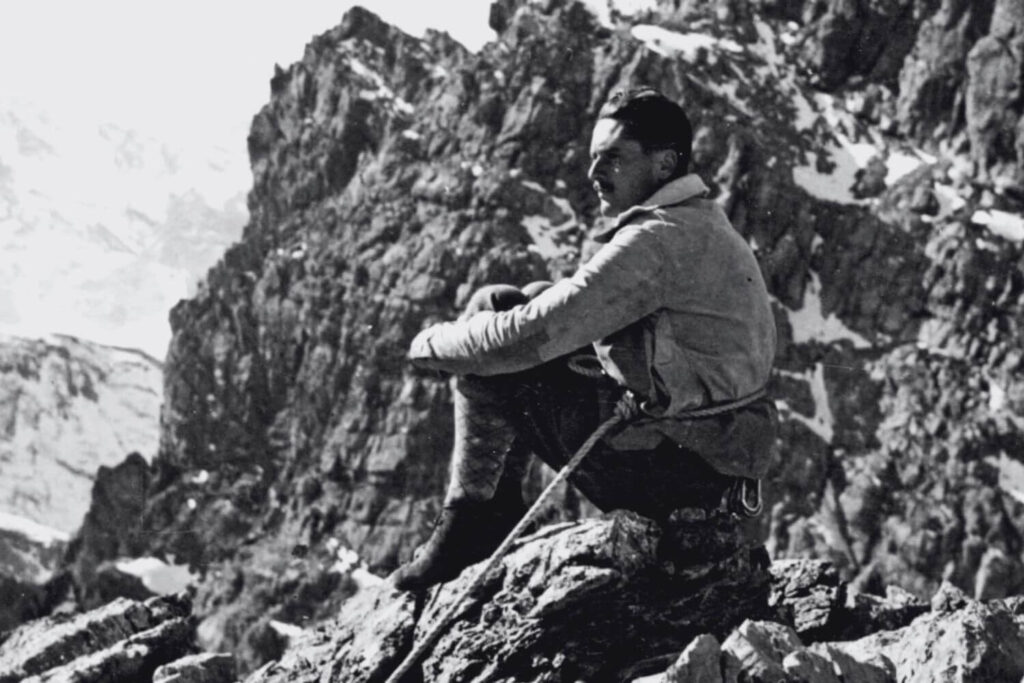
A born Parisian. One war had just ended when she was born. And more dark clouds were gathering in the distance when the twenty-year-old seamstress scraped together her hard-earned money, waved goodbye to the towers of Sacré-Cœur and made her way through the Ardennes forests to Belgium. She'd never had anything in her life, but she certainly wasn't going to marry her mother's boss's son just to climb the social ladder. Not a chance. So she ran away instead. And at last she found the life she liked. She sewed. And she discovered climbing. Every Sunday she spent with new friends on limestone cliffs, from whose tops – scraped and battered, but happy – she gazed down at the ever-rushing waters of the Meuse and at the Château de Freÿr on the opposite bank, its aristocratic grandeur in stark contrast to her patched-up clothes. But she felt good like this. Really good. Then came the German operational plan Fall Gelb. And the Battle of Belgium began.
An uncle in Nice. Warm sunshine instead of the darkness creeping out of the Reich. And maybe real mountains whose summits she could climb. Claude had good reasons to leave for the second time in her life. This time, though, amid the chaos shaking the world, secretly across the demarcation line and on across the whole of France.
Even on the still peaceful Côte d'Azur, a skilled seamstress was in immediate demand. That was good. But what really caught her attention was the local climbing club, whose members got on their bikes every Saturday and rode more than a hundred kilometres to the foot of their desires – to the Baou de Saint-Jeannet, to the Argentera valley or to Lougeurd. In this company she found what she had been missing a little in the wooded Ardennes – real mountains. Climbs to the heavens. Easier routes at first, since the club had a strict pecking order and for a long time she was still "the little new girl" to them, but even so everyone could see how deftly she moved over difficult ground. Georges Kogan in particular noticed – and Claude noticed him too. Rather more than the others.

What's more, Georges Kogan owned an old family business. A knitwear factory, which, however, was surviving on little more than the momentum of tradition. That didn't stop the young seamstress from developing her creative ideas, and in the end it was she who got the stalled, wheezing company moving again. Unfortunately, though, dark days reached the south of France too. And although nobody, including Claude, who was in love, had any idea that Jewish blood also ran in the veins of Georges Kogan – originally a Russian émigré – the German police were only too well informed about it. So he fled to the one place where he might find a safe hiding place. The mountains. But Georges was too impulsive to hide for months on end, maybe even years. So they caught him.
And how did Claude get him out of the prison in Briançon? Most likely with a ruse and feminine charm applied to the most influential militiaman. One way or another, Georges was out. And straight after the war the two of them got married. The business accounts quickly started piling up figures in the black, though in the end that wasn't what mattered most. Yes – the mountains always came first. They took over all their thoughts. The Alps, the Andes, the Himalaya. They had dreams scattered all over the world, and weekends were nowhere near enough for their adventurous souls, hungry for more and more summits. It seemed bold, especially at that time, but that's simply what they decided – six months of work and six months of travelling the world. The north face of the Dru in '46, the south ridge of the Aiguille Noire de Peuterey in '49 – where Claude led the entire climb –, Alpamayo and Quitaraju in 1950. And then Georges was struck by that damned stomach haemorrhage. After six years living the dream she was suddenly alone.

Salcantay in the Peruvian Andes. That was Georges's dream mountain. They'd talked about it many times – about the two jagged ridges running almost symmetrically from its summit, one to the south-east, the other to the north-west, drawing the shape of an almost perfect white pyramid against the blue South American sky. Now she stood on its 6,271-metre summit with an expedition organised by Bernard Pierre. When Georges died, she decided to carry on with the life they had mapped out together. Perhaps the only difference was that she now held death in greater contempt, having stood face to face with it.
In 1953 – again with Bernard Pierre's expedition – Claude Kogan went another thousand metres closer to the heavens – to the 7,135-metre Nun Kun in the Zanskar Himalaya. Not far below the summit she resolutely took on responsibility for the success of the whole expedition and broke trail upwards through deep snow ahead of Pierre Vittoz, while three other men were recovering from injuries caused by an avalanche. A year later, with the mountain guide Raymond Lambert – yes, that Lambert, who together with Tenzing Norgay came so close in 1952 to becoming the first people on Everest – she explored the slopes of the seven-thousander Gauri Sankar and the eight-thousander Cho Oyu, where, in the wind and bitter cold, they were eventually forced to flee from the fourth and last high camp below the summit.
Even so, newspapers and magazines at the time called her "the highest woman in the world". After all, no other woman had yet stood higher than she had on that failed attempt on Cho Oyu. But did such a title mean anything? No, not to her. Claude Kogan was determined to go back to that mountain. This time with her own expedition. An all-women team.

Mountains, mountains and more mountains. In 1955 the seven-thousander Ganesh, in 1956 Greenland, in '57 Peru and a year later the Caucasus. Did she regret that, with forty approaching, it was almost certain she would never become a mother? Perhaps. Yes. Probably yes. But the independence she would lose if she married again... No! Not that! Besides, for the last two years she had been planning something so big.
Together with Jeanne Franco she set out to put together an international women's team to attempt Cho Oyu. They couldn't be the very first on top – that was clear, because in October of that same year, 1954, when the mountain had mercilessly driven Claude Kogan away, the Austrian Herbert Tichy and Sherpa Pasang Dawa Lama reached the summit. But no woman had yet stood on an eight-thousander. And that was exactly what some of them were now going to change. If not the Frenchwomen Claude and Jeanne, then perhaps the former Belgian ski star Claudine van der Straten, the small, quicksilver Swiss Loulou Boulaz, the Englishwomen Dorothea Gravina and Eileen Healey of the Ladies' Alpine Club, or Tenzing Norgay's two daughters and niece – Pem, Nima and Doma.
The support of the famous Sherpa Tenzing, who also promised to pick a group of capable Sherpas to accompany the women on the climb, made many things easier. Especially when it came to negotiating with the authorities in Kathmandu. Then, on the first day of October 1959, in Camp IV, Claude Kogan wrote a note with hands shaking from the cold, which the descending Sherpa Chhapal delivered to Dorothea Gravina waiting in Camp II.
Camp IV, 1 October, 1 p.m.
Dear Dorothea,
We've pitched the Jannu tent at 7,100 metres. Bad weather, but we're in a relatively safe spot. We're worn out because we climbed up twice, the second time carrying the tent. The Sherpas are completely done in, all work has slowed down. Tomorrow we'll rest all day in our sleeping bags. I'm counting on you and Jeanne to set up Camp III properly. Take two tents up there.
Greetings to everyone,
Claude and Claudine

"Chowang is dead!" the bloodied Wangdi managed to gasp before collapsing in front of the women, who had heard his faint calls in base camp and followed him into the clouds sliding heavily down the mountain's slopes to its very foot. "Chowang is dead." After those words Jeanne had to calm the other women: "Now is not the time for tears." They had to look after the loyal Sherpa. And they had to find out what had happened up there. After all, the last news they had of Claude and Claudine was the letter they had sent down with Chhapal from Camp IV. Jeanne tried to get at least a few spoonfuls of soup into Wangdi, but in vain. His mouth was so swollen from the frost that it was impossible. After being treated by the doctor, Colette, he was at least able – despite his utter exhaustion – to tell the women what had happened up there: "Above Camp III we were caught by a big avalanche."
Above Camp III. A few hundred metres below the tent where Claude and Claudine lay huddled in their sleeping bags. All day long they had been listening to the thunder of avalanches in the gullies that carried tons and tons of wet, heavy snow off the mountain's slopes. Terrifying sounds. But still – both of them had lived through countless bouts of bad weather like this in the mountains. Only one thing worried Claude Kogan – when they got up there, they no longer had the strength to dig a snow cave. Its embrace would have given them far better protection against the tearing wind and roaring avalanches than the thin tent fabric they now had to rely on. Anyway, it was too late to dig a cave now. And time up there dragged. Only the faithful Ang Norbu made the women tea and now and then stuck his head out of the tent to confirm the bad news: it's still snowing.
They had to hold out. Wait for it to improve. They couldn't go down. The thaw was too strong and everything was on the move. Masses of heavy snow were no longer just pouring down the usual gullies – the whole mountain was sliding away in huge blocks. They were surrounded. The night seemed endless. And the dawn, slow to arrive, brought more grim prospects. If the weather had improved, if the sky had cleared, the morning light would have flooded the whole tent within minutes. But the gloom weighed down on the mountain, and now on their minds too. Every so often they heard a tremendous crash. And each one seemed closer and closer. Claude Kogan and Claudine van der Straten huddled together by the tent pole. Both already sensed what was coming: the Turquoise Goddess would keep them as proof of their absolute devotion to the mountains.
Claude Kogan, née Trouillet, was born on 21 February 1919 in Paris and died on 2 October 1959 under an avalanche on the slopes of Cho Oyu. She climbed in the Alps, the Andes and the Himalaya, and many of her ascents were also the first by a woman. In 2003 Charlie Buffet wrote a book about her, Première de cordée: Claude Kogan, femme d'audace et de passion (First on the Rope: Claude Kogan, a Woman of Daring and Passion).
Claudine van der Straten-Ponthoz (25 September 1924 – 2 October 1959) was a Belgian-French climber, a former ski star and the daughter of the Belgian count Roger van der Straten Ponthoz.
Cho Oyu (8,201 m) is the sixth highest mountain in the world. It lies on the border between China (Tibet) and Nepal, twenty kilometres west of Mount Everest, and was the fifth eight-thousander to be climbed. Its summit was reached on 19 October 1954 by members of a small Austrian expedition, Herbert Tichy and Sherpa Pasang Dawa Lama. In Tibetan, the name Cho Oyu means Turquoise Goddess.
The 1959 women's expedition to Cho Oyu was made up of 12 women of five nationalities and 11 Sherpas. It was also exceptional for being international, which was quite unheard of in an era of purely national expeditions.
After the deaths of Claude and Claudine, Dorothea Gravina took over the leadership of the expedition, but only to bring the remaining members home to Europe. Besides the two women, three Sherpas also did not return. Back home, the usual reproaches about climbers' irresponsible gambling were joined by objections to women, who “have no business being in such places”.
Women finally climbed an eight-thousander in 1974. A Japanese women's expedition reached the summit of Manaslu (8,163 m). Those on top were Naoko Nakaseko, Masako Uchida and Mieko Mori.