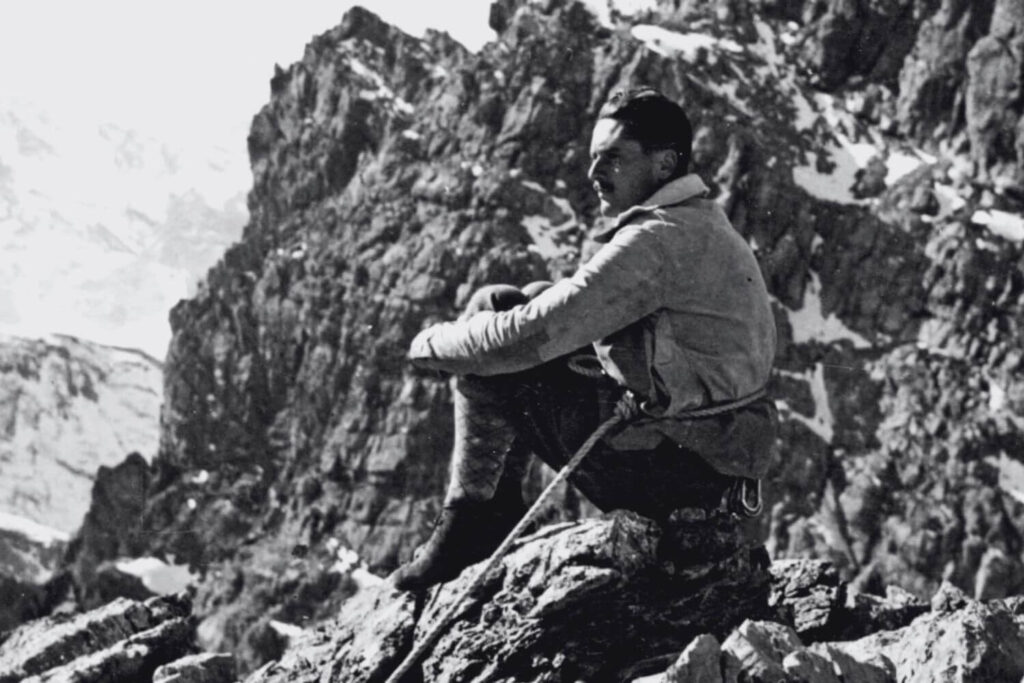
There was nothing unusual about them. True to the customs of Viennese high society, the whole Preuss family went off to the mountains for the summer. In fact, Paul Preuss was born on 19 August 1886 in the lakeside village of Altaussee, watched over from above by the limestone wall of the Loser. And his father – an amateur botanist and a music teacher by profession – dragged him around the hills behind the family's summer house from an early age. If they hadn't gone back to the Austro-Hungarian capital every winter, perhaps the crisp mountain air would have protected six-year-old Paul from the polio virus. As it was, he spent the whole winter and spring in his Viennese bed. Or in a wheelchair. Partly paralysed.
Fortunately, gymnastic exercises, long walks and the clean air flowing down from the mountains to the shores of Altaussee – all of it together drove the stiffness out of his body and gave him back his strength and youthful agility. Then, all summer long, he and his father once again bent over the evergreen rhododendrons, studied every kind of gentian, searched for tiny campions rooted in rock crevices and, once in a while, spotted the furry flowers of edelweiss peeping out among the sharp blades of alpine grass. So summer in the Salzkammergut passed, grey Viennese winter followed, then another colourful mountain summer, then winter, summer... and then his father died.
But even after that, ten-year-old Paul Preuss kept disappearing into the mountains for days on end. Sometimes his sisters Sophie and Mina came along, but later, when he started scrambling up the steepest grassy slopes, where limestone buttresses cut through towards the sky the higher you went, he more and more often had to make do on his own. He picked up the locals' rolling mountain gait, learned their songs and dialect and even started laughing like the mountain folk. But he never forgot anything he had experienced with his father, and he went on to study plant physiology at the University of Vienna, later earning a doctorate in Munich in 1911 along with a post as assistant at the Botanical Institute. By then he could also call himself "the doctor of climbing".

Month after month and year after year, the ground beneath Paul Preuss's feet grew steeper – and by the time he was twenty, his mountain outings had turned into genuine mountaineering. But something truly big, something worthy of admiration and talked about in mountain huts, came only a month before his twenty-second birthday. That July of 1908 he climbed the Pichl route on the seven-hundred-metre north face of the Planspitze in the Gesäuse completely alone – no partner on the rope and no technical aids of any kind. From then on, walls and summits piled up in his diary at a dizzying pace. He counted his ascents in the hundreds. First ascents in the dozens. And more and more often he dared to go up with nothing but what nature had given him – alone, unprotected, without a rope – no pitons, karabiners or other technical gear.
Over time this became his philosophy of life. That's how climbing should be done, he believed. "The rope is permitted as a means of relief, but never as the one true means of making the ascent of a mountain possible," wrote Paul Preuss in September 1911 in his essay Artificial Aids on Alpine Routes, published in the magazine Deutsche Alpenzeitung as a passionate polemic against the growing use of "technical cheats" in mountaineering. Earlier that summer, though, he had already made a name for himself with only the second ascent of the west face of the Totenkirchl, which – after the seven-hour first ascent by Tita Piaz's party – was said to be among the hardest in the whole Alps. Paul Preuss, however, climbed the face entirely alone, in two and a half hours.

Then, on 28 July, together with his sister Mina and their friend Paul Relly, he set off for the slender rock tower of Campanile Basso – the famous Guglia di Brenta – which juts like a raised finger out of the heavy fog lazily drifting through the labyrinth of the Brenta range. Even then he was deeply convinced that "climbing a mountain under your own steam isn't enough, you have to be able to climb down it too". And when, after conquering the famous yellow-and-black Parete Pooli and a forty-metre chimney, they reached the ring of the Stradone Provinciale together – a ledge that circles the spire on three sides and offers more than enough room among the steep walls for a rest before the summit push – Paul Preuss slipped away from the pair as they sat over their snack.
In the middle of the east face he spotted a line that looked so logical it would be a shame not to try it right then and there. Why wait? What better moment could there be? And so, with his typically fluid movements, he started on the first metres of rock. Utterly focused on every single touch of the rock, he slipped into a yellow corner which, after a few dozen metres, led back out onto solid grey rock. That was then broken by a narrow yellow ledge – the perfect place to let his arms hang for a moment and catch a breath. Another corner took him back out onto the open face with several hundred metres of air beneath his feet, and finally an inconspicuous black crack led him all the way to the summit of Campanile Basso. Paul Preuss climbed the hundred-and-ten-metre face up and down in two hours – two hours that wrote a new chapter in the history of Dolomites climbing. "Short, perhaps, yet possibly the most impressive route in the whole Dolomites," declared Angelo Dibona, the legendary mountain guide.

"A climber's abilities should not end at the difficulty of the climbs he undertakes. He should be even better prepared." That was another of the six principles Paul Preuss set out in his essay in the Deutsche Alpenzeitung. He himself trained for his climbs by, among other things, placing two upturned glasses on the edge of a wardrobe and doing pull-ups on them. Apparently excellent preparation for climbing on loose rock.
He also argued that "the use of artificial aids is justified only in the case of immediately threatening danger" and that "the piton is merely an emergency reserve and not the basis of a climb," underlining the purity of his climbing philosophy – but also turning other famous alpinists against him, who accused him of being too extreme and, at the same time, inconsistent, since the boots and ice axes he used should surely count as artificial aids too. He didn't take it much to heart, though, and could even joke about it: "I wore through my fingertips, so I had to resort to sticking plaster, which I hope not even my most stubborn critic will call a breach of my theories on artificial aids, since I used the plaster sticky side in."
When, in the summer of 1912, he headed to Courmayeur in Italy for his first climbs in the Mont Blanc massif, his climbing philosophy received a tragic blood-red stamp. For three days Paul Preuss waited at the Gamba hut for the weather to improve, and while he squinted through the raindrops running down the window panes into the clouds, he agreed with H.O. Jones, one of the best climbers in Wales, his wife Muriel Gwendolen Edwards and their guide Julius Truffer that once the storm passed they would try together for the only objective that could be reached without snow – the not-quite-three-thousand-metre Mont Rouge de Peuterey. Preuss climbed in front on his own, while Truffer led his clients on the rope. Above a short but steep chimney, he could only watch in horror as Truffer lost his balance and dragged H.O. Jones and his wife down with him to their deaths.
"The principle of safety is among the highest principles. Not, however, as the frantic correction of one's own uncertainty by means of artificial aids, but rather as that primary safeguard which every climber should base on a correct assessment of his abilities in relation to his desires." So ran the sixth principle of Preuss's essay in the Deutsche Alpenzeitung.

It took a while before he fully shook off those terrible memories of three lifeless bodies that came to rest only on the Freney Glacier. But a year later he returned to Courmayeur. In the jagged ridge running from Mont Rouge de Peuterey over the blade of the Aiguille Noire to the summit of the Aiguille Blanche and on along the huge granite mass of the Grand Pilier d'Angle all the way to the roof of Europe itself, he saw something visionary. First, though, he planned to climb most of those summits separately – before linking them into one continuous climb – the longest ridge traverse in the Alps.
Again it took several days before the weather even allowed Preuss to think about such heights. But as soon as the sun lit up the fresh snow on the Brenva Glacier, he soloed the normal route on the Aiguille Noire in under five hours. And straight after that he turned his attention to the Aiguille Blanche de Peuterey – a rather unstable granite mass which he considered the last serious obstacle on the way to the summit of Mont Blanc. But he sensed that it was too big a challenge for one person alone, so he invited his friend Count Aldo Bonacossa and his climbing partner Carlo Prochownick to join him. They set up their first bivouac at the Dames Anglaises – between the Aiguille Noire and the Aiguille Blanche. But in the morning everything was covered with fresh snow, so they had to wait in the cold col for another day and night, during which Paul Preuss kept team spirits up by singing bawdy Viennese street songs. And at dawn they finally set off.
Preuss was in front the whole time. Much of the rock had disappeared under ice and snow, but with crampons on their feet all three of them steadily chipped away metre after metre. And twenty-eight hours later they were descending into the green valley of Courmayeur. At that moment even the usually reserved Gunther von Saar declared in the pages of the British Alpine Journal that: "Preuss has succeeded in solving a great alpine problem." Linking the whole ridge, whose individual sections Preuss had gradually climbed, was within reach. All that remained was to wait for good weather. But that year it never came. Relentless rain and snow ruined his plans.
It was a disappointment. And after returning home to Altaussee he fell ill. But he longed so much for the mountains – for the freedom of the heights – for at least a small consolation for the shattered dream in the mountains above Courmayeur. And so, despite a lingering cold and his doctor's warnings, on Friday 3 October he set off for the north ridge of the Mandlkogel. On his last journey upwards.
"Solitary climbing will always have its critics as well as its devotees. But with the feeling of regret at the untimely death of a great climber and a great personality comes a feeling of pride that there are still men of the highest intellect in our generation who, in full knowledge of all the easier and more rewarding alternatives life offers, go on pitting their skills against ever-increasing difficulty and meet problems with calm courage."
Closing words of Geoffrey Winthrop Young's obituary
Paul Preuss (19 August 1886 – 3 October 1913) managed more than 1,200 ascents in his short life of just 27 years. Of these, 300 were solo and 150 were first ascents. He was renowned for his bold solo climbs and his advocacy of ethically clean alpinism. He made his living from lectures and articles for alpine magazines, and his life and approach to climbing inspired many other mountaineers. Reinhold Messner declared that “no other alpinist will ever be more important for what we do.”
The first continuous ascent of the Peuterey Ridge, as Paul Preuss had dreamed of it, was only made in July 1934 by the trio Adolf Göttner, Ludwig Schmaderer and Ferdinand Krobath. It took them four days to reach the summit of Mont Blanc.
In the early 1920s antisemitism spread among German and Austrian climbers. The Jewish members of the alpine clubs were expelled in 1924, and since Paul Preuss was also of Jewish descent, his name was erased from history. Only in the 1970s was his legacy finally restored.
Tito Piaz – Preuss's climbing rival of the day, his opponent in philosophy, but also his friend – built a hut in the Dolomites in the 1920s at the foot of the Torri del Vajolet and named it Rifugio Paul Preuss, a very risky move given the rising wave of antisemitism.
One of the rock formations in the Tre Cime di Lavaredo massif – Cima Piccolissima – was named Torre Preuss in Paul Preuss's honour. His name is also borne by a chimney on the south-east face of the Grohmannspitze – the Preusskamin. In Munich a whole street is named after him – Paul-Preuß-Straße. And a memorial to Paul Preuss also stands on the lakeshore in his native Altaussee.