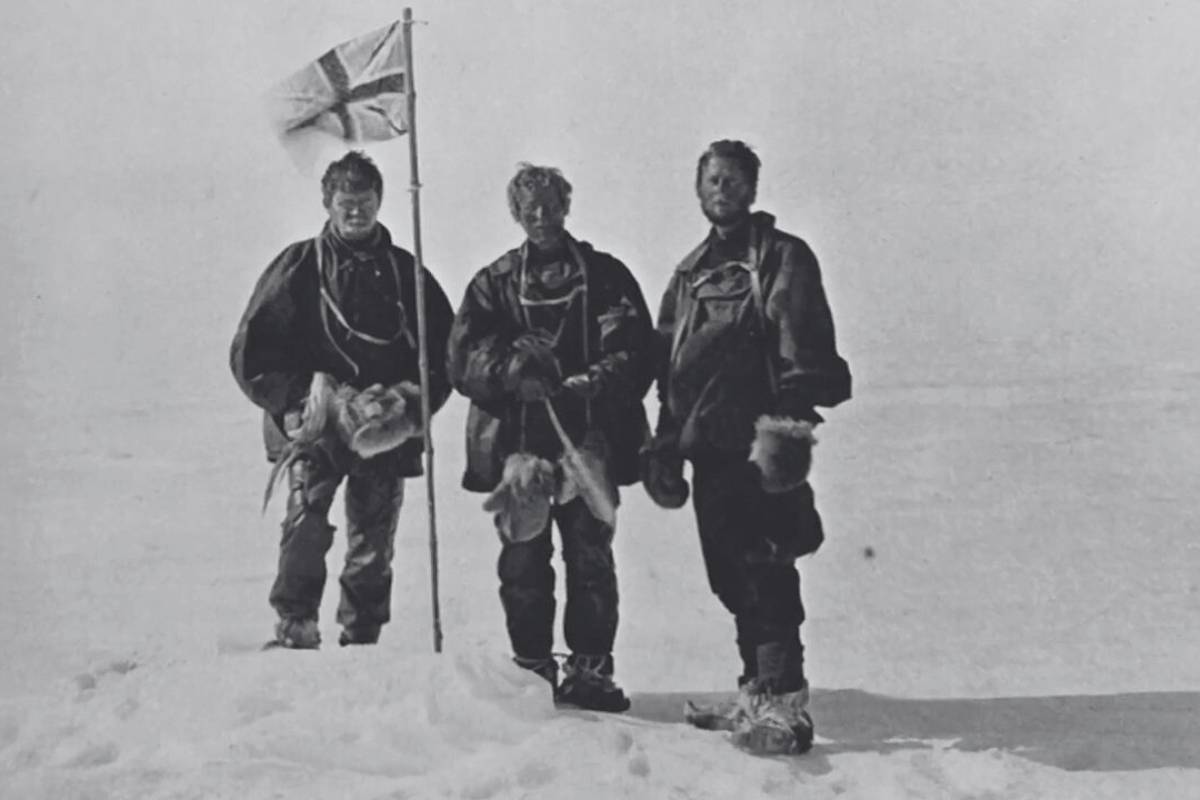
He wasn't even twenty-seven when, on 16 January 1909, he and Edgeworth David and Alistair Mackay puffed out their chests for the camera beside the British flag they had just raised at the South Magnetic Pole. Sir Ernest Shackleton's Nimrod expedition had reached its goal after two years in the icy wilderness of Antarctica, and the young geologist Douglas Mawson returned to Australia a true polar explorer – hardened by frost and long privation – and also as co-author of the book Aurora Australis, to which he contributed the science-fiction story Bathybia.
After his return, he spent some time mulling over Robert Falcon Scott's offer to join his 1910 expedition, named Terra Nova, and take part at his side in the race to the South Pole. But a tug-of-war with Amundsen didn't appeal to the scientifically minded Douglas Mawson even half as much as an expedition of his own to the parts of the seventh continent that, in the early years of the twentieth century, were still unexplored. His thoughts turned to King George V Land and Adélie Land – to mapping them, to scientific research and, if the polar winds were kind, perhaps even to another visit to the South Magnetic Pole. And because the name of the not-yet-thirty Mawson already carried weight in the right circles, on 2 December 1911 he was able to sail from Hobart in Australia aboard the SY Aurora, with the necessary funding in his pocket, heading straight south – towards Cape Denison in Commonwealth Bay.
But the place was hardly welcoming to the men who set foot on the Antarctic coast on 8 January 1912. First, huge ice cliffs jutting out of the irritable waters of the ocean made it hard to find any solid piece of land where they could safely go ashore. Then, day after day, the capricious air swirled around them at eighty kilometres an hour, and gusts of up to four times that speed shook the wooden hut in which they planned to overwinter, more than once threatening to tear it to splinters.
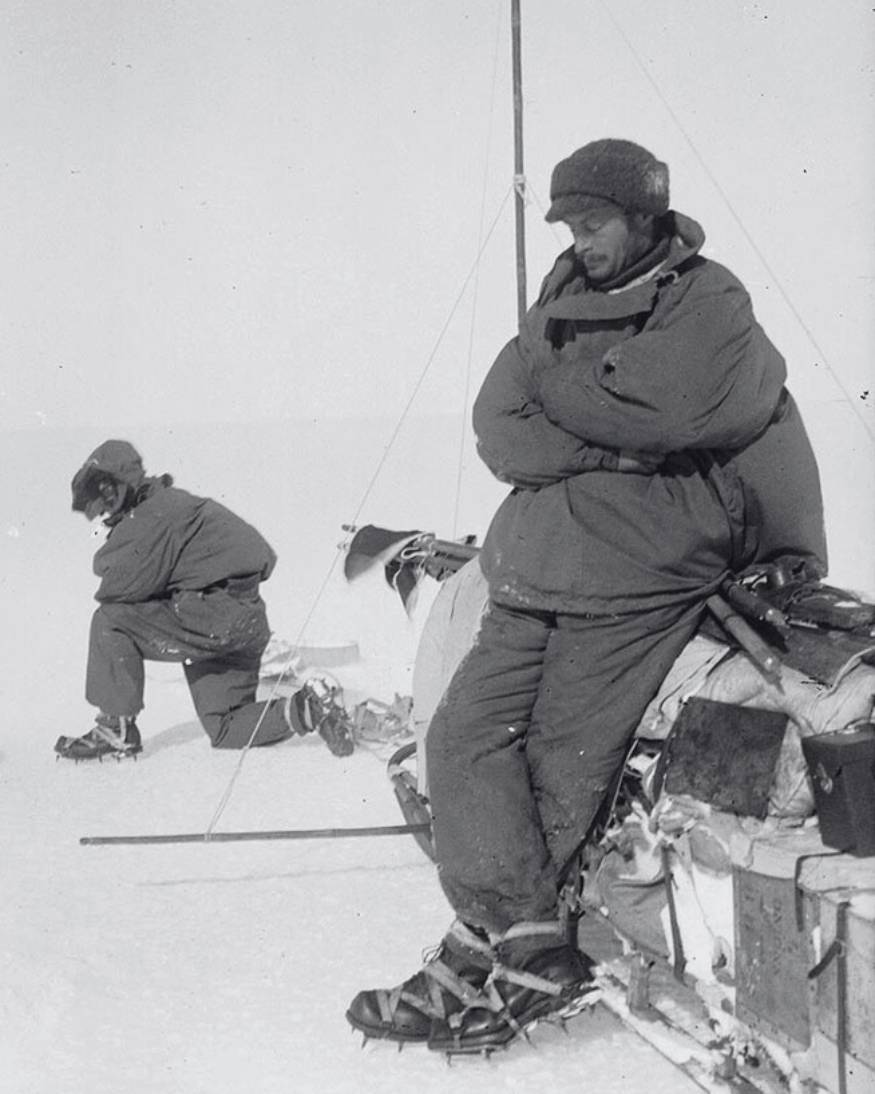
"A world of emptiness. Hideous, furious and terrifying. We stumble and fight our way through Stygian gloom. Merciless blasts, a breeding ground of vengeance. It stabs, it pounds, it freezes." That is what Douglas Mawson wrote in his diary as the ruthless weather kept him and six other members of the expedition imprisoned at Cape Denison for whole months longer than they had expected. It was not until 12 November that year – after ten drawn-out months – that Mawson set off with two younger companions – the Swiss mountaineer and ski champion Xavier Mertz and Belgrave Ninnis, a twenty-three-year-old British Army officer – and sixteen dogs to explore far to the east of their base. Through the hostile interior of Antarctica they hauled their sledges through the white darkness, across glaciers forever on the move, all the way to King George V Land, hundreds of kilometres away.
In a month they covered 480 kilometres. And in the evenings in the tent, each of them chased away thoughts of the daily grind and rumbling stomachs in his own way. Ninnis buried himself in a novel by William Makepeace Thackeray, Mertz escaped into Sherlock Holmes stories, and Mawson wrote up his diary and, photograph in hand, thought of his fiancée, whom nobody, not even in the Australian high society she came from, called anything but Paquita. They mapped a large part of the coast and packed the sledges with plenty of rare geological samples. All in all, things were going rather well.
But then Mawson had that strange dream in which his dying father appeared to him – although when he left Australia his father couldn't have been in better health. The next day they found one of the husky bitches devouring her own puppies. They had been told that this is common among dogs in such extreme conditions. But still... And finally, even though they were so endlessly far from the coast, a petrel crashed into Ninnis's sledge. Where on earth had that bird come from?

That was when everything turned. Mawson split his lip badly – so badly that blinding shafts of pain shot through the left side of his face. Ninnis fell through snow bridges three times and only by luck avoided plunging into the dark depths of a crevasse. On top of that he was struck by snow blindness, and an unpleasantly large abscess formed on one of his toes; in the end it hurt so much that Mawson lanced it with a pocket knife and the pus poured out from under the skin. Then, on 13 December 1912 – and yes, of course it was a Friday – they camped in the middle of yet another glacier, and none of the three men could sleep for more than a few minutes that night, with the ice booming and cracking beneath them. The warmer air had stirred the glaciers to life.
The morning was sunny and, by Antarctic standards, warm – just eleven degrees below zero. Mawson was looking up at the sun, trying to fix their position, when Ninnis, his sledge and his dogs vanished. It was clear what had happened. Mertz and Mawson could shout into the cold depths through the hole in the snow as loudly and as long as they liked. In return they heard nothing but the echo.
"Practically all the food is gone. And with it the spade, the pick and the tent," Mawson noted in his diary that day. They found themselves in a situation that could only be called desperate. And even that was a fairly optimistic description. Most of the supplies had been loaded on Ninnis's sledge, which left them with food for barely ten days. Yet the journey back to base would take at least a month – if Antarctica took pity on them.
They built at least a makeshift shelter – to replace the tent buried in the ice – from an old sledge they had left on the glacier the day before so it wouldn't slow them down. So it came in handy after all. And after another sleepless night, with the ground beneath them coming alive, they weighed up which route was more likely to keep them alive. If they headed for the coast – the longer way – they could hope to catch a seal and perhaps be spotted by the crew of the supply ship. In the end, though, Mawson chose the shorter route through the interior for them both. A route that might be days or even weeks faster, but offered not a grain of hope of finding food – not for them, and not for their dogs either. And so, after a few days, they killed and ate the weakest of them.

As the days of starvation went by, Mawson found that dog meat really had to be boiled thoroughly for the muscle and cartilage to take on the consistency of an easily digestible jelly. "The paws take longest to cook, but after long stewing they become quite digestible," went another of his diary entries. The tastiest and truly most nourishing part, however, was the liver. Yet in the end it was the liver that dealt another blow to their suffering. Mawson and Mertz writhed with terrible stomach pains, and diarrhoea forced them to pull down their trousers again and again in the damp, penetrating cold. On top of that, their skin began to peel off, especially from the soles of their feet and their groins, in whole strips. That too was a symptom of excessive vitamin A intake from the dogs' livers.
All that suffering hit Mertz much harder than Mawson, who was perhaps helped by having already once successfully wrestled with Antarctic conditions. But after less than a month, all that was left of the former Olympic skier was a gaunt reminder of his former self. On the evening of 7 January Mawson recorded: "During the afternoon Mertz had several fits, then fell into delirium. He soiled his trousers again and I cleaned them for him. He is very weak and only rarely manages to speak coherently." Just a few hours later, madness seized Mertz. He began to rage and in a fit broke a tent pole. Mawson only just managed to calm him and get him into his sleeping bag, where at two in the morning Mertz breathed his last.
The lone Mawson now faced another hundred and sixty kilometres, and time was running out fast. The SY Aurora had to leave the shores of Antarctica within a few days at the latest, or the coming winter would condemn it to eight months in the grip of the ice.
"Below me yawned a dark abyss. Exhausted, weak and chilled to the bone, because my hands were bare and kilos of snow had fallen under my clothes, I hung there in the firm belief that it was all over." It seemed almost inevitable that sooner or later Mawson would slip out of the harness, which by sheer luck had caught on the lip of a crevasse that had suddenly opened under his feet. He himself had no idea where his starved body found the strength that literally tore him out of those gaping icy jaws and brought him back to life.
With the soles of his feet completely stripped of skin as it peeled off his body in pieces, he dragged himself across the crevassed glacier, cowering before a blizzard that drove tears into his failing eyes, and tried with all his might to keep control of his own emptied body. His hair even began to fall out, and several more times he had to fight gravity, which longed to pull him into the depths of the glacier and end his suffering. In the gale he covered barely six or seven kilometres a day. But then, on Saturday 1 February, he woke to a clear, sunny day – within sight of the coast of Commonwealth Bay, where he also found a supply depot called Aladdin's Cave. When he found three oranges and a pineapple inside – something that, at last, wasn't just white – he burst into tears.
If his own willpower had brought him this far, surely he couldn't fail to manage the forty kilometres to the hut at Cape Denison. Surely the ship couldn't leave Antarctica without him. But the hope of that sunny day was swept off the stage by another blizzard, and when the ravaged Douglas Mawson finally looked out over the ocean from a high point just a few hundred paces from the base on 8 February, the SY Aurora was already rocking on the waves far from land.
After a two-month fight for his bare life, Douglas Mawson knew what lay ahead. He wouldn't be alone, no. He knew there were sure to be fresh men waiting at the base. But the question was whether he – this sculpture with sunken eyes, covered in a substance that no longer even resembled human skin – could survive one more long year in Antarctica. Even he didn't believe he could survive another cruel winter in a place the wind would perhaps never leave in even a moment's peace.
The SY Aurora had sailed just a few hours before Douglas Mawson reached Cape Denison. The six men who had stayed on land tried to contact the crew by wireless telegraph, but the bad weather meant the ship could no longer return. Douglas Mawson therefore spent another ten months at Cape Denison before leaving Antarctica in December 1913.
The expedition, which included other men who set out to explore in different directions from the trio of Douglas Mawson, Xavier Mertz and Belgrave Ninnis, surveyed a large part of the Antarctic coast, describing its geology, biology and meteorology, and pinpointed the location of the South Magnetic Pole.
After his return Douglas Mawson married Francisca Adriana Delprat, known as Paquita. In 1914 he was knighted, and in 1915 the Royal Geographical Society awarded him the Founder's Medal.
From 1929 to 1931 Douglas Mawson organised and led the joint British, Australian and New Zealand Antarctic Research Expedition, which led to the creation of the Australian Antarctic Territory in 1936.
Douglas Mawson died of a brain haemorrhage on 14 October 1958 at his home in Brighton, Australia. He was 76. He described his experiences in Antarctica from 1911 to 1913 in the book Home of the Blizzard.