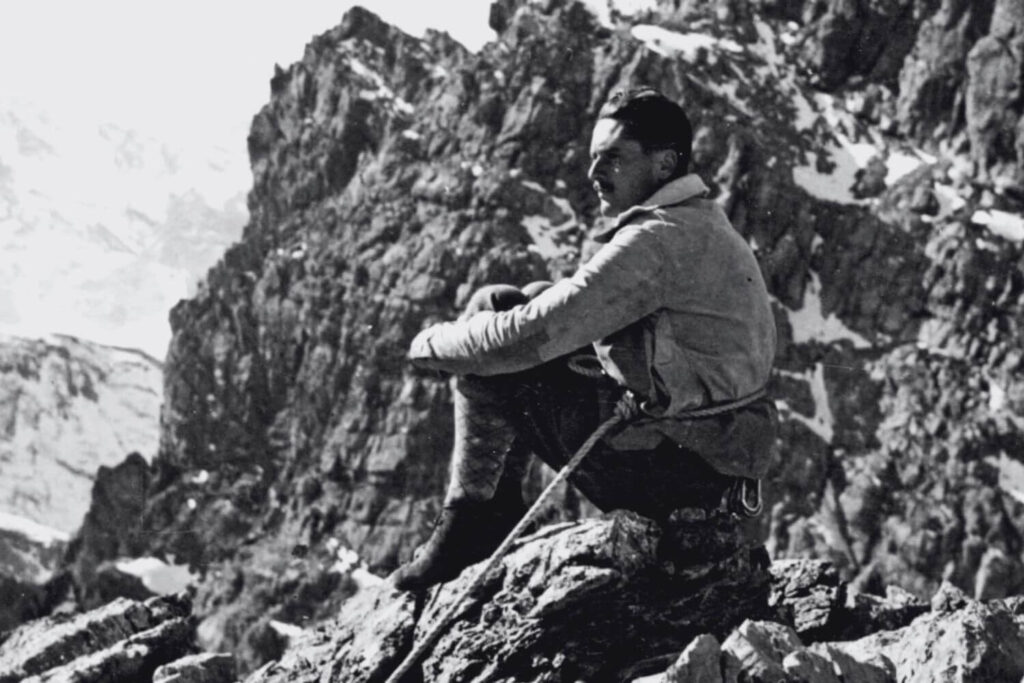
The canvas of his tent – which he had finally pitched in a spot well sheltered from the elements that only good old England can conjure up – gave him everything he needed until autumn. Dryness, shelter from the wind, a sense of safety and, in the end, of home, too. The summer months in the lake country around Keswick brought him all he had longed for and so badly missed in London, where something was always being built, everyone was always rushing after something – usually money and fame – and there was never complete, deathly silence. Whereas in the green hills rolling above the shores of Derwent Water, which came alive at night – at the lonely spot of High Lodore – the only thing buzzing in his ears was the mosquitoes. And those he had learnt to live with. Besides, the nasty little whiners much preferred to feast on the squeaky-clean, plump and well-fed weekend visitors to the Lake District than on his scrawny body, covered in a layer of grime that blunted their stingers so they could barely reach the sweet liquid under his skin.
For this newborn fugitive from a convention-bound regime of “nine to five, day after day, always the same”, summer was still fairly easy. He could make a fire, nature fed him, and the sun dried whatever got soaked in the British rain. But then came winter, and in the damp northern parts near the Scottish border it can be particularly nasty, and thirty-six-year-old Millican Dalton had to fight hard for his vagabond's freedom in a wooden hut – all right, more of a shed – that was resisting the fate of a pile of firewood on the edge of Epping Forest, north of London. Yet even as he lay starving on a hard bench, wrapped up in a blanket under which he hoarded the warmth that flowed into his body with the smoke of his Woodbine cigarettes, not even then did he long to return to the chair meant for a petty insurance clerk at the Union Assurance Society London.
“Day after day I went to the office at the same time. But that was no life for me. I gave up my job in the commercial world and set out to find romance and freedom.”

Mountaineering. Climbing the mountains that humans had feared until not long before, because those terrifying dark clouds sitting up there could only be the home of the gods – in the nineteenth century the whole cream of society was clambering up those huge mountains, into those divine dwellings and eventually onto much smaller crags, too. And even though they didn't find God up there, they probably found something else, no less divine, because in its honour they went on to found whole clubs and societies – such as the Alpine Club, the Climbers' Club and the Fell and Rock Climbing Club. In 1902 – still a model clerk, albeit already with a vagabond's intentions – Millican Dalton joined the last two. And this whole human movement heading towards nature turned out to suit him perfectly.
Dalton knew every path in the Lake District – safe and unsafe – every bog and every stone with a nice view, especially when you curled up around a fire there. And that was knowledge highly prized by those who came to nature only for a short while – to breathe out and take a proper breath in again, so as to survive the next, longer stretch in the cities. So Dalton the vagabond became a guide for those who fancied a taste of real wilderness. He scrambled with them up the steep crags of Borrowdale, from where the view of Derwent Water is said to be perfect, because beyond the rounded frame of green hills the cone of Skiddaw rises in the distance, cycling through every colour of the spectrum at sunset – the violet probably being the loveliest. He also showed the people who could pay a guide well how to lash tree trunks together so they could float all the way to St Herbert's Island in the middle of the lake. Then, on a sandy beach, he would conjure a campfire out of nothing and serve oatcakes with hot chocolate before bed.
The petty clerk – one of thousands in London alone, of no interest to anyone except as long as pound after pound dripped from them into the pockets of the big bosses – became a professional adventurer who drew attention. The newspapers wanted to write about him, and write they did. Photographers wanted shots of the shaggy little fellow with a Woodbine in the corner of his mouth, a crumpled Tyrolean hat and home-stitched shorts – which, as he claimed, he had invented himself, and not that first lord of the scouts, Baden-Powell – with wrinkly knees poking out underneath, and they got that shot too. Millican Dalton didn't run from publicity. His quirky look even became a hit in an advertisement for Keswick boots.
“Camping provides the most complete change possible from the ordinary existence of civilised town life. And living the healthiest and at the same time most unconventional way of life is the best cure for the rush and stress of working in the city.”

From the smoke creeping along the slate walls, people could always tell that the landlord and their guide was in residence. Cave Hotel – as Dalton named the man-made cave, long since abandoned, in a quarry near Borrowdale – became his new and, at last, permanent summer home. The place smelled not only of smoke but also of adventure and freedom. A fire flickered in the middle of the “living room”, and in an oven built from slate slabs baked bread that Dalton had patted together himself to his own vagabond recipe. At the edge of the cave, where the most light fell, stood a sewing machine – an absolute must when you've got holes not only in your pockets but also in your elbows, and a backside worn through from sitting on the rough stones set around campfires. On a shelf knocked together from whatever the woods and the remains of human dwellings provided lay neatly stacked books, papers and kitchen utensils. And the bedroom, with a quilted cover, was made up on the first floor, on a huge pile of slate softened with a layer of dry bracken.
Water dripped constantly from the cracks splitting the cave ceiling, but Dalton managed to channel and catch those rock tears, giving himself a source of the most precious thing a person needs to live – the thing people move hundreds of kilometres for and, in the end, go to war over. Apart from that, he needed little. Just a few nuts and berries, but also coffee and cigarettes – his only vice – for which he rode down on his ancient boneshaker of a bike to Rosthwaite, Grange or Keswick.
And then those long discussions, musings and philosophising round the campfire... Dalton knew nothing better than tossing words back and forth with his guests over the glowing flames. And whether they were men or women – so what? – it didn't matter in the slightest. In fact, it was the geologist, geographer and teacher Mabel Barker who owed her passion for climbing to Dalton. They first met in 1913, when she asked him to drop by her camp beyond the hills in Seathwaite and show a group of her freckled, pigtailed schoolgirls how to climb rocks. In the end, though, the most talented of them all turned out to be the teacher herself, and from then on Dalton encouraged her to make further progress in climbing. A year later he also led her and her friend through the Dove's Nest caves by the faint glow of candles, and in 1922 he even joined an expedition to the Austrian Alps organised by Barker herself. Three years later she became the very first woman to climb Central Buttress on Scafell, which is a damned hard and bold ascent.
“He taught his initiates, explained how to look after the safety of the whole party, and demonstrated the use of belays and knots. In fact, I never felt quite safe when knots other than his were used. Perhaps he was overcautious, but that is no bad thing at all.”
– Mabel Barker

Summer after summer, year after year, Millican Dalton roamed the Lake District – in clothes he had made himself, with a scarf that could be used in a hundred and one ways, even as a blanket, and in boots whose cracked leather bore the record of every one of the thousands of miles he had walked through forests and bogs, alone or with people just as passionate, though probably not as free. One war passed like this and a second was passing too, when Dalton – just as every year before – climbed the pointed rock crown of Napes Needle, a sort of stone finger raised above Wast Water. It was the fiftieth time. And such a round anniversary was worth hauling something to burn all the way up there, onto that tiny platform where two people had to be very close if they wanted to squeeze in side by side. Over a little flame he brewed coffee and savoured that sinful cigarette of his – still a Woodbine.
Then, in 1947, the British Isles were struck by a winter as harsh as they hadn't seen for a long time – probably so that people would pass from the terrible war years into better times gradually, not too fast, so as not to get a fright. But the “Professor of Adventure” – as people called Millican Dalton, and he never objected – just short of eighty, copped it rather worse than he deserved. His winter home, that ramshackle hut in the south of England that was somehow still holding together, went up to heaven in dark smoke, and old Dalton had to return to his flimsy tent canvas, under which, in that frost, he could only catch pneumonia. And catch it he did, and not even the doctors could drive it out of his body. But still – what a legend he must have been...
Millican Dalton was born on 20 April 1867 and died of pneumonia on 5 February 1947. He was one of the very first professional guides, introducing hundreds of people to outdoor experiences such as rock climbing, canoeing, sailing, hiking and camping. He was a vegetarian and teetotaller. He lived on just a small income from guiding and believed that a person could live on bread alone, adapted to taste with the help of a few other ingredients.
Millican Dalton's Cave lies on the eastern slope of Castle Crag near Derwent Water in the Lake District. Dalton lived in the cave for almost fifty years. In the upper chamber of the cave, Dalton's carving is still visible on the wall: “Don't Waste Worrds. Jump to Conclusions.”