“Wanted: good hunters. Stout, healthy, unmarried men, accustomed to the woods and capable of bearing bodily fatigue in a pretty considerable degree.”
In 1803 a great expedition was being prepared in Maysville, Kentucky. The United States had bought the lands west of the Mississippi from France, practically doubling the size of the country. Captain Meriwether Lewis and Lieutenant William Clark were now tasked with finding out exactly what lay out there. Among those who answered the call for men able to survive months and years in the wilderness was a young settler from Virginia – John Colter. And what he told the recruiters about his frontier life genuinely impressed Captain Lewis. The backwoodsman John Colter was given the rank of private and a monthly wage of five dollars.
But in November, a few months after the expedition left Kentucky, when the men reached Wood River, John Colter also earned his first ten days behind bars. Lewis and Clark's brief absence was the perfect chance – after months of trudging through the wilderness – to finally have a proper drink. But those few shots of whiskey and the carefree stagger back to camp cost Colter dearly. The free-spirited woodsman found it hard to get used to military discipline.
And that winter he even had to face a court martial – after threatening to shoot Sergeant Ordway. But an apology and a promise to mend his ways convinced the judges.
Admittedly, he never became the most disciplined of soldiers. But it turned out that John Colter was one of the very best hunters and trackers. He would set off alone to scout unknown country in search of game. It was he who did most to find a way through the Rocky Mountains, it was Colter who was sent to track down the lost horses carrying supplies, and it was him Captain Lewis entrusted with negotiating and trading with the Native American tribes. In the summer of 1806, however, after three years in uniform, John Colter came across two fur trappers heading for the Yellowstone River – and with twenty beaver traps and two years' worth of ammunition, he left the Lewis and Clark expedition to join them.
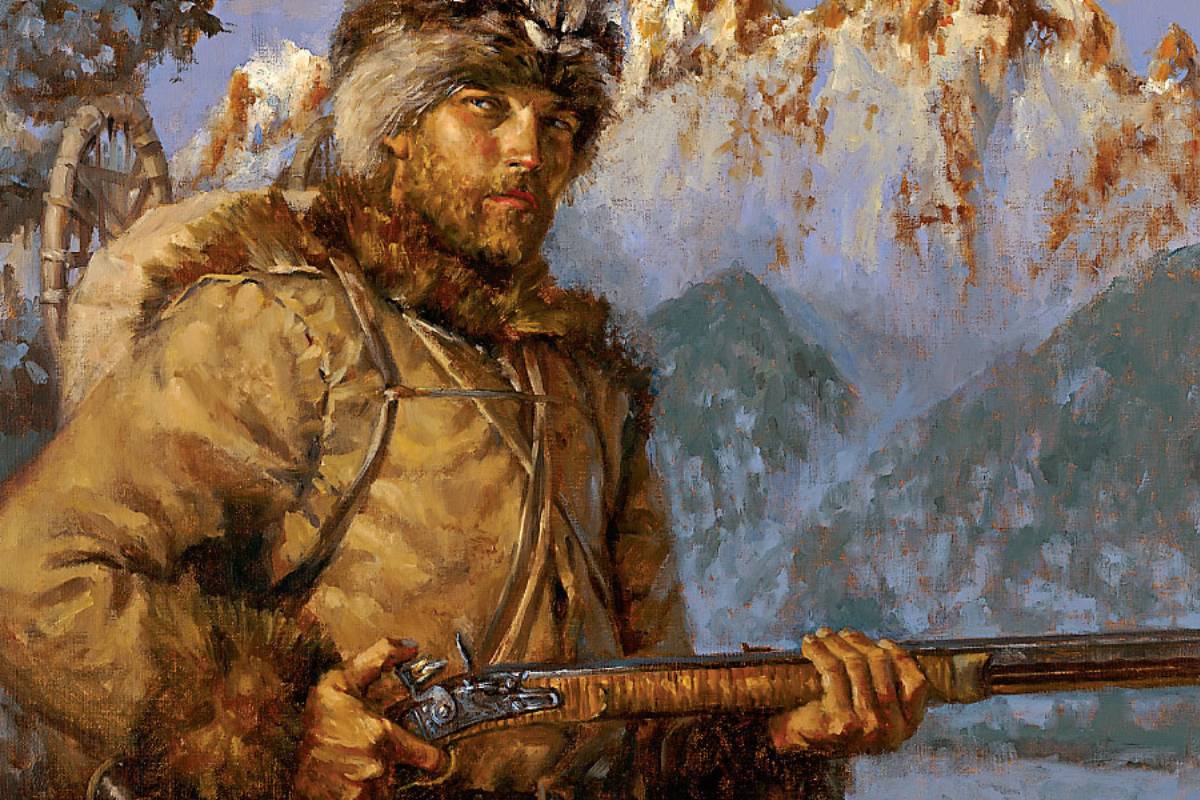
Hancock and Dixon. Those were the names of the two men with whom John Colter set out into Crow country. But toiling along the banks of the fast-flowing and game-poor Yellowstone wasn't very rewarding. And after a winter spent shivering in Clark's Fork Canyon, he headed back to civilisation. He was barely a week from St. Louis when, on the horizon – where, in green and fertile plains, the Platte River flows into the mighty Missouri – a party led by Manuel Lisa, founder of the Missouri Fur Trading Company, appeared.
And once again John Colter couldn't resist the call – the call of the Rocky Mountains, the wilderness and a steady wage.
As soon as Lisa's men had built Fort Raymond at the confluence of the Yellowstone and Bighorn rivers – by then their horses had a good thousand miles westward behind them – Colter was ordered to head deeper into the wilderness to negotiate trade deals with the local tribes. And it was then that John Colter wandered to Jackson Lake, into whose blue waters drop the cliffs of the three-thousand-metre peaks of the Grand Tetons. He became the first white man to cross the 2,500-metre Teton Pass, and after a long slog north and then east again, he eventually came upon Yellowstone Lake.
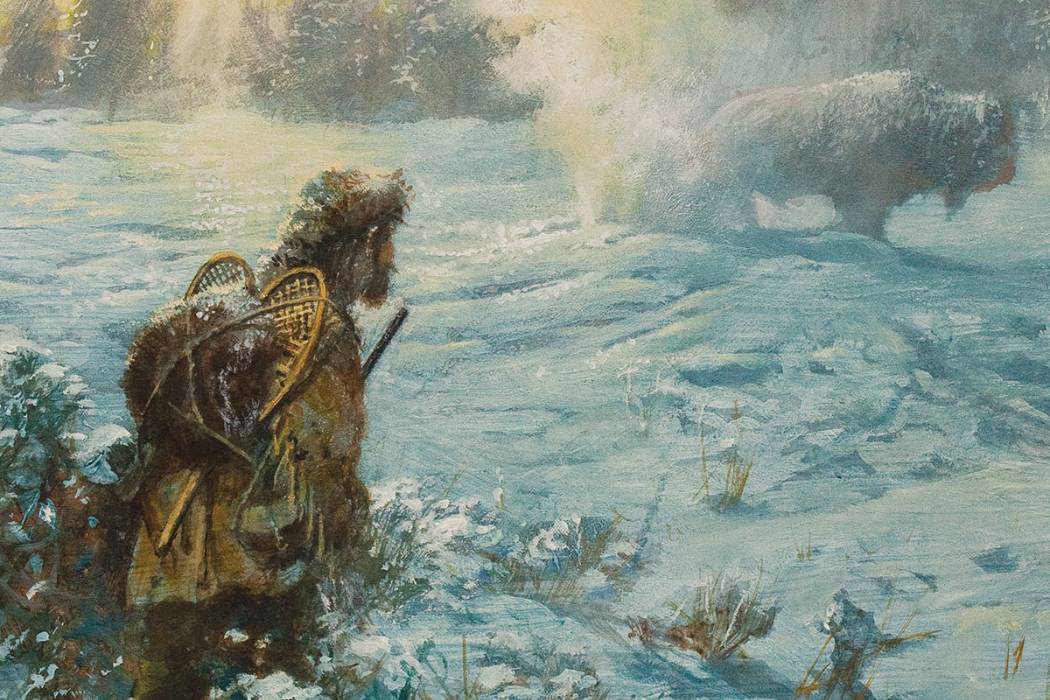
There he saw nature's boiling waterworks – Colter's Hell, as it was later dubbed by those who didn't believe a word of the tales about water geysers, bubbling mud pots and pools of water with smoke rising to the sky.
In any case, John Colter accomplished his mission. He made friends with the Crow. And the whole expedition had just one unpleasant moment. As he was returning to Fort Raymond accompanied by Crow warriors, there was a shriek, the ground shook, and a horde of Blackfoot warriors came charging through a cloud of dust. The age-old enemies of the Crow. In the end they were driven off – except that one of the Blackfoot arrows buried itself neatly in Colter's left leg. But a mountain man like him shook that off quickly. All that remained was a scar. A memory written in his skin.
And just a few weeks later Colter set off on another mission. Towards another encounter with the Blackfeet.

For eighty-three miles the Jefferson River winds through a green valley overlooked by the rocky three-thousand-metre peaks of Montana, before meeting the Gallatin and Madison rivers at a place called Three Forks. In the spring of 1809, John Colter and John Potts hauled their canoe up onto the riverbank and lit a fire. They watched the clouds drifting across the sky in the same direction they were heading, and rested. Years in the wilderness, however, had trained Colter's ears to hear what others paid no attention to.
They had just managed to push the canoe back into the water when an arrow struck Potts's body and a band of Blackfeet emerged behind them. Colter knew there was only one thing they could do – surrender. He was already raising his hands above his head when Potts lunged for his rifle and shot one of the warriors. The reply was a storm of arrows that turned his body into a pincushion.
John Colter was left alone – surrounded by a hostile, roaring crowd of warriors.
He had spent enough time with the Crow to follow the Blackfoot language now and to sense that nothing much better awaited him than poor Potts, whose lifeless body the warriors were just hacking to pieces. Colter lay bound in the scorching sun when suddenly the harsh rays were blocked by the figure of one of the older warriors. He told Colter what they would do with him: they would hunt him.

He stood there just as God – or perhaps Manitou – made him. Naked, barefoot, unarmed – just a few hundred paces ahead of the warriors, to give him a head start. And then he understood what one of them was signalling to him: Go! Run! And that's exactly what Colter did.
The cries of the enraged Blackfeet rang out behind him, his torn bare feet sprinkled the prairie with drops of blood, and he knew his only chance was to reach the river before his pursuers caught him and did to him what they had done to Potts. Only the river offered any hope of finding a place to hide. The howling behind him never stopped. He could no longer feel his shredded soles, his thighs burned and the landscape around him blurred before eyes starved of oxygen. But when he glanced back for a moment, he realised he was outrunning the warriors. Only one, spear in hand, was keeping up with him. And at that moment John Colter stopped.
The surprised warrior had no idea what to make of it when the naked white man suddenly stopped running and turned to face him – face to face. He was no less exhausted from the endless run than Colter, and so, when he finally went to hurl his spear at his prey, he stumbled. The spear hit the ground – and broke. Colter didn't hesitate for a second. He grabbed the end of the spear and drove it straight into the warrior's belly.
The rest of the hunters were closing in again. But Colter dragged himself across the prairie to the Madison River – a full five miles – just as he'd hoped. He dived under the surface and came up beneath a pile of driftwood logs – most likely a beaver lodge, offering life-giving air and perhaps a safe hiding place too. Until dark he could still hear the voices of the Blackfeet, who had no intention of giving up their prey so easily. They searched for a long time. They were so close. Had they found him then, he would never have escaped their arrows. But the first stars looking down from the night sky told the warriors to call off the hunt. They left. Yet Colter was far from safe. His feet were in shreds, he was naked, without food and hundreds of miles from the nearest civilisation.
Perhaps only edible weeds and all those years of roaming kept him from starving to death – and after eleven days on the prairie he dragged himself to the fort on the Little Bighorn. The John Colter who emerged from the wilderness that day, however, was not the same John Colter who years earlier had left Maysville, Kentucky, with the Lewis and Clark expedition – who for years had roamed the Rocky Mountains, traded with the tribes, tracked and hunted wild game.
John Colter, who for a while had himself become the prey, now decided to return east. He swore he would never travel to the mountains again. He married, settled down – and three years later he died.
John Colter (1770/1775 – 1812) returned to St. Louis, married a woman named Sallie and bought a farm near present-day New Haven, Missouri. Around 1810 he visited Lieutenant Clark once more and gave him detailed reports of his explorations. From this information Clark drew a map that remained the most comprehensive map of the region for the next 75 years.
During his travels in 1807 and 1808, John Colter became the first known person of European descent to enter the region that later became Yellowstone National Park.
Sometime between 1931 and 1933, a farmer in Idaho, west of the Teton Range, discovered a stone in the shape of a man's head. Carved into it were the words: John Colter, 1808. That would confirm that Colter really did cross the Teton Range and descend into Idaho. The stone's authenticity, however, has never been verified.
A number of places in north-western Wyoming are named after John Colter – for example Colter Bay on Jackson Lake in Grand Teton National Park and Colter Peak in the Absaroka Range in Yellowstone National Park.
John Colter spent long months alone in the wilderness and is widely recognised as the first known mountain man.