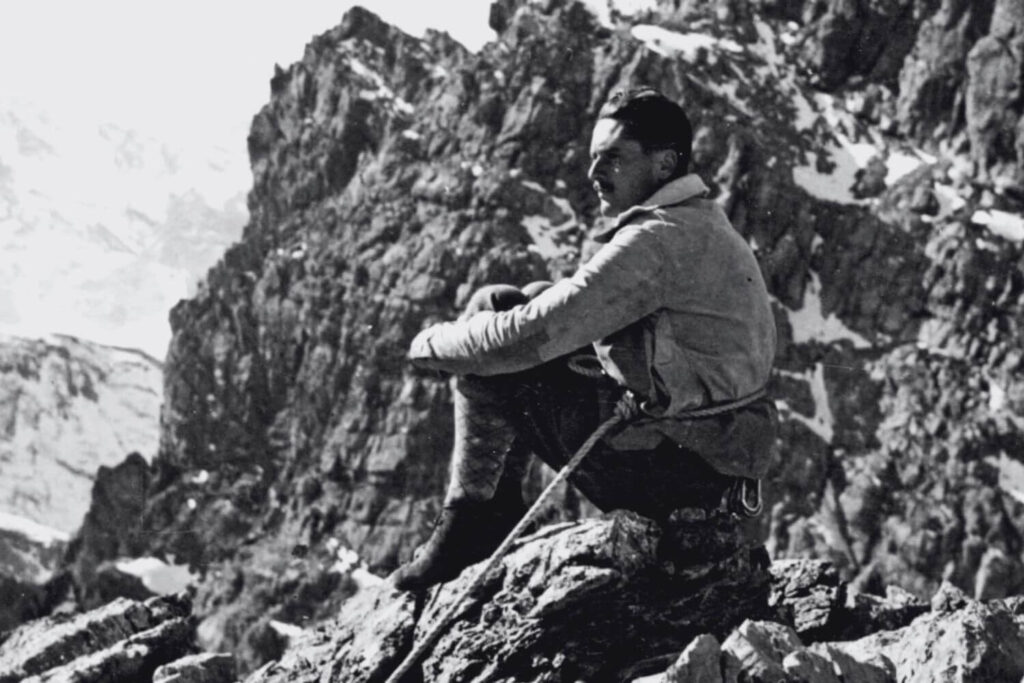
Long before dawn, voices began to ring out on the rocky outcrop that climbers called Camp Muir, wrapped in the eternal snow of the Cowlitz Glacier as it tumbled down into the green spring valleys. One male and one female. The words of those two people dissolved into the clear air, and the light but still fairly chilly morning breeze gathered them into its arms and carried them up high – right up to the stars in a clear sky that promised a fine day. A perfect day for the first ski descent of the almost kilometre-long Gibraltar Chute couloir.
Back then, at the end of the seventies, mountaineers were looking for exactly these kinds of new challenges. Climb up through mountaineering terrain and come down the same way – only without crampons on your feet and, for a change, with skis strapped on. And Marty Hoey, whose female voice was carried through the icy air on the still-sleeping Mount Rainier, was the one who came up with the idea of trying to ski the icy gully of Gibraltar Chute. She also knew that lonely snow cone of Rainier, more than 4,000 metres high, which every morning – in the soft light of a new, clear day – bathes in the velvet-smooth waters of Mowich Lake, almost perfectly. She was rightly proud to be part of the Rainier Mountaineering guiding company. The only woman – the only female mountain guide – on Rainier. Wow! Or rather: woman, wow! So she was without doubt well placed to pick something great. Bold, but hopefully not too risky.
Headtorches lit up at Camp Muir, and from then on all you could hear was heavy breathing – the skis strapped to their packs were no lightweights – and the creak of crampons biting into the frozen crust of snow. Clouds of breath rose slowly towards the sky, then began to veer slightly to the side, and as the wind picked up with the coming dawn, they had to bow their heads and breathe into the collars of their jackets. The sky stayed clear, but the gusts from the west brought something ominous. And then Marty took a hit on her right arm.

Mount Rainier was waking up. The edge of the glacier above their heads came to life and opened up a cannonade. Rick took a stone right in the neck and the barrage kept coming. They were right in the main line of fire, and Rick suggested escaping the stone chute by traversing onto the open Nisqually Glacier. But the mountain guide, who knew the mountain very well and probably sensed what bigger tricks it might still have in store for the cheeky folk on its slopes, refused to make a run for it. She considered traversing beneath the towering seracs far riskier than carrying on up towards the stones whizzing past their bodies in the morning gloom. And she was right. Marty – was – right. They had barely scrambled a few more metres higher when there was a thunderous roar to their left – as if the whole mountain were collapsing – and a falling serac sent one of the biggest avalanches either of them had ever seen shooting down into the valley. The escape route Rick had suggested a few minutes earlier vanished into the depths.
Apart from a few small knocks, neither of them took another big hit from a stone. When they peered out of the couloir, all they had to do was crouch against the wind and tense every muscle in their bodies so the gusts didn't knock them onto their backs. But that was nothing Marty hadn't experienced a hundred times before. Either way, Gibraltar Chute wasn't in the mood to let its first skiers onto its icy slopes that day, and after all – even a simple ski down the glacier was gorgeous that day. And, above all, safe.
Up there she was always like that – focused, professional, good at anticipating what might happen and making the right decisions accordingly. It was above all Lou Whittaker, her friend and mentor, who passed so much on to her – it was from him that she learnt to sense what the mountains were thinking. She had climbed Rainier perhaps a hundred times. Alone, or far more often with people who longed for the summit but didn't dare go up on their own. In 1974 her lungs heaved on the very summit of the 7,000-metre Lenin Peak, and two years later, as the only woman on an Indo-American expedition, she climbed the slopes of Nanda Devi. At thirty-one she was striding confidently towards her goal – to become the first American woman on the summit of the highest mountain of all.
What's more, in spring 1982 this was the first American team in decades of embargo to attempt Mount Everest from the north. From China. From long-closed Tibet. The best climbers ever born on the American mainland gathered at base camp. And Marty among them. The only woman.
When the expedition's documentary maker pointed his camera at her at base camp, she put down her favourite book – Thomas Mann's The Magic Mountain, which she'd had her head buried in perhaps as often as her feet in Rainier's snow – and, with humility in her voice but also with determination, said for the record: "I hope to be the first American woman to climb Everest. I hope I'm strong enough to even get the chance. And if it comes, I hope I'm ready…" Then she fell silent for a moment, drifting off into her inner world, and added: "I think in the end the mountain will decide who's ready to climb it."
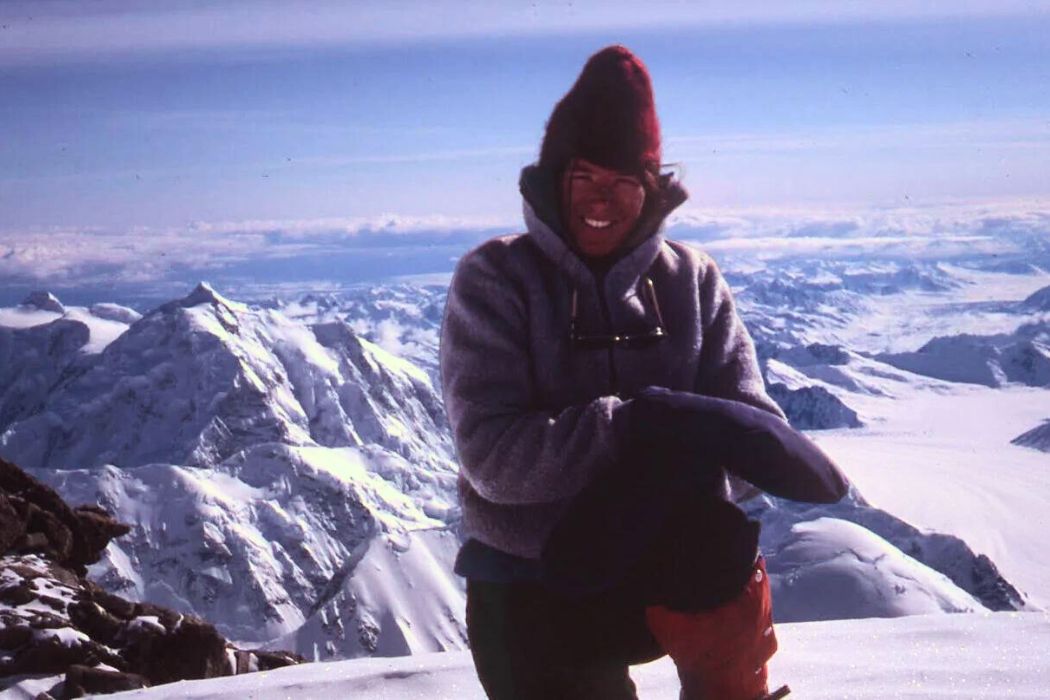
By mid-May it looked as though the mountain had made its choice. On the morning of 15 May, Marty and her climbing partner Jim Wickwire set off from Camp 5. They left the tent, anchored on an unusually roomy snow platform where you could even take a stroll if you felt like it after a whole day of scrabbling about in thin air, before the mountain had shed its pitch-black darkness and, in the first rays of sunlight, briefly swapped pink for purple, purple for crimson, crimson for orange and finally orange for a bright, crystal-clear day. They planned to set up Camp 6 and then... within two days they could already see themselves on the summit of the world's highest mountain.
At 8,100 metres they were gasping for every mouthful of oxygen. Everything was immensely strenuous. Every movement took a huge effort. Even thinking hurt, and keeping a clear head was enormously hard work. The 45-degree slope of the Great Couloir – as that narrow, steep section separating them from eternal glory was called – was certainly no place to stop comfortably and gather your strength. Only a thin strand of rope, fixed the day before, gave them some sort of support. Jim Wickwire was climbing first when he heard a clink. That sound didn't belong up there. He turned his head to see how Marty was doing, but all he saw was her rolling onto her side and grabbing at the rope with her left hand. Grabbing at nothing. Her arm swung through thin air, her body twisted, picked up speed on the icy, sun-glazed slope, and without a word of fear or horror Marty leapt from the mountain straight into the arms of the clouds that had wrapped themselves around Everest like a luxurious fluffy feather boa. As a keepsake, the Goddess Mother of the World kept only her harness – like an earring, a decorative trinket, hanging on the rope she had reached for so vainly.
Marty Hoey (1951 – 1982) was set to become the first American woman to climb Mount Everest. On 15 May, however, she fell during the ascent, and because she had forgotten to double the strap back through the buckle when putting on her sit harness, the harness came undone in the fall and Marty Hoey slipped out of it. Today harnesses have safer automatic buckles that don't need to be doubled back. Marty Hoey's body was never found. She was thirty-one.
None of the original seventeen members of the American expedition reached the summit of Everest in 1982. Jim Wickwire described the events of the ill-fated expedition in his memoir Addicted to Danger. „She never once screamed,“ he wrote in the book.
In 1982 a total of ten people died on Mount Everest. Among them were the British climbers Peter Boardman and Joe Tasker, who were attempting the first ascent of the North-East Ridge. They most likely died on 17 May (two days after Marty Hoey), when they were last seen at an altitude of 8,250 metres.
The first American woman to reach the summit of Mount Everest was Stacy Allison, on 29 September 1988. The expedition was led by Rob Hall, who died on Mount Everest in the tragic year of 1996, whose events are portrayed in the film Everest (2015).