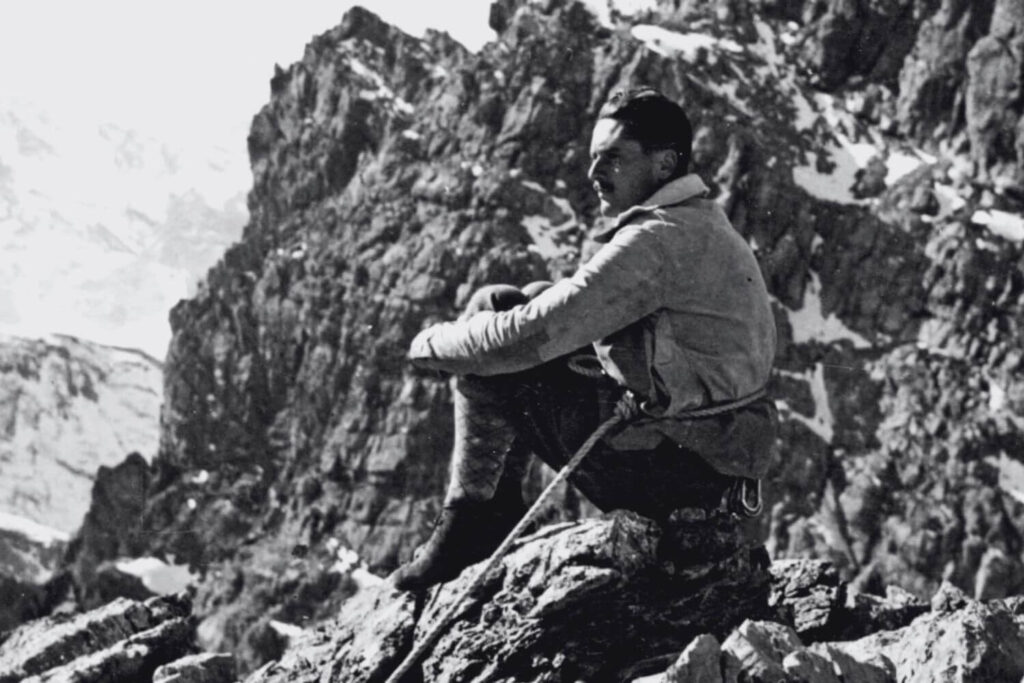
After her husband's death, Esther found it hard to stay at home in Dover. Looking at the empty armchair in the middle of the library where William used to sit, and watching the shadows creep across the stone walls of the vast Maison Dieu mansion – that sudden loneliness was hard to bear. So as soon as William's coffin was covered with earth, and with her husband's body all the weight of a situation so harshly dealt by fate had slid off their narrow shoulders into the ground too, Esther Mummery took their two sons – twenty-two-year-old William junior and thirteen-year-old Albert – and travelled with them to the Alps. She just wanted to breathe the mountain air, and wished it would flow through her whole body day after day. Until she was clean again – ready to live life to the full once more.
And the peaks rearing up to the sky, girdled with glittering snowfields from which glacial rivers foamed down into the valleys, worked their magic on young Albert too. At first the sight thrilled him. It was the first time he had seen something so big – enchanting and menacing at the same time. And then that world up above just kept on luring him. Drawing him in. Winding itself into his mind. Until it finally settled there for good. From then on, young Albert Frederick Mummery had nothing but mountains in his head.
They couldn't be erased. Not even when, a few weeks later, all three of them returned to Dover, where William junior had to take over the running of the prosperous family tannery and young Albert was supposed to give him a hand with such a responsibility. Mountains. Mountains. Mountains. They grew in his head and cast shadows over everything else. So three years later Albert went back to the Alps. He simply couldn't do otherwise. He seized the first opportunity that came along – one that might at least partly calm the longing shaking his body. And that was when he first saw it! The Matterhorn! The slender petrified horn, its tip pointing only and ever upwards, showed him which way his life would go. And three years later – in the summer of 1874 – he looked out over the world from its summit for the first time. From a place where few people had stood before him. That day, Albert Frederick Mummery became a mountaineer.

In the end he sat on the tip of the most beautiful of all Alpine mountains no fewer than seven times in his life. Once in mid-July 1883, with his strong, rock-creased fingers entwined in the much slimmer and far softer fingers of Mary Petherick – what's more, just a few days after they had tied their lives together with one big, strong knot. She too, the daughter of an Exeter solicitor, looked up to mountains and mountaineering with admiration. And that despite the fact that at the end of the nineteenth century, society didn't consider this pastime particularly fitting either for an English gentleman or for a Victorian lady.
But Mummery couldn't tear his eyes away from the peaks soaring to the heavens. The urge to climb mountains was already shaking his whole body, and in the end it was the renowned Swiss mountain guide Alexander Burgener who became his faithful companion in attempts to discover and conquer new routes. Together, in 1879, they made the daring first ascent of the Matterhorn by the sharp and treacherous Zmutt Ridge. And they belayed each other on the first audacious ascents of the French needles Grands Charmoz and Aiguille du Grépon. Things went well for them. And they got on.

Only in 1880 were they firmly rebuffed by the Dent du Géant, a tooth jutting out alone from a sugar-dusted gum of rock. A perfectly smooth granite slab without a single hold, mirroring the whole world around it, held up a merciless mirror to them too: "You're not up to this yet, gentlemen!" Mummery humbly accepted the message – and left his answer in a bottle on the face, along with a note for future challengers: "Absolutely inaccessible by fair means."
And then came his golden age. A time when, in his prime in his thirties, he broke free of convention and became a fully independent climber. Whereas until then he had followed the tradition of every foreigner in the Alps being accompanied by a local mountain guide, after 1892 it was Mummery alone who led his friends on the first ascents of the Dent du Requin and the Aiguille du Plan. And in the summer of 1894 he attempted something unheard of – and on the mountain that towers above everything else in the Alps. He set off up the steep red Brenva Face, down which pours the ice falling from the summit of the king himself, His Majesty, the highest of them all, Mont Blanc. But in the end not even that brought peace to his soul, in which the mountains kept expanding and causing only more tension that wouldn't let him sit still. Especially after he first saw the Himalaya in 1888.

In 1895 no eight-thousander had yet felt the tickle of human footsteps. And no human had yet discovered how suffocatingly thin and hostile to life the air is at Himalayan altitudes. So when Mummery decided to climb the ninth-highest mountain in the world – the Naked Mountain, Nanga Parbat – he also stepped into a completely new world he knew absolutely nothing about. Distances he would have covered in a few dozen minutes in the Alps stretched into many hours there. His appetite faded as the metres beneath his feet piled up. And there was no getting rid of his parched throat for the life of him, because even water grated in his mouth. Six men – four British climbers and two local Gurkhas as porters – stood facing a giant that dwarfed everything they had ever seen.
Three huge, terrifying faces dropped from the summit of Nanga Parbat into the valleys. The Rupal Face, so steep that snow clung to it only as sporadic decoration on otherwise dark rock, made it clear to them at once – with just a glance into its embrace – that in terrain like that they wouldn't stand a chance. The Diamir Face at least let them peek a little into its realm, but when Mummery's British companions Geoffrey Hastings, John Norman Collie and Charles Bruce discovered at six thousand metres how altitude can buckle your legs and drain your will to live, they had to descend quickly. They had been driven back by the mountain. And worn down. Had they bitten off more than they could chew? Mummery didn't think so. And he set off with the two Gurkhas towards the Rakhiot Face.

On 23 August 1895 they set up camp at the foot of the mountain. And the next day Mummery and the two Gurkhas, Ragobir Thapa and Goman Singh, headed up high for further reconnaissance. The other three men were to join them a few days later. As soon as they had recovered. Mummery could already picture himself on the rocky ridge leading to the summit of the Naked Mountain. After all, he had found hundreds, maybe even thousands of metres of terrain like that in the Alps. So he didn't see it as an obstacle. What frightened him more was the face below, with overhanging seracs so big they could have been mountains in their own right in the Alps. Mummery trod carefully near them, weaving between frost-shattered rocks and breaking trail through fresh snow for his two companions, who shared the essential load between them – including the silk tent Mummery had designed.
He had no doubts. And, possessed by desire, he headed higher. Here in the Himalaya the mountains had taken over his whole soul and grown into the furthest corners of his mind, where he kept memories of his wife, his children and his home. His body now obeyed just one single voice. And then – there was a roar. His head suddenly spun in a huge vortex that grew and grew and grew until – it suddenly stopped. A great weight settled on Mummery's soul, an endless icy weight, and in that moment he understood that the mountains had betrayed him. But it was too late.
Albert Frederick Mummery (1855 - 1895) and his companions were the very first people to attempt an eight-thousand-metre summit, in 1895. In a small team of just six, with very limited equipment and the aim of climbing the mountain without gradually building up high camps (a style known today as alpine style), they were way ahead of their time. The first eight-thousander, Annapurna, was not climbed until 1951, by Maurice Herzog and Louis Lachenal, using the so-called expedition style, which involved dozens of climbers and hundreds of porters.
Mummery and the two Gurkhas Ragobir Thapa and Goman Singh died on 24 August 1895 in an avalanche that broke loose on the slopes of Nanga Parbat. Their bodies were never found.
Nanga Parbat (8125 m), the ninth-highest mountain in the world, eventually earned the nickname Killer Mountain. During a German expedition in 1934, six Sherpas and three German climbers died in a week-long storm (among them engineer Willo Welzenbach). In 1937 an avalanche buried a large part of another German expedition, killing sixteen people. And during the 1939 expedition the Second World War broke out and the team members were interned in a prisoner-of-war camp in Dehradun, India. So Nanga Parbat was not climbed until Hermann Buhl reached the top in 1953.
In the Alps, Albert Frederick Mummery pioneered many routes still recognised as classics today, and before leaving for the Himalaya he wrote a book about his climbs, My Climbs in the Alps and Caucasus.